

Try this before your next board meeting. Pull the last significant approval your board made, maybe a capital project, a new system, or an acquisition, and trace it forward. Which strategic objective did it serve? When did it show up on the multi-year agenda? What did the board say had to be true before the next tranche of money was released? Who is providing assurance on it now, and when did they last report? Does the number in the latest board pack match the number in the approval paper, and if it doesn't, does anyone know why?
Most boards can answer two or three of those without much trouble. Very few can answer all five, and that's rarely because one governance process is broken. Each usually works fine on its own. The strategy offsite produces a decent strategy, the corporate secretary builds a solid agenda, finance runs a sensible capital approval process, and internal audit has a risk-based plan.
But these are separate machines with no wires between them. A strategic governance operating system is mostly about the wires: what passes from one layer to the next, in what form, by when, and who has to notice when it doesn't arrive.
This article is a wiring blueprint. It covers six layers (strategy, agenda portfolio, funding gates, assurance lanes, reporting QA, and a governance quality management system that feeds back into the rest), the five seams between them, and the loop that closes the circuit. It includes a RACI, the artifacts each gate should produce, SLA gates you can measure, and three worked wirings: AI oversight, M&A approvals, and vendor-concentration remediation. Adapt all of it. No board should run these exactly as written.
Where the failures actually happen
Governance reviews tend to look inside the boxes. Is the risk register any good? Is the audit plan risk-based? Are the minutes adequate? Fair questions, but they miss where most of the damage happens.
Failures cluster at the handoffs. Strategy gets approved, and the agenda for the next 18 months gets built from last year's template with a few new items bolted on. A funding request is approved "subject to assurance review," and nobody tells the assurance function. Or they're told, but it doesn't land in their plan until the following year. A management dashboard shows a project green while the latest internal audit memo rated it amber, and the two documents sit in the same board pack 40 pages apart. None of those is a failure of a single function. Each one is a missing wire.
Take a mid-sized distribution business that approves phase one of an ERP replacement, roughly $1.8M. The minute says something like "approved, with internal audit to review project controls." The audit plan for that year was already locked, so the review gets pencilled in for "next cycle." For the next three meetings the project appears in the CEO report as a status line, green each time. About ten months later phase two comes back asking for another $2.4M. By then around $1.5M of phase one is spent and the data migration scope has roughly doubled. The first independent look at the project happens after the second funding ask instead of before it.
Every individual process did its job and the decision still went wrong, because the condition the board attached had no mechanism behind it.
The obvious fix is "better follow-up," which isn't quite right. Follow-up is one wire, and you need the whole harness.
The six layers, and what each one owes the next
You know these layers already, so I won't define them. What matters is what each one has to hand forward, because that's the part most organizations never write down.
Eliminate boardroom chaos with seamless coordination.
Panlly simplifies scheduling, collaboration, and follow-ups for every board meeting.
- Centralized meeting scheduling
- Secure document sharing
- Task assignment & tracking
No credit card required
Strategy owes the agenda layer a set of objectives with stable IDs, plus risk appetite statements specific enough to test against. "Grow responsibly" can't be tested. "No single customer above 18% of revenue by FY27" can.
The agenda portfolio owes the funding layer predictable slots, so gate decisions land on meetings with enough time and the right people in the room. If you've built a multi-year board agenda portfolio aligned to strategy, this is where it starts paying off. Without one, funding asks arrive whenever management is ready, which is usually described as "urgent."
Funding gates owe the assurance layer a defined assurance plan attached to every approval: who looks, at what, and before which next gate. "Subject to review" doesn't count.
Assurance lanes owe the reporting layer dated opinions with ratings, caveats, and open findings, in a form that can sit next to management's own reporting so directors can actually see disagreement.
Reporting QA owes the quality layer a log of defects: what was wrong with the pack, where it came from, how it got caught.
The governance quality management system (GQMS) owes everything upstream a set of corrective actions routed to whichever layer caused the defect. This is what turns six processes into a system, and almost nobody builds it.
People tend to treat the GQMS as an annual board evaluation with extra steps. It isn't. A board evaluation asks how directors feel the board is performing. The GQMS asks what concretely went wrong in the machinery this quarter and which upstream layer has to change. One is a survey, the other is closer to a manufacturing defect log.
Who owns what: the RACI
A baseline RACI across the six layers is below. R = Responsible (does the work), A = Accountable (one per row, owns the outcome), C = Consulted, I = Informed.
| Layer | Board / Chair | Committee chairs | CEO & exec sponsors | CFO | Corporate secretary / governance office | 2nd line (risk, compliance) | Internal audit |
|---|---|---|---|---|---|---|---|
| Strategy & appetite | A | C | R | C | I | C | I |
| Agenda portfolio | A | C | C | I | R | C | C |
| Funding gates | A (above delegated limit) | R (within delegated limit) | R (sponsor submits) | R (validates case) | C | C | I |
| Assurance lanes | I | A (Audit/Risk chair) | C | C | I | R | R |
| Reporting QA | I | C | A | R (financial data) | R (completeness, format, traceability) | C | C (sample testing) |
| GQMS feedback loop | A | C | C | I | R | C | C (annual independent look) |
Two cells cause most of the arguments.
The first is who's accountable for reporting QA. Boards often default to the corporate secretary because they assemble the pack, and that's a mistake. The governance office can be responsible for completeness, formatting, and checking that every material number has a source and a date. It can't be accountable for the accuracy of numbers produced by finance or operations, because management owns accuracy. If the CEO isn't the A on that row, defects in the pack become "the secretariat's problem" and the people who generated the bad data never feel it.
The second is the funding gates row, which deliberately has several Rs. The sponsor builds the case, the CFO validates it, and the committee chair runs the gate when it falls within delegated authority. That works as long as the A is singular and the delegated limit is written down. It goes wrong when a committee approves something just above its limit "in principle" and nobody takes it to the full board, because each party assumed someone else would.
The five seams: artifacts and SLA gates
This is the core of the wiring. Each seam needs a handoff artifact (the thing that physically passes from one layer to the next) and an SLA gate (a measurable condition telling you whether the handoff happened on time and complete).
Treat the SLA figures below as starting points. Set yours based on where you are now, tightened a bit, rather than where you'd ideally like to be. An SLA you miss every cycle teaches everyone to ignore SLAs.
| Seam | Handoff artifact | Measurable SLA gate | What breaks without it |
|---|---|---|---|
| Strategy → Agenda | Objective register with stable IDs; appetite statements with thresholds | Portfolio re-mapped within ~30 days of strategy approval; 85–90%+ of substantive agenda items tagged to an objective ID | Agenda drifts toward whatever is loudest; strategy gets discussed once a year |
| Agenda → Funding gates | Gate calendar aligned to meeting slots; gate request form | Gate request lodged ≥21 days before target meeting; full gate packet to directors ≥7 days before | Funding asks arrive under "other business" with no time to challenge |
| Funding gates → Assurance | Assurance plan attached to approval (lane, scope, timing, next-gate dependency) | Assurance lane assigned within 10 business days of approval; first assurance read-out scheduled before next tranche gate | Money moves and nobody independent is watching |
| Assurance → Reporting | Dated assurance opinion with rating, caveats, open findings with owners | Opinion no older than ~45 days when it appears in a pack; management and assurance ratings shown side by side | Dashboard says green, auditor says amber, directors never notice the gap |
| Reporting → QA | Pack QA log; source-and-date trace for material figures | Pack locked T-7; fewer than ~3 material defects per pack; 100% of material figures traceable | Meeting time spent reconciling numbers instead of deciding |
| QA → GQMS → upstream | Defect register with root-cause layer and corrective action | Root cause assigned within 30 days; corrective action closed within 90; quarterly defect review | Same defects recur cycle after cycle |
On the strategy-to-agenda seam, the objective ID is the most underrated piece of the whole system. If every agenda item, funding request, assurance plan, report line, and QA defect carries the same ID, you can trace any decision forward and backward. Without it you're relying on memory and document names, and names change. A project called "Phoenix" in the strategy deck becomes "Platform Modernization" in the funding paper and "Core Systems" on the dashboard. Nobody realizes it's the same thing until audit asks.
On funding-to-assurance, the "before next tranche gate" condition matters more than the 10-day assignment. Plenty of organizations assign the assurance lane promptly and then schedule the review whenever it fits the audit plan. The board should never be asked to release the next tranche without an independent view of the previous one. If assurance can't deliver in time, the gate slips, not the assurance. That sounds rigid, and it is, on purpose. The value-realization framework for governance investments covers the staged-value side of this, and the wiring here just makes sure assurance is physically connected to each stage.
How a single decision travels the wire
It's easier to see this as a flow than as a table. Here is one funding decision moving through the system, start to finish:
> Strategy approves objective S-04 (reduce cost-to-serve in the regional network) with an appetite statement → governance office maps S-04 into the agenda portfolio, slotting a Finance Committee gate in Q2 and a board review in Q4 → sponsor lodges gate request 21+ days ahead, tagged S-04, with stage definition and kill criteria → CFO validates; gate packet circulates 7 days out → committee approves Stage 1 within delegated limit; approval record generates an assurance plan stub → within 10 business days, 2nd line accepts the lane, scopes a controls review, and books the read-out for the committee meeting before the Stage 2 gate → management reports progress on S-04 each meeting, with the dated assurance opinion next to it → pack QA catches that the cost-savings figure in the dashboard doesn't match the approved business case baseline; logs defect D-117, root cause "baseline not locked at gate" → quarterly GQMS review routes D-117 to the funding gate layer, and the gate template is updated to require a locked, signed baseline → next gate on any objective uses the new template.
Below is a simple workflow illustration of that decision moving through the layers and handoffs.
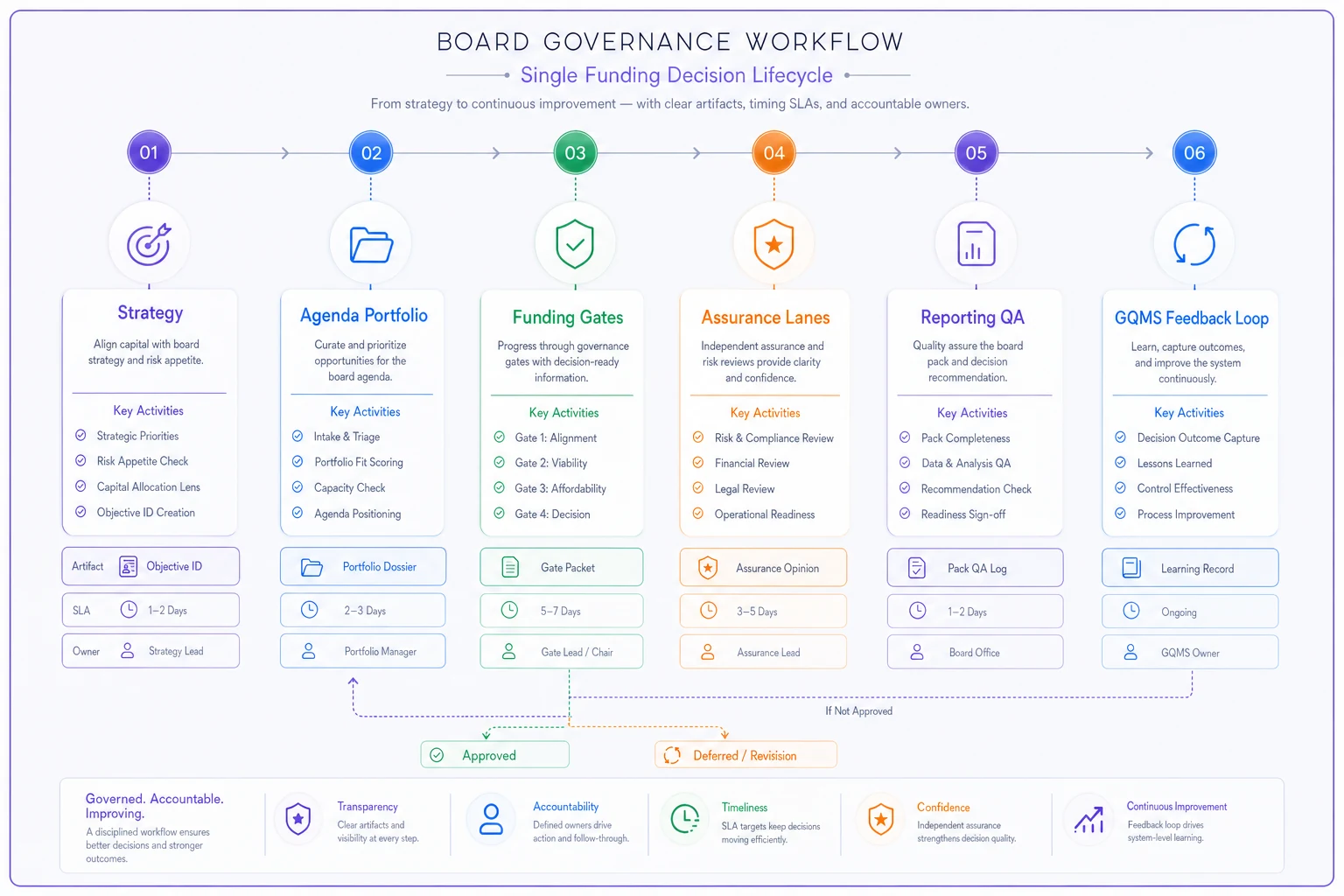
The last two steps are what make this a system instead of a sequence. Skip them and the baseline mismatch gets fixed in that one pack, someone sends an apologetic email, and the same thing happens on the next project because the template never changed.
Scenario wiring 1: AI oversight
AI oversight is a good stress test because it cuts across every layer, and the thing being overseen keeps changing after approval. A model that passed validation in March can drift by August. A SaaS tool bought for scheduling can add an AI feature in a release note nobody read.
Strategy. Usually there isn't a standalone "AI objective," and there shouldn't be. AI use attaches to business objectives like claims triage speed, underwriting consistency, or customer service cost. What the strategy layer does need is an appetite statement for automated decisions that affect customers, employees, or regulated outcomes. Something like: no fully automated adverse decision on a customer without a human review path, and override rates monitored.
Agenda portfolio. A standing twice-yearly slot at the risk committee for the AI inventory and incident review, plus an annual board-level session. Event-triggered items (a significant incident, a regulator letter) jump the queue.
Funding gates. Tier the gates by impact, not spend. A cheap model making customer-facing decisions needs more gating than an expensive internal analytics tool. For the higher tiers, three gates work well: pilot, production, scale. The production gate should produce:
-
Intended-use statement and explicit out-of-scope uses
-
Evaluation results against accuracy and fairness thresholds set before testing
-
Human override design, and who can use it
-
Third-party model and data dependencies
-
Kill criteria
what metric, at what level, triggers rollback
Assurance lanes. Second line validates before production go-live. Internal audit reviews the control environment within roughly six months of production. External review applies to the highest tier, where regulation or reputational exposure warrants it. A workable SLA: no top-tier model goes live without a validation sign-off dated within 60 days, and any drift-threshold breach reaches the risk committee chair within five business days.
Reporting. The useful lines are boring ones: inventory count by tier, percentage with current validation, override rates, incidents and their status. The decisions-to-KPIs reporting framework is a decent pattern for laying this out so each line traces back to the gate that approved the use case.
Reporting QA. The highest-value check is reconciling the AI inventory against procurement and contract records every quarter. It catches the most common defect by far, which is AI functionality arriving through existing software subscriptions that never went through a gate, because the gate only triggered on new purchases.
GQMS feedback. Don't just fix that defect by adding the tool to the inventory. Route it back to the funding-gate layer, where the trigger needs to change so renewals and material feature changes in existing SaaS contracts also prompt a tier assessment. That one change to the trigger usually does more than any amount of policy writing.
Scenario wiring 2: M&A approvals
M&A breaks governance systems in a specific way, which is that it gets treated as special. Timelines are compressed, confidentiality is tight, advisers drive the process, and the normal machinery is quietly set aside "just for this deal." Then the deal closes, everyone celebrates, and nobody checks whether the thesis held.
The wiring has to accept compression without accepting bypass.
Strategy. Every deal thesis memo cites the objective IDs it serves. That sounds bureaucratic until you watch a board approve an acquisition whose rationale shifted three times between first approach and signing, with nobody able to point to the strategic logic it started from.
Agenda portfolio. A standing confidential "pipeline" slot, even when it's empty, normalizes early visibility. Boards that only hear about deals when there's a signing decision to make are always under time pressure.
Funding gates. Five gates, and the last one is the one that gets skipped:
-
Gate 0, Approach. Authority to engage, NDA, exclusivity cost cap. Artifact: one-page thesis tied to objective IDs.
-
Gate 1, Non-binding offer. Valuation range with a walk-away number, diligence budget and scope. Artifact: valuation memo, conflicts declarations refreshed.
-
Gate 2, Signing. Artifact
diligence red-flag report, final valuation vs. walk-away, integration plan with named synergy owners, conflicts refreshed again.
-
Gate 3, Closing conditions. Artifact
condition tracker, material-change confirmation.
-
Gate 4, Value check. Around 100 days and again around 12 months post-close. Artifact: synergy realization vs. thesis, integration issues log.
Assurance lanes. Independent valuation review or fairness opinion at Gates 1 and 2, depending on size and structure. Second line reviews diligence findings in their specialist areas (cyber, regulatory, vendor dependencies) instead of trusting the adviser summary. Internal audit picks up post-close integration controls.
SLA gates. Compression has to be handled honestly. Set a standard of signing pack to directors at least five days out, with a hard floor of 72 hours. Anything shorter needs an explicit waiver, minuted with the reason. Boards will sometimes need to move fast, and the waiver turns "we moved fast" into a documented decision instead of a habit. Conflicts declarations get refreshed at every gate, not once at the start.
Reporting and QA. Synergy tracking gets reported quarterly for roughly eight quarters post-close, against the numbers in the Gate 2 pack, not revised numbers. QA checks that the baseline used in reporting matches what was signed. A surprising number of post-deal reports measure synergies against a re-forecast that was quietly lowered.
GQMS feedback. Gate 4 findings route back into the Gate 1 template. If the post-deal review shows the integration cost assumption was off by a wide margin, "be more careful next time" isn't the fix. A required sensitivity analysis on integration cost at Gate 1, for every future deal, is.
Scenario wiring 3: vendor-concentration remediation
This one differs from the other two because it's trigger-driven rather than calendar-driven. Nobody schedules a concentration problem. It shows up when a threshold is crossed, a vendor gets acquired, a key supplier has an outage, or a renewal arrives with a 30% price increase and nowhere else to go.
Strategy. The appetite statement matters a lot here, and most of them are written wrong. They define concentration by spend ("no vendor over 15% of third-party spend"), which consistently undercounts cheap-but-critical dependencies. A payroll processor might be a tiny fraction of spend and still bring the business to a stop if it fails. Better to define concentration by process criticality, with spend as a secondary measure.
Agenda portfolio. A standing quarterly metric line, plus a reserved trigger slot. The portfolio should have a rule that a threshold breach gets agenda time at the next scheduled meeting of the responsible committee, without waiting for the next "vendor risk" deep dive.
Funding gates. Remediation costs money. Dual-sourcing, migration, building internal capability, and negotiating exit terms all do. This is where remediation usually stalls: everyone agrees it's a problem, then it competes for budget against revenue projects and loses. A dedicated remediation gate helps, and its packet should include:
-
Exposure statement
which processes, what disruption looks like, how long recovery takes
-
Substitution options with rough cost and timeline for each
-
Contract leverage points
renewal dates, termination rights, notice periods
-
Interim controls while remediation is under way
-
What "remediated" means, stated measurably
SLA gates. Threshold breach → exec owner assigned within five business days → options paper to committee within 30–45 days → funding decision no later than the next scheduled meeting, with a hard ceiling around 90 days from breach. The ceiling is there because without one, remediation papers get deferred "pending more information" indefinitely.
Assurance lanes. Second line (procurement risk, or whoever owns third-party risk) verifies the concentration data itself. Internal audit tests whether the exit plan is feasible, ideally through a tabletop exercise rather than a document review. Exit plans that look fine on paper often fall apart the moment someone asks how long data extraction takes.
Reporting QA. Reconcile the concentration figures against accounts payable and the contract register. Common defects are subsidiary contracts excluded from the group view, and fourth-party dependencies (your vendor's critical vendor) being completely invisible.
GQMS feedback. If QA keeps finding critical vendors missing from the concentration view, the problem sits upstream in the strategy layer, because the appetite statement is measuring the wrong thing. Route it there. A data fix in the reporting layer would just paper over a definitional problem.
The GQMS loop in more detail
The feedback layer deserves more attention than it usually gets, since it's what lets the system improve instead of just repeating itself.
At its core is a defect register. A governance defect is anything that made a decision harder, slower, riskier, or less defensible than it should have been. A few categories cover most of what turns up:
-
Missing artifact (gate packet incomplete, assurance plan absent)
-
Late artifact (pack circulated inside the SLA window)
-
Untraceable figure (number with no source or date)
-
Assurance gap (approval with no assurance read-out before the next gate)
-
Ownerless decision (resolution passed, no named owner for execution)
-
Stale input (assurance opinion or data older than the SLA allows)
-
Ratings conflict (management and assurance disagree and the pack doesn't surface it)
Each defect gets a root-cause layer, which isn't necessarily where it was detected. A stale assurance opinion caught in reporting QA might have its root cause in the funding gate (no assurance plan attached) or the agenda (read-out slot never scheduled). Getting the root-cause layer right is most of the value. Log defects only where they're found and you'll keep fixing symptoms in the pack.
A quarterly defect review, run by the governance office and reported to whichever committee owns governance (often Nominations & Governance, sometimes Audit), looks at patterns: which layers generate the most defects, which corrective actions are overdue, which defects keep coming back. Once a year, the defect pattern feeds the strategy refresh. If the system can't support the oversight the strategy demands, that's strategic information.
This sits close to the board assurance operating system work. The assurance OS looks at the quality of assurance over the business, while the GQMS looks at the quality of the governance machinery itself. Think of it as the board auditing its own plumbing.
Wiring it in: start at the end
The instinct is to start at strategy and work forward, and that's usually the wrong order. Strategy is the most politically loaded layer to touch, and changing it first means months of work before anyone sees a result.
Start with reporting QA instead. It's cheap and fast, and it shows you which seams are broken, because broken seams show up as defects in the pack. The sequence that tends to work:
-
Run QA on the last two board packs retroactively. Log every defect you can find: untraceable numbers, missing assurance views, decisions with no visible follow-through. Tag each to the seam you think caused it. This takes a week or two of governance office time and usually produces a surprising list.
-
Assign objective IDs. Take the current strategy as-is and give each objective a stable ID. Don't rewrite the strategy, just label it.
-
Write minimal handoff artifacts for the five seams. One page each, maximum. A gate packet template, an assurance plan stub, an opinion format. Resist the urge to make them comprehensive.
-
Set SLAs at current performance, tightened slightly. If packs currently go out four days before meetings, set the SLA at five, not seven. Tighten next year.
-
Fill in the RACI and settle the contested cells. Particularly the A on reporting QA and the delegated limits on funding gates. These conversations take longer than you'd expect, which is a good reason to have them explicitly.
-
Pilot on one live item. Pick a decision currently in flight, ideally one of the three scenarios above, and run it through the full wiring. You'll find gaps in your templates fast.
-
Stand up the quarterly defect review. Even if the first one is short.
-
Recalibrate at the next strategy refresh. Bring the defect patterns into the strategy conversation. This is when the loop closes for the first time.
Pilot on a currently live decision to surface template and timing gaps quickly rather than debating hypotheticals.
Most organizations get through steps 1–6 in about a quarter. The full loop takes a year, because you need at least one strategy cycle to close it.
Real scenario: regional home-health and hospice operator
Business type: Regional home-health and hospice provider, around 1,900 staff across a few dozen locations, nine-member board with Audit & Risk, Finance, and Quality committees, governance office of one full-time person plus part-time support.
Problem: The board had approved a multi-phase EHR migration and a mobile scheduling platform within about a year of each other. Strategy, capital approvals, and the internal audit plan all ran on separate calendars. Directors kept getting status updates that didn't line up with the original business cases, and decisions kept getting deferred to "the next meeting" because the right information wasn't in the pack.
Before, based on a retroactive QA review of the prior three meetings:
-
Roughly 4 in 10 substantive agenda items couldn't be traced to a strategic objective
-
Board packs typically reached directors 2–3 days before meetings
-
About 30% of decision items were deferred at least once
-
Neither technology project had received an independent assurance read-out before its second funding gate
-
Each pack carried somewhere between 6 and 9 material defects (mostly untraceable figures and baseline mismatches)
What changed: They started with retroactive QA, assigned objective IDs to the existing strategy, and built one-page gate and assurance-plan templates. They also moved the A for reporting QA from the governance office to the CEO. That was the most contentious change and, in hindsight, probably the one that mattered most, because pack defects started landing on the desks of the people who generated the data. The EHR program's third-phase gate was held back about six weeks so an assurance read-out could happen first. It was unpopular at the time, and the read-out surfaced a data-conversion issue that would have been very expensive to find after cutover.
After about three meeting cycles:
-
Untraceable agenda items dropped to around 1 in 10
-
Packs reaching directors 6–7 days out, most of the time
-
Deferrals down to roughly 1 in 10 decision items
-
Both technology programs had assurance plans attached and scheduled before their next gates
-
Material defects per pack averaging 2–3, and falling
The governance office workload went up for the first couple of months, then settled below where it started. Mostly that was because less time went into chasing late papers and fixing packs the night before circulation.
Where software helps (and where it doesn't)
Most of this blueprint can run on documents and a well-kept spreadsheet. Plenty of boards do exactly that, and it's fine for a while.
It starts to strain in the mechanical parts: tracking dozens of SLA timers across gates, checking that every agenda item carries an objective ID, noticing that an assurance opinion in the draft pack is 70 days old, reconciling the AI inventory against contract records. That's where AI-assisted operational software earns its keep. It can tag draft papers to objective IDs and flag the ones that don't map, check gate packets for missing artifacts before they circulate, run the SLA clocks and escalate when a seam is about to miss, and cluster QA defects so the quarterly review starts from patterns instead of a raw list.
What software won't do is settle who's accountable for reporting QA, decide whether a gate should slip to wait for assurance, or write a good appetite statement. Those judgment calls stay with people. The automation should handle the plumbing checks so the people in the room can spend their time on the judgment.
When this makes sense
Full wiring is worth the effort when the board is overseeing several multi-stage investments at once, when decisions regularly span more than one committee, or when regulatory or litigation exposure makes traceability valuable in its own right. It also makes sense if you've had a decision go wrong and the post-mortem showed every function did its job. That's the clearest sign the problem is in the seams.
Growth is another trigger. A board with two committees and a handful of big decisions a year can hold the wiring in people's heads. Add a third committee, a subsidiary or two, and a few concurrent programs, and the informal coordination that used to work starts quietly failing. Usually nobody notices until something important falls through.
When this is a bad idea
If your board doesn't yet have the basics, such as a reasonably current strategy, a functioning committee structure, and minutes you'd be comfortable showing a regulator, don't start here. Wiring connects layers, and if the layers don't exist you're wiring nothing to nothing. The governance maturity model is a better place to figure out which layers need building first.
Rolling this out all at once during a crisis, like an active M&A process, a regulatory investigation, or a leadership transition, is also a bad idea. Use the pilot approach, or wait.
Who should NOT do this
Three situations where I'd hold off, even if everything above sounds relevant:
-
Very small boards (say, five directors, no committees, one or two material decisions a year). The overhead isn't worth it. A decent decision log and a habit of asking "who's checking on this?" will get you most of the way.
-
Boards where the governance office is one person already at capacity, unless the board is willing to resource the first quarter properly. Dumping this onto an overloaded secretariat produces templates nobody fills in.
-
Organizations whose management team will treat the gates as box-ticking. If the culture isn't there, gates become paperwork, and paperwork that people resent is worse than no paperwork.
If one of these is you, a lighter version still helps. Run the retroactive QA and the health check below, and leave the full gate structure for later.
A seam health check for your next meeting
You don't need to build the whole system to find out how badly you need it. Ask these at your next board or governance committee meeting:
-
Can we name the strategic objective behind each substantive item on today's agenda?
-
For the last three funding approvals, was an assurance plan attached, and has the first read-out happened (or been scheduled) before the next tranche?
-
Is there anywhere in this pack where management's rating and an assurance rating differ? Would we have noticed?
-
How old is the oldest assurance opinion referenced in this pack?
-
Did the pack arrive inside the window we'd agreed? If we haven't agreed a window, why not?
-
Can someone trace the headline number in the main dashboard back to its source and the date it was pulled?
-
Do we have a list of the defects in our last few packs, and do we know which layer caused them?
-
Has any condition attached to a board approval in the past year been quietly dropped?
If the honest answer to more than two or three of those is "not sure," the layers probably aren't the problem. The wiring is.
The six layers in this blueprint aren't new, and every reasonably run board has some version of each. What's usually missing is agreement on what passes between them, when, and who notices when it doesn't. Getting that written down, measured, and fed back into the layers that caused the problems is most of what turns a set of governance processes into a strategic governance operating system.
Don't start with the strategy layer or the RACI. Start with the retroactive QA on your last two packs. It takes very little time, it doesn't need anyone's permission, and the defect list you get will tell you which seams to wire first more reliably than any framework will, this one included.
Ready to enhance your board's productivity?
Join 500+ organizations using Panlly to save time, improve governance, and streamline board operations.