

Most boards don't lack governance ambition. They lack a staged path that connects where they are now to where they want to be, with concrete deliverables attached to each step. So improvement happens in bursts — usually after a bad audit, a near-miss, or a new chair — and then drifts back toward whatever the corporate secretary can personally hold together.
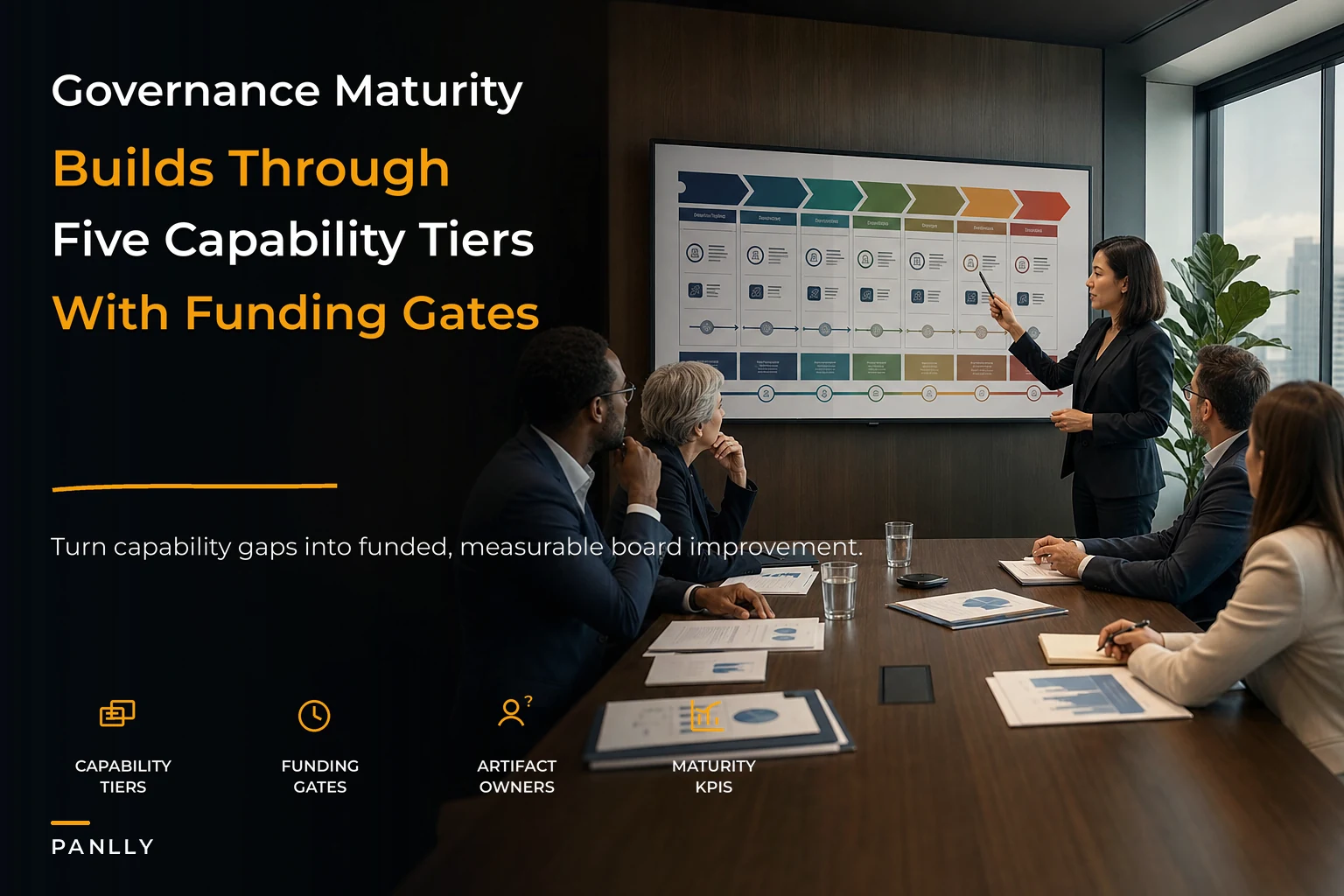
A governance maturity model fixes that drift by turning "better governance" into a sequence of capability tiers, each with its own artifacts, measurable KPIs, funding checkpoints, and a way to decide what gets built next. It's less a scorecard and more an operating map. The point isn't to score yourself a 3.4 out of 5. The point is to know, with some precision, what the next six months of governance investment should produce and how you'll know it worked.
What follows is a working model you can adapt — the tiers, the deliverable templates per stage, and the funding-gate logic that keeps a multi-year roadmap from stalling at tier two.
Why maturity resets instead of compounds
There's a pattern underneath most stalled governance programs. A board invests in one artifact — say, a decent minutes standard or a risk register tied to the agenda — and treats it as a finished project. Nobody attaches it to a tier, nobody defines what the next capability depends on, and nobody funds the maintenance. Two years later the person who built it leaves, the template rots, and the board rebuilds something similar from scratch.
This is the core failure a maturity model is meant to prevent: governance capability treated as a collection of one-off projects rather than a layered system where each tier depends on the one below it.
-
Artifacts outrun the operating discipline. A board buys a portal and builds dashboards before it has a document taxonomy or a reliable decision log. The dashboards show numbers nobody trusts because the underlying records are inconsistent.
-
KPIs get chosen for optics, not causality. "Director attendance 94%" looks healthy and tells you almost nothing about whether decisions are actually getting made and followed through.
-
Funding arrives emotionally, not structurally. Money shows up after an incident and dries up once the panic fades — which is exactly backwards from how you'd fund a multi-year capability build.
The maturity model's real job is to make capability sequential and fundable. You can't jump to assurance analytics if your records aren't clean. You can't do clean records without a taxonomy. The model names those dependencies so you stop paying for tier-four tools on a tier-one foundation.
The five capability tiers
The tiers below describe board operating capability — how the board governs itself and generates reliable oversight — not the quality of any single committee. Most organizations sit somewhere between tier two and three and massively underestimate the gap to tier four.
Eliminate boardroom chaos with seamless coordination.
Panlly simplifies scheduling, collaboration, and follow-ups for every board meeting.
- Centralized meeting scheduling
- Secure document sharing
- Task assignment & tracking
No credit card required
| Tier | Name | What characterizes it | Typical failure if you stop here |
|---|---|---|---|
| 1 | Ad hoc | Governance lives in individuals' heads and inboxes; records are inconsistent | Audit surprises, lost institutional memory |
| 2 | Documented | Standard artifacts exist (agendas, minutes, charters) but aren't connected | Compliant on paper, slow in practice |
| 3 | Operational | Workflows, SLAs, and a decision log tie artifacts together; roles defined | Works until scale or a crisis stresses it |
| 4 | Measured | KPIs map decisions to outcomes; assurance is evidenced, not asserted | Measurement without a remediation loop |
| 5 | Adaptive | The board improves its own processes on a cadence; maturity is self-correcting | Rare; risk is complacency |
The honest observation here: the jump from tier two to tier three is where most programs break. Tier two feels safe because you have all the documents a regulator asks to see. But documented isn't operational. A charter that doesn't drive a quarterly workplan, a risk register nobody maps to the agenda, minutes that don't link to a decision log — these are tier-two artifacts masquerading as tier-three capability.
What each tier must produce: the artifact catalog
Every tier has a deliverable set. If you can't point to the artifact, you haven't reached the tier — regardless of how your board feels about its governance.
Tier 1 → 2 artifacts (get the records real):
-
Standard agenda template and consent-agenda rules
-
Minutes standard with a defined evidence-preservation practice
-
Committee charters, current and dated
-
A document taxonomy and metadata standard so materials are findable
Tier 2 → 3 artifacts (connect the records into workflow):
-
A decision log that preserves rationale and links to source materials
-
Charter-to-workplan conversions (each committee's charter becomes a dated quarterly plan)
-
A delegated-authority matrix defining who approves what
-
Action-item tracking with owners, due dates, and escalation rules
-
Risk register mapped to agenda slots and tolerances
Tier 3 → 4 artifacts (make it measurable and assured):
-
A KPI suite linking board decisions to downstream outcomes
-
An assurance architecture aligning the three lines
-
An information-lifecycle model with retention SLAs and retirement rules
-
Reporting dashboards built on trusted underlying records
Tier 4 → 5 artifacts (self-correction):
-
A remediation roadmap template that converts KPI misses into dated fixes
-
A periodic effectiveness review that feeds back into the artifact catalog
-
A funding model that treats governance as ongoing capability, not episodic spend
A practical note on sequencing: boards love to start at the tier-four KPI suite because dashboards are visible and impressive. But a KPI suite sitting on a tier-two records base produces confident-looking garbage. Build the decision log first. The dashboard is only as honest as the log underneath it.
The KPI suite — measure capability, not activity
The most common mistake in governance KPIs is measuring activity (meetings held, packs distributed) instead of capability (decisions made, followed through, and evidenced). A tier-appropriate KPI suite shifts the question from "did we do the thing" to "did the thing produce reliable oversight."
A workable suite covers four lanes:
-
Decision throughput — share of agenda items reaching a clear decision vs. deferred; average cycle time from item raised to decision recorded.
-
Follow-through — percentage of action items closed on time; count of decisions reopened because prior rationale was lost.
-
Record reliability — percentage of decisions with complete evidence links; time to retrieve any record on request.
-
Assurance coverage — percentage of key risks with a named assurance owner and a current report.
For the mechanics of building these into dashboards and tying them back to remediation, the approach in a board effectiveness measurement system with KPIs and remediation roadmap pairs directly with this tier model — the KPIs are the measurement half, the maturity map is the sequencing half.
A realistic read on targets: at tier three, closing roughly 80–85% of action items on time is a solid, honest number. Boards that report 100% are usually not tracking escalations properly — the misses are getting quietly reclassified rather than remediated.
Funding gates: how the roadmap stays funded
This is where most multi-year governance roadmaps die — not from bad design, but from funding that evaporates between tiers. A funding-gate model treats each tier transition like a checkpoint: you don't release the next tranche until the prior tier's artifacts and KPIs are in place and holding.
A funding-gate checklist for moving from one tier to the next:
-
Prior-tier artifacts delivered — every item in the catalog exists, is dated, and is in use (not just drafted).
-
Prior-tier KPIs holding for two consecutive periods — one good quarter is luck; two is a signal.
-
Named owner for maintenance — the artifact has a steward, not just an author.
-
Dependency check passed — the next tier's work genuinely depends on this foundation being stable.
-
Cost of maintenance budgeted — ongoing upkeep is funded, not just the build.
-
Sponsor sign-off recorded in the decision log — the funding decision is itself governed.
The discipline here is that funding follows evidence of stability, not enthusiasm. This connects to the thinking in a governance investment and value-realization framework for boards — maturity tiers give you natural gates at which to test whether earlier investment actually realized value before you spend more.
Require two consecutive KPI periods before releasing the next funding tranche.
One pattern worth naming: boards that fund by calendar ("we do the governance upgrade every Q1") drift. Boards that fund by gate — release money only when the prior tier proves stable — compound. The gate is annoying precisely because it stops you skipping ahead, which is the point.
The prioritisation rubric: deciding what to build next
Once you have the tier map, you'll have more candidate artifacts than you can fund in a year. You need a rubric that isn't just "what's loudest right now." Score each candidate on four factors, roughly weighted:
Score each candidate on four factors, roughly weighted:
-
Dependency weight (×3) — how many later-tier capabilities are blocked without this? A document taxonomy scores high because dashboards, retrieval, and audit readiness all depend on it.
-
Risk exposure (×2) — what breaks, legally or operationally, if this stays absent?
-
Effort (×1, inverted) — lower effort scores higher when two items are otherwise tied.
-
Reversibility (×1) — can you course-correct cheaply if you get it wrong?
Multiply, sum, rank. The dependency weight does the heavy lifting on purpose. The single most common prioritisation error is funding the visible artifact (a shiny dashboard) over the load-bearing one (clean, retrievable records). The rubric forces the dependency question to the front, which is usually where it belongs.
A short worked example. Say a tier-two board is weighing three candidates: a KPI dashboard, a decision log, and an accessibility protocol. The dashboard scores high on visibility but low on dependency for this board because the records feeding it aren't reliable yet. The decision log scores highest — it unblocks the dashboard, improves record reliability, and reduces re-litigated decisions. The log wins. That's the rubric doing its job: putting the boring, load-bearing artifact first.
A real scenario: a mid-size co-operative stuck at tier two
A regional co-operative with a nine-person board and three committees had every document a regulator could ask for. Charters, minutes, an annual risk summary — all present, all tidy. On paper, mature. In practice, firmly tier two.
The symptoms were operational, not documentary. Roughly a third of agenda items got deferred because nobody could quickly find the prior decision or its rationale, so debates restarted from scratch. Action items lived in meeting minutes with no central tracking; the corporate secretary estimated maybe half got followed up without someone chasing. Pulling records for an insurer's due-diligence request took the better part of two weeks.
They used a maturity map to sequence a two-year climb to tier four. Year one targeted the tier-two-to-three artifacts, in dependency order: document taxonomy first, then a decision log linked to source materials, then action-item tracking with owners and escalation. They funded it by gate — the decision log tranche wasn't released until the taxonomy was in use and records were actually retrievable.
The underlying records discipline came largely from adopting an information-lifecycle approach along the lines of the governance information-lifecycle operating model with SLAs and retirement rules, which gave them retention rules and retrieval SLAs so the decision log sat on something durable.
By the end of year one: deferred items dropped from around a third to under 15%, action-item follow-through moved into the low 80s as a percentage, and record retrieval went from roughly two weeks to under two days. They hit the funding gate for tier four — a KPI suite — only because the records underneath were finally trustworthy. The dashboard they'd wanted at the start would have been meaningless a year earlier.
When a formal maturity model makes sense — and when it doesn't
When it makes sense:
-
Governance improvement keeps resetting after turnover or incidents
-
Multiple committees or subsidiaries need a shared capability language
-
You're investing real money and need gates to justify it
-
An audit or regulator has flagged inconsistency between what's documented and what actually happens
When it's overkill:
-
A very small board where one competent secretary holds everything reliably and scale isn't changing — a full tiered map can add ceremony without return
-
Organizations mid-crisis, where the honest move is stabilize first, then map maturity once things settle
Who should NOT start here:
Boards that haven't yet got reliable, retrievable records. If you can't find last quarter's decisions, don't build a maturity dashboard — build the records foundation first. A maturity model layered on broken records just measures the breakage more precisely.
Running the roadmap over multiple years
The multi-year view is what separates a maturity model from a one-time assessment. A realistic cadence:
A realistic cadence:
-
Baseline (month 1–2) — place yourself honestly on the tier map against the artifact catalog. Be strict: documented is not operational.
-
Sequence by rubric (month 2–3) — rank candidate artifacts by dependency weight, lock the next tier's build list.
-
Build to gate (year 1) — deliver the artifacts, stand up the KPIs, don't release the next tranche until the gate conditions hold.
-
Measure and remediate (ongoing) — KPI misses feed a remediation roadmap with dated fixes, not just a note.
-
Re-baseline annually — reposition on the map, adjust funding, and feed lessons back into the catalog templates.
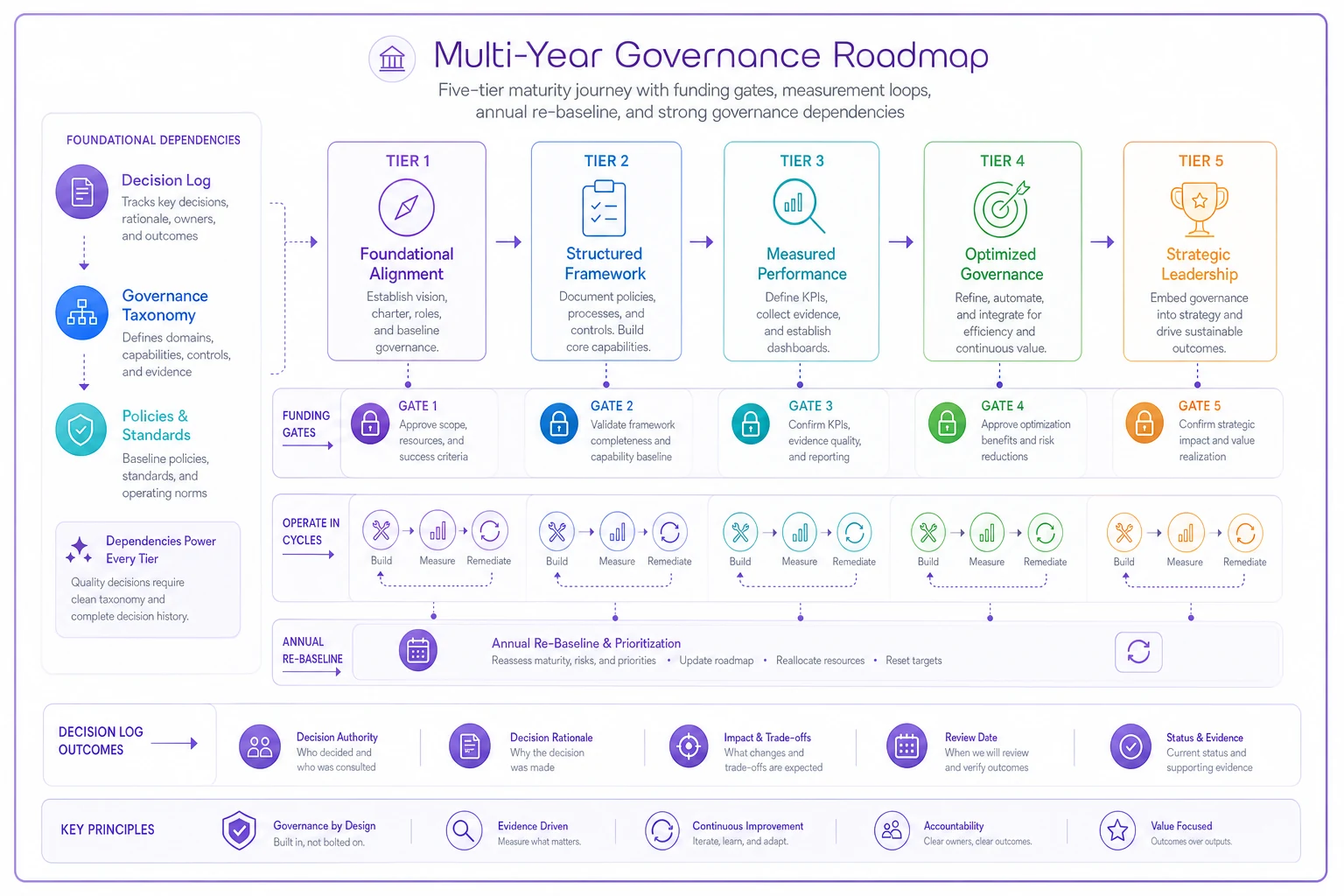
The step people skip is the fifth one. Without an annual re-baseline, the map becomes another dated artifact — ironically the exact tier-two failure the whole thing was meant to cure.
Here's a concise visual of the multi-year workflow.
The boards that reach tier four or five aren't the ones that spent the most. They're the ones that refused to skip tiers. They built the boring foundation, gated their funding to proof of stability, and let capability compound instead of resetting. The maturity model doesn't make governance exciting. It makes it cumulative — which, over a few years, is a much bigger advantage than any single improvement you could buy.
The boards that reach tier four or five aren't the ones that spent the most. They're the ones that refused to skip tiers. They built the boring foundation, gated their funding to proof of stability, and let capability compound instead of resetting. The maturity model doesn't make governance exciting. It makes it cumulative — which, over a few years, is a much bigger advantage than any single improvement you could buy.
Ready to enhance your board's productivity?
Join 500+ organizations using Panlly to save time, improve governance, and streamline board operations.