

Most boards don't have an assurance problem. They have a routing problem.
The policies exist. The committee charters exist. Somewhere in a shared drive there's a risk appetite statement, an escalation matrix, and three versions of an evidence standard nobody fully follows. What's missing is the connective tissue — the layer that takes a signal (an incident, a control failure, a regulator question, a vendor breach) and routes it the same way every single time, regardless of who's in the room or how busy the quarter is.
When that routing layer doesn't exist, assurance becomes personality-driven. The sharp audit chair catches things. The new comp committee member doesn't. A cyber event in March gets a full evidence pack and a minuted decision; a nearly identical one in September gets a verbal update and a line in the consent agenda. Same board, same risk, wildly different handling. That inconsistency is what regulators and plaintiff's counsel love most, because it tells a story about judgment that isn't flattering.
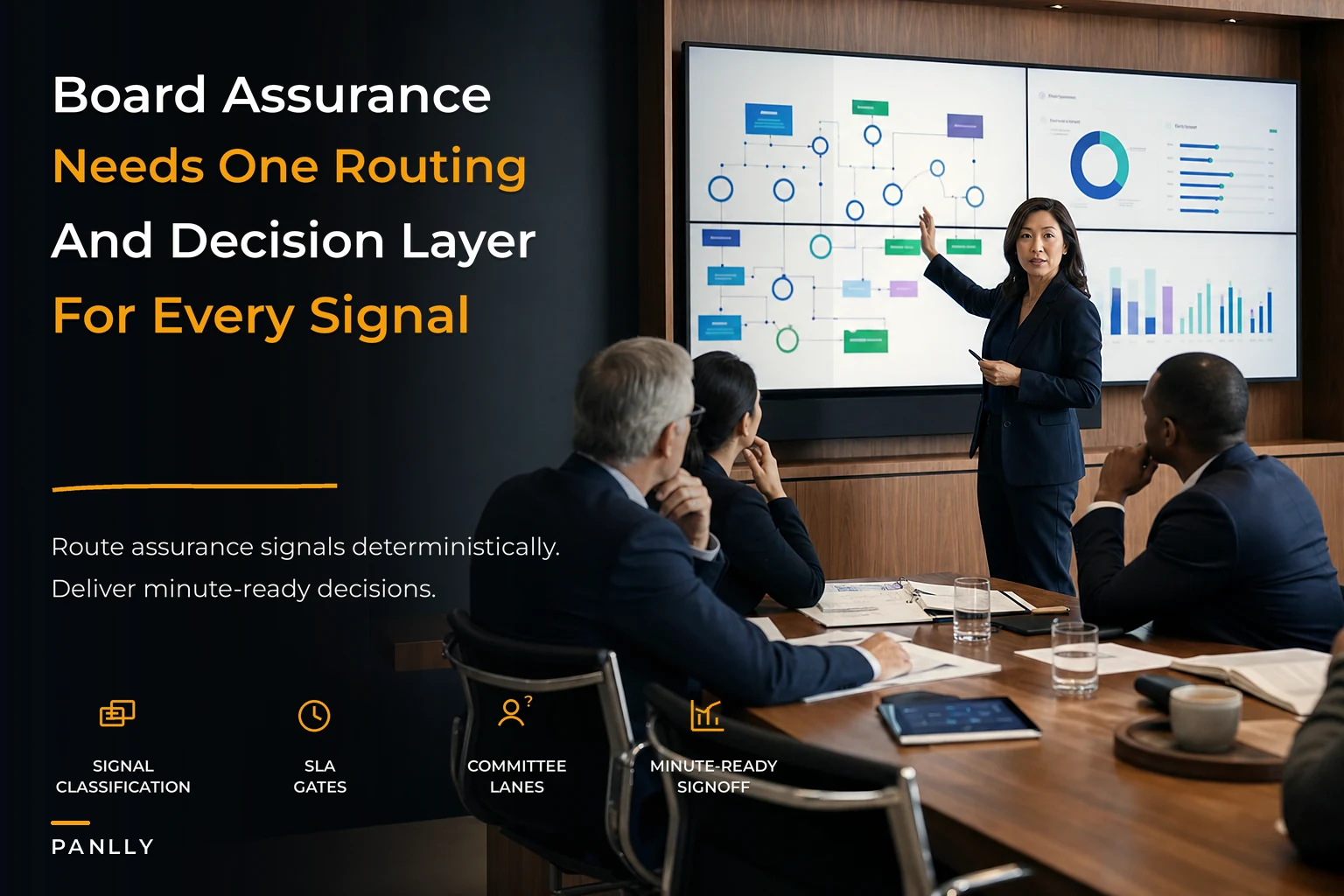
A board assurance operating system fixes this by making assurance deterministic. Not rigid — deterministic. Every signal flows through the same five stages: classification, lane mapping, evidence-pack requirements, SLA gates, and minute-ready signoff. The point isn't to remove judgment. It's to remove the randomness around where judgment gets applied.
Why assurance drifts out of shape as boards scale
Most assurance frameworks are written as reference documents, not routing logic. A charter tells you the audit committee is responsible for financial controls. It does not tell you what happens at 4pm on a Friday when internal audit flags a material control gap in a subsidiary three time zones away.
That gap between "who's responsible" and "what happens next" is where things break. And they break predictably as the organization grows.
At a small board — one entity, one jurisdiction, a tight group that's worked together for years — informal routing works because everyone has the same context. The CFO flags something, the audit chair knows instinctively whether it's a note-it or a full-session item, and institutional memory lives in a handful of heads.
Then the organization adds subsidiaries. A second regulator. A fourth committee. Two board members rotate off. Suddenly the informal routing has too many branches, and the people holding the context have left. What used to be a quiet judgment call becomes:
-
Signals that reach the wrong committee entirely, or reach two committees who both assume the other owns it
-
Evidence packs that vary in quality depending on who assembled them
-
Escalations that happen too late because nobody agreed in advance what "too late" means
-
Minutes that under-document the serious items and over-document the trivial ones
This is why the three-lines model, while conceptually sound, so often fails in practice — the lines are defined but the handoffs between them aren't. If you've mapped out how first, second, and third line responsibilities should align, the natural next step is turning that architecture into actual routing. There's good groundwork on that in board assurance architecture to align three lines of assurance, and the operating system described here is essentially the execution layer that sits on top of it.
The five-stage routing model
Think of the whole thing as a pipeline. A signal enters at one end and either exits as a documented, signed-off decision — or it gets explicitly parked with a reason. Nothing falls through, because every stage has a defined output that feeds the next.
Eliminate boardroom chaos with seamless coordination.
Panlly simplifies scheduling, collaboration, and follow-ups for every board meeting.
- Centralized meeting scheduling
- Secure document sharing
- Task assignment & tracking
No credit card required
-
Event classification — What kind of signal is this? (financial, cyber, legal/regulatory, operational, ESG, conduct, strategic)
-
Lane mapping — Which assurance lane owns it, and what severity tier is it?
-
Evidence-pack requirements — Based on lane and tier, what evidence must exist before a decision?
-
SLA gates — How fast must each stage happen, and what triggers escalation if it doesn't?
-
Minute-ready signoff — How does the decision get recorded so it survives review years later?
The power is in the determinism. Given the same inputs, the system produces the same routing — every time, for every committee, regardless of who's on duty. That's what makes it defensible.
Stage 1: Event classification
Classification is where most informal systems quietly fail, because people classify by who raised it rather than what it is. A control gap raised by the CFO gets treated as financial; the identical gap raised by IT gets treated as operational and routed somewhere else entirely.
The fix is a classification taxonomy that keys off the nature of the signal, not its source. In practice you want a short, closed list of event types — somewhere between six and ten. More than that and people can't hold it in their heads; fewer and everything collapses into "operational" as a catch-all.
-
Financial / reporting — control failures, restatement risk, disclosure gaps
-
Cyber / technology — breaches, vulnerabilities, vendor security incidents
-
Legal / regulatory — inquiries, notices, litigation triggers, compliance breaches
-
Conduct / whistleblower — ethics complaints, fraud allegations, culture signals
-
Strategic / transactional — M&A, major contracts, capital decisions
-
Operational resilience — supply chain, concentration, continuity events
-
ESG / sustainability — reporting obligations, commitment tracking, assurance gaps
One thing worth flagging: the taxonomy only works if there's a rule for ambiguous signals. Most events are multi-type — a vendor ransomware incident is cyber and operational and potentially legal. Without a tiebreaker rule, those multi-type events are exactly the ones that get dropped. The standard approach is to classify to the highest-severity applicable lane and notify the others. Simple, but it has to be written down.
Stage 2: Lane mapping and the decision-routing matrix
Once classified, the signal maps to an assurance lane and a severity tier. This is the heart of the system — the matrix that converts "what kind of thing" plus "how bad" into "who acts, how fast, and with what authority."
| Event Type | Tier 1 (Monitor) | Tier 2 (Manage) | Tier 3 (Escalate) |
|---|---|---|---|
| Financial / reporting | Mgmt handles, note in audit pack | Audit committee review, documented | Full board + external auditor, minuted motion |
| Cyber / technology | CISO log, quarterly summary | Risk committee + counsel notified | Board emergency session, counsel + comms engaged |
| Legal / regulatory | GC tracks, routine update | GC + relevant committee, counsel brief | Board + outside counsel, privilege protocol |
| Conduct / whistleblower | Intake log, triage | Audit/ethics committee, investigation plan | Independent committee, external investigator |
| Strategic / transactional | Mgmt pipeline review | Relevant committee pre-review | Full board approval, conflict checks, record |
| Operational resilience | Ops dashboard | Risk committee + remediation plan | Board review, continuity activation |
| ESG / sustainability | Mgmt metrics | Designated committee review | Board + assurance provider review |
The tier definitions have to be written down and tied to thresholds, not vibes. "Tier 3 financial" shouldn't mean "whatever the audit chair thinks is serious." It should mean something like: potential misstatement above a defined materiality threshold, OR any event requiring external auditor notification, OR anything with regulatory disclosure implications.
A pattern that comes up repeatedly: boards that build this matrix almost always under-specify Tier 2. Everyone argues about what's catastrophic (Tier 3) and what's noise (Tier 1), but the middle tier — "manage it formally but don't panic" — is where most real work lives, and it's the tier most likely to get skipped straight to a verbal update. Spend your definitional energy on the middle.
For organizations wrestling with AI-specific signals, the lane mapping gets its own wrinkle around explainability and model risk, which is worth handling with a dedicated set of lanes rather than forcing it into "operational" — there's a fuller treatment in the board AI oversight framework with explainability and assurance lanes.
Stage 3: Evidence-pack requirements per lane
This is the stage that makes the difference between a decision that survives scrutiny and one that evaporates under it. The rule is simple and strict: the evidence pack is determined by the lane and tier, not by how much time someone had.
Each lane gets a template. The template specifies the minimum evidence that must exist before a decision can be signed off. If the evidence isn't there, the decision can't proceed — it gets parked at an SLA gate with the gap explicitly recorded.
Cyber / technology (Tier 2–3):
-
Incident timeline with timestamps
-
Scope and systems affected
-
Root-cause summary (or interim if investigation ongoing)
-
Remediation status and owner
-
Notification obligations analysis (regulator, customer, counsel)
-
Vendor impact if third-party originated
-
Residual risk assessment
Financial / reporting (Tier 2–3):
-
Description of control gap or reporting issue
-
Quantified exposure or materiality assessment
-
Period(s) affected
-
Management's remediation plan with dates
-
Internal audit / external auditor position
-
Disclosure implications
Conduct / whistleblower (Tier 2–3):
-
Intake record (anonymized as needed)
-
Preservation confirmation for relevant evidence
-
Conflict-of-interest screen for investigators
-
Investigation plan and scope
-
Interim findings
-
Recommended action with rationale
The insight that saves boards a lot of pain: standardize the template, not the content. You're not dictating what the answer is — you're dictating what questions must be answered before the board decides. That distinction keeps the system from feeling bureaucratic while still guaranteeing that no decision gets made on a half-empty file.
When an event is moving fast — the first hours of a live incident — the evidence pack starts as a skeleton and fills in as the situation develops, with timestamps showing when each piece landed. The sequencing of those early hours matters enormously for how defensible the record looks later; the operational detail on that is in the playbook for the first 72 hours.
Stage 4: SLA gates
SLAs are what make the pipeline move. Without time limits, signals sit. The classic failure: an issue gets flagged, someone says "let's bring it to the next committee meeting," and the next meeting is eleven weeks away. By then the window to act defensibly has closed.
| Stage | Tier 1 SLA | Tier 2 SLA | Tier 3 SLA |
|---|---|---|---|
| Classification | 5 business days | 2 business days | Same day |
| Lane assignment | 5 business days | 2 business days | 4 hours |
| Evidence pack assembled | Next cycle | 10 business days | 48 hours |
| Decision / signoff | Next meeting | 15 business days | 72 hours |
| Breach escalation | — | Committee chair | Board chair + GC |
The important mechanic isn't the specific numbers — those depend on your organization. It's that a breached SLA is itself a signal that gets escalated. If an evidence pack isn't ready in time, that fact routes upward automatically. This is what stops things from quietly stalling, because the delay becomes visible rather than invisible.
A realistic failure mode to design against: the SLA clock that nobody is watching. An SLA with no owner and no automated reminder is just a sentence in a document. The gate has to be attached to a named role and a tracking mechanism, or it won't hold.
Stage 5: Minute-ready signoff
The last stage closes the loop by producing a record that is decision-ready at the moment of decision, not reconstructed weeks later from someone's notes. Reconstruction is where minutes go wrong — gaps get filled with assumptions, dates get fuzzy, and the version that exists doesn't match what actually happened.
-
The classified event and tier
-
The lane that owned it
-
The evidence pack referenced (with document IDs, not vague descriptions)
-
The decision, stated as an actionable motion
-
Who moved, who seconded, the vote
-
Dissents or abstentions, recorded faithfully
-
Follow-up actions with owners and dates
-
Any SLA breaches and why
Because every earlier stage already produced structured outputs, the minute practically writes itself — the classification, the lane, the evidence references, the SLA record are all already captured. That's the quiet payoff of determinism: good minutes stop being a writing exercise and become a byproduct of the routing.
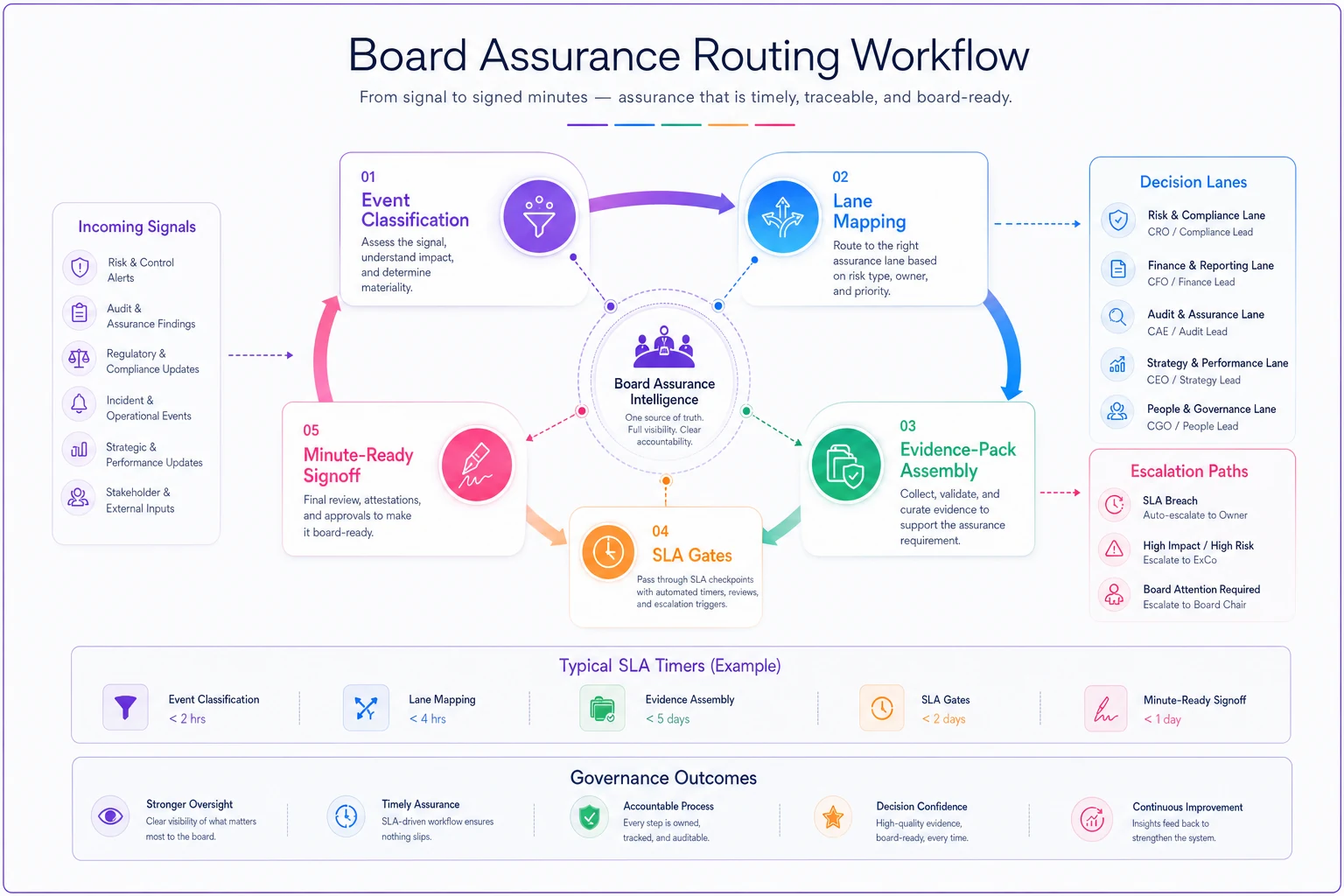
The diagram shows the pipeline flow and where escalations and SLA checks occur.
The committee escalation rules that stitch it all together
A board isn't one committee — it's several, each with its own playbook. The operating system's real job is making those playbooks interoperate so a signal that starts in one committee's lane can escalate cleanly into another's, or up to the full board, without renegotiating the rules each time.
Workable escalation rules look like this:
-
Automatic cross-notification. Any Tier 2+ event in one lane triggers notification to adjacent lanes. A Tier 2 cyber event cc's the audit committee (financial exposure) and GC (notification obligations) by default.
-
Tier-3 convening authority. Any committee chair can convene an emergency full-board session for a Tier 3 event without waiting for the regular cycle. This has to be pre-authorized in the charters, or it won't happen when it's needed.
-
Repeat-signal escalation. Three Tier 1 events of the same type within a quarter auto-escalate to Tier 2. Recurrence is itself a signal — a pattern of "minor" issues is rarely minor.
-
Stalled-decision escalation. Any breached decision SLA escalates one tier and notifies the board chair. Indecision is a decision, and it should be visible as one.
-
Conflict-triggered rerouting. If the owning committee has a conflict, the signal reroutes to an independent committee automatically, with the conflict recorded.
The mistake boards make here is treating escalation as exceptional — something that only happens when things go really wrong. In a well-designed system, escalation is routine mechanics. It happens dozens of times a year quietly, mostly at Tier 1 and Tier 2, and precisely because it's routine, the Tier 3 escalations run smoothly when they're genuinely needed.
A real scenario
A mid-sized financial-services group — one parent board, four subsidiaries across three jurisdictions, five committees — kept running into the same wall. Signals routed inconsistently. A subsidiary data incident had taken something like nine weeks to reach the parent board, by which point the regulatory notification window had been missed and the decision record was a mess of reconstructed emails.
They weren't short on policy. They had charters, a risk appetite statement, an escalation matrix. What they didn't have was deterministic routing — the policies described responsibilities but not the handoffs.
They built the five-stage pipeline. Closed classification taxonomy. A decision-routing matrix with written tier thresholds. Evidence-pack templates per lane. SLA gates with named owners. Minute-ready signoff baked into the flow.
The change over the following year was less about any single metric and more about variance collapsing. Time-to-board for serious signals dropped from the multi-week range to, typically, a handful of days for Tier 3 events. Evidence packs stopped varying by assembler because the template no longer left room to improvise. In a routine regulatory review, the examiner's main comment was that the consistency of the decision records was unusual — every serious item had the same shape, the same evidence depth, the same traceable escalation path.
What's worth noting is what didn't change: the board didn't make fewer judgment calls. They made the same calls, in the same room, with the same people. The system just made sure every call got the same routing, the same evidence standard, and the same record — so the quality of a decision no longer depended on the quarter's workload or which director was sharp that day.
When this makes sense — and when it doesn't
When to build it:
-
Multiple committees or multiple entities, where informal routing has started to break
-
Regulated industries where inconsistent handling creates real exposure
-
Boards that have already had at least one signal route badly (most have)
-
Organizations growing fast enough that institutional memory is leaving faster than it's being written down
When it's overkill:
-
A single-entity board with one committee and a stable, long-tenured group — the overhead may exceed the benefit
-
Very early-stage organizations where the risk surface is small and genuinely known to everyone
Who should not do this yet:
Boards that haven't first sorted out their underlying assurance architecture. The operating system is a routing layer — it routes between defined lanes and responsibilities. If those aren't defined, you're building a router with nowhere to route to. Get the architecture right first, then layer the routing logic on top.
Where the tooling actually earns its place
None of this requires software to design. You can define the taxonomy, the matrix, the templates, the SLAs, and the escalation rules on paper. The problem is that paper systems depend on humans to execute every handoff — and humans forget, get busy, go on leave, and rotate off boards.
That's where AI-assisted governance platforms do quiet, useful work: not making the decisions, but enforcing the routing around them. The genuinely tedious parts — classifying an incoming signal against the taxonomy, checking an evidence pack against the required template and flagging what's missing, watching the SLA clock and auto-escalating a breach, notifying adjacent committees on a Tier 2 event, assembling the structured minute from the stages that already ran —these are exactly the parts that decay in a manual system and exactly the parts automation holds steady at scale.
Attach SLA gates to named owners and automated reminders so the SLA clock is visible and someone is accountable the moment a timer starts.
The value isn't "the system decides for you." It's that the routing stays deterministic even when the people change, the quarter gets busy, and three signals land in the same week. The determinism is the whole point, and determinism is hard to sustain by hand.
The bigger picture
A board assurance operating system isn't really about adding process. Most boards already have more process than they can execute. It's about making the process you have run the same way every time — so that the quality of assurance stops depending on who's in the room, how busy the quarter is, or whether the institutional knowledge walked out the door when a director rotated off.
The five stages — classify, map, evidence, gate, sign off — are deliberately mechanical. That's the feature, not the bug. Judgment belongs in the decision itself, not in the routing around it. When you make the routing deterministic, you free the board to spend its judgment where it matters and stop spending it, badly, on figuring out where things should go.
Ready to enhance your board's productivity?
Join 500+ organizations using Panlly to save time, improve governance, and streamline board operations.