


Most boards don't struggle to approve governance spending. They struggle to defend it afterward. The portal gets bought, the GRC platform rolls out, the committee restructure happens — and eighteen months later nobody can say with a straight face whether any of it reduced risk, saved time, or kept the organization out of trouble. The money was spent. The outcome is a shrug.
That gap — between funding a governance initiative and proving it worked — is the actual problem a governance investment framework has to solve. Not the approval. The accountability loop around the approval.
What follows isn't a pitch for spending more on governance. It's a system for deciding which governance investments deserve money, how to release that money in stages instead of all at once, and how to come back later with evidence rather than vibes. If you've ever sat through a board meeting where someone asked "didn't we already pay for something that does this?" and the room went quiet — this is for that.
Why governance spending is uniquely hard to justify
Governance initiatives have a measurement problem baked into their DNA. The whole point of a lot of them is that nothing bad happens. You invest in better minute-taking standards so you never face a restatement. You fund a conflict-of-interest workflow so you never have a director scandal. Success looks like absence.
That's a brutal thing to defend in a budget cycle. Operational projects can point to revenue, throughput, cost per unit. Governance projects point to a restatement that didn't occur, a regulator inquiry that went smoothly, a D&O claim that never materialized. The counterfactual is invisible, and invisible things lose funding fights to things with dashboards.
In real board conversations, this plays out in a pretty predictable way. The CFO sees governance line items as a cost center with no return. The general counsel sees them as non-negotiable risk insurance. The CIO sees overlapping tool purchases and quietly wonders why three committees each bought their own document system. Nobody is wrong exactly — they're just scoring the same initiative on different scales with no shared rubric.
The failure isn't any single bad decision. It's the absence of a system that forces everyone to score the same way, fund in increments, and report back against what was promised. Without that, governance spending becomes a series of one-off persuasion exercises where the most confident sponsor wins.
Scoring: a shared rubric before anyone talks money
The first thing a serious framework needs is a way to rank competing governance initiatives against each other using the same lens. Not "which one does the loudest director care about" — an actual rubric.
Eliminate boardroom chaos with seamless coordination.
Panlly simplifies scheduling, collaboration, and follow-ups for every board meeting.
- Centralized meeting scheduling
- Secure document sharing
- Task assignment & tracking
No credit card required
-
Risk reduction — lowers the probability or severity of a loss event (litigation, breach, fine, restatement)
-
Productivity — reduces hours spent by directors, the corporate secretary, or committee staff on low-value manual work
-
Compliance avoidance — reduces the cost and chaos of being caught unprepared by a regulator, auditor, or claim
Score each initiative 1–5 on all three, then weight them. Most boards weight risk reduction highest, but a board coming off a painful audit cycle might weight compliance avoidance heavier for a year or two. The weighting is a board decision, and making it explicit is half the value.
Here's a simplified version of the rubric in practice:
| Initiative | Risk reduction (×3) | Productivity (×2) | Compliance avoidance (×2) | Weighted score |
|---|---|---|---|---|
| Whistleblower intake + triage system | 5 | 3 | 4 | 29 |
| Board portal document taxonomy overhaul | 2 | 5 | 4 | 24 |
| Subsidiary reporting harmonization | 3 | 4 | 5 | 27 |
| Automated action-item tracking | 2 | 5 | 2 | 20 |
| Committee charter-to-workplan redesign | 3 | 3 | 3 | 18 |
The scores aren't the point — the conversation the scores force is the point. When the whistleblower system and the taxonomy overhaul land within five points of each other, the board has to actually articulate why one goes first. That beats whoever argues hardest.
One mistake worth flagging: don't let sponsors score their own initiatives. The person who wants the budget always finds a 5 where there's a 3. Have the corporate secretary or a governance committee score, with the sponsor allowed to challenge afterward. The friction is healthy.
The board investment brief: one page, decision-ready
Once something scores high enough to consider, it needs a brief. Not a 40-slide deck. A one-page document that a director can read in three minutes and vote on with a clear conscience.
A good brief answers six questions and nothing else:
-
What are we buying, and what specific problem does it fix? (One sentence. If it takes a paragraph, the sponsor doesn't understand it.)
-
What's the weighted rubric score, and how did it rank against alternatives?
-
What's the total cost — including the stuff people forget (implementation, training, the internal hours, the ongoing license)?
-
How will we know in 12 months whether it worked? (The KPIs. Named. Measurable.)
-
Who owns delivery, and who owns the outcome? (These are often different people, which is where things rot.)
-
What happens if we don't do it? (The honest counterfactual, not scare tactics.)
That last question matters more than it looks. Boards that fund governance well are the ones that can state the downside of inaction in plain language — "if we don't harmonize subsidiary reporting, consolidation takes six weeks and we're exposed if a regulator asks for entity-level data." Vague downside, weak brief.
This connects directly to how you structure larger transformation programs. If you're funding governance tooling as part of a broader shift, the sequencing logic in a board digital-transformation playbook for staged value and sponsorship pairs naturally with the brief — the brief justifies the single initiative, the playbook sequences the whole portfolio.
Staged-gate funding: stop writing blank checks
The single biggest fix most boards can make is to stop approving governance initiatives as one lump sum. Approve them in gates.
Staged-gate funding means the board releases money in tranches tied to evidence. You don't get the full budget on day one. You get enough to hit the next checkpoint, and the next tranche depends on proving you got there. This is standard practice in venture and capital projects, and it's weirdly rare in governance spending — which is exactly why so much governance money disappears into tools nobody adopts.
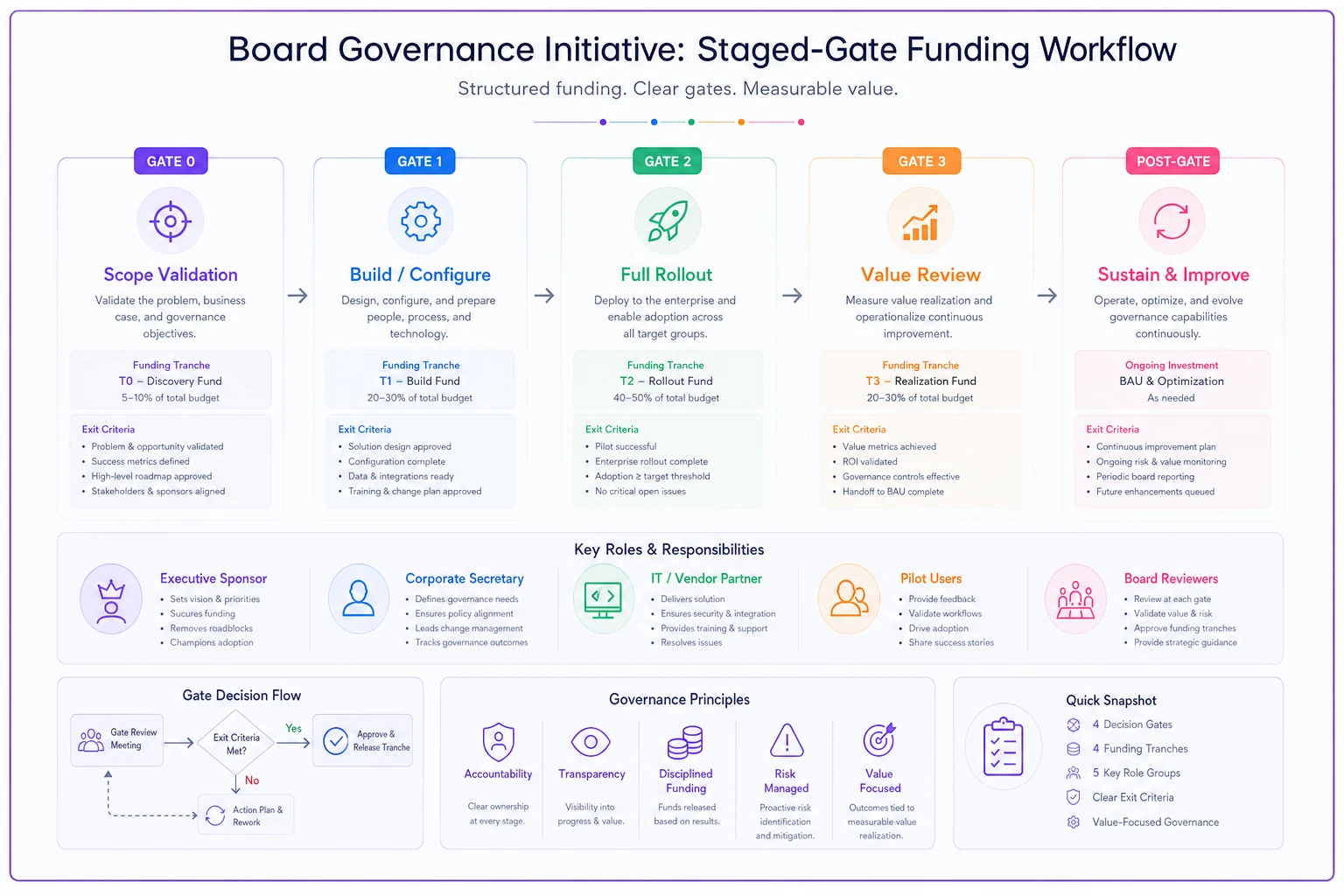
Gate 0 → Scope Validation → Gate 1 → Build/Configure → Gate 2 → Full Rollout → Gate 3 → Value Review (5–10%) (30–40%) (Remaining) (No new spend)
Gate 0 — Approval to scope (5–10% of budget). Funds discovery, requirements, vendor shortlisting. Exit criteria: a validated scope and a confirmed rubric score. Many initiatives quietly die here, which is a success — you spent 8% to learn it wasn't worth 100%.
Gate 1 — Approval to build/configure (30–40%). Funds implementation and configuration. Exit criteria: the system works in a test environment, data migration is validated, a pilot group is trained.
Gate 2 — Approval to roll out (remaining budget). Funds full deployment. Exit criteria: pilot adoption metrics hit a pre-agreed threshold — say, 70% of the pilot group actively using it within 30 days.
Gate 3 — Value realization review (no new money, but it's the gate that matters). 6–12 months post-rollout. This is where the promised KPIs get checked against reality.
The discipline here is that each gate has written exit criteria agreed in advance. Not "we'll see how it's going." Specific thresholds. If a sponsor can't hit Gate 1 criteria, you don't throw the next tranche at the problem hoping it fixes itself. You pause and ask why.
Make exit criteria numeric and attach the data source you'll use to verify them.
A visual of the staged-gate flow can help clarify who owns each checkpoint and what evidence is required at each stage.
A pattern worth naming: the initiatives that fail at Gate 2 almost always had an adoption problem that was visible at Gate 1 and ignored. The pilot group grumbled, logins were low, and everyone pushed forward anyway because the budget was already committed in people's heads. Gates break that momentum trap.
The RACI nobody wants to fill out (but has to)
Governance initiatives rot at the handoffs. The tool gets implemented by IT, owned by the corporate secretary, used by directors, and reported on by... nobody's quite sure. That ambiguity is where value leaks out.
A tight RACI for a governance investment usually looks like this:
| Activity | Responsible | Accountable | Consulted | Informed |
|---|---|---|---|---|
| Initiative scoring | Corporate secretary | Governance committee chair | Sponsor, CFO | Full board |
| Investment brief | Sponsor | Governance committee chair | Counsel, CIO | Full board |
| Gate approvals | Governance committee | Board | CFO | Executive team |
| Implementation | IT / vendor | CIO | Corporate secretary | Sponsor |
| Adoption tracking | Corporate secretary | Sponsor | — | Governance committee |
| Value realization review | Corporate secretary | CFO + sponsor | Internal audit | Full board |
The crucial move is that accountability for the outcome sits with the sponsor and the CFO jointly at the value review — not with IT, who only owned delivery. This stops the classic dodge where a project is declared a success because it was "delivered on time," while the thing it was supposed to improve didn't budge.
Measuring adoption and realized value separately
Boards routinely conflate two very different questions: is this being used? and is this actually delivering the value we funded? They're not the same, and a mature framework tracks them on separate tracks.
Adoption KPIs tell you whether the thing is alive:
-
Active users as a percentage of intended users (30/60/90 days post-rollout)
-
Frequency of use against the expected cadence
-
Percentage of relevant processes actually running through the new system vs. old workarounds
-
Time-to-competency for new users
Realized-value KPIs tell you whether it worked:
-
For risk-reduction initiatives
reduction in open high-risk findings, faster time-to-escalation, fewer repeated issues
-
For productivity initiatives
hours saved per meeting cycle, reduction in document retrieval time, fewer last-minute scrambles before board meetings
-
For compliance-avoidance initiatives
audit prep time, number of regulator requests answered within SLA, reduction in control exceptions
The uncomfortable truth these two tracks expose: you can have excellent adoption and zero realized value. Everyone uses the new risk register religiously, and the number of overdue high-risk items hasn't moved because nobody acts on what it surfaces. High adoption, no value. That's a finding, not a footnote.
For boards building this measurement muscle more broadly, the KPI design and remediation logic in a board effectiveness measurement system with KPIs and remediation carries straight over — the same discipline of pairing a metric with a remediation path applies to proving governance investment value.
A real scenario: the subsidiary reporting investment
Consider a holding company with around a dozen subsidiaries across three jurisdictions. Consolidation at quarter-end was taking the corporate secretary's team roughly five to six weeks, most of it chasing inconsistent entity-level reports in different formats. The audit committee had flagged twice that it couldn't get clean entity-level data fast enough when it wanted to drill into a specific subsidiary's risk exposure.
The proposal was a reporting harmonization initiative — standard templates, a shared repository, consistent data fields across entities. Budget came in around $140k all-in, including the internal hours.
Scored on the rubric, it landed at 27 (risk 3, productivity 4, compliance avoidance 5) — compliance avoidance scored high because inconsistent entity data was a live audit concern, not a hypothetical.
They funded it in gates. Gate 0 ($12k) confirmed scope and killed a fancier analytics add-on that would've pushed the budget past $200k for features nobody asked for. Gate 1 ($50k) got the templates built and piloted with three subsidiaries. Gate 2 released the rest once the pilot subsidiaries were submitting clean data on time.
At the value realization review roughly nine months later, consolidation time had dropped to about two weeks. Adoption was solid — eleven of twelve entities submitting on the standard template. The one holdout became its own agenda item rather than a vague "rollout incomplete" line. Audit committee drill-down requests, which used to take days to answer, were turning around in under a day.
What made it defensible wasn't the outcome alone. It was that the board had written down, at Gate 0, exactly what two-weeks-and-eleven-entities would prove — so when it happened, nobody had to argue about whether the money was well spent.
When this framework actually makes sense
This level of rigor isn't free.
It adds process, and process has a cost. It's worth it when:
-
You're funding multiple competing governance initiatives and need to rank them honestly
-
Past governance spending has been hard to defend or quietly overlapped
-
The board includes directors who are skeptical of governance ROI and need evidence, not assurance
-
You operate in a regulated environment where "we invested in controls" needs to be provable, not just stated
It's worth it when:
When it's overkill
Don't wrap a $5k tool purchase in a four-gate funding structure. The ceremony costs more than the decision. For small, obvious, low-risk governance buys, a one-line approval and a note in the decision log is fine.
It's also the wrong approach for genuinely urgent initiatives — a live regulatory deadline, an active incident response. Those need fast, documented decisions, not a staged-gate review that burns three weeks you don't have. Reserve the full framework for discretionary, meaningful-spend governance investments where the whole point is choosing well among options.
Who should not try to run this
Boards without a clear owner for governance operations — usually the corporate secretary or a dedicated governance lead — will struggle. The framework needs someone accountable for scoring, briefing, and tracking who isn't the sponsor of every initiative. If that role doesn't exist, build it before you build the framework, or the whole thing collapses into the sponsor marking their own homework.
Likewise, if your board can't tolerate killing initiatives at Gate 0, don't bother with gates. The entire value of a staged structure is the willingness to stop. A board that treats every Gate 0 as a formality on the way to inevitable full funding has just added paperwork to a decision it already made.
Tooling the framework without overbuying
The scoring, briefs, gates, and KPI tracking don't require specialized software — a disciplined team can run the whole thing on a spreadsheet and a decision log. What does help is having your governance records, decision logs, and KPI data in a system where the value-realization review can pull real usage and outcome data instead of relying on someone's recollection.
That said, the tools themselves are governance investments that should run through this same framework — which is exactly why a clear-eyed governance-tech procurement checklist for board oversight and exit matters. The same rubric, gates, and value review you'd apply to any initiative should apply to the software you buy to manage them. Nothing undermines a governance investment framework faster than exempting your own tooling from it.
Closing the loop
The organizations that fund governance well aren't the ones that spend the most. They're the ones that can walk into a meeting a year after a decision and show, with evidence, what the money bought — or admit honestly that it didn't deliver and adjust.
Score before you fund. Fund in gates. Separate adoption from value. Put the outcome on a named person's shoulders. Come back and check. It's not complicated — it's just disciplined, and discipline is usually the thing that's missing when a director asks what happened to last year's governance budget and the room goes quiet.
Score before you fund. Fund in gates. Separate adoption from value. Put the outcome on a named person's shoulders. Come back and check. It's not complicated — it's just disciplined, and discipline is usually the thing that's missing when a director asks what happened to last year's governance budget and the room goes quiet.
Ready to enhance your board's productivity?
Join 500+ organizations using Panlly to save time, improve governance, and streamline board operations.