


Most boards don't have an agenda problem in any single meeting. The March meeting looks fine. The June meeting looks fine. The problem shows up when you stack twelve months of agendas next to the strategic plan and realize the two documents barely touch. Capital allocation gets four mentions. The talent pipeline gets none until someone quits. Cyber shows up once, reactively, after an advisory lands. Meanwhile the same three operational updates eat 40% of every meeting because nobody ever decided to stop reviewing them.
The agenda drifts. It drifts because it's built one meeting at a time, by whoever assembles the pack, under time pressure, using last quarter's agenda as the template. That's the real failure mode — not a bad meeting, but a sequence of individually reasonable meetings that never add up to coherent oversight.
A multi-year board agenda portfolio fixes this by managing agenda topics the way you'd manage any portfolio: with lifecycles, review cadences, entry and exit criteria, and a deliberate view of how everything fits together over two or three years. The word "portfolio" matters. You're not scheduling meetings. You're allocating the board's scarcest resource — attention — across a fixed number of hours per year against a moving strategy.
Why single-meeting agenda planning breaks down
The mechanics of drift are predictable once you look for them.
Whoever owns agenda assembly — usually the corporate secretary working with the chair — starts from the previous meeting. That's efficient and completely rational at the meeting level. But it means topics enter the agenda easily and almost never leave. A quarterly review of the pension plan gets added during a year when it mattered. Three years later it's still there, still quarterly, still consuming fifteen minutes, long after the reason evaporated.
New topics only enter when something forces them: a regulatory deadline, an incident, an activist letter. So the agenda becomes a fossil record of past crises rather than a forward-looking plan. Across a lot of boards, roughly a third of standing agenda time goes to topics no director could actually justify from scratch if you asked them to defend the cadence.
There's also a coordination gap between the board and its committees. Committees run their own workplans — and if you've already converted committee charters into quarterly workplans, you're ahead of most. But those committee plans and the full-board agenda are often built by different people at different times, so the audit committee does a deep-dive on financial controls in Q2 and the full board reviews the same controls in Q3 with no memory that the work already happened. Duplication and gaps live in that seam.
The last driver is the hardest to see: strategy moves faster than the agenda. A three-year strategic plan gets refreshed, priorities shift, a new market gets entered — but the agenda template rolls forward unchanged. Oversight quietly decouples from the thing it's supposed to oversee.
The portfolio model: three topic lifecycles
The core idea is that not every topic deserves the same treatment. Boards that run tight agendas tend to sort every oversight topic into one of three lifecycle categories, each with its own cadence and depth.
Eliminate boardroom chaos with seamless coordination.
Panlly simplifies scheduling, collaboration, and follow-ups for every board meeting.
- Centralized meeting scheduling
- Secure document sharing
- Task assignment & tracking
No credit card required
Annual topics get one substantive treatment per year, usually anchored to a predictable event — strategy refresh, budget approval, external auditor appointment, the annual risk appetite review. These are load-bearing but don't need repeat visits. A second look in the same year usually means the first one was incomplete.
Biannual topics get two touches: a review and a follow-up. Talent and succession planning fits here well — one session on the pipeline, a later one on progress against the gaps you found. Major capital programs, ESG targets, and cyber posture often work best on this rhythm too, because they move enough over six months to warrant a re-look but not enough to justify quarterly attention.
Deep-dive topics are the ones the board rotates through on a multi-year cycle — one genuinely deep session per topic, maybe every 18 to 24 months, going well below the routine reporting layer. A single business unit's competitive position. The technology architecture. The full supply chain. You can't deep-dive everything every year, and the portfolio approach is honest about that. It schedules the rotation so nothing goes years without a hard look.
| Lifecycle | Cadence | Typical depth | Example topics | Exit signal |
|---|---|---|---|---|
| Annual | Once per year | Decision + approval | Budget, strategy refresh, auditor appointment | Merged into strategy session |
| Biannual | Review + follow-up | Progress against targets | Succession, cyber posture, ESG milestones | No material change across 3 cycles |
| Deep-dive | Every 18–24 months | Foundational, below reporting layer | Business-unit strategy, tech architecture | Rotated out after full cycle completes |
The value isn't in the categories themselves. It's that once every topic is tagged, you can look at a two-year calendar and immediately see the imbalances — six annual topics clustered in Q4, no deep-dive scheduled for the international business in over two years, three biannual topics that haven't changed in three cycles and should probably drop to annual.
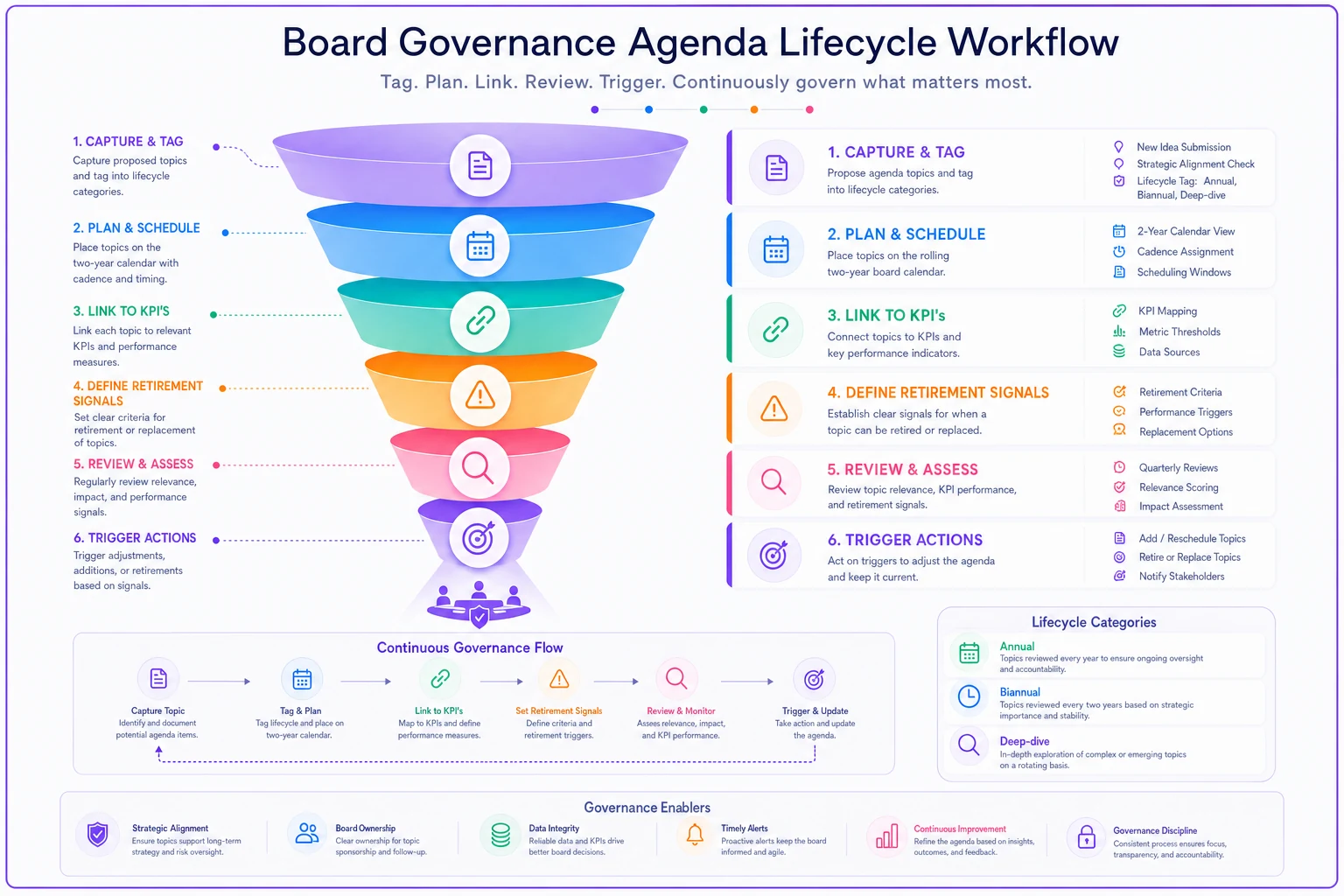
A quick workflow to visualize how topics move through lifecycle tagging and scheduling.
Mapping the portfolio to strategy and KPIs
A lifecycle tag alone doesn't tell you whether a topic deserves its slot. That's where the agenda has to connect to strategy and to measurable outcomes.
The cleanest way to test strategic fit is to lay the strategic priorities across the top of a grid and the agenda topics down the side, then ask which priorities get board attention and which get none. It's uncomfortable how often a top-three strategic priority turns out to have zero recurring agenda coverage — everyone assumed it was "handled in the ops update."
This is also where governance stops being about activity and starts being about outcomes. If you've built the plumbing to map board decisions to KPIs, the agenda portfolio can attach governance milestones directly to those metrics. Instead of "review customer strategy in Q2," the milestone becomes "review customer strategy when net retention drops below the tolerance band, and no later than Q2." The KPI does two jobs: it justifies the agenda slot and it can trigger one early.
KPI-linked governance milestones work like this in practice:
-
Define the metric each recurring topic actually governs (e.g., safety oversight → total recordable incident rate).
-
Set a tolerance band that represents "no board action needed."
-
Schedule the baseline touch at the topic's normal lifecycle cadence.
-
Attach a trigger so a breach pulls the topic forward regardless of calendar.
-
Record the linkage in the milestone itself so a future secretary knows why the slot exists.
That fifth step is the one people skip, and it's the one that prevents the next generation of drift. A topic that carries its own justification is a topic someone can confidently retire later.
Decision-retirement signals: knowing when a topic should leave
Adding topics is easy. The discipline nobody builds is removing them, and that's the single biggest reason agendas bloat. A portfolio needs explicit retirement signals — conditions that flag a topic for removal or downgrade at the annual agenda review.
Watch for these:
-
No decision in three cycles. If a recurring item has produced only "noted" for its last several appearances, it's a report, not a board topic. Move it to the consent agenda or the reading pack.
-
Stable KPI inside tolerance across multiple reviews. A metric that hasn't moved and hasn't threatened its band doesn't need recurring live discussion — downgrade the cadence.
-
Ownership has fully shifted to a committee. Once a committee owns a topic end-to-end and reports cleanly, full-board duplication is waste.
-
The underlying risk or program has closed out. Post-integration reviews after an acquisition, remediation tracking after an incident — these have a natural end. Put an expiry date on them when you create them.
-
The topic only survives out of habit. If nobody can articulate what a "yes" or "no" would look like, there's no decision to be made.
The practical move is to give every recurring topic a review date and a default retirement condition at the moment it's added. Topics created without an exit condition are the ones that live forever. Building the exit into the birth of the topic is what keeps the portfolio from quietly expanding by two or three items a year until meetings run long and the important work gets crowded to the end — which is exactly where decision bottlenecks form in the meeting lifecycle.
Facilitator preparation rules
A portfolio only works if the prep behind each agenda item is consistent. Otherwise you get a strategy deep-dive walked through with the same shallow slide deck as a routine update, and the depth you designed for evaporates in the room.
-
Deep-dives require a pre-read circulated at least a week out, plus a defined decision or set of questions the board is expected to resolve. No decision framing, no deep-dive.
-
Every recurring topic names an accountable executive who owns the material and attends. "The team will present" is how prep quality slips.
-
Materials for KPI-linked topics lead with the metric and the tolerance band, not with narrative. Directors should see where the number sits before they read the story around it.
-
Each item is time-boxed against its lifecycle, and the facilitator holds the box. Annual approvals get real time; noted items get minutes.
-
Prep for triggered topics starts the moment the trigger fires, not at the next agenda-assembly cycle — otherwise the KPI trigger you built is theater.
Circulate deep-dive pre-reads at least a week out and include a clear decision framing so the board can use the time for discussion, not discovery.
Prep quality, not meeting length, determines oversight quality. A board that spends four hours poorly prepared covers less ground than one that spends two hours on well-framed, decision-ready material.
A real scenario
A mid-market industrial manufacturer — around $600M in revenue, seven-person board — kept running long meetings that somehow never got to strategy. Their agendas had accreted over years. Roughly 55% of standing time went to operational and financial updates that produced no decisions. Strategy consistently landed last and got the leftover twenty minutes.
They rebuilt the agenda as a two-year portfolio. Every topic was tagged annual, biannual, or deep-dive. They mapped topics against their four strategic priorities and found their entire international expansion — a top priority — had no recurring slot at all. They set retirement conditions on everything and, in the first annual review, moved eleven items to the consent agenda or the reading pack.
The results weren't dramatic on paper, but they mattered. Meeting length dropped by roughly a quarter. More importantly, strategy and the two deep-dives they scheduled that year got real, front-loaded time instead of scraps. In the second cycle, three biannual topics whose KPIs had stayed inside tolerance were downgraded to annual, freeing another block of time. Directors described it, informally, as the first year the agenda "felt like it was about something."
When this makes sense — and when it doesn't
The portfolio approach earns its overhead when the board oversees real strategic complexity — multiple business units, a multi-year strategic plan, meaningful capital allocation, or a heavy regulatory footprint. If your board is managing genuine breadth and meetings feel reactive, this structure pays off quickly.
When it's overkill: a small, single-line-of-business company or an early-stage board with four meetings a year and a handful of topics doesn't need a two-year rotation matrix. The lifecycle discipline still helps, but the full portfolio apparatus is more machinery than the situation warrants.
Who should be careful with it: boards where the chair won't hold time boxes or enforce prep rules. The portfolio is only as strong as the facilitator discipline behind it. Build the calendar, tag every topic, then let a weak chair wave through unprepared deep-dives, and you've just added paperwork to the same old drift.
Making the portfolio a living document
The final piece is treating the calendar as something maintained, not filed. A multi-year agenda calendar built in a spreadsheet and forgotten is worse than useless — it gives false confidence. It needs a real annual review where the board looks at the whole thing: lifecycles, KPI linkages, retirement candidates, strategic coverage gaps. Then rebalances before the next cycle locks in.
That annual review is the heartbeat. It's where topics enter with exit conditions attached, where stale topics get downgraded or dropped, where a shifted strategy pulls new items into rotation, and where the deep-dive schedule gets checked so nothing important goes dark for years. Governance teams that keep the agenda, the committee workplans, and the KPI framework in one connected view — rather than three disconnected documents maintained by three people — are the ones where the portfolio actually holds together over time.
The point of all this isn't a tidier calendar. It's that the board's limited hours end up spent on the things that move the strategy and the metrics, with the routine noise pushed to the edges where it belongs. An agenda managed as a portfolio stops being a record of what already went wrong and starts being a plan for what the board actually needs to see next.
Ready to enhance your board's productivity?
Join 500+ organizations using Panlly to save time, improve governance, and streamline board operations.