
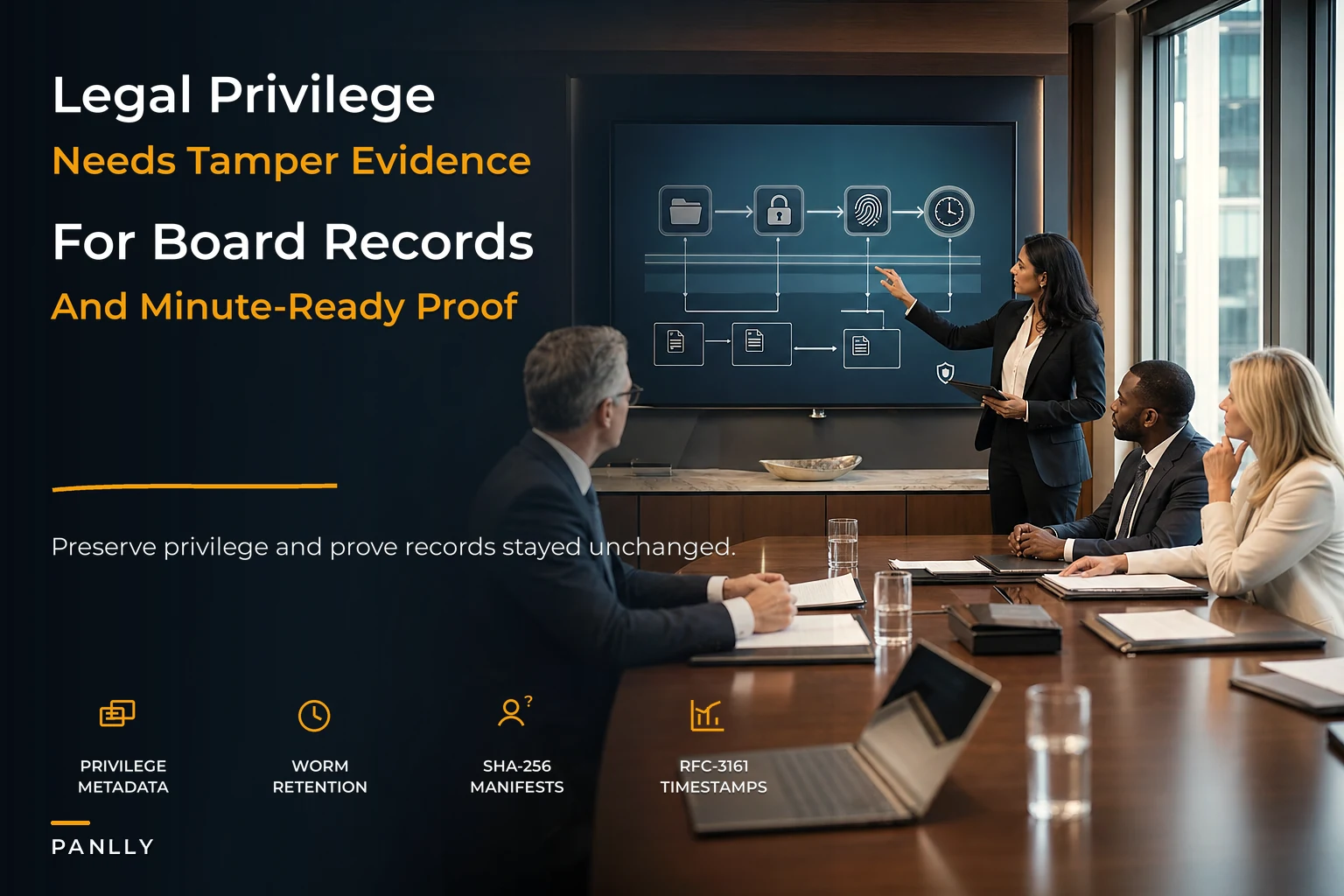

The uncomfortable truth most boards don't confront until they're mid-litigation: the moment opposing counsel or a regulator challenges privilege, the question stops being "was this advice privileged?" and becomes "can you prove this document existed, unchanged, when you say it did, and that it was actually treated as privileged the entire time?"
Those are two different problems. One is legal. The other is technical. And the gap between them is exactly where privilege gets waived — not because the advice wasn't privileged, but because the board couldn't demonstrate consistent treatment, couldn't prove the file wasn't altered, and couldn't produce a clean chain from creation to the moment it got pulled from the portal.
This article is about building a single standard that closes that gap. Not a philosophy of privilege — your counsel already owns that — but an implementation-grade operating standard a corporate secretary can actually run: what metadata to attach, how to store it so it can't be silently edited, how to prove tamper-evidence with hashes and trusted timestamps, and how to assert all of it in minutes that hold up two years later when nobody remembers the meeting.
Why privilege actually fails (and it's rarely the advice)
Privilege doesn't usually collapse because someone shared legal advice with the wrong person. It collapses because of inconsistency the board can't explain under scrutiny.
A typical pattern looks like this. General counsel sends a memo marked "Privileged & Confidential." It lands in the board portal. Three directors download it to personal devices. Two forward it to an executive assistant to print for the binder. Someone pastes a paragraph into an unmarked email summarizing the risk. Six months later the same memo gets attached to a committee pack — this time without the privilege header, because whoever assembled the pack copied an older draft.
Now you have the same underlying advice sitting in four states across the organization, with inconsistent markings, inconsistent access, and no record of which version is authoritative. When that history surfaces in discovery, the argument writes itself: the company didn't treat this as privileged, so neither should the court.
What breaks here isn't judgment. It's the absence of a system that enforces consistent treatment automatically and leaves a provable trail. Privilege is a behavior, and behaviors that depend on every director and administrator remembering the rules every single time will fail. The whole point of a standard is to remove the remembering.
The four layers that actually have to work together
Most boards treat privilege, records retention, document integrity, and minute-taking as four separate workstreams owned by four different people. That separation is the root problem. A defensible standard treats them as one connected chain, where each layer feeds the next.
Eliminate boardroom chaos with seamless coordination.
Panlly simplifies scheduling, collaboration, and follow-ups for every board meeting.
- Centralized meeting scheduling
- Secure document sharing
- Task assignment & tracking
No credit card required
| Layer | What it answers | What fails without it |
|---|---|---|
| Privilege metadata | Was this treated as privileged, by whom, under what basis? | You can't show consistent treatment; waiver arguments gain traction |
| WORM storage | Could anyone have altered it after the fact? | No defensible retention; records look editable, so they look untrustworthy |
| SHA-256 manifest | Is this the exact file, byte-for-byte? | You can't prove the produced document matches the original |
| RFC-3161 timestamp | Did it exist, unchanged, at this specific time? | You can prove content but not when — the timeline stays attackable |
Read down that table and notice the dependency. A hash proves a file is identical to itself but says nothing about when. A trusted timestamp proves existence-at-a-time but only matters if the file is also immutable. WORM storage makes immutability credible but is useless if nobody recorded privilege basis at creation. And privilege metadata is just an assertion unless you can prove the metadata itself wasn't backdated.
Each layer patches the hole in the one next to it. Run three of four and you've built something that looks rigorous and fails in exactly one predictable spot.
Here's a quick visual of how the layers connect.
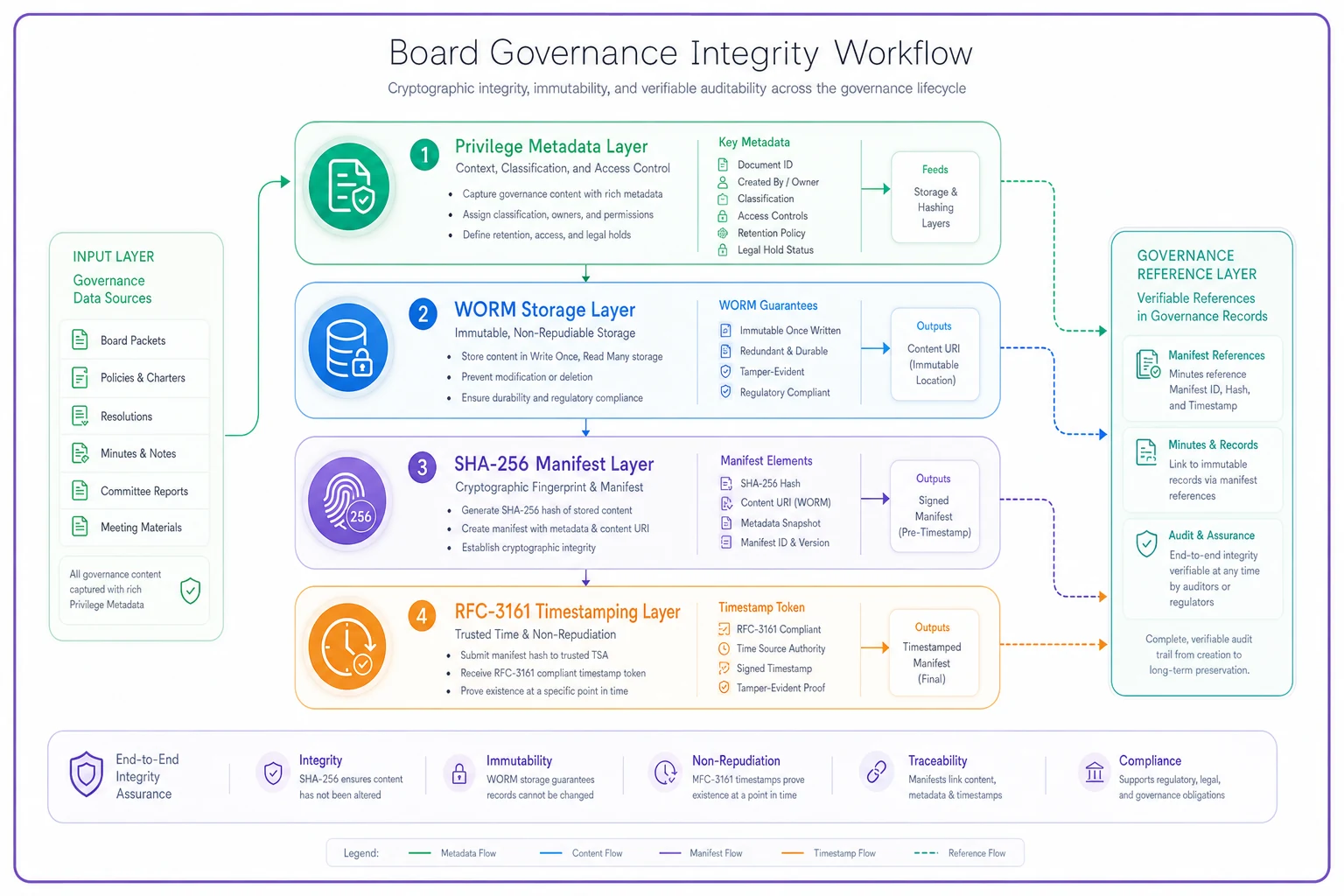
Run three of four and you've built something that looks rigorous and fails in exactly one predictable spot.
Layer 1: Privilege metadata that survives cross-examination
The mistake here is marking documents and calling it done. A "Privileged & Confidential" banner is a header, not evidence. What you need is structured metadata captured at the moment of creation or receipt, stored alongside the file, and never editable after the fact.
A workable metadata schema for every privileged board artifact:
-
privilege_basis — attorney-client, work-product, or dual; name the privilege explicitly rather than implying it
-
privilege_holder — the entity holding the privilege (often the company, sometimes a committee)
-
asserting_counsel — the attorney (internal or external) under whose advice this falls
-
createdby / createdat — author and creation timestamp, system-captured, not user-entered
-
access_scope — the defined list of individuals cleared to view, not "the board" as a vague group
-
purpose_tag — the legal purpose that triggers the privilege (e.g., "advice re: regulatory exposure")
-
litigationholdref — if a hold applies, the hold identifier it attaches to
-
version_id — a single authoritative version pointer so copies can't compete
The two fields people skip — and regret — are purposetag and accessscope. Purpose matters because privilege attaches to legal advice, not business advice, and a board memo that mixes both is the easiest thing to challenge. Recording the legal purpose at creation forces the discipline of separating the two. Access scope matters because an over-broad distribution list is itself a waiver risk; if everyone on the portal can see it, privilege starts looking like a formality rather than a protected channel.
Capture privilegebasis and accessscope at ingestion so they can't be altered later.
One operational note: this metadata has to be captured by the system, not typed by a human into a free-text field. The moment privilege basis becomes a dropdown someone fills in from memory three days later, you've reintroduced the inconsistency you were trying to kill.
Layer 2: WORM rules, and why "we back things up" isn't enough
Write Once, Read Many storage means that once a record is committed, it cannot be modified or deleted until a defined retention period expires. The distinction that matters: a normal backup proves you have a copy. WORM proves nobody could have quietly changed the original. Those are very different claims when someone alleges a document was edited after a lawsuit was filed.
The practical standard:
-
Privileged board records commit to WORM storage at the point of finalization — the moment a pack is published, a memo is received, minutes are approved.
-
Retention periods are set by record class and enforced by the storage layer, not by a person remembering to keep things.
-
Legal holds override retention expiry — a document under hold cannot age out, and the override itself is logged.
-
Deletion, when finally permitted, happens on a scheduled, logged basis so you can show disposal was routine and policy-driven, not convenient.
Where this breaks at scale is the override logic. Small boards can get away with "we just don't delete board stuff." But once you're managing multiple committees, subsidiaries, and years of accumulated records, you need retention and legal-hold logic that interact correctly — because the failure mode is a document that ages out on schedule right when it becomes relevant to a dispute. That's not a cover-up; it's negligence, and it often reads worse than a cover-up. This is the same discipline that underpins a genuinely compliance-first approach to board records: retention and immutability aren't filing preferences, they're the foundation that keeps audits from turning into surprises.
Layer 3: SHA-256 manifests — proving the file is the file
A SHA-256 hash is a fixed-length fingerprint of a file's exact contents. Change a single character, a single pixel, a single byte of metadata, and the hash changes completely. That's the property you're buying: the ability to prove, years later, that the PDF you produced in discovery is byte-for-byte identical to the one that existed on the day you say it did.
A manifest is where this becomes operational. Instead of hashing one file in isolation, you generate a manifest — a signed list of every document in a board pack or export, each paired with its SHA-256 hash and its metadata. The manifest itself gets hashed. Now you have a single fingerprint that covers the entire collection and its structure.
A minimal export manifest entry in plain terms:
-
Document filename and version_id
-
SHA-256 hash of the document
-
Privilege metadata block (from Layer 1)
-
WORM commit reference and timestamp
-
The individual who generated the export
The reason manifests matter more than individual hashes: in real disputes you rarely produce one document. You produce a set, and the set's completeness and ordering are themselves contestable. A manifest lets you prove not just that each file is intact but that this specific collection existed as a unit — nothing added, nothing removed. When you're responding to a regulator and need to preserve evidence without scrambling, a pre-built manifest is the difference between a clean, confident production and a frantic reconstruction that itself invites doubt.
Layer 4: RFC-3161 timestamping — proving *when*
This is the piece boards almost always miss. You can hash a document perfectly and still lose the argument, because a hash proves what but not when. If opposing counsel claims the document was created last Tuesday to manufacture a privilege defense, your hash doesn't refute them — you generated the hash yourself, and you could have done that last Tuesday too.
RFC-3161 is a standard for trusted timestamping. A trusted third party — a Time Stamp Authority — cryptographically signs your document's hash along with the current time. The result is a token proving that this exact content existed at this exact moment, attested by someone who has no stake in your dispute. You're no longer asking the court to trust your internal clock.
The operational rule is simple: timestamp the manifest, not just individual files. When you publish a board pack, finalize minutes, or generate an export, you hash the manifest and send that hash to the TSA. The returned token gets stored with the record. Now your claim is airtight on all three axes — what (the hash), whether it changed (WORM), and when (the timestamp) — and each is attested by a mechanism that doesn't rely on anyone's word.
A detail worth getting right: timestamp at every state transition that matters legally. Creation, publication, approval, export. A single timestamp at creation leaves gaps; a document that's trustworthy at birth but unverifiable at the moment you produced it still has a soft spot. The timeline should be continuous, not a single point.
Minute-ready privilege assertions
All four layers above are infrastructure. They become legally operative in the minutes — and this is where most of the work gets wasted, because the records are solid but the minutes don't assert anything.
Minutes should affirmatively record privilege treatment, not leave it to inference. Vague entries like "the board discussed legal matters" invite exactly the wrong questions. A minute-ready privilege assertion names the basis without disclosing the substance:
> "At [time], directors entered privileged session to receive legal advice from [counsel] regarding [general subject]. Non-privileged attendees [name/role] were excused. Materials distributed under privilege: [reference to manifest ID]. Session concluded at [time]; the board returned to open session."
Notice what this does. It records that a privileged session occurred, who was in and out of the room (the access-scope discipline from Layer 1, now reflected in the minutes), which materials were privileged by reference to the manifest, and clean start/stop times. It asserts privilege without waiving it by over-describing the advice.
The connective tissue here is the manifest reference. When minutes point to a timestamped, hashed, WORM-committed manifest, the entire chain becomes self-proving: the minutes assert privilege, the manifest proves which documents, the hash proves integrity, the timestamp proves timing, and WORM proves nothing changed. That's the full loop. This same rigor is what makes minutes defensible when D&O claims surface and evidence-preservation practices get tested — the privilege chain and the liability-defense chain are built from the same materials.
A real scenario: where the standard earns its keep
A mid-sized financial services company — roughly 400 employees, a seven-member board, three active committees — received a regulatory inquiry touching on a strategic decision made about eighteen months earlier. Counsel had advised the board extensively during that period, and most of that advice was privileged.
Before adopting any structured standard, their first internal review was ugly. The relevant legal memo existed in at least three versions across the portal and email. Two had privilege headers; one didn't. Minutes from the key meeting said only that "the board discussed the matter with counsel" — no record of who was excused, no reference to which materials were privileged, no way to prove the memo hadn't been touched since. Counsel estimated it would take two to three weeks of paralegal and attorney time — somewhere in the range of $40k–$60k in fees — just to reconstruct a defensible privilege position for documents that were genuinely privileged all along.
The painful part: they'd done nothing wrong. The advice was privileged. They simply couldn't prove consistent treatment, and the cost of that gap was real money and real exposure.
After implementing a metadata-plus-manifest-plus-timestamp standard going forward, the next inquiry — about a year later — ran completely differently. Pulling a defensible privilege set took the corporate secretary a few hours, not a few weeks. Every privileged document carried its basis, its access scope, its hash, and a trusted timestamp. The minutes named the privileged sessions and referenced the manifests. Counsel's reconstruction work dropped to roughly a tenth of the earlier effort, because there was nothing to reconstruct — the record proved itself.
The before/after wasn't about better lawyers. It was about whether the proof existed before anyone needed it.
When this level of rigor makes sense — and when it doesn't
When it makes sense:
-
You operate in a regulated sector where inquiries and litigation are realistic, not hypothetical
-
The board regularly receives genuine legal advice that needs protecting
-
You manage multiple committees, subsidiaries, or entities where consistency can't be held in one person's head
-
You've already had one scare where you couldn't cleanly prove document integrity or timing
When it's overkill:
-
A small board with infrequent legal advice and low litigation exposure may not need full RFC-3161 timestamping on every artifact. Metadata discipline and WORM retention might be proportionate on their own.
-
If your board produces very few privileged documents, building the full manifest pipeline can cost more operational overhead than the risk justifies. Start with consistent marking and immutable storage; add cryptographic proof when volume or exposure grows.
Who should not attempt this without counsel involvement: anyone treating it as a purely technical project. The hashes and timestamps are the easy part. The hard part — what qualifies as privileged, how to scope access, how to phrase assertions — is a legal determination. Build the technical layer in service of legal judgment, never as a substitute for it.
Procurement language, so the standard survives a tool change
A standard that lives only in your current board platform evaporates the day you switch vendors. Bake the requirements into procurement so any tool you adopt has to support them:
-
"Vendor shall capture privilege metadata at document ingestion using a structured, non-editable schema, with metadata exportable in a machine-readable format."
-
"Vendor shall commit designated records to WORM storage with configurable, policy-enforced retention and legal-hold override, and shall log all override and disposal events."
-
"Vendor shall generate SHA-256 manifests for exported record sets and support independent verification of file hashes outside the platform."
-
"Vendor shall support RFC-3161 trusted timestamping of record manifests via a recognized Time Stamp Authority."
-
"On termination, vendor shall provide a complete export of records, metadata, manifests, and timestamp tokens in open formats permitting independent verification."
That last clause matters most. The whole premise of tamper-evidence is that proof can be verified independently of the system that produced it. If your integrity proof only works inside the vendor's platform, it isn't really proof — it's a feature you're renting. Demand verifiability you can take with you.
The part worth sitting with
Building this standard isn't about making privilege bulletproof — nothing does that. It's about moving the proof before the dispute instead of after. Every layer here exists to answer a question you won't get to answer calmly if you wait until it's asked under pressure.
Privilege, retention, integrity, and timing are usually owned by different people who rarely talk. The actual work of a tamper-evidence standard is less about cryptography and more about wiring those four accountabilities into one chain that runs automatically, captures proof at the moment of creation, and doesn't depend on anyone remembering to do the right thing at the worst possible time. Get that wiring right, and the technical pieces — hashes, timestamps, manifests — mostly take care of themselves.
Building this standard isn't about making privilege bulletproof — nothing does that. It's about moving the proof before the dispute instead of after. Every layer here exists to answer a question you won't get to answer calmly if you wait until it's asked under pressure.
Ready to enhance your board's productivity?
Join 500+ organizations using Panlly to save time, improve governance, and streamline board operations.