

Three years pass. A shareholder derivative suit lands on your desk. The complaint alleges directors breached fiduciary duty during an acquisition that went sideways. Outside counsel asks for all board materials from Q2 2021 through Q1 2022. You pull the minutes. They read: "Management presented acquisition opportunity. Discussion ensued. Motion approved 5-2."
That's it. No record of what the two dissenting directors actually said. No documentation of the financial analysis reviewed. No evidence of any risk assessment. Then your D&O carrier starts asking uncomfortable questions about coverage.
This plays out more often than boards realize. The average D&O claim costs companies somewhere between $1.2 million and $3.8 million to defend, even when directors ultimately prevail. What most boards miss is that the quality of evidence preservation during normal operations determines whether you fight from a position of strength or scramble to reconstruct history under litigation pressure.
Evidence preservation starts before anyone thinks about litigation
Most boards treat minutes as administrative checkboxes. Someone takes notes, cleans them up a few weeks later, gets them approved at the next meeting. By then, critical context has evaporated - the actual deliberation, the alternatives considered, the specific expertise relied upon.
D&O evidence preservation means capturing decision context while it's still fresh. Not just what was decided, but how directors fulfilled their duty of care. That means documenting the information reviewed, questions raised, expert opinions sought, and risk factors weighed.
Think about what happens during a typical strategic decision. Directors receive materials five to seven days before the meeting. They review financial projections, market analysis, legal opinions. During the meeting, they challenge assumptions, request clarifications, debate alternatives. The CEO provides additional context. The CFO walks through sensitivity analysis. External advisors present their recommendations.
Standard minutes capture almost none of this. They record motions and votes. Maybe a brief summary of topics discussed. The actual evidence of director diligence disappears into memory, where it degrades fast and becomes unreliable under deposition.
The stakes become clear when you understand how plaintiff attorneys operate. They don't just read your minutes - they map them against emails, calendar entries, text messages, and depositions. Every gap becomes a question. Every vague phrase becomes an opening. "Discussion ensued" becomes "directors failed to adequately investigate."
Critical fields most minute templates completely miss
Standard minute templates focus on attendance, agenda items, and resolutions. For D&O evidence preservation, you need fields that actually capture decision-making rigor.
Eliminate boardroom chaos with seamless coordination.
Panlly simplifies scheduling, collaboration, and follow-ups for every board meeting.
- Centralized meeting scheduling
- Secure document sharing
- Task assignment & tracking
No credit card required
Start with information basis. What specific documents did directors review? Not "management presentation" but "15-page strategic analysis dated [date] including 3-year financial projections, competitive landscape assessment, and integration risk matrix." List every substantive document by title, date, and key contents.
Next, capture expertise engaged. Which directors asked questions? What specific concerns did they raise? If Director Smith, with 20 years of M&A experience, questioned the integration timeline, document that. If Director Jones, the former CFO, challenged the EBITDA assumptions, record it. This shows the board actually leveraged relevant expertise rather than nodding along.
Document external validation. Did you engage investment bankers? Legal counsel? Industry consultants? Record not just their presence but their specific contributions. "Counsel advised that the proposed structure complies with Delaware law and reviewed comparable transactions showing the price falls within market range."
When documenting external validation, quote the specific advice provided rather than just noting the advisor's presence.
Track deliberation time. Plaintiff attorneys love arguing that boards rubber-stamped major decisions. Counter this by recording actual discussion duration. "Board discussed acquisition proposal for 47 minutes, with 15 minutes on valuation methodology, 12 minutes on integration risks, 10 minutes on regulatory considerations, and 10 minutes on financing alternatives."
Include dissent and concerns. This feels counterintuitive, but documenting disagreement actually strengthens your position - it proves real deliberation occurred. Record specific concerns raised, how they were addressed, and why the majority still proceeded. "Director Smith expressed concern about customer concentration risk. Management presented customer retention data from three prior acquisitions showing 94% retention. Board determined risk acceptable given mitigation strategies."
Red flags that should trigger immediate evidence preservation
Certain board discussions carry inherently higher litigation risk. When these topics come up, your documentation needs to shift into a different gear.
Related-party transactions top the list. Any deal involving a director, officer, or major shareholder requires meticulous documentation. Record every recusal, every independent review, every fairness opinion. The burden flips in these situations - instead of plaintiffs proving unfairness, you must prove the process was untainted.
Major strategic pivots need similar treatment. Abandoning a core business, entering a new market, or fundamentally changing strategy often triggers shareholder suits when things go wrong. Document the strategic rationale, alternatives considered, and why the board believed the pivot served shareholder interests.
Regulatory investigations or compliance failures demand careful minute-taking. When the SEC comes knocking or a data breach occurs, how the board responds becomes evidence. Document when directors learned of issues, what immediate actions they took, what experts they engaged, and how they monitored remediation.
Executive compensation decisions - especially severance packages or emergency retention bonuses - attract scrutiny. Record the benchmarking data reviewed, compensation consultant recommendations, and performance metrics considered. Show the board actively shaped the package rather than just approving whatever management requested.
Rejection of acquisition offers requires bulletproof documentation. When boards turn down premium offers, shareholders sue. Your minutes must show directors carefully evaluated the offer, understood the premium, and had legitimate reasons for believing shareholders benefit more from remaining independent.
Financial restatements or audit issues need extensive documentation. Record when directors learned of problems, what questions they asked, what internal controls they reviewed, and how they ensured accurate reporting going forward. Poor minutes invite scrutiny, especially when financial reporting is already under a microscope.
When to engage counsel before the meeting even starts
Some board topics require counsel involvement from the planning stage, not just when problems arise. Getting lawyers in early creates privileged channels for sensitive discussions and ensures proper documentation from day one.
Schedule counsel participation when considering hostile takeover defenses. Whether implementing a poison pill or negotiating standstill agreements, having counsel present protects strategic discussions under attorney-client privilege while making sure procedural requirements get met.
Bring in lawyers before discussing internal investigations. Once the board suspects wrongdoing by management, every step becomes potential evidence. Counsel can establish proper investigation protocols, maintain privilege over findings, and document the board's fulfillment of oversight duties.
Engage counsel when evaluating conflicted transactions. Before the related-party deal even reaches the agenda, lawyers should help establish special committees, define decision-making protocols, and create documentation standards that will hold up under entire fairness review.
For cyber incidents or data breaches, immediate counsel involvement helps navigate notification requirements while preserving evidence of the board's response. They'll make sure your minutes reflect appropriate urgency without inadvertently creating admissions of negligence.
Think carefully about counsel involvement when terminating senior executives, especially for cause. The line between vigorous oversight and interference with business judgment can get blurry. Legal guidance helps document legitimate performance concerns while avoiding discrimination or retaliation claims.
Building an evidence log that links everything together
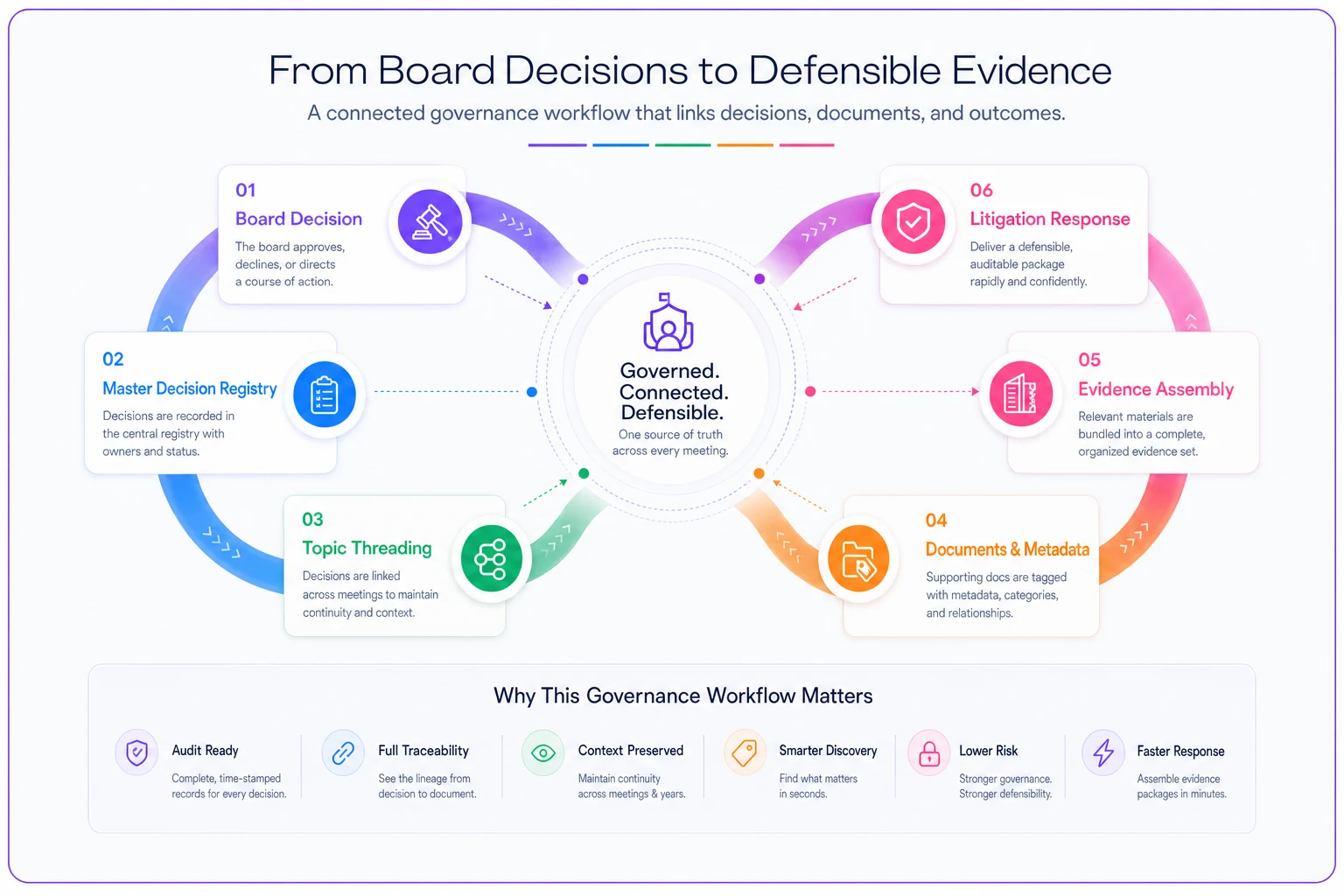
Think of your evidence log as a searchable index connecting board decisions to their supporting documentation. This isn't chronological file storage - it's a retrieval system that can quickly surface everything related to any challenged decision.
Start with a master decision registry. Every significant board action gets a unique identifier, date, description, and vote tally. Link this to all related documents: pre-meeting materials, management presentations, expert opinions, and final minutes. When litigation hits, you can pull everything about a specific decision in minutes rather than weeks.
| Evidence Category | What to Capture | Linking Method | Retention Period |
|---|---|---|---|
| Pre-meeting materials | Board packets, financial models, legal memos | Reference in minutes by title and date | 7 years minimum |
| Expert presentations | Banker pitch books, consultant reports, counsel opinions | Note specific slides discussed and questions raised | 7 years or through statute of limitations |
| Director questions | Email queries, requests for additional info | Link to agenda item and response provided | Through D&O policy period |
| Management responses | Follow-up memos, supplemental analysis | Reference original question and satisfactory resolution | 7 years minimum |
| Vote records | Individual positions, dissents, abstentions | Connect to rationale if provided | Permanent |
| Action items | Post-meeting directives, implementation steps | Track completion status and board review | Until fully resolved plus 3 years |
Create topic threading across meetings. Major decisions rarely happen in a single session. The board might discuss an acquisition across five meetings over three months. Your evidence log should connect all these discussions, showing the progression of diligence and deliberation - which counters claims that directors acted hastily or without adequate information.
Use this visual to see how decisions connect to documents for fast retrieval.
Establish retention policies that go beyond minimum requirements. Delaware requires only one year of minute retention, but D&O claims can arise years later. Your board decision log becomes worthless if the supporting documents behind it get deleted.
Tag documents for quick retrieval during discovery. Use consistent naming conventions and metadata. When plaintiff's counsel requests "all documents relating to executive compensation decisions in 2021," you should be able to compile them without manually reviewing thousands of files.
The practical evidence-log template that actually works
Here's a functional template that captures what D&O carriers and defense counsel actually need:
Decision Header Section:
-
Decision ID
[Unique identifier]
-
Meeting Date
[Date]
-
Decision Type
[Strategic/Financial/Governance/Compliance/Personnel]
-
Risk Level
[Standard/Elevated/Critical]
-
Vote
[For/Against/Abstain breakdown]
Information Basis Section:
-
Documents Reviewed
[List with dates and key contents]
-
Time Spent on Prep
[Director preparation hours if tracked]
-
Additional Info Requested
[What directors asked for beyond standard packet]
-
Information Gaps Noted
[What directors wished they had but proceeded without]
Deliberation Documentation:
-
Discussion Duration
[Actual time spent on this item]
-
Key Questions Raised
[Who asked what, with focus on risk areas]
-
Alternatives Considered
[Other options discussed and why rejected]
-
Expertise Leveraged
[Which directors provided specialized knowledge]
External Input Section:
-
Advisors Present
[Names, firms, and roles]
-
Opinions Provided
[Summary of recommendations]
-
Reliance Statement
[Board's statement of reliance on experts]
-
Independence Confirmation
[Any conflicts disclosed]
Risk Assessment Section:
-
Identified Risks
[Specific concerns raised]
-
Mitigation Discussed
[How risks would be managed]
-
Risk Acceptance
[Board's rationale for proceeding despite risks]
-
Monitoring Plan
[How outcomes will be tracked]
Linkage Section:
-
Prior Discussions
[Previous meetings where topic arose]
-
Supporting Documents
[File locations or document management system IDs]
-
Follow-up Actions
[What happens next and who's responsible]
-
Review Triggers
[When board will revisit this decision]
This template looks extensive, but filling it out during or immediately after the meeting takes maybe 10-15 extra minutes. Those minutes could save millions in defense costs and prevent coverage disputes with your D&O carrier.
What plaintiff attorneys actually do when they attack your minutes
Discovery in D&O litigation follows predictable patterns. Plaintiff's counsel requests broad document categories, looking for gaps and inconsistencies. They map board minutes against management emails, text messages against calendar entries, searching for evidence that the official record doesn't match reality.
They depose directors about specific meetings years after they occurred. Without comprehensive minutes, directors struggle to recall details. Fuzzy memories become evidence of inattention. Conflicting recollections start suggesting dysfunction or coverup.
Weak documentation pushes you into defensive positions. You assert attorney-client privilege more aggressively, which judges tend to view skeptically. You claim work product protection for documents created during normal operations, which rarely succeeds. You fight about discovery scope because you know your records look bad.
Strong evidence preservation flips this dynamic. Comprehensive minutes actually support director testimony. When Director Johnson says she raised concerns about market conditions, the minutes confirm it. When Director Lee claims the board spent significant time on risk assessment, the records back him up.
Detailed documentation also deters frivolous claims. Plaintiff attorneys evaluating potential suits review whatever public minutes exist. When they see thorough documentation suggesting careful deliberation, they often move on to easier targets. In that sense, evidence preservation is preventive medicine.
Converting documentation into actual legal protection
Good minutes alone don't guarantee D&O protection, but they dramatically improve your position. Courts applying the business judgment rule look for evidence of informed decision-making. Your documentation provides that evidence.
When boards face entire fairness review in conflicted transactions, comprehensive records show the process was thorough and untainted. Special committee minutes demonstrate independence. Documentation of negotiations proves directors fought for the best terms available.
For Caremark claims alleging oversight failure, your evidence log shows directors didn't ignore red flags. They asked questions, demanded answers, and followed up on concerns. The board actively monitored risk areas rather than passively receiving reports.
Strong documentation also matters when coverage disputes arise with D&O carriers. Carriers scrutinize whether directors actually fulfilled their duties before paying claims. Solid minutes support coverage. Weak minutes invite coverage defenses based on alleged breaches of duty.
Modern board portal software can help here - platforms that track document access, capture vote records, and maintain audit trails. Some now use AI automation to flag high-risk discussions that need enhanced documentation, which reduces the manual burden while improving evidence quality. But technology just enables better process. The board still has to commit to rigorous documentation standards. Directors should review and correct minutes while memories are still fresh, and insist on capturing substance rather than just procedure.
The evidence preservation dividend beyond litigation
What boards often discover after implementing proper evidence preservation is that it also improves how the board actually functions. When decisions are documented properly, you create institutional memory that makes future decision-making better.
New directors can understand how the board approaches complex issues. The evidence log shows what information is typically required, what questions get asked, how long deliberations run. They come up to speed faster because they can see the standard rather than guessing at it.
Management benefits too. When boards document specific concerns and risk tolerances clearly, executives understand boundaries better. They know what information directors want and what level of detail satisfies diligence requirements.
The discipline of evidence preservation also tends to improve meeting quality. When directors know their questions and comments are being documented, they prepare more thoroughly and participate more actively.
Over time, your evidence log becomes something more than a legal defense tool. It shows patterns in board decision-making, surfaces recurring issues that need structural solutions, and demonstrates governance evolution over years. It transforms from defensive documentation into organizational learning.
Strong evidence preservation does take extra work upfront. But consider the alternative - when D&O litigation strikes, you'll spend hundreds of hours reconstructing history, preparing witnesses, and explaining gaps to lawyers who are billing by the hour. You'll pay defense counsel to argue about things that should have been documented clearly from the start.
Build evidence preservation into your standard board operations. Make it systematic, consistent, and comprehensive. Your future legal counsel will thank you. Your D&O carrier will thank you. Most importantly, your directors will sleep better knowing their diligence is documented and defensible.
Ready to enhance your board's productivity?
Join 500+ organizations using Panlly to save time, improve governance, and streamline board operations.