



The CFO of a mid-sized healthcare company called me in a panic last year. Their auditors wanted board meeting minutes from 18 months ago—specifically the version distributed before the meeting, not the final approved version. Simple request, right?
Except their general counsel stored everything in personal folders, their corporate secretary kept version control in Excel, and their board portal only retained "final" versions.
Three days and $45,000 in legal fees later, they'd reconstructed something resembling the original draft.
The auditors weren't impressed.
This wasn't about technology failing. Their board portal worked fine. Document management was enterprise-grade. But their board records information governance system? That was basically "everyone does their own thing and we hope for the best."
The regulatory scenarios nobody prepares for
Most companies think they're prepared for audits because they keep board minutes. That's like saying you're prepared for surgery because you own band-aids.
Real regulatory scenarios hit differently. The pharmaceutical company that got hit with a shareholder derivative suit? Plaintiff's attorneys didn't just want board minutes—they wanted every draft, every redline, every email discussion about agenda items, and proof of who had access to what information when. Their system of saving final PDFs to a shared drive suddenly looked inadequate.
Consider the financial services firm facing an SEC investigation. Investigators wanted to know exactly which board members had reviewed risk committee materials before a critical vote. Not just whether they received them—evidence they actually opened and reviewed them. The company's practice of emailing PDFs couldn't prove anything beyond delivery.
These aren't edge cases. Regulatory bodies and courts increasingly expect companies to demonstrate not just what decisions were made, but how the decision-making process unfolded. They want the full governance story, not just the ending.
What auditors actually ask for
"Show us the materials distributed to the board seven days before the March 2023 meeting."
"Sounds straightforward until you realize your system only keeps the final board book, not what was actually sent out beforehand."
"Provide evidence that all independent directors received and acknowledged the updated conflict of interest policy."
"Your email system shows you sent it. Can you prove Director Smith actually received it before making that acquisition vote?"
"We need all communications related to the executive compensation decision from Q4 2022."
"Does that include Slack messages? Text messages between committee members? Draft presentations that never made it to the full board?"
"Document your retention policy and demonstrate compliance for the past 36 months."
"You have a policy. Can you actually show it's been consistently followed? Can you prove documents were deleted according to schedule, not randomly when someone needed server space?"
Building defensibility before you need it
The healthcare company learned their lesson. Now they run what I call a "mock audit" every quarter—picking random requests and seeing how quickly they can fulfill them. First quarter after implementing proper governance controls took 6 hours to gather everything. By the third quarter, they had it down to 45 minutes.
Eliminate boardroom chaos with seamless coordination.
Panlly simplifies scheduling, collaboration, and follow-ups for every board meeting.
- Centralized meeting scheduling
- Secure document sharing
- Task assignment & tracking
No credit card required
The difference wasn't just better technology. It was thinking about board records as an interconnected system rather than isolated documents.
Your retention matrix becomes your roadmap
-
Document lifecycle stages (draft → review → final → archived)
-
Access permissions at each stage
-
Trigger events for retention changes
-
Audit trail requirements
-
Legal hold procedures
An actually useful retention matrix looks like this:
| Document Type | Pre-Meeting Retention | Post-Meeting Retention | Legal Hold Override | Audit Trail Depth | Access Tiers |
|---|---|---|---|---|---|
| Board Minutes (Draft) | Until final approved | 7 years from approval | Indefinite | Full edit history | Legal, Secretary |
| Board Minutes (Final) | N/A | Permanent | Permanent | Signature & access log | All directors, Legal |
| Committee Reports | 30 days | 7 years | Indefinite | View & download tracking | Committee + Board |
| Strategic Plans | Until superseded | 10 years from replacement | Indefinite | Version comparison | Board + C-Suite |
| Financial Presentations | 90 days | 3 years if routine, 7 if material | Indefinite | Full access log | Board + CFO team |
Each document type has different rules because regulators and courts care about different things. Draft minutes might contain discussions that didn't make it to the final version—exactly what litigation attorneys look for. Financial presentations might be routine monthly updates or material decision drivers—you need to know the difference.
Sample audit responses that actually work
-
The specific date of the last assessment
-
Which documents the board reviewed
-
How potential conflicts were investigated
-
What changes were made from the previous year
-
Where the supporting documentation is stored
-
Who has access to sensitive conflict information
Auditors smell boilerplate responses immediately. The key is demonstrating process, not just claiming compliance.
Version control that tells the truth
Version control in board governance isn't about tracking document edits—it's about preserving decision context. The private equity firm that just went through a Delaware lawsuit had 14 versions of a merger agreement, all labeled "final." When the court asked which version the board actually approved, nobody could say with certainty.
Real version control in board records requires:
Immutable checkpoints: Certain versions get locked—the version sent to directors, the version presented at the meeting, the version approved. These become permanent records, even if errors are found later.
Contextual metadata: Each version needs to capture who had access, when they accessed it, what comments were made, and what changed from the previous version. "Version 2.1" means nothing. "Revised after audit committee feedback on revenue recognition, distributed 3/15/24 at 2:47 PM" means everything.
Parallel track management: Sometimes you're running multiple scenarios simultaneously. The board might be reviewing three different acquisition targets, each with evolving terms. Your versioning system needs to handle parallel branches, not just linear updates.
One manufacturing company thought they had great version control—until they realized their system was overwriting metadata every time someone opened a document. The "last accessed" field only showed the most recent person, not the full history. During their SEC investigation, they couldn't prove which board members had actually reviewed critical risk assessments before approving a major expansion.
RBAC rules that match reality, not theory
Role-based access control (RBAC) for board records usually fails because it's designed by IT teams who've never been in a boardroom. They create rigid hierarchies that don't match how board work actually happens.
Real board work is fluid. The compensation committee chair might need to share draft materials with the board chair before the full committee sees them. The lead independent director might need access to legal opinions that other directors shouldn't see yet. Outside counsel might need temporary access to specific historical records without seeing current deliberations.
Temporal permissions: Access rights that automatically adjust based on meeting cycles, not manual updates. Directors get read access to materials 7 days before meetings, edit access to their committee materials only, and historical access to all records from their tenure.
Confidentiality cascades: Some materials start highly restricted and gradually expand access. Executive session minutes might be CEO-excluded for 30 days, then CEO-visible but director-edit-only, then locked as read-only for everyone.
Emergency override protocols: When crisis hits, you need predetermined escalation paths. Who can grant emergency access to restricted records? How is that logged? What triggers automatic legal hold?
The biotech company that just went through a hostile takeover attempt had beautiful RBAC rules—on paper. In practice, their corporate secretary was manually managing permissions through email forwards and shared folders. When they needed to prove that certain directors hadn't seen privileged legal advice before making public statements, they couldn't.
The defensibility checklist that matters
Most defensibility checklists focus on whether documents exist. Real defensibility means proving your governance process works as designed.
Every quarter, run through these scenarios:
The sudden departure test: A board member resigns unexpectedly and requests copies of all materials they reviewed during their tenure. Can you produce them within 48 hours? Can you prove what they didn't have access to?
The privilege challenge: Opposing counsel claims attorney-client privilege was waived because legal advice was shared with the full board. Can you demonstrate exactly who saw what and whether proper privilege protocols were followed?
The timeline reconstruction: Regulators want to understand the board's decision-making process for a specific issue over six months. Can you show the evolution of discussions, not just final decisions?
The access audit: An activist investor claims certain directors had conflicts that weren't disclosed. Can you prove what information each director could access when making key votes?
Run these scenarios quarterly and treat failures as remediation priorities.
A retail company aced their first three tests, then completely failed the access audit. They could show documents were sent but not whether conflicted directors had recused themselves from accessing specific materials. Their system treated recusal as an honor system rather than a technical control.
When AI-powered operational software changes the game
The volume and complexity of records has exploded while the time to respond to requests has shrunk. The average board package has grown from 50 pages to 200+ pages over the past decade. Meanwhile, regulators expect responses in days, not weeks.
Traditional document management can't handle this. You need systems that understand context, not just keywords. When an auditor asks for "all materials related to cybersecurity discussions," that might include:
-
Formal cyber risk reports
-
Mentions in broader risk assessments
-
Email threads about vendor breaches
-
Questions raised during other presentations
-
Follow-up actions from executive sessions
Manual searching through thousands of documents takes weeks and misses critical connections. AI-powered operational software can map these relationships automatically, understanding that a discussion about "vendor reliability" might actually be about cybersecurity risk.
The real power isn't search—it's pattern recognition. The software can identify when similar issues were discussed across multiple meetings, flag when current decisions might conflict with previous board guidance, and alert when retention deadlines approach.
One pharmaceutical company implemented AI-assisted board governance after a near-miss with regulators. Their manual process had failed to connect discussions across committee meetings—the risk committee had flagged an issue that the full board later approved without realizing the connection. Now their system automatically identifies related discussions across all board records, regardless of terminology differences.
The automation doesn't replace judgment—it ensures nothing gets missed. It's like having a corporate secretary with perfect memory who never sleeps and can instantly recall every discussion, decision, and document.
Building your compliance-first system
The companies that handle audits smoothly aren't lucky—they're prepared. They've built systems that assume every document will be scrutinized, every decision questioned, every process challenged.
A compliance-first workflow looks like this:
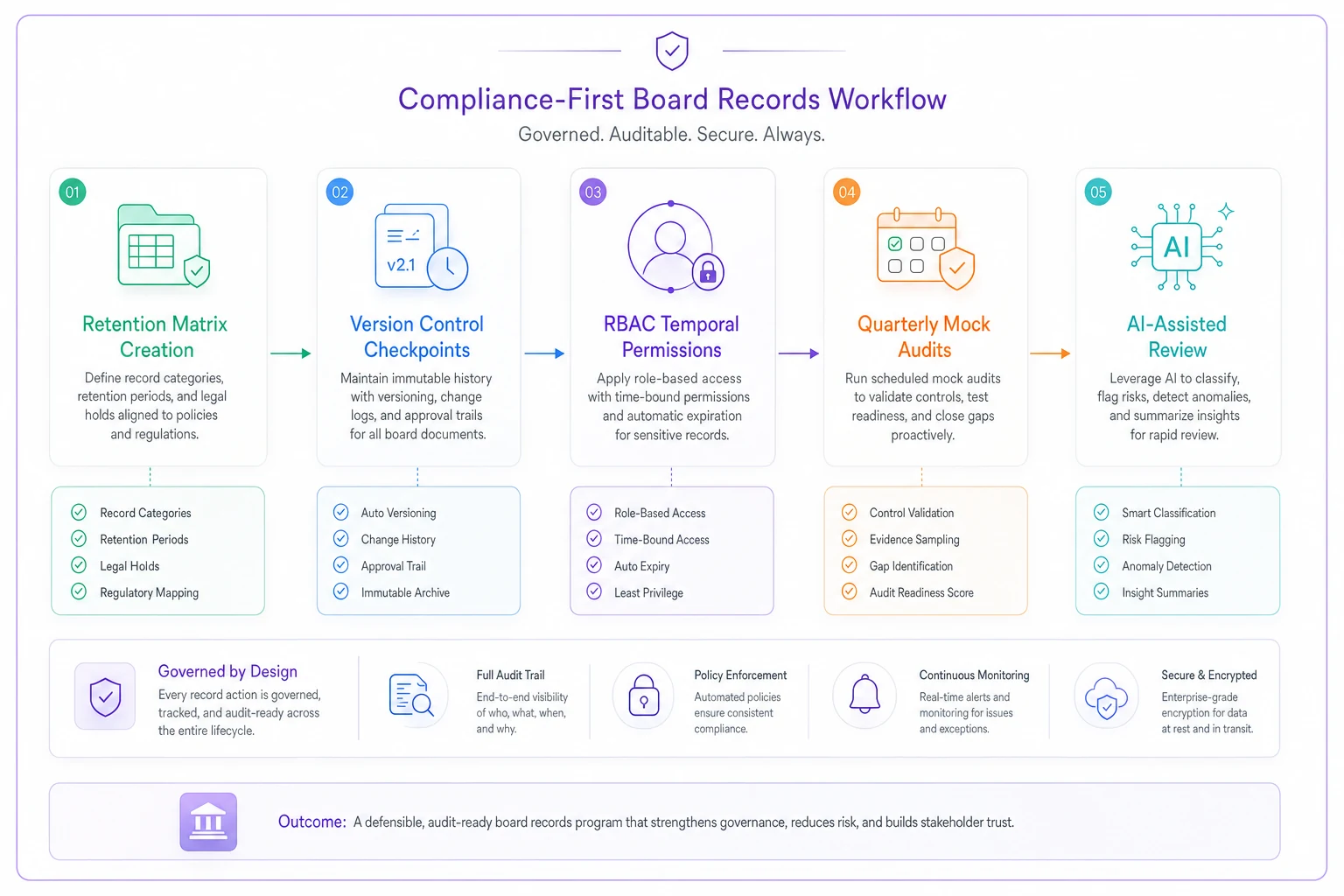
Start with your highest-risk areas. For most companies, that's executive compensation, related-party transactions, and risk oversight. Build your retention matrices, access controls, and audit procedures around these first. Get them bulletproof before expanding.
Your board records system should feel boring when it's working properly. Documents flow predictably, permissions adjust automatically, retention happens systematically. The only excitement should be how quickly you can respond to audit requests.
The healthcare company from the beginning recently went through another audit. The auditors asked for 18 months of committee materials, including all drafts and communications. Total time to compile and deliver: 3 hours. Total additional legal fees: zero.
That's what happens when you treat board records information governance as a strategic system, not an administrative afterthought. The next audit or investigation isn't a question of if, but when. The only question is whether you'll be ready with answers or scrambling for excuses.
Companies that survive regulatory scrutiny don't just keep good records—they build systems that tell the true story of their governance, completely and accurately, every single time.
Ready to enhance your board's productivity?
Join 500+ organizations using Panlly to save time, improve governance, and streamline board operations.