
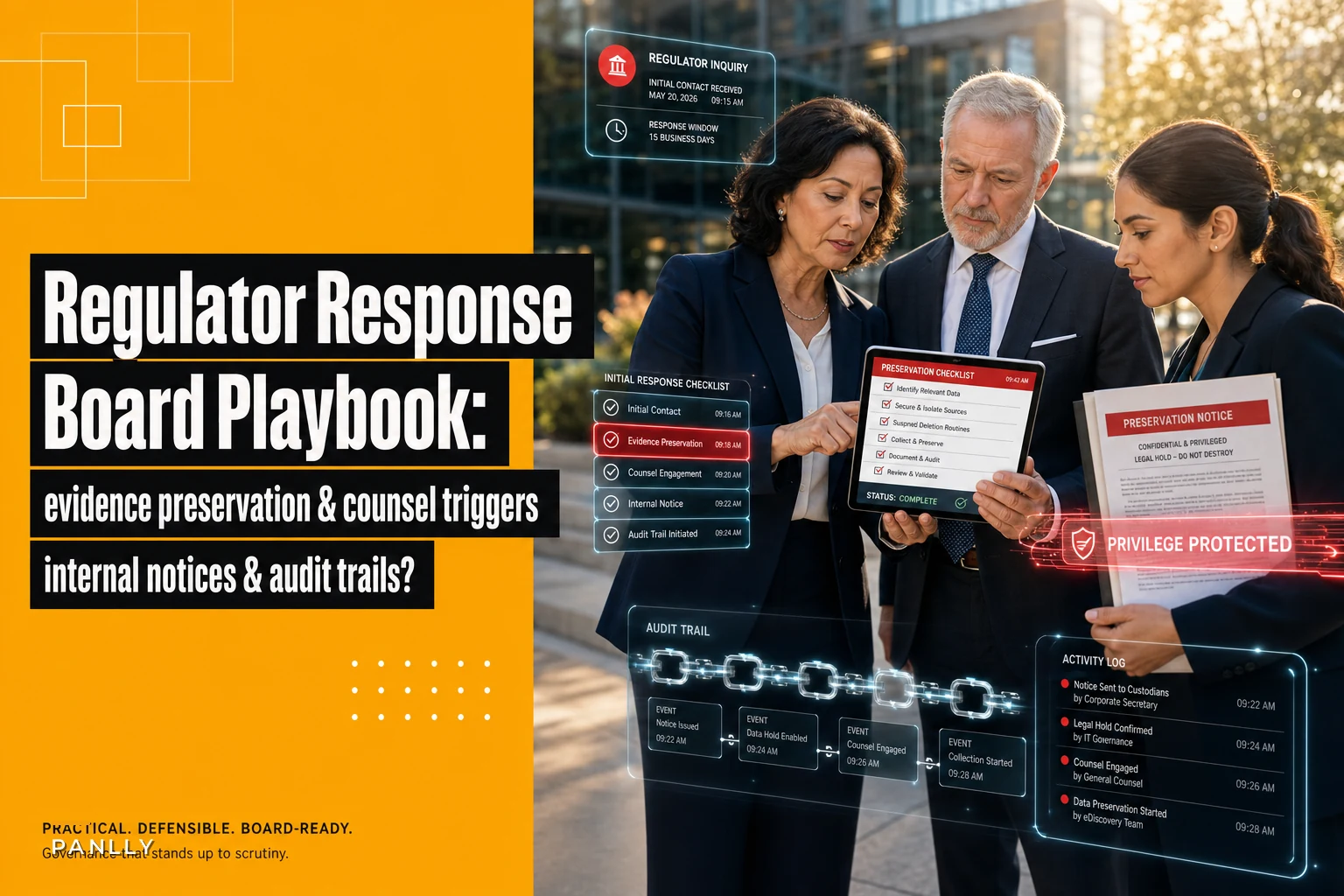

That first regulator contact changes everything. Suddenly every email, every Slack message, every handwritten note from the past three years becomes potential evidence. The general counsel starts talking about litigation holds. The audit committee chair wants an emergency meeting. And meanwhile, someone still needs to actually respond to the regulator within 48 hours.
Most boards treat regulator inquiries like fire drills — scrambling to figure out who does what, when to call outside counsel, how to preserve evidence without freezing operations. Regulatory investigations follow predictable patterns, though. Boards that handle them without chaos have clear triggers, defined roles, and templated communications ready before that first contact ever arrives.
The Preservation Panic That Kills Operational Momentum
When the Consumer Financial Protection Bureau sends an information request to a fintech company's board, the knee-jerk reaction often causes more damage than the investigation itself. Boards implement blanket preservation orders that freeze decision-making for months. Every director becomes afraid to delete anything. Email inboxes overflow. SharePoint sites hit storage limits. Normal operations stall.
The real damage happens in the coordination gaps. The corporate secretary doesn't know whether to keep draft meeting minutes. The CFO isn't sure whether internal financial models need to be preserved. Directors start building personal archives "just in case," which actually increases legal risk. Without clear preservation boundaries, everything gets saved — which makes finding relevant materials nearly impossible when regulators ask specific questions.
A mid-sized healthcare company learned this the hard way when CMS opened an investigation into their billing practices. Their board issued a broad "preserve everything" directive that resulted in 47 terabytes of saved data. When CMS requested specific board discussions about billing oversight, it took their legal team six weeks and around $180,000 in outside counsel fees just to identify what was actually relevant. The investigation itself only took three weeks.
Building Evidence Preservation That Actually Works
Effective preservation starts with defining categories before you need them. Your protocol needs specific triggers, clear scope, and practical limits that keep operations running while protecting the company.
Eliminate boardroom chaos with seamless coordination.
Panlly simplifies scheduling, collaboration, and follow-ups for every board meeting.
- Centralized meeting scheduling
- Secure document sharing
- Task assignment & tracking
No credit card required
Start with triggering events. Most boards only think about formal subpoenas, but regulators often start informally. A phone call from an SEC staffer asking about accounting practices triggers preservation duties just as much as a formal Wells notice. Define these triggers explicitly:
-
Written regulatory inquiries (formal or informal)
-
Verbal regulatory contact about substantive matters
-
Media reports suggesting regulatory interest
-
Whistleblower complaints with regulatory implications
-
Industry-wide investigations affecting peer companies
Then establish preservation scope by document type. Not everything needs to be preserved — focus on materials that relate to board oversight.
Always preserve:
-
Final board and committee minutes
-
Board packages and presentations
-
Written consents and resolutions
-
Director communications about investigation topics
-
Audit committee correspondence with external auditors
Conditionally preserve (if related to inquiry):
-
Draft minutes and meeting notes
-
Director emails about specific topics
-
Text messages between directors
-
Financial models presented to the board
-
Management reports referenced in board discussions
Usually outside scope:
-
Routine scheduling communications
-
Administrative correspondence
-
Public information already filed with regulators
-
News clippings and external reports
Timeframe matters too. Most investigations look back two to three years, though some go back five. Default to three years and expand based on the specific inquiry.
When to Engage Outside Counsel (and When Not To)
Boards either call outside counsel too early or too late. Engaging a law firm for every informal regulator question wastes money and signals panic. Waiting until you receive a formal subpoena limits your options just as badly.
Define specific triggers for counsel engagement:
Immediate outside counsel triggers:
-
Formal investigation notices
-
Subpoenas or document requests
-
Requests for director testimony or interviews
-
Criminal investigation indicators
-
Multi-agency coordinated inquiries
Internal counsel first, escalate if needed:
-
Informal information requests
-
Routine examination findings
-
Industry-wide data collection
-
Clarification of previous filings
-
Technical compliance questions
One medical device manufacturer built a useful escalation framework around this. For informal FDA inquiries, their general counsel handles the initial response with a 48-hour assessment window. If the inquiry expands or suggests enforcement interest, outside counsel gets engaged. That approach saved them roughly $400,000 annually in unnecessary legal fees while ensuring appropriate representation when it actually mattered.
The Internal Communication Cascade That Preserves Privilege
How you communicate internally about a regulatory inquiry determines whether your response stays privileged. Most boards accidentally waive privilege by copying non-legal personnel on sensitive discussions or forwarding legal advice without protection.
Structure your internal notices to maintain privilege while keeping the right people informed:
Initial Notification Template (T+2 hours)
To: Board Chair, CEO, General Counsel
Subject: [PRIVILEGED AND CONFIDENTIAL - ATTORNEY CLIENT]
Content:
-
Nature of regulatory contact
-
Initial assessment of scope
-
Immediate preservation requirements
-
Next steps and timeline
-
Request to avoid discussing via unsecured channels
Broader Stakeholder Notice (T+24 hours)
To: Full Board, C-Suite, relevant department heads
Subject: Important: Document Preservation Notice - [Matter Name]
Content:
-
Factual description of inquiry (no legal analysis)
-
Specific preservation requirements by role
-
Prohibited actions (document destruction, system updates)
-
Communication protocols going forward
-
Single point of contact for questions
Ongoing Status Updates (Weekly during active phase)
To: Board and designated response team
Via: Secure board portal only
Includes:
-
Response timeline status
-
Document production metrics
-
Key decisions needed
-
Budget and resource updates
-
Anticipated next steps
The privilege question comes up constantly in these situations. Even well-intentioned directors create problems by forwarding attorney analysis to department heads or looping in consultants before checking with legal. Building separate channels for privileged communication — and actually training directors on what belongs there — prevents most of these mistakes before they happen.
Creating Audit Trails That Satisfy Regulators
Regulators don't just want documents — they want to understand your decision-making process. Strong audit trails demonstrate good faith and can meaningfully reduce penalty exposure. Poor documentation practices invite deeper scrutiny, while clear trails often let regulators close matters faster.
Build your audit trail in real-time, not after the fact. Reconstructing timelines weeks later creates inconsistencies that look worse than the underlying issue.
Response Log Requirements:
| Date/Time | Action Taken | Responsible Party | Documentation | Review Status |
|---|---|---|---|---|
| Day 1, 9:15 AM | Initial contact received | General Counsel | Email saved to matter file | Completed |
| Day 1, 11:30 AM | Preservation notice issued | Corp Secretary | Notice distributed via portal | Confirmed by all |
| Day 2, 2:00 PM | Outside counsel engaged | General Counsel | Engagement letter executed | Approved by Chair |
| Day 3, 10:00 AM | Document collection started | IT + Legal | Collection protocol documented | In progress |
| Day 5, 4:30 PM | Initial production delivered | Outside counsel | Transmittal letter filed | Regulator acknowledged |
Track not just what you provided, but what you couldn't provide and why. If certain documents don't exist or were legitimately destroyed per your retention policy, document that clearly. Regulators generally accept reasonable explanations when backed by consistent policies — what they don't accept is silence or inconsistency.
The Coordination Framework Between Board and Management
Regulatory responses break down when boards and management work at cross-purposes. Directors try to oversee while executives try to respond, creating duplication, gaps, and friction. The solution isn't complicated — it's just clarity.
Board's Role:
-
Oversight of response strategy
-
Approval of significant decisions (settlement, litigation)
-
Review of privilege assertions
-
Budget authorization for outside resources
-
Communication with shareholders if material
Management's Role:
-
Day-to-day response coordination
-
Document collection and review
-
Interface with regulators
-
Preparation of responsive materials
-
Operational continuity during investigation
Corporate Secretary as Orchestrator:
-
Maintains official response record
-
Coordinates between board and management
-
Ensures privilege protection
-
Manages document preservation compliance
-
Tracks all deadlines and deliverables
A regional bank facing parallel investigations from the FDIC and state regulators handled this well by designating their corporate secretary as "Response Coordinator" with weekly reporting to a board Special Committee. Directors stayed informed without getting pulled into privileged operational details. The investigations resolved in about four months — well under the typical 8–12 month range — largely because the response stayed coordinated rather than fragmented across departments.
Templated Protocols That Accelerate Response
Speed matters, but rushing creates mistakes. Pre-built templates let you move quickly without cutting corners. Build these during calm periods, not while you're already in a crisis.
Essential Response Templates
-
1. Preservation Notice Checklist - [ ] Define preservation scope - [ ] Identify key custodians - [ ] Suspend auto-deletion policies - [ ] Notify IT of system preservation needs - [ ] Document preservation steps taken - [ ] Confirm receipt from all parties - [ ] Calendar periodic compliance reminders
-
2. Regulator Response Tracking - Request receipt date and time - Response deadline (regulatory or self-imposed) - Internal review milestones - Production batches and dates - Privilege log requirements - Meet-and-confer scheduling - Close-out documentation
-
3. Board Reporting Format - Current status (phase of investigation) - Key developments since last report - Upcoming milestones and decisions - Resource utilization (internal and external costs) - Risk assessment updates - Recommended board actions
-
4. Document Production Protocol - Collection methodology - Review workflow and criteria - Privilege screen process - Quality control steps - Production format specifications - Chain of custody documentation - Completeness certification
Run tabletop exercises using these templates so people know where to find them and how to execute them under pressure.
Having these sitting in a folder somewhere isn't enough — people need to know they exist and where to find them. The boards that execute well under pressure are usually the ones that ran through these templates at least once during a tabletop exercise before anything real happened.
Common Failure Points and How to Prevent Them
Even well-prepared boards stumble at predictable moments. Knowing where things tend to go wrong helps you build prevention into the playbook before you need it.
Failure Point 1: Mixed privilege communications
Directors forward attorney advice to non-privileged parties or discuss legal strategy in general board channels. Prevention: Create separate privileged communication channels and train directors on proper usage.
Failure Point 2: Inconsistent preservation
Different departments interpret preservation notices differently — some over-preserve, others under-preserve. Prevention: Provide role-specific preservation guides with concrete examples.
Failure Point 3: Scope creep
Narrow initial inquiries expand into broad investigations because responses raise new questions. Prevention: Review all productions for potential follow-up triggers before submitting anything.
Failure Point 4: Timeline violations
Missing regulator deadlines because of internal review bottlenecks or unclear approval paths. Prevention: Build buffer time into response calendars and define clear escalation steps.
Failure Point 5: Inadequate documentation
Failing to document why certain decisions were made or documents weren't preserved. Prevention: Require written rationale for all significant response decisions.
Scope creep is probably the most underestimated of these. A narrow inquiry about one product line can expand quickly when your production inadvertently surfaces unrelated issues. Review everything for secondary exposure before anything goes out.
Making the Playbook Operational With the Right Systems
Manual coordination of regulatory responses creates unnecessary risk. Modern board governance platforms can handle a lot of the mechanical work — triggering preservation notices, maintaining privileged communication channels, tracking deadlines, building contemporaneous audit trails — so your legal team can focus on strategy rather than logistics.
When a regulator inquiry arrives, AI-assisted governance platforms can automatically:
-
Issue templated preservation notices to predefined groups
-
Create secure workspaces for privileged discussions
-
Set up document collection folders with appropriate access controls
-
Initialize response tracking logs with regulatory deadlines
-
Generate periodic status reports for board review
This becomes especially valuable when investigations expand. A pharmaceutical company using automated response workflows handled an FDA investigation that grew from one product to an entire therapeutic area. Their system automatically expanded preservation scope, notified newly relevant custodians, and tracked document production across 14 separate response threads. Their existing corporate secretary team managed what would have otherwise required a full paralegal team to coordinate.
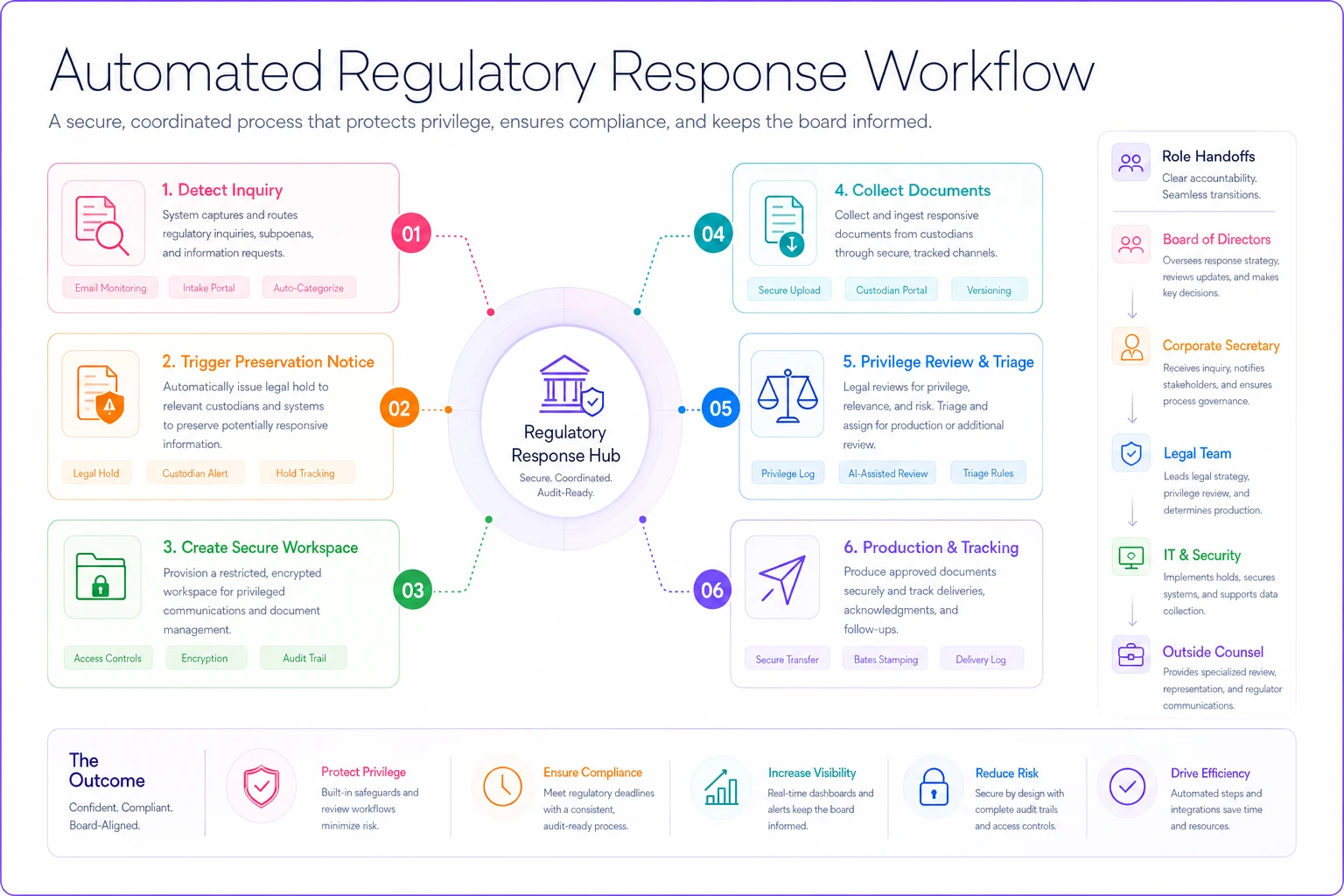
The diagram maps automated triggers and handoffs across legal, IT, corporate secretary and outside counsel.
The operational software doesn't replace judgment — it removes the coordination overhead that causes delays and mistakes when bandwidth is already stretched.
The Difference Between Scrambling and Systematic Response
Regulatory inquiries test board governance in ways that routine operations never do. Boards that handle them smoothly aren't necessarily better governed — they're just better prepared. They've already thought through preservation requirements before the first letter arrives. They know exactly when outside counsel needs to be involved. Their templates are ready.
That preparation turns a potential corporate emergency into a manageable project. Yes, investigations still require significant attention and resources. But the response follows established patterns instead of creating new ones under pressure. Directors know their roles. Management understands the boundaries. The corporate secretary orchestrates rather than scrambles.
There's also a credibility dimension worth considering. When your initial response arrives on time, properly formatted, with clear documentation and appropriate preservation in place, regulators notice. They're more likely to view the company as cooperative and responsible — a perception that often influences investigation scope, penalty recommendations, and how quickly things resolve.
None of this requires massive investment. It requires thinking through scenarios, documenting decisions, and building templates before you need them. The few hours spent on a preservation protocol today can save weeks of crisis management when regulators call.
Because regulatory inquiries aren't a question of if. The only variable is whether you'll be ready when they do.
Ready to enhance your board's productivity?
Join 500+ organizations using Panlly to save time, improve governance, and streamline board operations.