

Most boards approve governance technology the same way they approve office furniture. Someone in the corporate secretary's office runs a shortlist, procurement negotiates a price, legal skims the terms, and the board sees a one-line recommendation in the consent agenda. Two years later the platform holds every minute, every resolution, every privileged committee file — and nobody on the board can tell you how they'd get all of that out if the vendor got acquired, raised prices 40%, or quietly changed its data-residency terms.
That gap is the whole problem. Governance tech isn't a tool the board uses occasionally. It's the system of record for the board's own decisions and legal defensibility. When directors don't set procurement and exit standards at the front end, they inherit a lock-in they can't see until it's expensive.
This is a checklist directors can actually review at a meeting — RFP clauses worth insisting on, SLA KPIs that mean something, portability tests that prove you can leave, and an auditable exit plan a corporate secretary can walk through in minutes. Not a vendor-selection guide. A board-oversight guide.
Why procurement of governance tech breaks differently than other software
Ordinary software procurement optimizes for features and price. Governance procurement has to optimize for something most buyers ignore until it's too late: the ability to reconstruct and remove your entire record with the evidence trail intact.
-
The vendor gets acquired and the new owner reprices or sunsets the product.
-
A regulator or litigation hold requires producing minutes and their metadata, and the export turns out to be a flat PDF with no audit history.
-
The board decides to change platforms and discovers that "export your data" means a ZIP of documents with none of the version history, access logs, or approval chains that made those documents legally meaningful.
None of these are edge cases. They're the normal lifecycle of a software vendor relationship. The reason boards get caught is that procurement treated entry as the whole decision and never priced exit.
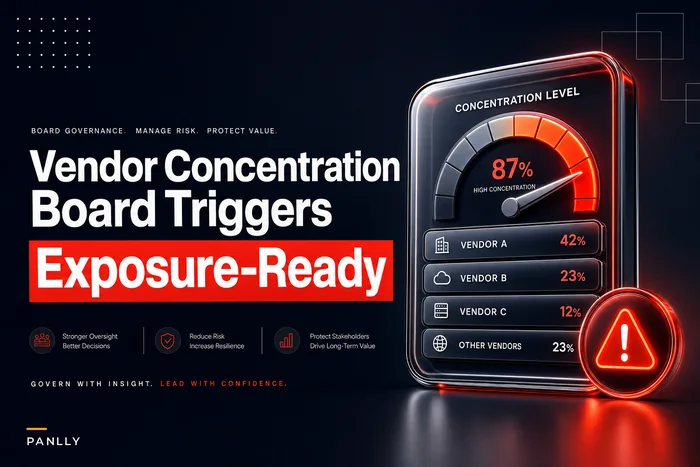
There's a second-order effect too. Once a platform holds a few years of board history, switching cost becomes a governance risk of its own — it's a form of vendor concentration, and it deserves the same scrutiny you'd apply anywhere else. If your board already tracks single points of failure through a vendor concentration dashboard and remediation triggers, your governance platform belongs on that map. It's usually one of the most concentrated dependencies in the entire organization and one of the least examined.
The RFP clauses that actually protect the board
Most governance RFPs are 80% feature checklist and 20% commercial terms. Flip that ratio. Features will be roughly comparable across serious vendors. The terms are where boards win or lose three years later.
Eliminate boardroom chaos with seamless coordination.
Panlly simplifies scheduling, collaboration, and follow-ups for every board meeting.
- Centralized meeting scheduling
- Secure document sharing
- Task assignment & tracking
No credit card required
Below are the clause categories that matter, with sample language you can hand to counsel as a starting point. These aren't final legal text — they're the positions to negotiate from.
Data ownership and format
> "Customer retains sole ownership of all data, documents, metadata, audit logs, and derived records. Vendor grants no rights to use Customer data for model training, analytics, or any secondary purpose. Upon request, Vendor shall provide a complete export in open, non-proprietary formats (e.g., PDF/A for documents, JSON or CSV for structured records and logs) that preserves version history, timestamps, actor identity, and approval chains."
The clause everyone forgets is the metadata clause. Getting your documents back is easy. Getting the history around those documents — who accessed a privileged file, when a resolution was amended, which director opened materials before a vote — is what makes an export legally usable. If the export strips that, you've lost the part regulators and litigators care about most.
Data residency and change notice
> "Vendor shall store and process Customer data only within [named jurisdictions]. Any change to storage location, subprocessors, or data-residency terms requires 90 days' prior written notice, during which Customer may terminate without penalty."
Business continuity and vendor change of control
> "In the event of Vendor acquisition, merger, insolvency, or product discontinuation, Customer retains the right to a full data export and continued access for a transition period of no less than 180 days at existing pricing."
Pricing protection
> "Renewal price increases shall not exceed [CPI or a fixed cap, e.g., 5%] annually. Any usage-based charges shall be disclosed in advance with the right to set spend limits."
Security and audit rights
> "Vendor shall provide a current SOC 2 Type II report annually, notify Customer of any security incident affecting Customer data within [24–72] hours, and permit reasonable audit of controls relevant to governance data handling."
A quick way to pressure-test any vendor's answers: ask them to demonstrate an export during the RFP, not describe one. The gap between "yes we support export" and an actual sample file is where most procurement mistakes live.
A quick way to pressure-test any vendor's answers: ask them to demonstrate an export during the RFP, not describe one.
The gap between "yes we support export" and an actual sample file is where most procurement mistakes live.
SLA KPIs that mean something to a board
Vendors love uptime SLAs because 99.9% sounds impressive and is easy to hit. Uptime is table stakes. The KPIs a board should actually track are the ones tied to the board's own risk — availability when it matters, recovery when something breaks, and responsiveness when counsel is on the line.
| KPI | Weak / vendor-default version | Board-relevant version |
|---|---|---|
| Availability | 99.9% monthly uptime | Uptime measured excluding planned maintenance during board/committee meeting windows |
| Recovery | "Backups performed regularly" | RPO ≤ 1 hour, RTO ≤ 4 hours, tested and reported quarterly |
| Support response | "24/7 support" | Priority-1 (data access / security) response ≤ 1 hour, with named escalation contact |
| Export turnaround | Not specified | Full portable export delivered within 5 business days of request |
| Incident notification | "Prompt notice" | Security incident notice within 24–72 hours, breach report within regulatory deadlines |
| Audit-log integrity | Not addressed | Immutable, exportable logs retained for the full contract term plus retention period |
The two rows most boards never negotiate are export turnaround and audit-log integrity. Both are invisible until the exact moment you need them — a regulator inquiry, a litigation hold, a platform migration under time pressure. Put a number on export turnaround in the contract. "We'll get to it" is not an SLA.
One realistic failure worth internalizing: a mid-size company faced a document production request with a two-week response window. The platform's self-service export produced clean PDFs but no access logs, and the full audit-history export required a vendor engineering ticket that took eleven business days. They made the deadline by hours, with outside counsel billing overtime the whole way. That fix would have cost nothing at procurement — one sentence in the SLA.
Portability acceptance tests: prove you can leave before you sign
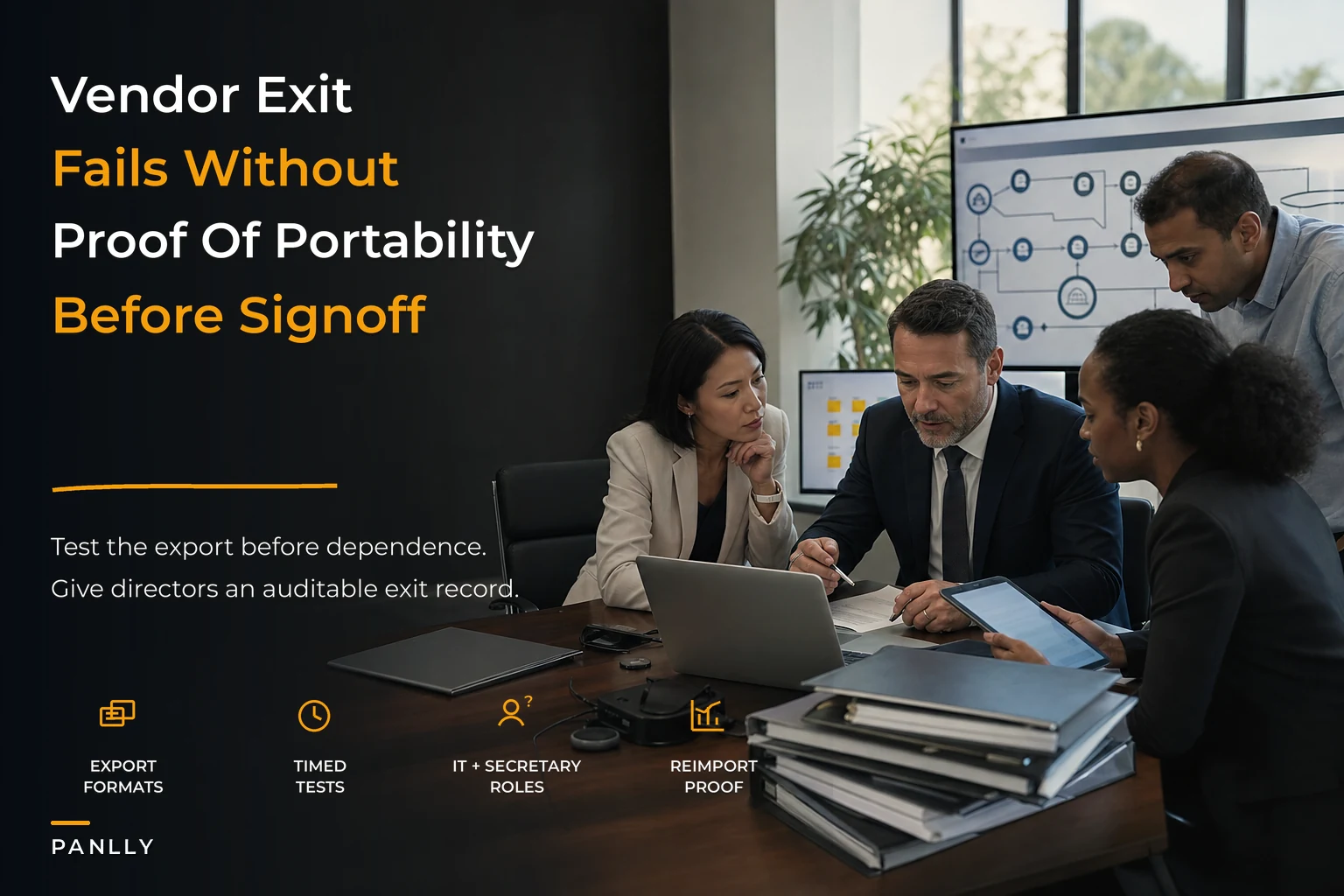
The single highest-leverage thing a board can require is a portability acceptance test run during the evaluation, not promised for later. If a vendor can't produce a clean, complete, re-importable export in a controlled test, they won't produce one in a crisis either.
-
Request a full export of a representative dataset — a mix of minutes, resolutions, committee packs, and access logs across at least two committees and a full meeting cycle.
-
Verify formats. Documents in PDF/A or equivalent, structured records in JSON/CSV. Reject proprietary container formats that only the vendor's tool can read.
-
Verify completeness. Confirm the export includes version history, timestamps, actor identity, approval/signature chains, and access logs — not just final documents.
-
Verify integrity. Check that document hashes or checksums match, that nothing is silently truncated, and that redaction/privilege flags survive the export.
-
Attempt a re-import or independent read. Open the structured data outside the vendor's environment. Can a different system read it? Can you reconstruct who did what and when from the export alone?
-
Time the whole thing. Record how long each step took, whether it was self-service or vendor-assisted, and what it would cost at scale.
-
Document the result in a short acceptance memo the board can review.
Here's a simple workflow to run the portability acceptance test.
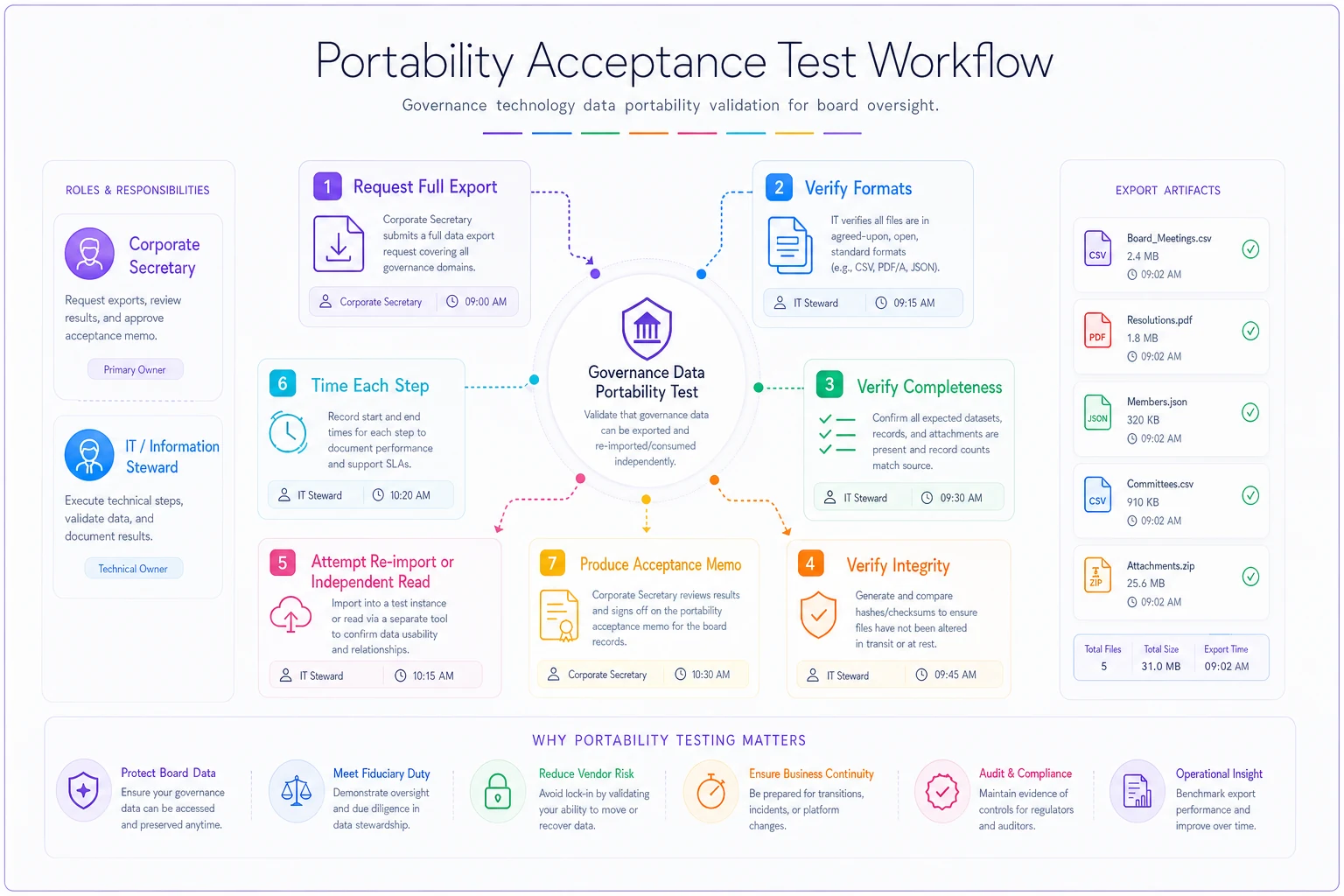
The pass/fail criterion is blunt: could you hand this export to a new platform or a forensic examiner and have them reconstruct the board's decision record without the original vendor? If the answer is no, the portability clause failed regardless of what the contract says.
Worth flagging: vendors frequently pass steps 1–4 and fail step 5. The data comes out, but it's shaped so that only their own product can meaningfully reassemble it. That's soft lock-in, and it doesn't show up until migration day.
An auditable exit and rollback plan directors can review
Exit planning isn't pessimism about a vendor. It's the same discipline the board applies to succession or business continuity — you build the plan while things are calm so nobody improvises during a crisis. The plan should live as a standing document, reviewed periodically, with a version and a date, so it can go into the minutes as reviewed.
The exit checklist (for minute review)
-
[ ] Data ownership confirmed — contract language on file, verified by counsel, no secondary-use rights granted
-
[ ] Current export tested — most recent portability acceptance test dated within the last 12 months
-
[ ] Export format catalog — documented list of what comes out and in what format, including metadata and logs
-
[ ] Destination readiness — a named target (successor platform or interim archive) that can ingest the export format
-
[ ] Transition-period rights — post-termination access window confirmed (recommend ≥ 180 days)
-
[ ] Rollback path — for migrations, a documented ability to revert if the new platform fails acceptance
-
[ ] Retention and deletion — vendor's certified data-deletion process and timeline after exit, with written confirmation
-
[ ] Continuity of legal holds — process to ensure active litigation/regulatory holds survive any transition
-
[ ] Cost of exit estimated — export fees, migration labor, dual-running period, documented and current
-
[ ] Named owner — a specific person (usually the corporate secretary) accountable for executing the plan
-
[ ] Review cadence set — plan reviewed at least annually, or on any vendor change-of-control event
The rollback piece deserves emphasis because it's the one people skip. Migrating governance records means living in a two-platform state for a period — data exists in both the old and new systems simultaneously. If the new platform fails its own acceptance tests mid-migration and you've already terminated the old contract, you're stranded. The rollback plan is simply: keep the old environment accessible and read-only until the new one has passed acceptance and a full cycle has run cleanly. Don't cut the cord on faith.
If you're actively moving platforms, the sequencing and audit-trail preservation matter enough to plan as a program in their own right. The mechanics of doing that without breaking the record are worth a dedicated look at a proper governance migration roadmap rather than treating it as an IT afterthought.
Where this sits in the board's operating rhythm
None of this works as a one-time procurement exercise. Exit plans go stale because ownership is fuzzy — everyone assumes the corporate secretary has it, IT assumes legal reviewed it, and the board assumes someone tested the export. Then a vendor change-of-control notice lands and nobody has looked at the plan in eighteen months.
The fix is to assign this the way you assign any recurring oversight duty: a named owner and a defined cadence. Procurement standards, SLA reviews, and the exit checklist should map to specific roles rather than float. Boards that already run a defined governance operating model with role-level resourcing can slot governance-tech oversight directly into it — one more standing responsibility with a clear owner and a review date, not a fire drill.
A workable rhythm: the exit checklist gets a light review annually alongside the risk register. SLA performance gets reported to the audit or risk committee whenever there was a notable incident. Any vendor change-of-control, repricing, or residency change triggers an out-of-cycle review. A fresh portability test runs at least once a year, with the acceptance memo filed. That's four small touchpoints across a year — enough to keep the plan real without turning it into busywork.
When to insist on all of this — and when it's overkill
Not every organization needs the full apparatus, and pretending otherwise burns credibility with management.
Insist on the full checklist when: the platform holds privileged committee material, you operate in regulated sectors, you have multiple entities or subsidiaries consolidating records, or you've had any regulator or litigation touch in recent memory. In those cases the exit and portability discipline isn't optional — it's part of your defensibility.
A lighter version is fine when: you're a small single-entity organization with a low-complexity board, limited privileged material, and a platform you could realistically walk away from in a weekend. Insisting on 180-day transition clauses and quarterly RPO reports just slows procurement without reducing real risk. Get the data-ownership clause and a tested export, and move on.
Who should be careful about over-engineering this: newly forming boards and early-stage companies. If you don't yet have years of records to protect, front-loading a heavy exit regime can be a distraction from actually building good record-keeping habits in the first place. Get the ownership and export basics right, and add the rest as the record — and the risk — grows.
Governance technology quietly becomes the board's memory. Every resolution, every privileged discussion, every access log that proves who saw what and when — it all accumulates inside one vendor relationship. The board's job at procurement isn't to pick the flashiest platform. It's to make sure that the day the relationship ends — on your terms or the vendor's — the board can walk out with its complete, auditable record intact and reconstructable somewhere else.
That's what a governance tech procurement checklist is really for. Not to fill out a form, but to price the exit before you're forced to take it. Run the portability test before you sign. Put real numbers in the SLA. Keep the exit checklist current and reviewed in the minutes. Do that, and the vendor decision stops being a lock-in you discover later and becomes a relationship you can actually govern.
Ready to enhance your board's productivity?
Join 500+ organizations using Panlly to save time, improve governance, and streamline board operations.