

Most governance migrations don't fail at the technology layer. They fail at the seam between the old system and the new one — the moment when a director asks for a 2019 resolution and nobody can prove the version they're looking at is the one that was actually approved. That's the real risk. Not downtime. Not data loss in the dramatic sense. It's the slow erosion of trust in the record itself, which is the one thing a board archive exists to protect.
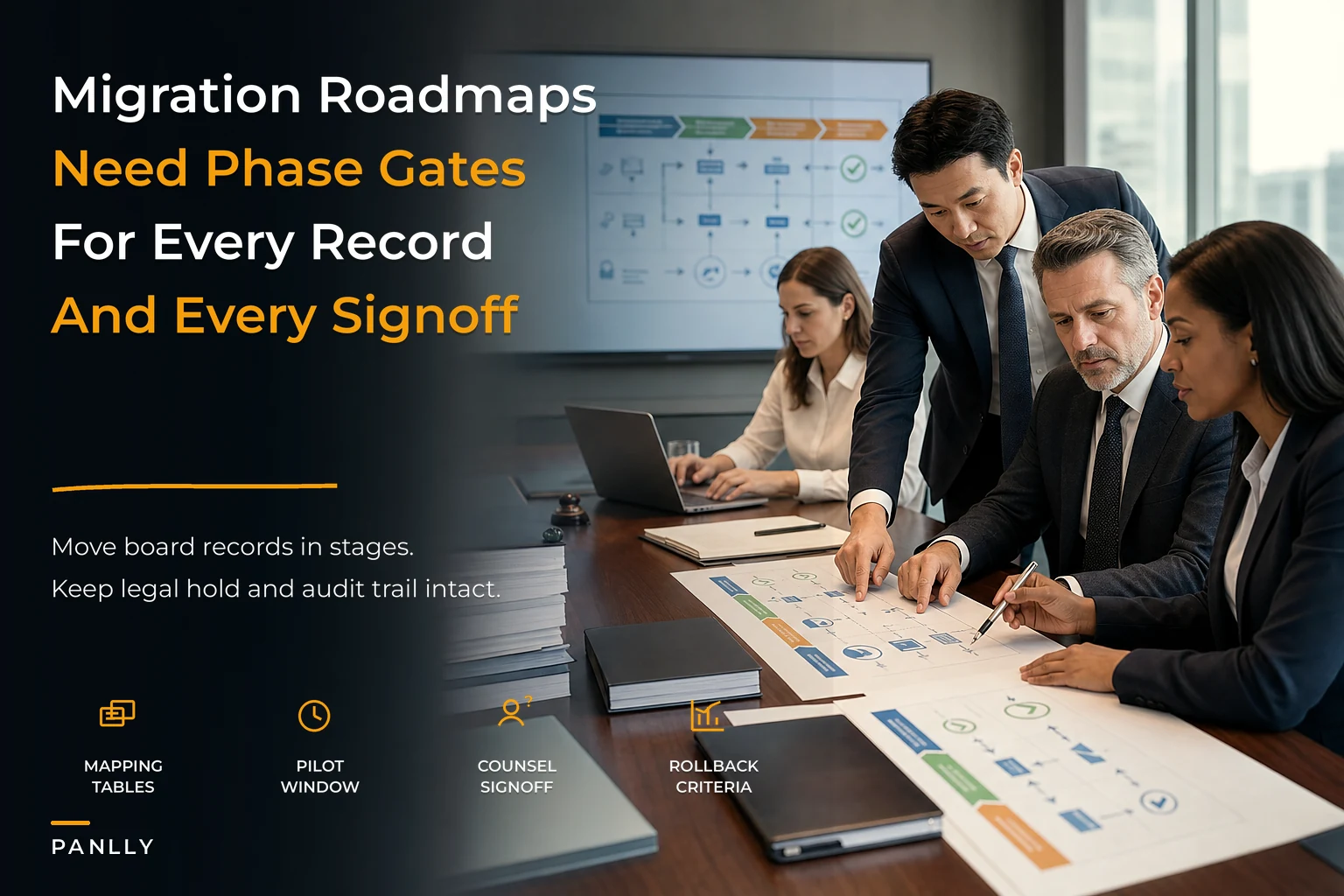
A board governance migration roadmap isn't a project plan for copying files into a new folder structure. It's a program that has to hold four things together simultaneously: metadata fidelity, legal-hold continuity, evidentiary chain-of-custody, and the ability to prove — after the fact, to a regulator or opposing counsel — that nothing changed during the move. Do those four things in the wrong order and you create gaps that don't surface until litigation, when it's far too late to fix.
This is the part almost everyone underestimates. Migration is where governance either gets stronger or quietly gets weaker, and it usually happens without anyone noticing until an inquiry forces the question.
Why board migrations break where they do
Board records aren't like operational data. A CRM migration that drops a few phone numbers is annoying. A board migration that drops the approval date on a resolution, or silently re-timestamps a document to the migration date, has just erased the exact metadata a court would care about.
The pattern that keeps coming up is that the technical team treats the migration as a bulk file transfer, while the corporate secretary treats it as a records-integrity exercise — and the two never actually reconcile their definitions. IT measures success by "files moved without errors." Governance measures success by "can I still defend this record." Those are different tests, and the second one almost never gets written down.
Here's where it typically falls apart:
-
Metadata collapses into the file itself. Original author, approval date, meeting reference, version lineage — these live as separate fields in the old system. During export they get flattened into a filename or lost entirely. Now a 2021 audit committee pre-read looks like it was created last Tuesday.
-
Legal holds don't travel. A document under litigation hold in the old repository gets migrated as a normal file. The hold flag doesn't come across, the retention clock resets, and something that should have been frozen becomes deletable.
-
Version history gets truncated. The new system imports the "final" version and quietly discards the drafts and redlines. In most cases that's fine. In a dispute over what the board knew and when, those drafts were the evidence.
-
No one can prove the before-and-after matched. There's no reconciliation report showing that 14,320 records went in and 14,320 came out with matching checksums. So even a clean migration can't be proven clean.
If your archive taxonomy was shaky to begin with, migration multiplies the problem rather than fixing it. This is why getting your document taxonomy and metadata standard settled before you migrate matters so much — you can't map fields cleanly if you never defined them in the first place.
The phase structure that actually holds
The mistake is treating migration as one event. It works far better as five overlapping phases, each with its own exit gate. You don't advance until the gate is signed. That single discipline — no phase advances without a named signoff — prevents most of the failures that show up later.
Eliminate boardroom chaos with seamless coordination.
Panlly simplifies scheduling, collaboration, and follow-ups for every board meeting.
- Centralized meeting scheduling
- Secure document sharing
- Task assignment & tracking
No credit card required
| Phase | Primary goal | Owner | Exit gate |
|---|---|---|---|
| 1. Discovery & mapping | Inventory records, map every metadata field old→new | Corporate secretary + IT | Field-mapping table approved by counsel |
| 2. Legal-hold reconciliation | Identify all active holds, ensure they carry forward | General counsel | Hold register matched and re-applied in target |
| 3. Pilot migration | Move a representative sample, validate integrity | IT + governance lead | Pilot checklist passes 100%, no metadata drift |
| 4. Full cutover | Migrate remaining records in controlled batches | IT | Reconciliation report matches source counts + checksums |
| 5. Post-cutover QC | Independent verification, spot audits, sign-off | Governance lead + external counsel | Counsel signoff on evidentiary integrity |
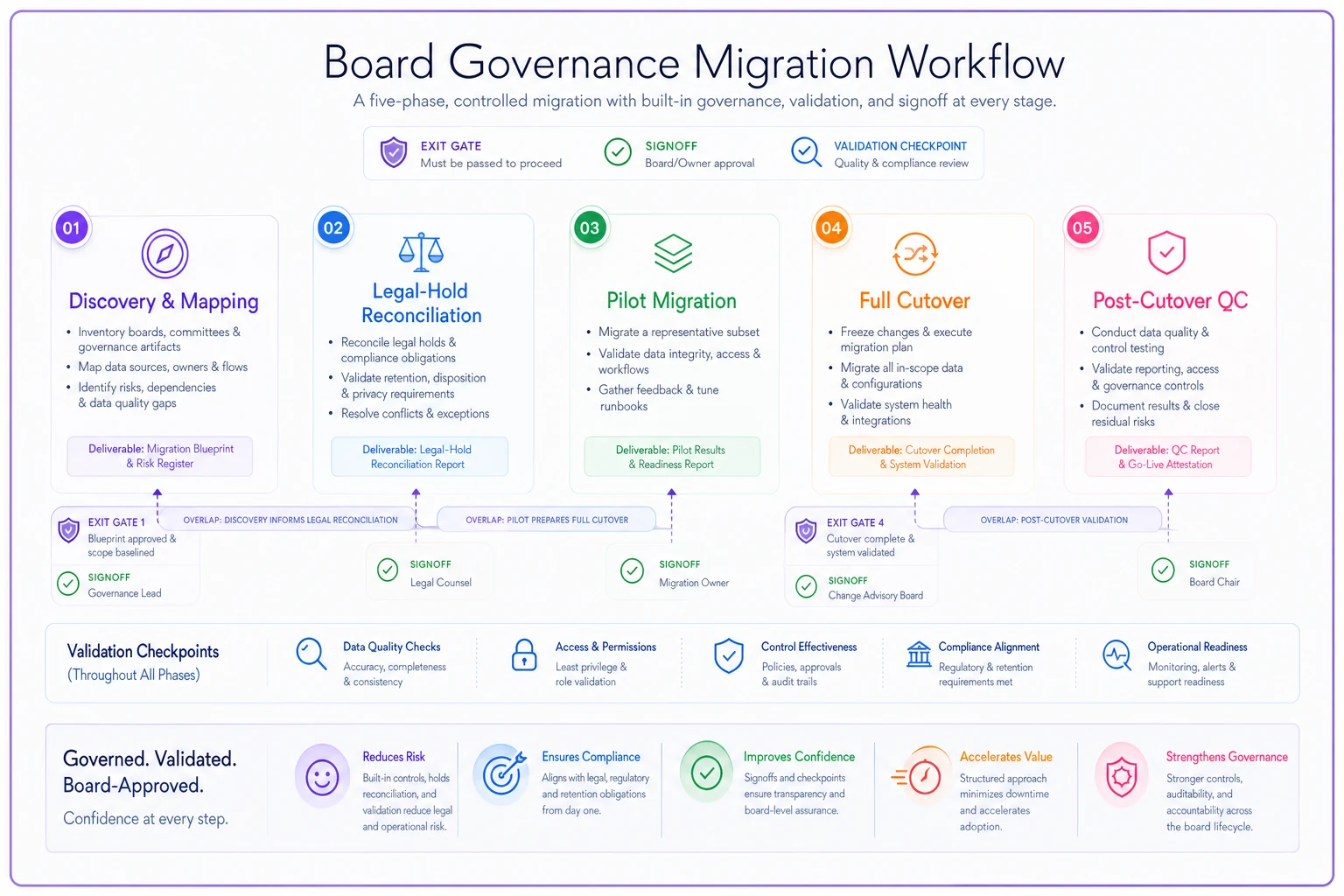
A simple visual can help stakeholders understand phases and gates at a glance.
The phases overlap deliberately. You're reconciling legal holds while you finish mapping. You're running pilot validation before you commit to the full move. What you never do is skip the gate between pilot and cutover — that's the point of no return.
Phase 1: Metadata mapping done properly
This is the unglamorous phase that determines everything downstream. You cannot preserve an audit trail if you haven't mapped where each piece of it lives in the old system and where it needs to land in the new one.
Build a field-level mapping table. Not a summary — an actual row for every metadata field that carries evidentiary weight. A workable sample:
| Source field | Source type | Target field | Transform rule | Evidentiary? |
|---|---|---|---|---|
| DocAuthor | text | created_by | direct copy | Yes |
| ApprovalDate | date | resolutionapprovedon | preserve original TZ | Yes — critical |
| MeetingRef | text | linkedmeetingid | lookup + relink | Yes |
| VersionNum | integer | version_lineage | preserve full chain | Yes |
| RetentionClass | picklist | retention_policy | map to new schema | Yes |
| HoldFlag | boolean | legalholdstatus | carry forward, do not reset | Critical |
| LastModified | timestamp | sourcelastmodified | store as read-only | Yes |
| DocBody | file | document_blob | checksum before/after | Yes |
The column that catches most teams off guard is the transform rule. "Direct copy" is easy. The trouble starts with fields that don't map cleanly — where the old system used one retention class and the new one uses three. Every one of those transformations needs a documented rule and a decision-maker's initials next to it, because a regulator will eventually ask why a record was classified the way it was.
Require a decision-maker's initials next to every transform rule so you can trace classification choices during audit.
One field deserves particular paranoia: approval dates. If your new platform stamps created_on at import time and you didn't preserve the original in a separate, read-only field, you've just made every document look like it was created during migration. That's the single most common metadata failure, and it's silent — everything looks fine until someone needs to prove chronology.
This connects directly to a compliance-first approach to board records: the metadata you preserve during migration is the same metadata that keeps audits from turning into surprises later.
Phase 2: Legal-hold continuity — the phase people forget until it's a subpoena
Legal holds are where a quiet mistake becomes an existential problem. If a document is under litigation hold and the migration resets its retention clock or drops the hold flag, you've potentially spoliated evidence. That's not a technical bug you patch next sprint — that's a conversation with outside counsel about disclosure obligations.
Before any records move, general counsel needs to produce a current hold register: every matter, every custodian, every document class under hold. Then — and this is the discipline that gets skipped — you reconcile that register against the migration plan and confirm each held item is either (a) migrated with its hold intact or (b) explicitly excluded from migration and left frozen in place.
-
GC exports the active hold register with matter IDs and affected document sets.
-
IT tags every in-scope record against that register before export begins.
-
The migration tool carries the hold status as a first-class field — never as a derived attribute that recalculates on import.
-
After migration, GC re-runs a hold report in the new system and confirms every held item still shows as held.
-
Any discrepancy stops the cutover. No exceptions.
Holds are almost never centrally documented before a migration forces the issue. People know "there's litigation on the 2022 vendor matter" but nobody has the definitive list of which documents that touches. The migration becomes the forcing function for building a proper hold register — genuinely valuable, but only if you do it before you press go.
Phase 3: The pilot — prove it small before you prove it wrong at scale
Never migrate everything first. Take a representative sample — somewhere around 200–400 records — that deliberately includes the hard cases: a document under hold, a resolution with a long version history, a minute set with cross-references to other meetings, something from the oldest era of your archive with the ugliest metadata.
Run that pilot, then validate against a checklist. The pilot passes only if every item passes:
-
[ ] Every approval date in the target matches the source date exactly, in the correct timezone
-
[ ] Version lineage is complete — no drafts silently dropped
-
[ ] Legal-hold flags carried forward and appear correctly in the new system
-
[ ] Checksums match on document bodies (byte-for-byte integrity)
-
[ ] Meeting cross-references still resolve to the correct linked records
-
[ ] Retention classifications mapped correctly per the transform rules
-
[ ] Original author and last-modified metadata preserved as read-only
-
[ ] Full-text search returns the pilot documents by content and by metadata
-
[ ] Access permissions match the source — no over-exposure, no lockouts
-
[ ] A reconciliation report shows records-in equals records-out
If any box fails, you fix the mapping and re-run the pilot. You do not "note it and move on." The whole point of the pilot is to surface transform errors while they affect 300 records instead of 30,000.
Teams tend to pilot the clean, recent, well-tagged documents — which migrate perfectly — and then get ambushed by the 2014 board pack with three custom fields and a broken meeting reference during the full run. Make sure the pilot includes the genuinely awful records.
Phase 4: Cutover with rollback criteria defined in advance
Cutover is where you commit. Which means before you start, you need to know exactly what would make you abort — written down, agreed, and not decided emotionally at 11pm when the batch is halfway through.
Define your rollback triggers explicitly:
-
Reconciliation counts don't match (records-in ≠ records-out) beyond zero tolerance for evidentiary records
-
Any checksum mismatch on a document body
-
Any legal-hold flag failing to carry forward
-
Approval-date drift on any resolution
-
Access-control failures exposing records to the wrong people
Migrate in controlled batches, not one giant push. After each batch, run the reconciliation report before starting the next. If a trigger fires, you roll back that batch — which is only possible if you kept the source system intact and read-only throughout the cutover. Do not decommission the old repository until post-cutover QC has fully signed off. The number of organizations that turn off the old system too early and then discover a gap they can no longer fix is higher than it should be.
Phase 5: Post-cutover QC and counsel signoff
Migration isn't done when the files land. It's done when someone independent has verified the record is defensible. This phase is deliberately separate from the people who ran the migration — you want fresh eyes on the work, because the team that built the mapping is the least likely to notice its own blind spots.
Post-cutover QC covers:
-
Independent spot audits. Pull a random sample across eras and document types, verify metadata and integrity against the source.
-
Search validation. Confirm records surface correctly by content, date, meeting, and classification — a migrated archive nobody can search is just a filing cabinet with the labels torn off.
-
Hold re-verification. GC confirms, in writing, that every legal hold survived.
-
Chain-of-custody documentation. Produce the reconciliation reports, checksum logs, and mapping decisions as a permanent record of how the migration preserved integrity.
Then the counsel signoff gate. External or general counsel reviews the QC evidence and signs a statement that the migrated archive preserves evidentiary integrity and audit trails. This signoff is itself a governance record — keep it. When a regulator later asks how you know your records are trustworthy, that document backed by reconciliation logs is your answer.
A migration executed this way also strengthens your ability to defend decisions going forward. The same institutional memory you protect during the move is what a well-kept board decision log relies on to prevent the board from re-litigating settled questions.
A real scenario
A mid-sized financial-services company — roughly a 9-person board plus four standing committees — had about twelve years of records spread across a legacy portal, a shared drive, and a corporate secretary's personal filing structure going back to around 2012. They'd bought a modern platform and the plan was a weekend lift-and-shift.
The pilot is what saved them. When they migrated a sample of about 250 records, three problems surfaced immediately: every resolution's approval date was being overwritten with the import timestamp, two documents under an active employment-dispute hold came across with no hold flag, and version history on their more complex resolutions was collapsing to final-only. On a full run of roughly 15,000 records, those three defects would have quietly corrupted the exact fields most likely to matter in a dispute.
They stopped, rebuilt the field mapping — added a read-only sourceapprovedon field, made the hold flag a hard-carry field, preserved full version lineage — and re-piloted twice until it passed clean. The full migration then took about three controlled weekends instead of one, with reconciliation after each batch. Counsel signed off roughly six weeks after the original planned date.
Slower than planned, and worth every extra week. The alternative was a defensible-looking archive that wasn't actually defensible — which they'd have discovered only when someone challenged it.
When a full phased program makes sense — and when it's overkill
When this makes sense: You have years of records with real evidentiary weight, active or foreseeable litigation, regulatory oversight, or a board archive that's already a discovery target. Any organization where "can you prove this record wasn't altered?" is a question that could actually be asked should run the full program.
When it's overkill: A young organization with two years of clean, well-tagged records, no active holds, and no regulatory exposure doesn't need five gated phases and counsel signoff for a few hundred documents. Run a solid pilot, verify integrity, and move. Don't manufacture ceremony where there's no real risk to manage.
Who should not attempt this without help: If nobody in the organization can produce a current legal-hold register, and no one owns the metadata standard, stop. You're not ready to migrate — you're ready to build the foundation a migration depends on. Fix the taxonomy and the hold register first, then come back to the roadmap.
Where good tooling quietly helps
None of this requires magic software, but the reconciliation and audit-trail work is genuinely tedious to do by hand, and manual checking is where errors hide. Governance platforms that treat metadata as first-class — preserving original timestamps, carrying hold status as a real field, generating reconciliation and checksum reports automatically, and logging every mapping decision — turn the defensibility question into something you can answer with a report rather than a hopeful shrug.
The value isn't automation for its own sake; it's that the chain-of-custody evidence gets produced as a byproduct of doing the migration properly, rather than as a separate scramble when someone asks for it.
The point of the whole roadmap is simple to state and hard to execute: at the end, you should be able to hand a regulator a clean chain of custody showing that nothing of evidentiary value changed when you moved. Get the phases and gates right, and the migration becomes the moment your governance record got stronger — not the moment it quietly sprung a leak nobody found until it mattered.
Ready to enhance your board's productivity?
Join 500+ organizations using Panlly to save time, improve governance, and streamline board operations.