

Most boards can tell you what they decided last quarter. Far fewer can tell you how much it cost to run the governance function that produced those decisions, who did the work, or whether the advisors they paid actually delivered against a defined standard. The result is a governance function that looks polished on the surface — clean minutes, tidy agendas — and is completely opaque underneath when a regulator, an auditor, or a new chair starts asking where the money and effort actually went.
That gap is where a board governance operating model earns its keep. Not the glossy charter language — the operational plumbing. How many people at what level are resourced against each governance activity, how advisors get selected and held to service levels, how briefings clear signoff before they reach directors, and how all of it rolls up into a defensible budget. When those four things connect, you can answer resourcing, procurement, and signoff questions from a single evidence trail instead of reconstructing them under pressure.
This piece walks through how to build that connective tissue — and where it tends to snap as the board scales from a single entity to a group with committees, subsidiaries, and a stack of external advisors.
Why resourcing invisibility is the root problem
The corporate secretary's function is one of the least measured operations in most organizations. Everyone assumes it runs. Nobody tracks the load. And because the work is mostly coordination — chasing signoffs, formatting packs, managing advisor relationships — it's easy to under-resource until something breaks in a visible, expensive way.
A predictable pattern plays out across a wide range of boards. A company grows from one board and one committee to three or four committees plus a couple of subsidiary boards. The governance workload roughly triples. Headcount stays at one corporate secretary plus a shared paralegal. The people don't complain loudly because they're competent and proud, so the strain shows up indirectly: briefing packs land 36 hours before meetings instead of a week out, advisor invoices arrive with no matching scope, and nobody can say whether external governance counsel spent 12 hours or 40 on the last board matter.
-
The board wants quality materials and independent advice, but doesn't see the effort behind them.
-
Finance sees the invoices but has no framework to judge whether the spend was reasonable.
-
The corporate secretary does the work but has no formal band to point to when asking for more people.
Without a model that names role levels, resourcing bands, and cost, every one of these conversations becomes anecdotal. And anecdotal governance is exactly what falls apart under scrutiny.
Start with role-level FTE bands, not headcount
The first building block is a resourcing map that ties governance activities to role levels and effort bands — expressed in fractional FTE, because almost no governance role is a clean full-time slot. The point isn't precision to the decimal. It's making the load visible so you can defend it and scale it.
Eliminate boardroom chaos with seamless coordination.
Panlly simplifies scheduling, collaboration, and follow-ups for every board meeting.
- Centralized meeting scheduling
- Secure document sharing
- Task assignment & tracking
No credit card required
A useful way to structure this is by activity cluster rather than by person. People change; the work doesn't. Here's a sample banding table for a mid-sized group board running four committees and two subsidiary entities.
| Activity cluster | Role level | Resourcing band (FTE) | Peak-cycle multiplier |
|---|---|---|---|
| Meeting lifecycle & agenda management | Corporate Secretary | 0.4 – 0.6 | 1.5x in AGM quarter |
| Briefing pack production & signoff | Governance Analyst | 0.5 – 0.8 | 2x around results |
| Advisor management & RFP coordination | Deputy Secretary / Manager | 0.2 – 0.35 | 1.3x during procurement |
| Minutes, decision logs & records | Governance Analyst | 0.3 – 0.5 | 1.4x post-meeting week |
| Committee support (Audit/Comp/Nom/Risk) | Shared analyst pool | 0.6 – 1.0 combined | 1.6x reporting season |
| Subsidiary board oversight | Deputy Secretary | 0.25 per entity | steady |
The band ranges matter more than midpoints. When actual effort consistently runs at or above the top of a band for two consecutive cycles, that's your objective trigger to add resource — not a vague sense that people are stretched. This is the same logic that makes a role-level meeting lifecycle work: you assign the work to a level, then measure whether that level is overloaded.
Track actual hours against band tops over at least two cycles to create objective evidence before requesting additional FTE.
One thing worth flagging here: boards that skip the banding step tend to resource around the person — "Priya handles it" — and when Priya leaves, the whole function's capacity walks out the door with no documented baseline for whoever comes next. The band table is partly a resourcing tool and partly insurance against key-person risk.
Advisor RFPs: turn ad-hoc engagements into a governed pipeline
Once internal effort is mapped, external spend becomes the next blind spot. Most boards engage advisors — governance counsel, compensation consultants, proxy advisors, D&O brokers, forensic specialists — through relationships rather than process. Someone knows someone. The engagement letter is thin. Scope creeps. Twelve months later the audit committee is staring at a six-figure line with no way to assess whether it was value for money.
An RFP discipline fixes this, but it has to be proportionate. You don't run a full competitive tender for a two-hour advice call. The trick is a threshold-based procurement ladder tied to the resourcing model, so the level of process matches the level of spend and risk.
-
Under ~$10k, low risk — Single-source with a one-page scope note and rate confirmation. Logged, not tendered.
-
~$10k–$50k — Three-quote comparison. Written scope, deliverables, and an SLA schedule attached to the engagement.
-
~$50k–$150k — Formal RFP with at least three invited firms, scored against defined criteria, decision documented for the audit committee.
-
Above ~$150k or high sensitivity — Full RFP plus conflict checks, reference calls, and committee-level signoff on the award.
The scoring criteria for mid and upper tiers should be fixed in advance so awards are defensible. A simple weighted rubric — technical capability, relevant sector experience, independence and conflicts, responsiveness and SLA commitments, and cost — prevents the "we went with who we trust" narrative that looks bad in hindsight. Keep the completed scorecards; they're part of the audit trail.
Worth flagging: the firms boards most want to hire quickly — the trusted, senior, expensive ones — are exactly the ones most likely to skip a written scope. Discipline has to apply hardest where the relationship is warmest, or the whole procurement ladder becomes theater.
SLA templates: define "delivered" before the work starts
An RFP tells you who you hired. An SLA tells you whether they did the job. Without service-level definitions, advisor performance gets judged on vibes and invoice size, which is no basis for renewing or replacing a firm.
Governance SLAs don't need to be complex, but they need to be measurable. The categories that actually matter in board work:
-
Turnaround commitments — e.g., first draft of a board matter within X business days, urgent advice within 24 hours.
-
Point-of-contact and escalation — named lead, named backup, defined escalation path when the lead is unavailable.
-
Deliverable standards — format, length, and whether output must be board-ready (i.e., usable in a pack without heavy rework).
-
Reporting cadence — monthly spend-against-budget updates for engagements over a set threshold.
-
Conflict and confidentiality obligations — ongoing, not just at onboarding.
Here's a sample SLA snapshot you can adapt per engagement tier:
| SLA dimension | Standard engagement | Priority engagement |
|---|---|---|
| Acknowledge new instruction | 1 business day | 4 hours |
| First substantive draft | 5 business days | 48 hours |
| Named lead + backup | Required | Required |
| Monthly spend report | Over $25k | All |
| Board-ready formatting | On request | Default |
| Post-matter debrief | Optional | Required |
Two things make SLAs stick. First, the metrics have to be captured somewhere consistent — a simple advisor scorecard maintained per engagement, reviewed at renewal. Second, missed SLAs need a defined consequence, even a soft one: a documented note, a conversation at review, a weighting hit on the next RFP. An SLA with no teeth is just a wish list.
This connects closely to how boards automate action-item follow-up with SLAs and escalation rules internally — the same accountability logic applies to external advisors, just pointed outward.
Briefing signoff gates: the quality control layer
Resourcing and advisors feed the machine, but the output that reaches directors is the briefing pack. This is where a lot of governance risk actually lives, because a pack that goes out unreviewed — with a stale figure, an unresolved conflict, or a motion that doesn't match the recommendation — creates exactly the kind of record that gets picked apart later.
Signoff gates put controlled checkpoints between "someone drafted this" and "directors are relying on this." A three-gate model handles most boards:
-
Gate 1 — Content complete. Analyst confirms all sections present, data sourced, advisor inputs incorporated. No formatting judgment yet, just completeness.
-
Gate 2 — Accuracy and conflict check. Corporate secretary or deputy verifies figures against source, confirms conflict declarations are current, and checks that every decision item has a clean, minute-ready motion.
-
Gate 3 — Release authorization. Chair or committee chair signs off that the pack is fit to circulate.
Each gate produces a timestamped record of who cleared it and when. That's what turns signoff from an informal courtesy into an audit-ready control. When something in a pack is later questioned, you can show the gate history rather than shrugging.
The most common failure here isn't a missing gate — it's a gate that exists on paper but gets skipped under time pressure. When the pack is running late (and it will), the temptation is to circulate first and review after. A resourcing model that's honestly banded reduces this, because the analyst pool isn't perpetually overloaded and blowing through gates just to hit the deadline. Signoff discipline and realistic resourcing are really the same problem viewed from two different ends.
Here's a simple workflow to visualise the three-gate signoff process.
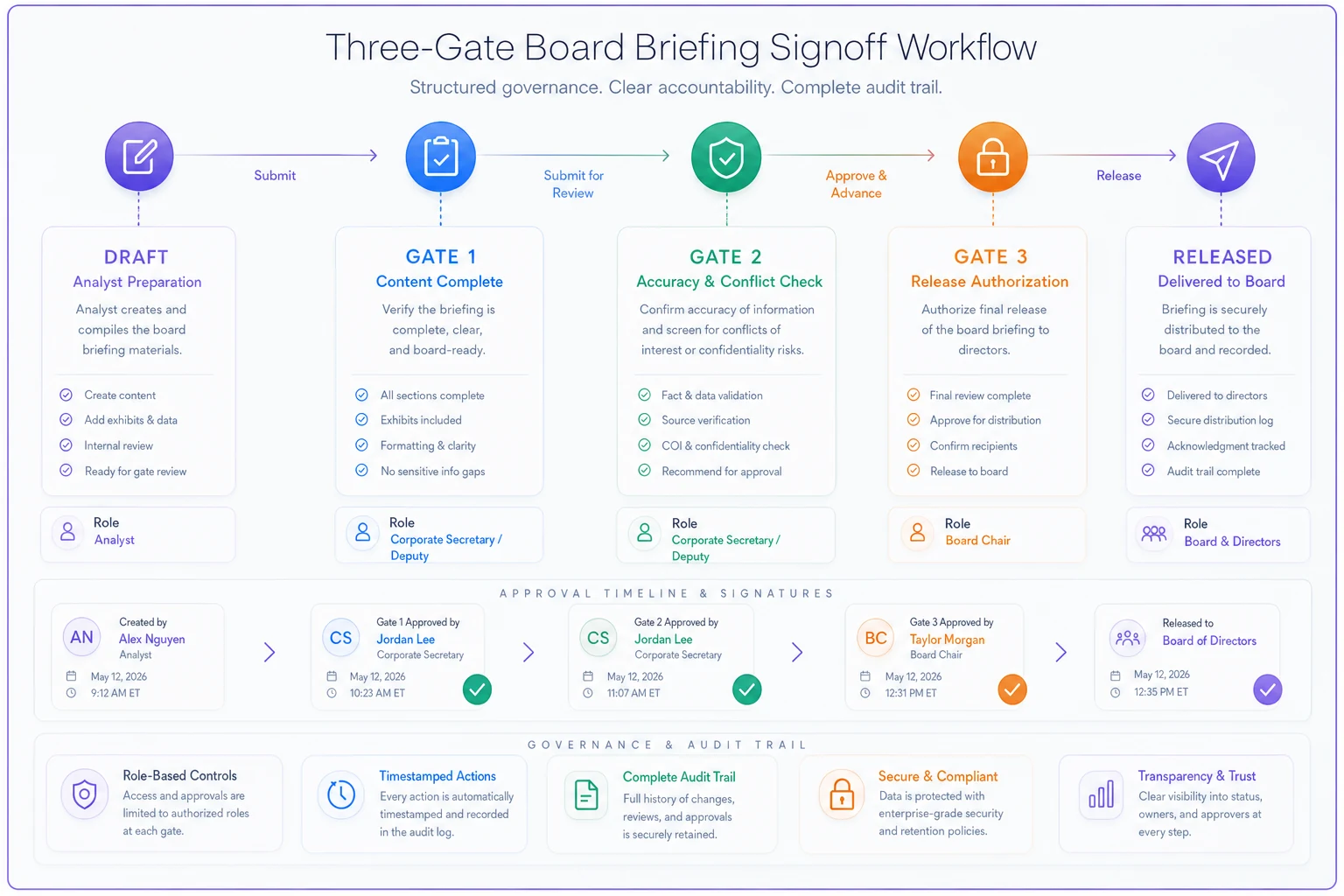
Use the gate timestamps as the evidence trail when responding to queries.
The governance budget worksheet: where it all connects
Now the pieces join. Internal FTE bands give you people cost. The advisor procurement ladder gives you external cost. SLAs and signoff gates give you the assurance that the spend produced defined value. A governance budget worksheet is where these roll up into a single, defensible number the audit or finance committee can actually interrogate.
A sample structure:
| Budget line | Basis | Annual estimate | Notes / trigger |
|---|---|---|---|
| Internal governance FTE | Sum of banded FTE × loaded cost | ~$310k–$360k | Review if any cluster exceeds top of band 2 cycles running |
| Governance counsel (retained) | Tier-3 RFP, capped hours | ~$90k–$120k | SLA scorecard at renewal |
| Compensation consultant | Tier-3 RFP | ~$60k–$80k | Comp cycle peak |
| Proxy / disclosure advisory | Tier-2 | ~$25k–$40k | Seasonal |
| Board portal & records tooling | Fixed subscription | ~$30k–$50k | Contract review annually |
| Contingency (investigations, special matters) | Reserve | ~$50k | Tier-4 process if drawn |
Two things worth noting from real budget builds. First, the contingency line is the one everyone forgets and everyone needs — a whistleblower matter, a surprise regulatory inquiry, or an M&A conflict review can blow a governance budget that was scoped for steady-state. Naming a reserve keeps those events from becoming ugly variance conversations. Second, tie each external line back to its procurement tier and SLA in the worksheet notes. When finance asks "why is counsel $110k," the answer should be a tier-3 RFP outcome with a scorecard, not "that's what they charged."
When this full model makes sense — and when it's overkill
This is a real program with real overhead, and it isn't right for every board.
It makes sense when: you're running multiple committees, one or more subsidiary boards, or a group structure; when advisor spend is meaningful enough that finance is already asking questions; when key-person risk in the secretary function keeps you up at night; or when you've had an audit or regulatory experience that exposed how thin your governance evidence trail was.
It's overkill when: you're a single small board with one committee and one part-time secretary, engaging maybe one advisor a year. Building four gate levels and a procurement ladder for that is process for its own sake. Start with the FTE band table and a basic advisor scope template; add the rest as complexity arrives.
Who should be cautious: boards mid-way through a governance digitization effort. Layering a full operating model on top of processes that are still half-manual and half-migrated tends to create friction rather than solve it. It's usually cleaner to sequence this alongside a broader phase-based program to digitize board processes so the resourcing model, procurement ladder, and signoff gates all land on stable infrastructure rather than being retrofitted twice.
A real scenario: from opaque spend to defensible program
A regional financial-services group ran three committees and two subsidiary boards with a single corporate secretary and a shared paralegal. Advisor spend across governance counsel, comp consulting, and proxy advisory came to roughly $240k a year, spread across five firms — none on a written SLA, most engaged by relationship. When a new audit committee chair asked for a breakdown of what that spend bought, nobody could produce one in under two weeks.
They built the model over about four months. FTE banding revealed the analyst function was running consistently above the top of its band during results season — objective evidence that justified adding a 0.6 FTE governance analyst, which the board had previously resisted as "nice to have." A procurement ladder was applied retroactively: two engagements over $50k went through a proper tier-3 RFP at renewal, and one firm was replaced after scoring poorly on responsiveness. SLA scorecards started at the next cycle. Briefing signoff moved to a three-gate model with timestamped clearance.
The outcomes weren't dramatic in headline terms, but they were the right ones. Advisor spend came down to roughly $205k–$215k — not through cost-cutting but through scoped engagements and one competitive re-tender. Briefing packs consistently cleared Gate 3 several days ahead of meetings instead of the night before. And when a regulator later asked about a specific board decision and the advice behind it, the corporate secretary produced the RFP record, the SLA-tracked deliverable, and the gate history in an afternoon — which is exactly the scenario the whole program was built for.
Bringing it together
Governance resourcing stays invisible because no single stakeholder owns the full picture — the board sees output, finance sees invoices, and the secretary carries the load without a documented baseline. A board governance operating model works precisely because it forces those views into one connected structure: FTE bands make internal effort visible and defensible, an RFP ladder governs external spend proportionately, SLAs define what "delivered" actually means, signoff gates control quality, and the budget worksheet rolls it all into a number a committee can genuinely challenge.
None of these pieces is exotic on its own. The value is in the connection — resourcing decisions that trace to procurement decisions that trace to service levels that trace to the pack that reaches directors, all leaving an evidence trail as they go. Build it that way and governance stops being the function everyone assumes is running and becomes one you can actually account for, out loud, when it matters most.
Ready to enhance your board's productivity?
Join 500+ organizations using Panlly to save time, improve governance, and streamline board operations.