


Three quarters into a board meeting last month, a director asked the question that derailed everything: "Why aren't we pursuing international expansion? Seems like we're leaving money on the table."
The CEO exchanged a glance with the corporate secretary. They'd spent six months analyzing international markets back in 2021. The board had reviewed detailed financial models, regulatory assessments, and partnership proposals before voting 7-2 against expansion. The analysis showed they needed $12M in working capital they didn't have, and regulatory compliance in target markets would eat 18% margins down to 4%.
But the director asking was new. Two others who'd voted on the original decision had rotated off. Nobody could pull up the specific rationale without digging through three years of minutes.
They spent the next 40 minutes rehashing arguments from 2021. The meeting ran long. Action items got pushed. And worst of all — they'd probably have this same conversation again when the next new director joined.
Why Boards Keep Having the Same Conversations
Board composition changes. Directors rotate every few years. New members join with fresh perspectives but no context for past decisions. The institutional knowledge walks out the door with departing directors.
Meeting minutes capture what happened but rarely preserve the why. They'll show a 7-2 vote against international expansion. They won't explain the working capital constraints, the regulatory analysis, or the partnership terms that made it unfeasible. Minutes document decisions, not reasoning.
Even comprehensive board packages get archived and forgotten. That 47-page market analysis from 2021 is sitting in a SharePoint folder somewhere, disconnected from the actual decision it informed. New directors won't even know it exists.
The problem compounds when decisions span multiple meetings. Strategic initiatives often involve preliminary discussions, committee reviews, expert presentations, and final votes spread across quarters. Three years later, nobody remembers the full picture — just fragments.
This institutional amnesia is expensive. Companies typically report spending somewhere between 15-20% of board meeting time revisiting old decisions. That's roughly 8-10 hours per year of director time — at compensation rates of $250k-$350k annually, you're burning real money just relitigating the past.
Building a Board Decision Log That Actually Works
A proper board decision log isn't just a list of votes. It's a searchable repository of institutional knowledge that connects decisions to their full context.
Eliminate boardroom chaos with seamless coordination.
Panlly simplifies scheduling, collaboration, and follow-ups for every board meeting.
- Centralized meeting scheduling
- Secure document sharing
- Task assignment & tracking
No credit card required
Start with these core fields for every major decision:
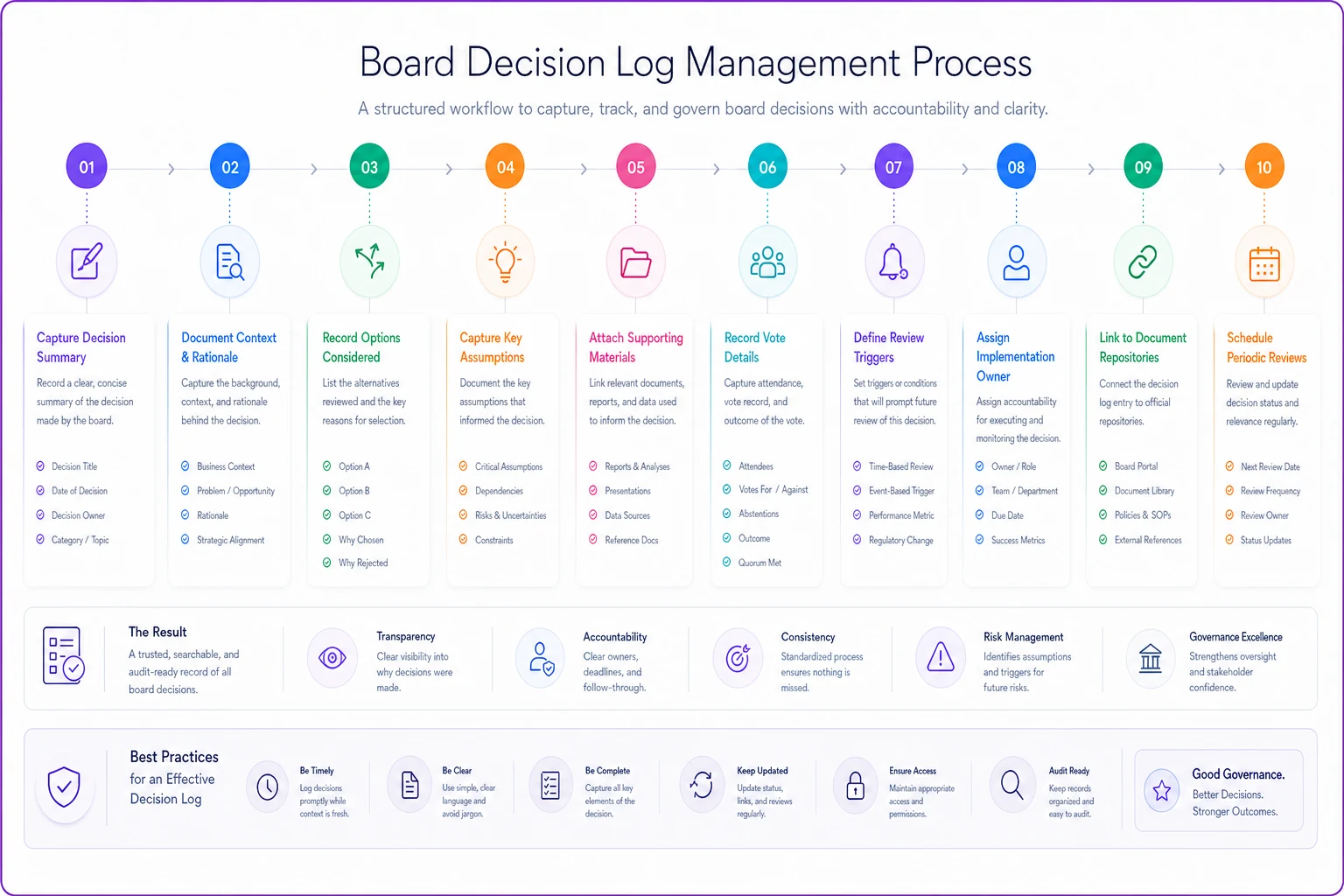
Decision Summary — The actual choice made, stated clearly in 1-2 sentences. Not "approved expansion proposal" but "declined international expansion due to $12M working capital requirement exceeding available credit facilities."
Context and Rationale — The business situation that triggered the decision. Market conditions, competitive pressures, regulatory changes, financial constraints. This is where you capture the "why" that minutes miss.
Options Considered — What alternatives did the board evaluate? Include the pros and cons discussed for each path. This prevents future boards from unknowingly proposing already-rejected options.
Key Assumptions — What facts or projections underpinned the decision? "Assumed 2.5% interest rates through 2024" or "Required maintaining 1.5x debt coverage ratio per loan covenants." When these change, you know to revisit.
Supporting Materials — Direct links to the analyses, presentations, and reports that informed the decision. Not just file names — actual links that work. Include page numbers for relevant sections in longer documents.
Vote Record — Who voted how, but also capture any noted concerns or conditions. "Director Smith voted yes contingent on quarterly progress reviews" provides context beyond the bare vote count.
Review Triggers — When should this decision be revisited? Could be time-based ("review after 18 months") or event-based ("reconsider if interest rates drop below 3%").
Implementation Owner — Who's accountable for executing this decision? Include their direct report to the board for continuity when roles change.
Here's a simple workflow to visualize how decision fields link to documents and review triggers.
Fields alone don't make a functional system though. You need operational rules that ensure the log stays current and actually usable.
Linking Decisions to Meeting Materials Without Creating a Mess
The biggest failure point in decision logs? Broken links to supporting documents. A decision log entry pointing to materials that can't be found is worse than useless — it creates false confidence.
Create a parallel folder structure that mirrors your decision log categories. If you organize decisions by strategic, financial, governance, and risk categories, create matching folders in your document repository. Every decision's supporting materials live in the corresponding folder, named with the decision date and ID number.
For example: "2024-03-15DEC047InternationalExpansionAnalysis.pdf"
This seems basic, but boards typically scatter materials across email attachments, board portals, and shared drives. Six months later, nobody can find anything.
More importantly, establish a single source of truth for each document. The March 2024 board book might contain the expansion analysis, but that's not where you link from the decision log. Extract the relevant analysis as a standalone document and link to that. Future directors shouldn't have to wade through 200-page board books to find the 12 pages that matter.
Establish a single source of truth for each document and link directly to extracted analyses rather than whole board books to avoid broken or buried references.
For discussions that stretched across multiple meetings, create a decision journey document. Capture the evolution of thinking chronologically — the preliminary discussion in January, the committee deep-dive in February, the expert testimony in March, the final vote in April. One document, one narrative.
When documents reference other decisions, cross-link them in your log. The expansion decision might relate to a capital allocation framework from 2019. Connect them. This builds a web of context that helps new directors understand how decisions relate to each other.
Making Your Decision Log Actually Searchable
A decision log you can't search is just a prettier version of scattered minutes. But "searchable" means more than hitting Ctrl+F in a spreadsheet.
-
Decision type (strategic, financial, governance, risk)
-
Business area (operations, sales, technology, HR)
-
Stakeholders affected (customers, employees, investors, regulators)
-
Financial threshold (decisions over $1M, $5M, $10M)
-
Time horizon (immediate, 1-year, 3-year, 5+ year impact)
Tag every decision with relevant categories. This lets new directors quickly find all technology decisions, all decisions affecting customers, or all decisions with significant financial impact.
The real power comes from narrative summaries written for search. Don't write "approved budget." Write "approved 2024 operating budget with 15% increase in R&D spending focused on AI capabilities and 10% reduction in marketing following shift to product-led growth strategy." Those extra words become searchable context later.
Include common variations in your descriptions too. If you declined a "private equity acquisition offer," also mention "PE buyout proposal rejected" somewhere in your summary. This catches searches regardless of how someone phrases the query.
Review Cadences That Keep Decisions Fresh
Decisions rot. Market conditions change, assumptions prove wrong, strategies pivot. A decision log without regular reviews becomes a museum of outdated thinking.
Three review cycles worth establishing:
Quarterly flag review — The corporate secretary scans the log for decisions with triggered review conditions. Interest rates changed? Flag all decisions that assumed stable rates. New competitor entered the market? Flag market positioning decisions. Takes maybe 2 hours per quarter but prevents surprise obsolescence.
Annual assumption audit — Once yearly, typically before strategic planning, review the key assumptions underlying major decisions.
| Original assumption | Current reality | Variance | Impact |
|---|---|---|---|
| Assumed 2.5% interest rates through 2024 |
Anything with significant variance gets flagged for board discussion.
New director onboarding — Within their first 60 days, walk every new director through the past few years of strategic decisions. Not just what was decided, but why. Include the debates, the close calls, the contingency plans that didn't get used. This is what prevents the "why aren't we doing X" questions that derail meetings.
Some boards resist regular reviews as overhead. But consider the alternative: spending 20% of meeting time relitigating old decisions because nobody remembers the reasoning. A structured review process takes less time than the chaos it prevents.
Real Examples: How Decision Logs Transform Board Operations
A software company's board spent three consecutive quarters debating whether to build or buy their mobile app capabilities. Each meeting, someone proposed a different angle. "What about acqui-hiring that team in Toronto?" "Should we partner instead?" "Maybe we should wait for better valuations?"
They finally built a decision log that captured not just their ultimate "build internally" decision, but also:
-
The 7 acquisition targets evaluated and why each was rejected
-
The 3 partnership proposals reviewed with specific term sheet problems
-
The financial model showing build costs of $3.2M vs acquisition prices of $8M-$15M
-
The talent assessment showing they had roughly 70% of required skills in-house
New board members could immediately see the full landscape of options already explored. When a director suggested acquiring a Miami-based team nine months later, they could reference why similar targets hadn't worked. The conversation took 5 minutes instead of 45.
Another example: a healthcare company's board approved a major ERP implementation in 2019. By 2022, with two new directors and a new CEO, someone questioned why they'd chosen such an expensive system. Without context, it looked like overspending.
Their decision log showed:
-
The cheaper alternative would have required replacing their entire warehouse management system
-
Regulatory compliance for their FDA-regulated products eliminated 3 of 5 vendor options
-
The "expensive" system included 5 years of updates vs 2 years from competitors
-
Integration costs for the cheaper option actually made it 20% more expensive over 7 years
That context shifted the conversation from "why did we waste money?" to "are we maximizing our investment?" — a much more productive discussion.
The Technology Component Without Overcomplicating
You don't need complex software to start. A well-structured spreadsheet with consistent formatting beats a fancy system nobody uses. But as your log grows past 50-100 decisions, basic tools start showing limits.
The evolution typically goes like this:
Start with a spreadsheet template. Include all fields mentioned earlier. Use data validation to enforce consistent categories and terminology. Create filtered views for common searches. Link to documents stored in an organized folder structure.
After 12-18 months, search becomes painful. This is when boards typically move to something database-driven — Airtable or Notion handle documents and search better than spreadsheets while staying approachable for non-technical users.
The key integration is with your board portal or meeting management system. Decisions logged during meetings should flow into your log without manual double-entry. Manual re-entry guarantees inconsistency and gaps over time.
Modern board governance platforms increasingly include decision logging features. Some can suggest when past decisions might be relevant to current discussions based on topic overlap.
But the technology is maybe 20% of the solution. The other 80% is process discipline. A sophisticated system with spotty usage fails. A simple spreadsheet with consistent updates succeeds.
Who Should Own This (And Why It Usually Fails)
Decision logs fail when ownership is unclear. "The board" can't own it — that's nobody. The CEO is too busy and too close to management. Board committees lack continuity across membership changes.
The corporate secretary should own the decision log. They're already capturing minutes, managing documents, and maintaining governance records. The decision log extends their existing workflow rather than creating entirely new work for someone else.
But they need explicit authority and support. Directors must understand that providing decision context isn't optional paperwork — it's preserving institutional knowledge. The CEO needs to ensure management supplies supporting materials in usable formats. The board chair needs to enforce review cadences.
Budget 4-6 hours monthly for maintenance. That includes updating new decisions, checking document links, running searches for recurring topics, and preparing review reports. A lot of this is restructuring existing work rather than adding to it. Time spent maintaining the log is time not spent hunting through old minutes or recreating lost analyses.
The Compound Value of Institutional Memory
A functioning board decision log pays dividends that compound over time.
New director onboarding drops from months to weeks. Instead of gradually absorbing context through multiple meeting cycles, new members can review categorized decisions relevant to their expertise. A director with supply chain background can scan all operations and vendor decisions. Someone joining the audit committee can review every risk-related decision from the past few years.
Meeting efficiency improves substantially. That 15-20% of time spent revisiting old ground drops significantly. Discussions start from informed positions rather than blank slates. When someone asks "have we considered X?" you can show what you considered, when, and why you decided against it.
Strategic consistency strengthens too. Boards can see patterns in their decisions over time. Are you consistently conservative on capital allocation but aggressive on market expansion? Does that alignment hold up to scrutiny? The log reveals your actual strategy through revealed preferences rather than stated intentions.
Regulatory and litigation readiness improves as well. When regulators question board oversight or plaintiffs challenge decisions, you have contemporaneous documentation of thoughtful deliberation — not just what you decided, but evidence of careful consideration of alternatives, risks, and stakeholder impacts.
Perhaps most importantly, decision-making itself improves. When you can reference similar past decisions and their outcomes, current decisions get better. You spot patterns in what worked. You avoid repeating the same mistakes. You build on successful approaches rather than stumbling back into them by accident.
Making This Actually Happen
Building a decision log feels like overhead at first. The first few entries are awkward. The categories feel forced. The summaries seem redundant alongside minutes.
Around decision 20 or so, something shifts. The categories make sense. Search becomes genuinely useful. New directors start pulling up past decisions on their own. The log stops feeling like a burden and starts feeling like an asset.
Start with strategic decisions over $1M impact only. Don't try to backfill years of history all at once. Begin with decisions going forward and add historical context when it's actually needed. Five well-documented decisions are worth more than 50 sketchy entries.
Create your template before your next board meeting. Draft the fields, categories, and naming conventions. Test it against your last major decision. Refine what feels awkward or missing.
Most importantly, use it immediately and visibly. The first time a director wants to revisit an old decision, pull up your log. Show them the context. Demonstrate what it does. Once directors see 40 minutes of debate compressed into 5 minutes of review, they'll become your biggest advocates.
The boards that maintain institutional memory make better decisions faster. They spend less time in meetings but accomplish more. New directors contribute sooner. Management wastes less time recreating analyses that already exist somewhere.
Your board's collective wisdom shouldn't reset every time composition changes. The investment in preserving institutional memory pays for itself the first time you avoid relitigating a complex decision. Every avoided repetition after that is pure value creation.
Ready to enhance your board's productivity?
Join 500+ organizations using Panlly to save time, improve governance, and streamline board operations.