

Most boards don't have a governance information problem at the point where a document gets created. They have it everywhere else: the thing sits in a shared drive with no owner, nobody knows if it's final, it skips the committee that was supposed to see it, and five years later a litigation hold lands and nobody can confidently say whether that board deck was retained, altered, or quietly deleted by someone cleaning up storage.
This keeps happening because governance information isn't managed as a lifecycle. It's managed as a pile of artifacts that each move through their own ad hoc path. One director emails a memo. The secretary drops a deck in the portal. Legal keeps a separate folder for anything sensitive. Each of those paths carries different rules, different retention assumptions, and different levels of discipline — which means the organization's real retention policy is whatever the most careless person did last.
What actually fixes this is treating every piece of board-facing information as something that moves through a defined set of states, each with required metadata, a time limit, and a clear rule for what happens next. That's what this article lays out: a board-facing state machine covering intake → triage → decision-ready → implementation → review → retire, with the SLAs, retirement triggers, dashboards, and drop-in artifacts you need to make it real.
Why the "pile of artifacts" model breaks — and exactly where
The failure isn't random. It clusters at the handoffs. In real operations, the breakdown usually shows up in one of four predictable places.
Intake with no owner. Something arrives — a whistleblower summary, a vendor risk flag, a strategy memo — and it lands in an inbox or a channel. Nobody is formally accountable for it yet, so it sits. The clock the board thinks is running isn't running at all.
Triage that never happens. Even when intake works, deciding where something goes is often informal. Is this an audit committee matter or a full-board matter? Is it decision-ready or does it need more work? When triage is a hallway conversation, the same item gets re-debated at three meetings because nobody classified it the first time. This is exactly the dynamic that a disciplined board decision log that preserves institutional memory is supposed to prevent — but a decision log only works if items enter it in a structured state, not as scattered notes.
Decision-ready that isn't. A huge volume of board time gets burned on items labeled "ready for decision" that arrive without the metadata a director actually needs — no clear recommendation, no risk owner, no evidence map. The item bounces back, quietly re-entering an earlier state without anyone recording that it did.
Retirement that's purely accidental. Most organizations don't retire governance records on purpose. Things get deleted when drives fill up, kept forever "just in case," or scattered across personal folders. When a legal hold hits, you discover your retention policy was fiction.
What breaks at scale is the connective tissue. A ten-person board with one engaged secretary can hold the whole lifecycle in their head. Add three subsidiaries, four committees, and a couple of regulators who each want evidence on demand, and that model collapses. You can't audit a process that only exists as habits.
The state machine: six states, hard edges
Every governance information object — a memo, a risk item, a policy proposal, an investigation summary — exists in exactly one state at any moment. It can only move to the next state when its exit criteria are met. No skipping, no limbo.
Eliminate boardroom chaos with seamless coordination.
Panlly simplifies scheduling, collaboration, and follow-ups for every board meeting.
- Centralized meeting scheduling
- Secure document sharing
- Task assignment & tracking
No credit card required
| State | Purpose | Required metadata (minimum) | Owner | Exit criteria |
|---|---|---|---|---|
| Intake | Capture and timestamp anything entering the governance system | Source, date received, confidentiality level, provisional category, intake owner | Corporate secretary / governance admin | Item classified and assigned |
| Triage | Decide routing, priority, and whether more work is needed | Routed body (committee/full board), priority, sensitivity flag, legal-hold applicable (Y/N), sponsor | Committee chair / secretary | Routing confirmed; sponsor accepts |
| Decision-ready | Package for an actual decision | Recommendation, risk owner, evidence map, options, financial impact, proposed motion | Sponsor | Complete pack passes QC |
| Implementation | Track the approved decision into execution | Decision reference, action owners, deadlines, dependencies, status | Management liaison | All actions closed or formally deferred |
| Review | Confirm the decision produced the intended outcome | Outcome metrics, variance notes, review date, reviewer | Relevant committee | Outcome recorded; keep-or-retire recommendation |
| Retire | Dispose or archive per policy | Retention class, disposition action, disposition date, legal-hold status, approver | Records / legal | Disposition executed and logged |
The discipline that makes this work is the required metadata gate. An item physically cannot advance until its mandatory fields are populated. That one rule eliminates most of the "it wasn't really ready" churn, because "ready" stops being a judgment call and becomes a checklist the system enforces.
One pattern worth flagging: the arrows aren't only forward. Items in Decision-ready frequently bounce back to Triage or even Intake when a director asks a question nobody anticipated. The state machine has to record those backward transitions — an item that quietly returns to an earlier stage with no log entry is how timelines get fudged and how the same debate resurfaces months later.
Below is a simplified view of how information flows through the lifecycle, including those backward transitions that tend to get ignored in cleaner diagrams.
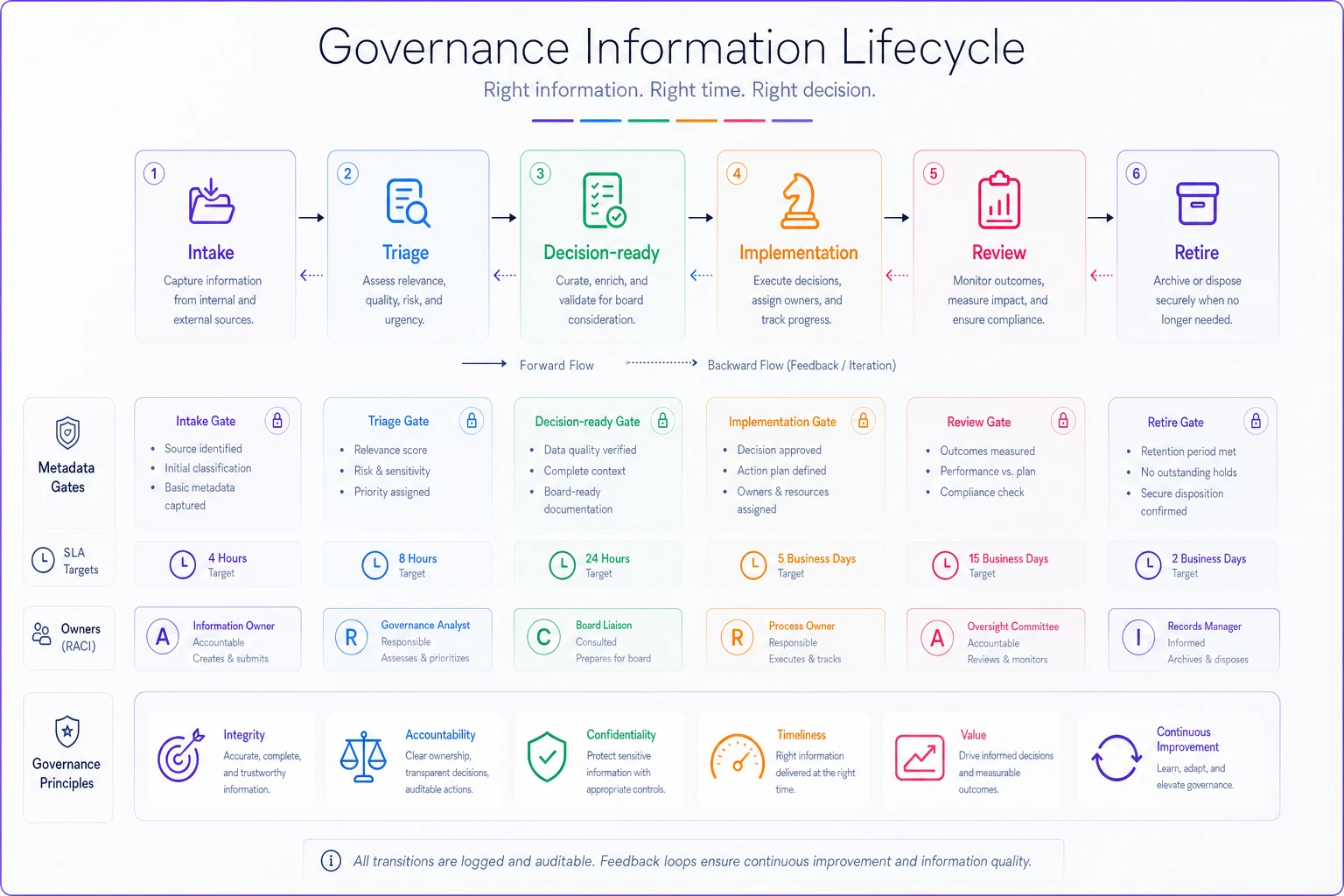
Every stage has a defined owner, an SLA, and a hard exit gate. Nothing drifts forward on its own, and nothing goes backward without a logged reason.
Lifecycle SLAs: putting a clock on every state
States without time limits just become nicer-looking piles. The point of defining states is so you can attach an SLA to each one and measure where things actually stall.
| State | Routine SLA | Priority SLA | Escalation trigger |
|---|---|---|---|
| Intake → classified | 3 business days | Same day | Unassigned after SLA |
| Triage → routed | 5 business days | 2 business days | No sponsor accepted |
| Decision-ready prep | 2–4 weeks | 1 week | Second QC failure |
| Decision pending (in front of board) | By next scheduled meeting | Called/written consent | Deferred twice |
| Implementation | Per action deadlines | Per action deadlines | Any action overdue >10 days |
| Review | 30–90 days post-outcome | 30 days | Review date passed, no reviewer |
| Retire disposition | Per retention schedule | On hold release | Disposition overdue |
A couple of operational notes from how this actually behaves in practice:
The Decision-ready prep state is where most of the real time lives, and it's the one boards measure least. If your dashboard shows items averaging five weeks here against a four-week SLA, that's not a secretary problem — that's a signal your sponsors are under-resourced or your QC bar is unclear.
Deferred twice is a specific, countable trigger. Everyone has experienced the item that gets "pushed to next meeting" indefinitely. Make the second deferral an automatic escalation to the chair, with a written reason. It's remarkable how quickly chronic deferrals disappear once they generate a visible flag.
Retirement triggers tied to legal-hold policy
Retirement is where governance lifecycles most often fall apart, so it deserves its own logic rather than a vague "keep for seven years" footnote.
-
Determine retention class at Triage (not at Retire). You want to know how long something lives the moment you know what it is.
-
Check hold status at the point of disposition. If any hold flag is active, route to Hold instead of Dispose and re-queue for periodic re-check.
-
Require dual approval for disposition of anything above a defined sensitivity level — typically the corporate secretary plus legal.
-
Log the disposition itself as a permanent record. The fact that you destroyed something on purpose, with authorization, on a given date, is itself evidence you need to keep.
-
Re-check held items on a cadence (quarterly works for most) so released holds flow back into normal disposition instead of becoming permanent clutter.
The common mistake is treating retention and legal hold as the same system. They're not. Retention is a default timeline; legal hold is an interrupt that suspends it. Build them as two layers, and the hold layer always wins.
Sample lifecycle dashboard and governance KPIs
The whole model earns its keep when a chair can look at one screen and see where governance information is stuck. Here's a wireframe you can hand to whoever builds your reporting.
GOVERNANCE INFORMATION LIFECYCLE — BOARD DASHBOARD -------------------------------------------------------------- STATE PIPELINE (counts + SLA status) Intake [12] Triage [8] Decision-ready [15] Impl [23] Review [6] Retire [4] ●on-time ●on-time ⚠ 4 breached ●on-time ⚠1 overdue ●on-time -------------------------------------------------------------- AGING — ITEMS PAST SLA • Vendor concentration review .......... Decision-ready .... 11 days over • Subsidiary policy refresh ............ Triage ............ 4 days over • Audit remediation follow-up .......... Implementation .... 14 days over -------------------------------------------------------------- DEFERRALS RETIREMENT & HOLDS Deferred once: 3 Scheduled this quarter: 9 Deferred twice (ESCALATED):1 On legal hold: 6 Disposition overdue: 1 -------------------------------------------------------------- METADATA COMPLETENESS: 94% | AVG DECISION CYCLE: 26 days
-
Metadata completeness rate — % of active items with all required fields populated. Below roughly 90% means your gates are being bypassed.
-
SLA adherence by state — tells you where the pipeline clogs, not just that it clogs.
-
Average decision cycle time — intake to decision. The single best measure of whether the board is a bottleneck or a throughput engine.
-
Deferral rate and repeat-deferral count — a proxy for how much the board re-litigates settled questions.
-
Retirement compliance — % of due dispositions executed on schedule, and open holds aging.
-
Backward-transition rate — how often decision-ready items bounce back. A rising number usually means packs are going up half-baked.
Connecting these KPIs to actual board outcomes is its own discipline. If you want the fuller treatment of linking lifecycle metrics to governance performance, the board stakeholder intelligence operating model for agenda mapping covers how pipeline data feeds agenda prioritization.
A real scenario: a four-subsidiary group tightens the lifecycle
A mid-sized group — a parent plus four operating subsidiaries, two board committees, one overworked corporate secretary — ran the classic pile-of-artifacts model. Board materials lived across email, a shared drive, and a lightly used portal. Nobody owned "intake," and retirement happened whenever IT complained about storage.
The visible symptoms: items routinely re-debated across meetings, a decision cycle that ran somewhere between eight and ten weeks from first mention to actual board sign-off, and metadata so inconsistent that roughly a third of archived items couldn't be reliably tied to the meeting that approved them.
They didn't buy anything exotic. They defined the six states, wrote the required-metadata gates, attached the SLA matrix above, and made "deferred twice = escalate to chair" a hard rule. Disposition got a dual-approval check against an active hold register. Within about two quarters, the decision cycle tightened to around four weeks for routine items. Repeat deferrals dropped to a handful. The thing that surprised them most wasn't speed — it was the retirement side. The first honest pass through disposition surfaced close to 200 items that should have been retired years earlier, and about a dozen sitting in a retirement queue despite being under an active dispute. Catching those dozen was, by itself, worth the whole exercise.
When this makes sense — and when it doesn't
When it's worth building. If you have multiple committees, more than one legal entity, any regulator who can demand evidence on short notice, or a history of re-debating decisions, the state machine pays for itself fast. Complexity is exactly what it's designed for.
When it's overkill. A single-entity nonprofit board with eight members, four meetings a year, and a strong secretary who genuinely has it all in hand doesn't need a formal state machine on day one. Forcing heavy metadata gates onto a tiny, high-trust board creates friction without much payoff. Start with intake discipline and a retention schedule, then add states as you grow.
Who should not roll this out cold. Any organization mid-crisis — active litigation, a live regulatory inquiry, a breach — should not try to redesign its information lifecycle while the house is on fire. Stabilize first, preserve everything, then formalize. Dropping a new disposition process into an active legal-hold situation is how accidents happen.
Making it real without boiling the ocean
You don't have to implement all six states at once. The sequence that tends to work:
-
Nail intake first. One owner, one timestamp, one classification. Most of the downstream mess is upstream neglect.
-
Add the retention class at triage. Decide how long things live before you decide where they go. It's trivial to capture at that point and painful to reconstruct later.
-
Put a clock on decision-ready. This is where your real cycle time hides.
-
Build retirement last, but build it deliberately — with the legal-hold override wired in from the start.
Whether you run this inside a dedicated governance platform or stitch it across tools you already have matters less than whether the rules are enforced somewhere other than one person's memory. Boards moving from drives and inboxes into a structured system see the biggest lift in auditability; if you're weighing that transition, the phase-based governance migration roadmap walks through sequencing the move without losing audit trails along the way.
Start with intake before adding other states to get the most immediate benefit.
The core shift is this: stop treating governance information as a collection of documents you hope people filed correctly, and start treating it as objects moving through states you can see, time, and account for. A memo isn't "in the drive" — it's in Triage, three days over SLA, owned by the audit chair, retention class seven years, no hold. Once every piece of information can describe itself that precisely, audits stop being scrambles, retirement stops being accidental, and the board stops re-arguing things it already decided.
The core shift is this: stop treating governance information as a collection of documents you hope people filed correctly, and start treating it as objects moving through states you can see, time, and account for. A memo isn't "in the drive" — it's in Triage, three days over SLA, owned by the audit chair, retention class seven years, no hold. Once every piece of information can describe itself that precisely, audits stop being scrambles, retirement stops being accidental, and the board stops re-arguing things it already decided.
Ready to enhance your board's productivity?
Join 500+ organizations using Panlly to save time, improve governance, and streamline board operations.