

Most boards don't fail because they lack information. They fail because the information arrives in the wrong format, at the wrong time, through the wrong door. A regulator sends a letter to the general counsel. An activist investor emails the IR team. A whistleblower files through an anonymous portal. A major customer flags a contract dispute to the CFO. A rating agency shifts its outlook. Each of these lands in a different inbox, gets triaged by a different person using different judgment, and — if the board hears about it at all — shows up months later as a bullet on slide 34.
The board sees fragments. The people running the company see fragments. Nobody sees the pattern until the pattern becomes a crisis.
A board stakeholder intelligence operating model fixes this by treating stakeholder signals the way a good operations team treats inbound work: one intake, consistent triage, scored impact, structured routing, and a clean handoff into the agenda. It's not about collecting more information. It's about building the connective tissue between where signals originate and where decisions get made.
This is a systems article, not a tips list. The goal is to show how intake, triage, scoring, digest, and agenda-mapping work together as one pipeline — and where that pipeline tends to snap under growth.
Why stakeholder signals fragment across the organization
Think about how stakeholder information actually moves inside a mid-sized company. There's rarely a single owner. Instead you get something like this:
-
- Investors and analysts → Investor Relations
-
- Regulators → General Counsel / Compliance
-
- Employees → HR, ethics hotline, or a manager who may or may not escalate
-
- Customers and partners → Sales, account management, or Legal if it turns contractual
-
- Media and public → Communications / PR
-
- Vendors and supply chain → Procurement / Operations
-
- Communities and NGOs → ESG lead, if one exists
Each of these functions has its own definition of "important," its own escalation reflexes, and its own reasons to keep problems contained until they're "figured out." That last part is the quiet killer. The instinct to solve a problem before surfacing it means the board often learns about issues after the window for cheap intervention has already closed.
The fragmentation isn't a character flaw. It's the natural result of a company that grew function by function. Nobody designed the system to lose signals — it just was never designed at all. Stakeholder intelligence tends to live in the gaps between departments, and gaps don't have owners.
What breaks as the company scales
At a small company, one competent corporate secretary or GC can hold the whole picture in their head. They know which investor is grumpy, which regulator is circling, which customer is threatening to walk. The "operating model" is one person's memory and relationships.
Eliminate boardroom chaos with seamless coordination.
Panlly simplifies scheduling, collaboration, and follow-ups for every board meeting.
- Centralized meeting scheduling
- Secure document sharing
- Task assignment & tracking
No credit card required
That works until it doesn't. Here's roughly the sequence of what breaks:
Volume outpaces memory. Once you cross a few hundred employees and a broader shareholder base, the number of signals exceeds any one person's ability to track. Things start slipping not because anyone is careless but because the volume is genuinely too high for informal handling.
Inconsistent triage creates blind spots. Two similar complaints get treated completely differently depending on who catches them. One gets escalated, one gets filed. The board never knows the second one existed until it becomes a lawsuit.
No shared scoring means no real prioritization. Without a common way to rate impact, "urgent" gets defined by whoever is loudest. The activist investor with a PR firm gets attention. The slow-building regulatory drift doesn't — even though the second one is often more dangerous.
Agenda time gets allocated by habit, not evidence. The board spends 40 minutes on the topic someone remembered to prep and zero minutes on the emerging risk nobody packaged. If you've built a multi-year board agenda portfolio, you already know agenda time is the scarcest governance resource there is. When stakeholder signals don't feed the agenda systematically, that scarce time gets misallocated by default.
Institutional memory evaporates. The corporate secretary retires or the GC leaves, and half the informal knowledge walks out the door. There's no record of which signals were seen, scored, and consciously deprioritized versus simply missed.
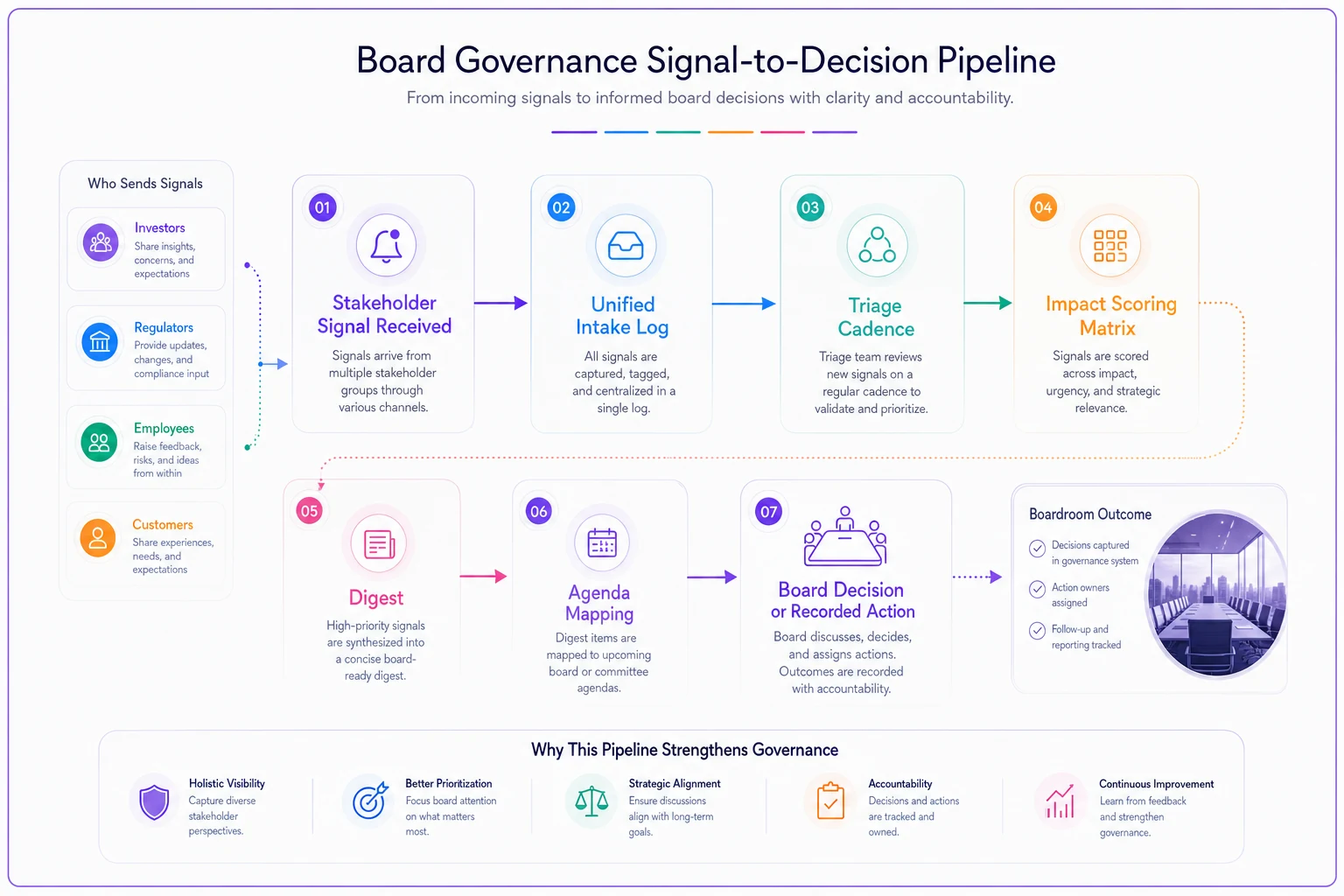
The pipeline: intake → triage → impact scoring → digest → agenda mapping
The fix is making the invisible flow explicit. Every stakeholder signal should travel the same path, regardless of which door it came through. Here's how the stages connect.
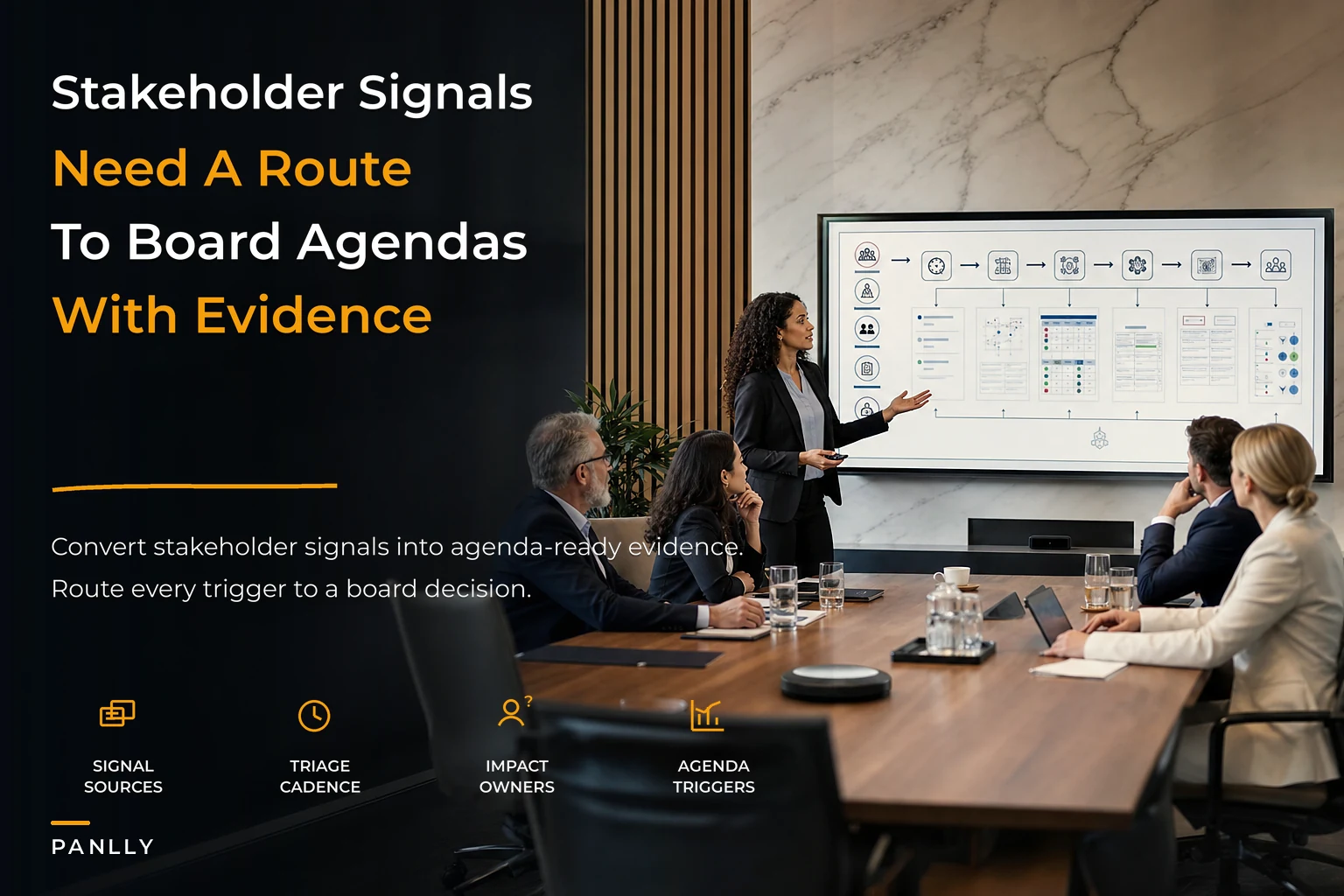
[Stakeholder Signal Received] ↓ [Unified Intake Log — source, channel, date received, date registered, raw description, confidentiality flag] ↓ [Triage Cadence — daily sweep → weekly huddle → monthly consolidation] ↓ [Impact Scoring Matrix — severity × velocity → score 1–5] ↓ [Digest — changes, escalations, clusters, deprioritized signals] ↓ [Agenda Mapping — score tier determines routing: committee, board, or management] ↓ [Board Decision or Recorded Action]
Here's a simple visual of the pipeline.
1. Unified intake
The goal of intake isn't to force everyone through one form — that fails because the IR team and the ethics hotline have genuinely different needs. The goal is that every signal, however it arrives, gets registered in one place with a minimum common data set.
-
- Source stream (investor, regulator, employee, customer, vendor, media, community)
-
- Originating channel (email, portal, letter, call, meeting)
-
- Date received and date registered (the gap between these two is itself a diagnostic)
-
- Raw description (what was actually said, not someone's interpretation)
-
- Function that received it
-
- Confidentiality / privilege flag
You keep the specialized forms each function already uses. What you add is a lightweight registration step that pushes a standard header into a shared log. In practice, the single most valuable field here is the gap between "received" and "registered." When that gap starts stretching from hours to weeks, you've found a broken door.
2. Triage cadence
Triage is where a raw signal becomes a classified one. The mistake most organizations make is treating triage as an event ("we'll review these at the quarterly meeting") instead of a cadence. Signals don't respect quarterly rhythms.
-
- Daily light-touch sweep — a designated triage owner (often the corporate secretary's office or a governance analyst) scans new intake for anything flagged high-severity by the originating function.
-
- Weekly triage huddle — 30 minutes, cross-functional, to classify the week's new signals and reconcile disagreements about severity.
-
- Monthly consolidation — pattern review across streams, looking for clusters (three customer complaints about the same product line, two regulators asking similar questions).
The weekly huddle is the load-bearing element. It's where the IR person hears what the ethics hotline saw, and where someone finally connects two dots that were sitting in separate departments.
3. Impact scoring matrix
This is the stage that makes prioritization defensible. Without a scoring matrix, escalation is political. With one, it's evidence-based — and you can show a regulator or a plaintiff's attorney exactly how you decided what mattered.
| Score | Severity (impact if realized) | Velocity (how fast it's moving) | Default routing |
|---|---|---|---|
| 1 – Low | Minor, contained, reversible | Slow / dormant | Log only, monthly review |
| 2 – Moderate | Meaningful but manageable | Developing over quarters | Management action, digest note |
| 3 – Elevated | Material to a function or region | Moving over weeks | Committee attention |
| 4 – High | Enterprise-material | Moving over days | Board digest + committee chair alert |
| 5 – Critical | Existential / reputational | Immediate | Board notification + trigger protocol |
Scoring shouldn't be a solo judgment call. It's set in the triage huddle so at least two sets of eyes are on anything scored 3 or above. The pattern to watch for: signals that individually score a 2 but cluster into a 4. Vendor concentration, ESG drift, and slow regulatory pressure almost always show up this way — small until they aren't. This is the same logic behind mapping your risk register to board agendas and escalation triggers; stakeholder signals are early-warning inputs to that same risk machinery.
A well-calibrated scoring matrix should be stable enough that two different triage participants land on the same score most of the time. If you're getting consistent disagreements, the definitions need tightening, not the judgment.
4. Digest
The digest is the translation layer between operational detail and board-level attention. Directors don't need every signal. They need a curated, consistent read on what's moving and why it matters.
-
- What changed this period (new signals scored 3+)
-
- What's escalating (signals that moved up the matrix)
-
- Emerging clusters (patterns across streams)
-
- What was deprioritized and why (this is the part most boards skip, and it's the part that protects them later)
That last bullet matters more than it looks. Documenting what you consciously chose not to act on — and the reasoning behind it — is what separates "we exercised judgment" from "we were asleep" if things go sideways.
5. Agenda mapping
The final stage routes scored, digested signals into the actual board agenda. This is where the whole pipeline either pays off or dies. If a signal scores a 4 and there's no mechanism to get it onto an agenda, you've built an elaborate machine that produces a nice report nobody acts on.
-
1. Score 5 → immediate board notification, potential special meeting, trigger protocol
-
2. Score 4 → next board meeting, committee chair pre-briefed
-
3. Score 3 → relevant committee workplan
-
4. Score 2 → management dashboard, referenced in quarterly digest
-
5. Score 1 → logged, reviewed monthly
The connection to decision-making is where this earns its keep. When you can trace a boardroom decision back through the digest, the score, the triage, and the original signal, you get a clean evidence chain. That same discipline underpins how you'd map decisions to KPIs in a board reporting framework — stakeholder intelligence becomes another input stream feeding a coherent decision record.
A real scenario
Consider a regional healthcare services company — roughly 1,400 employees, private equity backed, five subsidiary entities. Stakeholder signals were scattered across a GC, a two-person IR function, an ethics hotline run by an outside vendor, and account managers who escalated to whoever they trusted.
Over about eight months, three separate things happened: two clinics generated repeat patient-billing complaints through the hotline, a state regulator sent an informal information request to the GC, and a large payer partner flagged contract-compliance concerns to an account manager. Each was handled in isolation. Each looked minor on its own. The board didn't see any of them until the regulator's second, more formal request landed — at which point the billing complaints suddenly looked like corroborating evidence, and the payer's concern looked like a pattern.
The cleanup cost real money — outside counsel, a compliance review, and a delayed refinancing while the PE sponsor asked hard questions. The internal estimate of avoidable cost landed somewhere in the low-to-mid six figures, most of it attributable to a late start on the response.
After the fact, they stood up a stakeholder intelligence pipeline. The mechanics were unglamorous: a shared intake log, a weekly 30-minute triage huddle, a 1–5 scoring matrix, and a one-page monthly digest to the audit committee chair. Within two quarters, clustering became visible early. A similar billing pattern surfaced again — but this time it scored a 3 in week two instead of hiding for months. The committee addressed it before it reached a regulator at all. No dramatic transformation. Just a noticeable shift from reactive to ahead-of-it.
Where the right tooling actually helps
You can run this pipeline on spreadsheets and calendar invites, and plenty of smaller boards do. It works until volume and multi-entity complexity make manual reconciliation the bottleneck. Once you're tracking signals across several subsidiaries, multiple functions, and different confidentiality tiers, the reconciliation itself becomes a job.
-
- Automatically deduplicating and clustering related signals across streams so the "three complaints, one root cause" pattern surfaces without someone manually cross-referencing.
-
- Flagging aging intake — signals sitting untriaged past their SLA — so nothing rots in a queue.
-
- Drafting the digest from the underlying log so the corporate secretary is editing rather than assembling from scratch.
-
- Preserving the evidence chain automatically, so the link from signal to score to decision is always intact for regulators or litigation.
The point isn't automation for its own sake. The reconciliation and pattern-detection work — the stuff that eats hours and still gets missed — is exactly where AI-powered operational software reduces manual load and human error. The judgment stays with people. The tedious cross-checking gets handled underneath.
When this operating model makes sense
It makes sense when:
-
- You have multiple stakeholder streams entering through different functions with no shared view.
-
- You operate across multiple entities, regions, or regulatory regimes.
-
- You've been surprised at least once by something that "should have been caught earlier."
-
- Your board agenda feels reactive — driven by whatever got prepped rather than what's actually most material.
It's overkill when:
-
- You're a small board with a single, tightly held relationship map that genuinely fits in one person's head.
-
- Signal volume is low enough that a monthly informal review catches everything.
Who should not do this halfway: organizations in heavily regulated sectors. A partial pipeline — intake and scoring but no agenda mapping, or a digest nobody reads — is arguably worse than nothing, because it creates a paper trail showing you saw the signal and did nothing with it. If you build the machine, wire it all the way through to the agenda.
Getting started without boiling the ocean
You don't need a six-month project. A minimal viable version:
-
1. Map your streams and doors. List every stakeholder type and where their signals currently land. This alone usually reveals two or three orphaned channels.
-
2. Stand up a shared intake log. One place, minimum common fields, existing forms feed into it.
-
3. Set a weekly triage huddle. Thirty minutes, cross-functional, recurring.
-
4. Adopt a simple scoring matrix. Two axes, five levels, agreed definitions.
-
5. Define agenda routing by tier. Every score has a predetermined destination.
-
6. Ship a one-page digest. Same format, every cycle, including what you deprioritized.
Start with the weekly triage huddle and a minimal intake log — you can expand scoring and routing later.
The whole thing can go from concept to running in a quarter. The hard part isn't the design — it's holding the weekly huddle when everyone's busy and nothing seems urgent. That's precisely when the pipeline is doing its most valuable work: catching the quiet signal before it gets loud.
Closing thought
Boards are accountable for oversight, but oversight is only as good as the signals reaching the boardroom. A stakeholder intelligence operating model doesn't make directors smarter — it makes sure the information they need actually arrives, scored and structured, in time to matter.
The companies that get burned rarely lacked the data. They lacked the pipeline connecting the data to the decision. Build that pipeline, keep it disciplined, and most of the surprises that end up in headlines get caught while they're still just line items in a weekly huddle.
Boards are accountable for oversight, but oversight is only as good as the signals reaching the boardroom. A stakeholder intelligence operating model doesn't make directors smarter — it makes sure the information they need actually arrives, scored and structured, in time to matter.
Ready to enhance your board's productivity?
Join 500+ organizations using Panlly to save time, improve governance, and streamline board operations.