



Most governance "data strategies" fall apart at the exact moment they need to prove themselves: the migration. A board has lived in one platform for six years, signs a deal with a new vendor, and then discovers that the thing they thought they owned — their minutes, their resolutions, their decision history — comes out as a flat PDF dump with no structure, no reliable metadata, and no way to verify that what came out matches what went in.
That failure isn't a vendor problem. It's an architecture problem. Nobody ever defined what "correct" looked like in machine-readable terms, so there was nothing to test against.
This is the gap a real governance information architecture closes. Not a taxonomy document sitting in a shared drive, but a set of contracts — testable API definitions, import/export acceptance criteria, portability measures, and mapping rules — that legal, IT, and procurement can each hold a vendor accountable to. The board doesn't need to read JSON. The board needs to know that someone can, and that the standard is written down before the money moves.
Why the three departments break the architecture in three different ways
The reason governance data ends up ungovernable is that the three groups responsible for it never share a definition of done.
Legal cares about defensibility — can we prove this record is authentic, unaltered, and retrievable years later. IT cares about interoperability — can this system talk to our identity provider, our storage, our retention tooling. Procurement cares about exit and leverage — can we leave this vendor without a hostage negotiation over our own data.
What tends to happen across enterprise governance stacks is that each group writes its requirements in its own language, hands them to the vendor separately, and nobody reconciles them. Legal asks for "immutable audit trails." IT asks for "API access." Procurement asks for "data export on termination." All three sound reasonable. None of them are testable. A vendor can honestly answer "yes" to all three and still hand you a useless archive on the way out.
The fix is to collapse those three requirement sets into one shared artifact: a contract that defines the actual shape of the data, the behavior of the APIs that move it, and the measurable criteria that prove portability. When that artifact exists, each department is testing the same thing from its own angle — instead of three groups each testing three imaginary things.
Start with the object model, not the system
Before any API talk, you need agreement on what the governance objects actually are. Not screens, not modules — objects. A resolution is an object. A meeting is an object. A director is an object. A vote is an object. An attachment is an object with its own lineage.
Eliminate boardroom chaos with seamless coordination.
Panlly simplifies scheduling, collaboration, and follow-ups for every board meeting.
- Centralized meeting scheduling
- Secure document sharing
- Task assignment & tracking
No credit card required
The mistake most organizations make is modeling around the current vendor's UI. If your data model is shaped like your incumbent's product, vendor lock-in is already baked in before you've started. The model should describe governance reality, which is stable — not a software layout, which changes every procurement cycle.
A workable resolution object looks something like this:
``json
{
"$schema": "https://governance.example.org/schemas/resolution.v1.json",
"resolutionid": "RES-2024-0471",
"entityid": "ENT-0003",
"meetingid": "MTG-2024-0088",
"title": "Approval of FY25 capital budget",
"status": "carried",
"proposedby": "DIR-0012",
"secondedby": "DIR-0021",
"vote": {
"method": "rollcall",
"for": 7,
"against": 1,
"abstain": 1,
"recused": ["DIR-0019"]
},
"effectivedate": "2024-11-14",
"supersedes": null,
"attachments": ["DOC-55210", "DOC-55211"],
"provenance": {
"createdat": "2024-11-14T15:42:00Z",
"createdby": "SEC-0002",
"sourcesystem": "boardportal-v4",
"contenthash": "sha256:9f2c...a71e"
},
"retention": {
"class": "permanent",
"legalhold": false
}
}
``
Three things in there do most of the heavy lifting and tend to get skipped. The provenance block is what legal needs for authenticity. The supersedes field is how you preserve decision history instead of overwriting it — the same principle behind a durable governance data model that maps decision logs to KPIs and enterprise systems. The content_hash is what makes an import/export verifiable later, because it gives you something to compare against after data round-trips through another system.
If the object model is right, the API contract and the portability tests mostly write themselves. If it's wrong, no amount of API elegance saves you.
The API contract is where "yes" becomes provable
An API contract isn't documentation. It's a specification precise enough that you could write an automated test against it and have that test pass or fail without anyone arguing about interpretation.
``` GET /v1/entities/{entityid}/resolutions ?modifiedsince={iso8601} &pagesize={int, max 500} Response: 200 Content-Type: application/json Body: { "data": [ <resolution objects conforming to resolution.v1.json> ], "page": { "nextcursor": "string|null", "total": "int" } } Guarantees:
-
Every object in
dataMUST validate against resolution.v1.json -
content_hashMUST be reproducible from canonical object serialization -
Deleted records MUST appear with status="void", never silently omitted
-
Pagination MUST be stable under concurrent writes (cursor-based)
Errors: 401 unauthorized — missing/invalid token 403 forbidden — entity scope not granted 422 unprocessable — malformed query param ```
Two clauses matter more than they look. "Deleted records must appear with status void, never silently omitted" is what stops a migration from quietly losing rescinded resolutions — a classic way decision history disappears. "Content hash must be reproducible from canonical serialization" is what makes the whole portability story testable, because it defines a deterministic way to prove two systems hold the same record.
A common failure pattern: vendors expose an API that returns whatever the UI happens to show, with fields that shift based on user permissions or screen context. That's not a contract, that's a view. If the same request can return different shapes on different days, you can't build acceptance tests on top of it, and you can't trust an export.
Acceptance tests: the part procurement should refuse to skip
Import/export acceptance tests are the single highest-leverage thing a board can insist on during procurement, and they're the first thing cut when timelines slip. They shouldn't be.
The idea is simple. You define a representative sample of governance data, push it through the full round trip — export from system A, import into system B, export again — and assert that nothing meaningful changed. If a record came out different than it went in, the test fails, and the vendor fixes it before go-live, not during litigation.
``` TEST: resolutionroundtrippreserves_integrity GIVEN a fixture set of 50 resolutions covering:
-
carried, failed, withdrawn, and void statuses
-
recusals and abstentions
-
superseding chains (A supersedes B supersedes C)
-
unicode titles and attachments
WHEN the set is exported from System A AND imported into System B AND re-exported from System B THEN every resolutionid present in source is present in output AND contenthash matches for every unchanged record AND supersedes chains resolve to the same ordering AND recused director lists match exactly AND no status silently converts (e.g. "void" never becomes "carried") AND attachment references resolve to byte-identical files ```
The fixtures are the real work. Clean, happy-path data always migrates fine. Governance data breaks on edge cases: the resolution that was carried then rescinded, the director who recused on one vote and voted on the next, the attachment replaced after the meeting. Your fixture set should be deliberately messy, because that's where silent corruption hides.
This discipline pairs directly with a staged phase-based program to digitize board processes and preserve audit trails — the acceptance tests are what tell you a phase actually succeeded instead of just appearing to.
A portability KPI rubric directors can actually review
Boards shouldn't be reading test logs. They should be looking at a small set of indicators that tell them whether their governance data is genuinely portable or quietly trapped. Here's a rubric that translates engineering reality into something reviewable in a committee meeting.
| KPI | What it measures | Green | Amber | Red |
|---|---|---|---|---|
| Schema conformance | % of exported records that validate against the published schema | ≥ 99.5% | 95–99.4% | < 95% |
| Round-trip fidelity | % of records byte/hash-identical after export→import→export | ≥ 99.9% | 99–99.8% | < 99% |
| Export completeness | Exported record count vs. system of record count | 100% | 99.5–99.9% | < 99.5% |
| Export latency | Time to produce a full certified export | < 24h | 1–3 days | > 3 days |
| Standalone usability | Can exported data be read without the vendor's software? | Fully | Partially | No |
| Mapping coverage | % of fields with documented cross-system mapping | ≥ 95% | 80–94% | < 80% |
The one directors consistently underweight is standalone usability. An export that technically contains everything but can only be opened inside the same vendor's proprietary viewer isn't portability — it's a longer leash. The test is blunt: hand the export to someone with no access to the original system and ask them to reconstruct a decision. If they can't, you're red regardless of what the other rows say.
The other quiet trap is export latency. A vendor who can produce a full certified export in under a day is a vendor you can leave on your own timeline. A vendor whose export takes a week and a support ticket controls your exit schedule — which is exactly the leverage you don't want them holding during a contract dispute.
Cross-system mapping: the rules nobody writes down until it's too late
Governance data never lives in one place. Resolutions touch the GRC system. Director records touch identity management. Attachments touch document storage. Retention classes touch records management. The mapping rules that connect these are usually tribal knowledge sitting in one administrator's head, which means they vanish the moment that person leaves.
Written mapping rules turn that tribal knowledge into an asset. A usable mapping entry has four parts: source field, target field, transformation, and the rule for what happens when the mapping fails.
``
source: resolution.vote.recused[]      (array of directorid)
target: GRC.conflictregister.events[] (one event per recusal)
transform:
  for each directorid in recused[]:
    create conflictevent {
      personref: lookup(directorid) in IDM,
      contextref: resolutionid,
      type: "recusal",
      date: resolution.effectivedate
    }
onfailure:
  if lookup(director_id) returns null:
    halt import, flag record, do not create partial event
``
That on_failure line is what separates a mapping rule from a hopeful suggestion. The default behavior in most integrations is to skip what it can't map and keep going, which produces a target system that looks complete and is silently missing records. For governance data, partial success is worse than failure — failure is visible, partial success isn't. The rule should almost always be halt-and-flag, not skip-and-proceed.
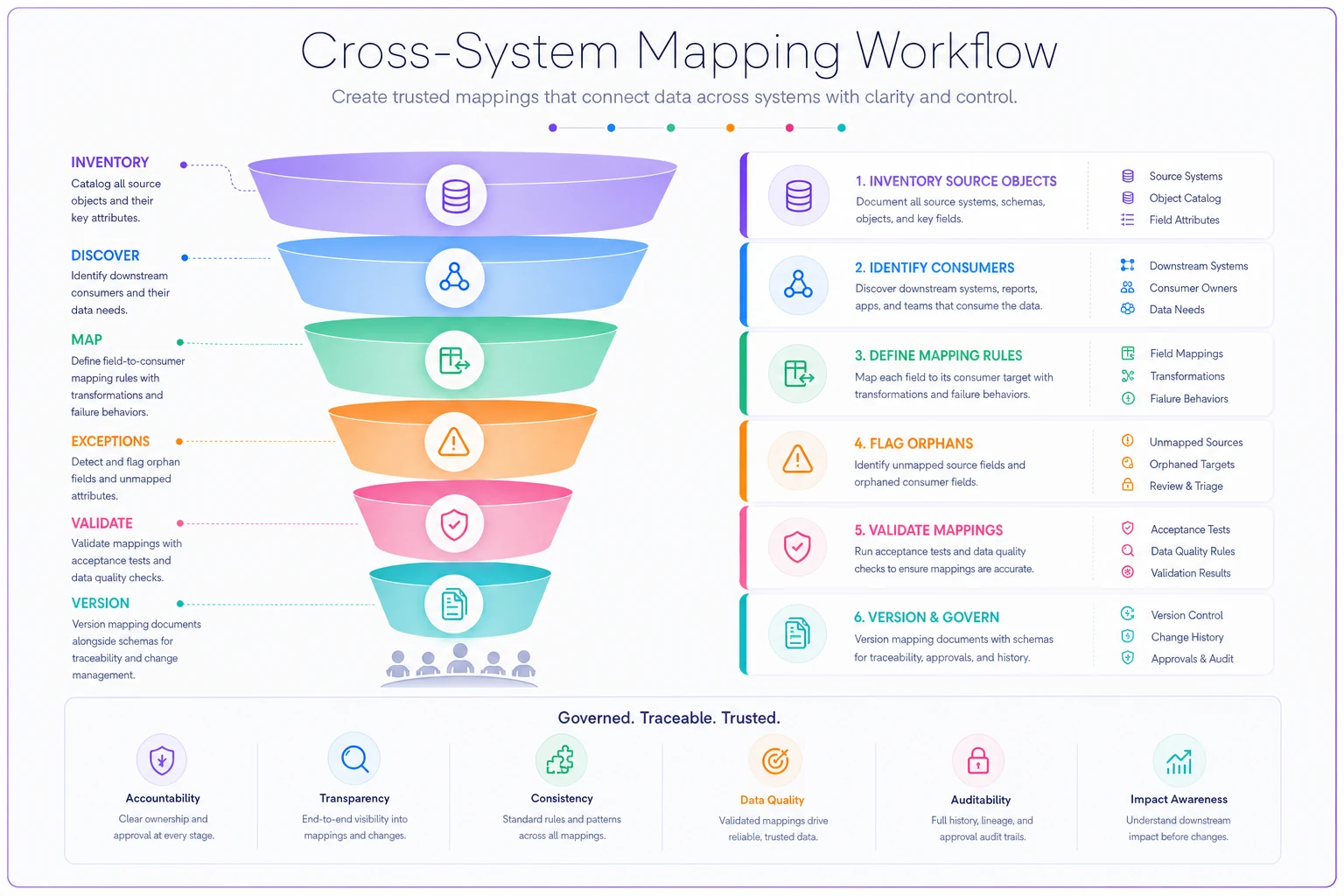
A simple process for building the mapping layer
-
Inventory the source objects — list every governance object and its fields as they actually exist, not as the schema wishes they existed.
-
Identify every downstream consumer — which systems read each object, and which fields they depend on.
-
Write one mapping rule per field-to-consumer relationship, including the transformation and the failure behavior.
-
Flag the orphans — any field with no documented consumer, and any consumer expecting a field that doesn't exist. Orphans are future outages.
-
Validate against the acceptance tests — run real fixtures through the mappings and confirm the failure rules actually fire.
-
Version the mapping document alongside the schema, so changes to one force review of the other.
Flagging orphans early often uncovers assumptions that caused long-running data gaps.
The orphan step catches more problems than anything else. A field nobody consumes is either dead weight or a dependency someone forgot to document — and you want to know which before a migration, not after. That single check has a way of surfacing assumptions that have been silently wrong for years.
Here's a simple visual of the mapping process.
That single check has a way of surfacing assumptions that have been silently wrong for years.
When this level of rigor makes sense — and when it doesn't
This is real work, and it isn't free. Worth being honest about where it pays off.
When it makes sense: multi-entity groups with subsidiary boards, regulated industries where records face litigation or regulator review, any organization mid-way through or planning a platform migration, and any board signing a multi-year governance software contract. If you're committing to a vendor for five years, the cost of defining these contracts is trivial next to the cost of discovering at year five that you can't leave.
When it's probably overkill: a single small entity with a simple board, low record volume, and no regulatory exposure, where the full governance history would fit in a well-organized shared drive. Building testable API contracts for twelve resolutions a year is engineering theater.
Who should not lead this: legal alone, IT alone, or procurement alone. Every time one department owns it in isolation, the artifact bends toward that department's priorities and the other two get shortchanged. It needs one owner with authority to pull all three into the same document. The procurement discipline around this overlaps heavily with a proper governance-tech procurement checklist for board oversight and exit — the acceptance tests and portability KPIs belong in the contract, not in a side conversation.
A real scenario: the migration that nearly lost a decade
A mid-sized holding company with four operating subsidiaries decided to move off a board portal they'd used for roughly nine years. The new vendor demo'd a clean import. Procurement was ready to sign.
Before signing, the corporate secretary insisted on a round-trip acceptance test against a fixture set of around 200 historical resolutions — deliberately including the messy ones: rescinded approvals, recusals, superseding chains from a reorganization three years earlier.
The first test run failed on two counts. Roughly 11% of superseding chains collapsed — the new system kept the latest resolution but dropped the record it had replaced, erasing the "why" behind several decisions. And every recusal was silently flattened; the import treated recused directors as simply absent, which would have quietly broken the conflict register in their GRC system.
Neither problem was visible in the demo. Both would have surfaced years later, probably during exactly the kind of review you least want surprises in. The vendor fixed the superseding logic and the recusal mapping before go-live, and the contract was updated to include a certified-export clause with a sub-24-hour latency requirement. The cost of catching it early was about three weeks of testing. The cost of catching it late would have been a decade of decision history with holes in it.
The point isn't the JSON
Schemas and contracts look like technical artifacts, and the temptation is to treat them as IT's problem. They aren't. They're the mechanism that turns a vague promise — "your data is yours, you can always get it out" — into something a board can verify before it matters.
A governance information architecture built this way does three things at once. It gives legal provenance they can defend, gives IT interoperability they can actually integrate, and gives procurement an exit they can execute on their own schedule. More importantly, it means the next migration, the next regulator request, and the next vendor dispute all start from a position of knowing exactly what you have and being able to prove it moves intact. That certainty is the whole product. Everything above is just how you get there.
Schemas and contracts look like technical artifacts, and the temptation is to treat them as IT's problem. They aren't. They're the mechanism that turns a vague promise — "your data is yours, you can always get it out" — into something a board can verify before it matters.
A governance information architecture built this way does three things at once. It gives legal provenance they can defend, gives IT interoperability they can actually integrate, and gives procurement an exit they can execute on their own schedule. More importantly, it means the next migration, the next regulator request, and the next vendor dispute all start from a position of knowing exactly what you have and being able to prove it moves intact. That certainty is the whole product. Everything above is just how you get there.
Ready to enhance your board's productivity?
Join 500+ organizations using Panlly to save time, improve governance, and streamline board operations.