


Three quarters into a transformative acquisition, the board of a mid-sized healthcare technology company discovered their risk register hadn't been updated in eighteen months. The acquisition target's largest customer had been flagging payment delays for weeks, but it never made it to the board agenda because the risk fell into what management called "the gray zone" — not quite routine enough for regular reporting, not severe enough for emergency escalation.
The deal survived, barely. But the post-mortem revealed something that goes well beyond one missed signal. Risk information tends to flow to directors through three broken channels: quarterly updates that arrive too late, crisis calls without context, or signals buried in management reports where they get lost in operational noise.
The real problem isn't that boards don't care about risk. It's that most organizations never build the connective tissue between their risk register and their board agenda. They track risks in one system, plan board meetings in another, and wonder why directors feel blindsided when things escalate.
Why risk registers and board agendas exist in parallel universes
Walk into any corporate secretary's office and you'll find two documents that should talk to each other but rarely do. The risk register sits with the Chief Risk Officer, updated quarterly if you're lucky, filled with heat maps and probability scores that make sense to risk professionals but don't mean much to directors planning next month's agenda. Meanwhile, the board agenda gets built from a template, with standing items that haven't changed in years, plus whatever fires erupted recently.
Risk managers categorize threats by likelihood and impact — 5x5 matrices, traffic light systems, the usual. But when the corporate secretary builds the agenda, they're thinking about time allocation, committee jurisdiction, and whether directors have enough context to make decisions. These two groups speak different languages about the same underlying issues.
I watched this at a fintech company where customer data exposure risk bounced between "moderate" and "high" on their register for six months. The risk team dutifully updated their assessments. The board got quarterly summaries. But because the risk never crossed the threshold for "critical," it never got dedicated agenda time. When a small breach eventually happened, directors asked the obvious question: why didn't we discuss this earlier?
That question reveals the core problem. Most companies treat risk reporting as a compliance exercise rather than a decision-making tool. They update registers because auditors expect it. They brief boards because regulations require it. But they never build the machinery to convert risk signals into board action.
The classification system that changes everything
Companies that get this right stop classifying risks by likelihood and impact alone. They add a third dimension: board decision impact.
Eliminate boardroom chaos with seamless coordination.
Panlly simplifies scheduling, collaboration, and follow-ups for every board meeting.
- Centralized meeting scheduling
- Secure document sharing
- Task assignment & tracking
No credit card required
Operationally, this means adding one column to your risk register: "Board Decision Required Within." For each risk, define the timeframe where board input becomes necessary. A cybersecurity vulnerability might need board awareness within 48 hours if exploited. A regulatory change might need board discussion within one quarter to adjust strategy. A competitive threat might need board input within six months to approve defensive investments.
Pro-tip: When you add the "Board Decision Required Within" column, ensure each entry includes a clear owner and a specific timeframe so agendas can be driven by decision windows rather than calendar cycles.
This immediately changes how you think about agendas. Instead of scheduling risk discussions on arbitrary quarterly cycles, you're scheduling based on decision windows. The board's time gets allocated based on when they actually need to weigh in, not when the calendar says it's time for a risk update.
One manufacturing company restructured their entire risk governance after implementing this. They discovered that roughly 60% of their "high impact" risks required no board decision within the next year — they were operational issues management could handle with existing authority. Meanwhile, several "moderate" risks involving strategic partnerships needed board input within 90 days but weren't scheduled until the annual strategy session.
The classification also helps clarify what belongs in committee versus full board discussion. Risks requiring near-term decisions go to the full board. Risks requiring monitoring but no immediate decisions go to the relevant committee. Risks requiring only management action stay off the board agenda entirely, appearing only in dashboard summaries.
Building tolerance bands that actually trigger agenda changes
Every board talks about risk tolerance. Few translate those tolerances into operational triggers that change meeting agendas. Companies that do this well create explicit tolerance bands with defined escalation thresholds.
| Band | Criteria/Trigger |
|---|---|
| Operating range | Operating range means the risk stays in regular reporting. Operating range: no single customer exceeds 15% of revenue. |
| Exception range | Exception range triggers inclusion in the next scheduled board meeting. Exception range: any customer between 15-20% triggers board discussion at the next meeting. |
| Crisis range | Crisis range triggers an immediate briefing within a defined timeframe. Crisis range: any customer exceeding 20%, or showing signs of churn, triggers board notification within 72 hours. |
The important part is making triggers automatic rather than subject to management judgment. When an indicator crosses into exception range, it goes on the next board agenda — no discussion about whether it's "really necessary" or whether management can handle it quietly. The trigger creates the agenda item.
This solves the eternal tension between management wanting to solve problems before escalating and boards wanting early warning. Management knows exactly when issues will hit the board agenda. Boards know they'll hear about risks while there's still time to influence outcomes.
The escalation matrix that prevents surprises
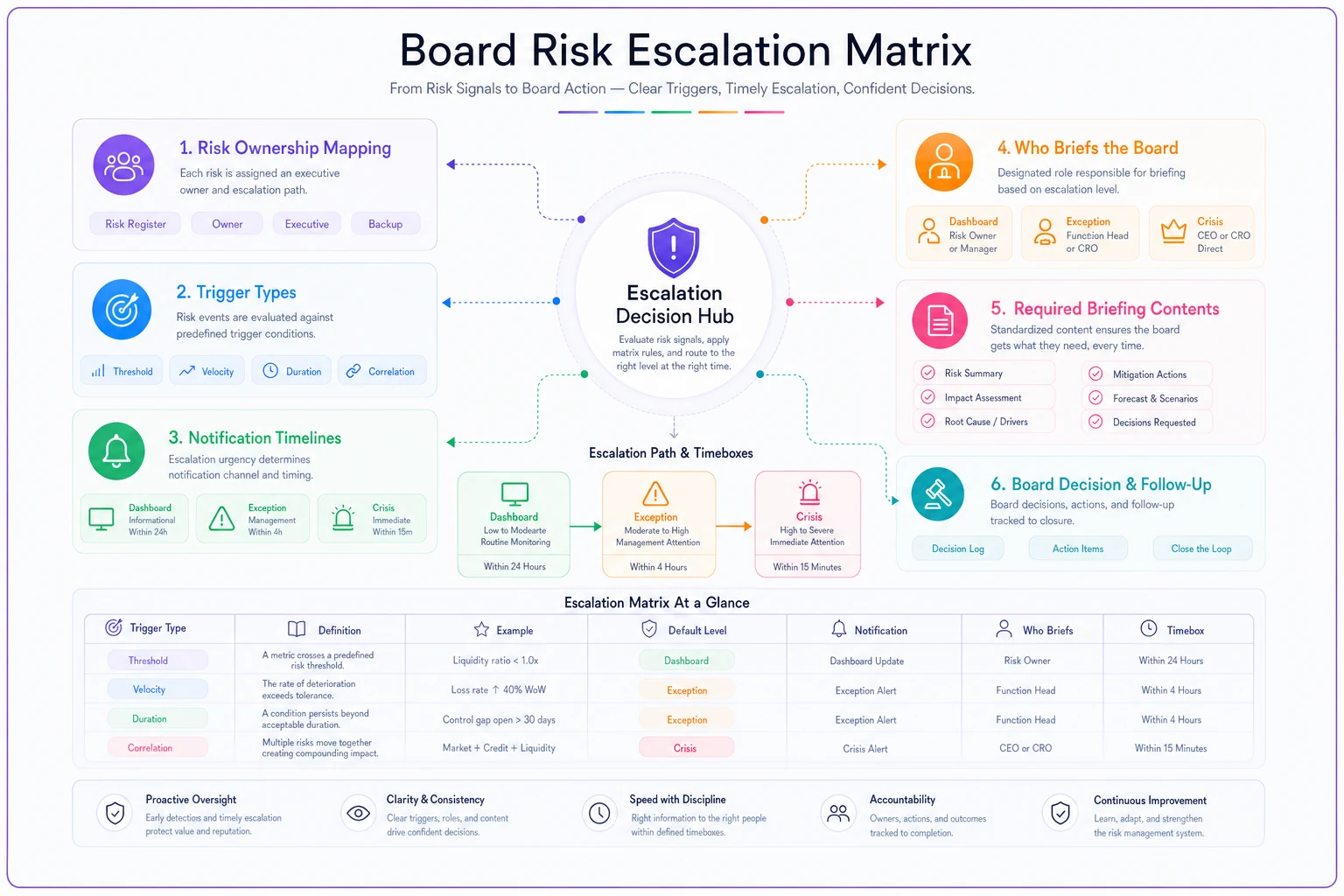
High-functioning boards create escalation matrices defining exactly who must brief the board, when, and with what information. This isn't bureaucracy — it's about ensuring the right information reaches directors while they can still influence outcomes.
Start with risk ownership. For each major risk category, identify the executive owner and their escalation obligations. The CFO owns financial risks. The CISO owns cyber risks. But here's where most companies stop: they fail to define what triggers mandatory board briefing regardless of the executive's own assessment.
A retail company learned this after their Chief Marketing Officer held onto declining customer satisfaction scores for six months, confident they could reverse the trend without board involvement. By the time the board found out, same-store sales had dropped 12% and recovery required significant unbudgeted investment.
Their revised escalation matrix includes triggers that bypass executive discretion. Customer satisfaction below 70%? Automatic board briefing at next meeting. Same-store sales declining two consecutive quarters? Board notification with an action plan due within two weeks. Data breach affecting more than 1,000 customers? Board notification within 24 hours, special meeting within 72 hours if not contained.
The matrix also specifies what information each escalation level requires. Regular monitoring gets dashboard metrics. Exception escalations require root cause analysis, management action plan, and resource requirements. Crisis escalations require containment actions, regulatory notification status, customer impact assessment, and financial exposure estimates.
This structure transforms board reporting from reactive to proactive, giving directors the context they need to make real decisions rather than receiving after-the-fact updates.
Sample agenda templates that embed risk discussions
The best enterprise risk oversight board agenda templates don't treat risk as a standalone item — they weave risk considerations throughout the meeting. Instead of one "risk update" presentation, risk discussions appear wherever they naturally connect to board decisions.
-
Opening (15 minutes) - CEO update including material risk indicator changes - Any risks that moved into exception or crisis bands since last meeting
-
Strategic Items (60 minutes) - Each strategic initiative includes a risk assessment update - New initiatives include risk factors in approval materials - Post-implementation reviews include risk realization vs. projection
-
Operating Performance (30 minutes) - Financial results annotated with risk indicators - Operational metrics shown with tolerance bands - Variance analysis includes risk factor attribution
-
Risk Deep Dive (20 minutes) - Rotating focus on one risk category per meeting - Detailed review of controls, indicators, and preparedness - Stress test results or scenario analysis
-
Consent Agenda - Risks within operating range (dashboard only) - Previously discussed risks with no material change
This structure ensures risk gets discussed in context, not isolation. When the board reviews a new product launch, they simultaneously review launch risks. When they evaluate financial performance, they see how risk factors influenced results.
One technology company improved their board discussions by requiring every agenda item to include a simple risk notation: Green (within tolerance), Yellow (approaching limits), Red (outside tolerance). That visual cue immediately tells directors where to focus. A strategic initiative marked yellow gets more scrutiny than one marked green, even if both are technically "on track."
The trigger logic that forces difficult conversations
Most executives hesitate to escalate issues to the board even when triggers are clear. They want to present solutions, not problems. They don't want to look like they've lost control. This tendency undermines even well-designed frameworks.
The solution is trigger logic that removes discretion from the escalation decision. When defined conditions are met, board notification becomes mandatory. This actually protects executives too — they can't be blamed for escalating per policy, and directors can't claim they should have been informed earlier.
Effective trigger logic covers multiple dimensions:
Velocity triggers: Risk indicator deteriorating at a defined rate (revenue declining more than 5% month-over-month, customer churn accelerating more than 2% per quarter)
Threshold triggers: Absolute levels requiring board attention (cash below 90 days of operating expenses, employee turnover exceeding 25%)
Duration triggers: Conditions persisting beyond acceptable timeframes (system outage exceeding 4 hours, regulatory response delayed beyond 30 days)
Correlation triggers: Multiple indicators moving together (customer satisfaction declining AND renewal rates dropping AND support tickets increasing)
A healthcare services company implemented correlation triggers after realizing individual metrics looked acceptable but the combined pattern was a problem. No single metric hit red, but when three yellow indicators appeared in the same business unit simultaneously, it triggered automatic board review. They caught a quality issue six months before it would have surfaced in traditional reporting.
The trigger logic needs to connect to your action item tracking system so escalated issues get resolved, not just discussed. When a trigger forces board discussion, the resulting decisions need tracking and accountability until the risk returns to acceptable levels.
Making it operational without adding overhead
This framework might sound like it requires a risk analysis army and a complete governance overhaul. In practice, companies implement it by building into existing processes rather than creating new ones.
Start with your current risk register. Add the board decision timeline column. That single addition immediately identifies which risks need different treatment at board meetings. You're not creating new assessments — you're adding one data point that connects risk management to governance.
Then take your existing board agenda template and add risk indicators to each section. Don't create a new risk report — annotate your existing reports with risk context. Financial reports already exist; add tolerance bands. Strategic updates already happen; include risk assessments. Operational dashboards already get produced; add trigger indicators.
The escalation matrix seems complex but really just documents what should happen anyway. Every executive already knows, roughly, when they'd call the board chair about a genuine crisis. The matrix makes those thresholds explicit and consistent. It's not adding process — it's clarifying process that already exists informally.
For trigger logic, start simple. Pick five critical metrics that would cause you to call a special board meeting if they went seriously wrong. Define what "seriously wrong" means numerically. Build simple monitoring that alerts when those thresholds are crossed. You can add sophistication later, but even basic triggers beat judgment-based escalation.
When frameworks meet corporate politics
Every framework eventually hits organizational reality. The CFO who doesn't want to escalate declining margins before year-end. The CEO convinced they can turn around customer satisfaction without board involvement. The Chief Risk Officer who fears being seen as crying wolf.
Good frameworks acknowledge these dynamics and build in safeguards. Anonymous escalation paths for significant concerns. Audit committee oversight of whether triggers are actually being followed. External risk assessments that validate internal ratings. Board executive sessions where directors can raise concerns about risks not appearing on agendas.
One pharmaceutical company discovered their trigger system was being gamed when internal audit found managers splitting large incidents into smaller ones to stay below escalation thresholds. Their fix: any incident that would have triggered escalation if combined with related incidents in the past quarter automatically escalates. Clean solution.
The framework also needs regular calibration. Triggers set too sensitive create alert fatigue. Triggers set too loose miss important signals. That calibration conversation is itself valuable — when management and the board discuss whether triggers are appropriate, they're really discussing risk appetite and governance philosophy.
Building the system that scales with complexity
As organizations grow, their risk landscape gets more complicated. A framework that works for a single-product company won't hold up across a multi-division conglomerate. But the principles stay constant: clear classification, automatic triggers, forced escalation, contextual discussion.
More mature organizations add risk interdependency mapping. They recognize that risks rarely exist in isolation. Supply chain disruption affects customer satisfaction, which affects financial performance, which constrains strategic flexibility. Boards need to see those connections, not just individual ratings in a heat map.
Technology plays a growing role in scaling these frameworks. AI-powered operational platforms can monitor multiple risk indicators simultaneously, surface patterns that might go unnoticed in manual review, and generate board-ready narratives automatically. But the technology supports the framework — it doesn't replace the need for clear classification, defined triggers, and structured escalation paths.
The organizations getting this right treat risk oversight as an operational capability, not a compliance checkbox. They invest in the systems and governance structures that ensure boards see risks while there's still time to act. Surprising the board is a system failure, not just a communication failure.
Risk will always exist. Surprises will still happen. But with the right framework connecting your risk register to your board agenda, those surprises become manageable exceptions rather than governance failures. The board stays informed without being overwhelmed. Management maintains flexibility within clear boundaries. And when a real crisis hits, everyone knows their role because the playbook was written before the pressure started.
Ready to enhance your board's productivity?
Join 500+ organizations using Panlly to save time, improve governance, and streamline board operations.