

Most privacy impact assessments arrive at the board already wrong for the room. They're 40 pages of engineering detail, risk heat maps nobody reads the same way, and a recommendation buried on page 31. The data protection team spent three weeks on it. The board gets it in the pre-read Friday afternoon. By Tuesday's meeting, directors have skimmed the executive summary, nodded, and the minutes record "the Board approved the PIA." That line is exactly what gets picked apart two years later when a regulator or plaintiff's counsel asks what the board actually reviewed.
The gap isn't the quality of the PIA. It's that the board review and the PIA are two different documents serving two different audiences, and almost nobody separates them. Directors don't need the full assessment — they need a structured way to interrogate it and a clean record of what they concluded.
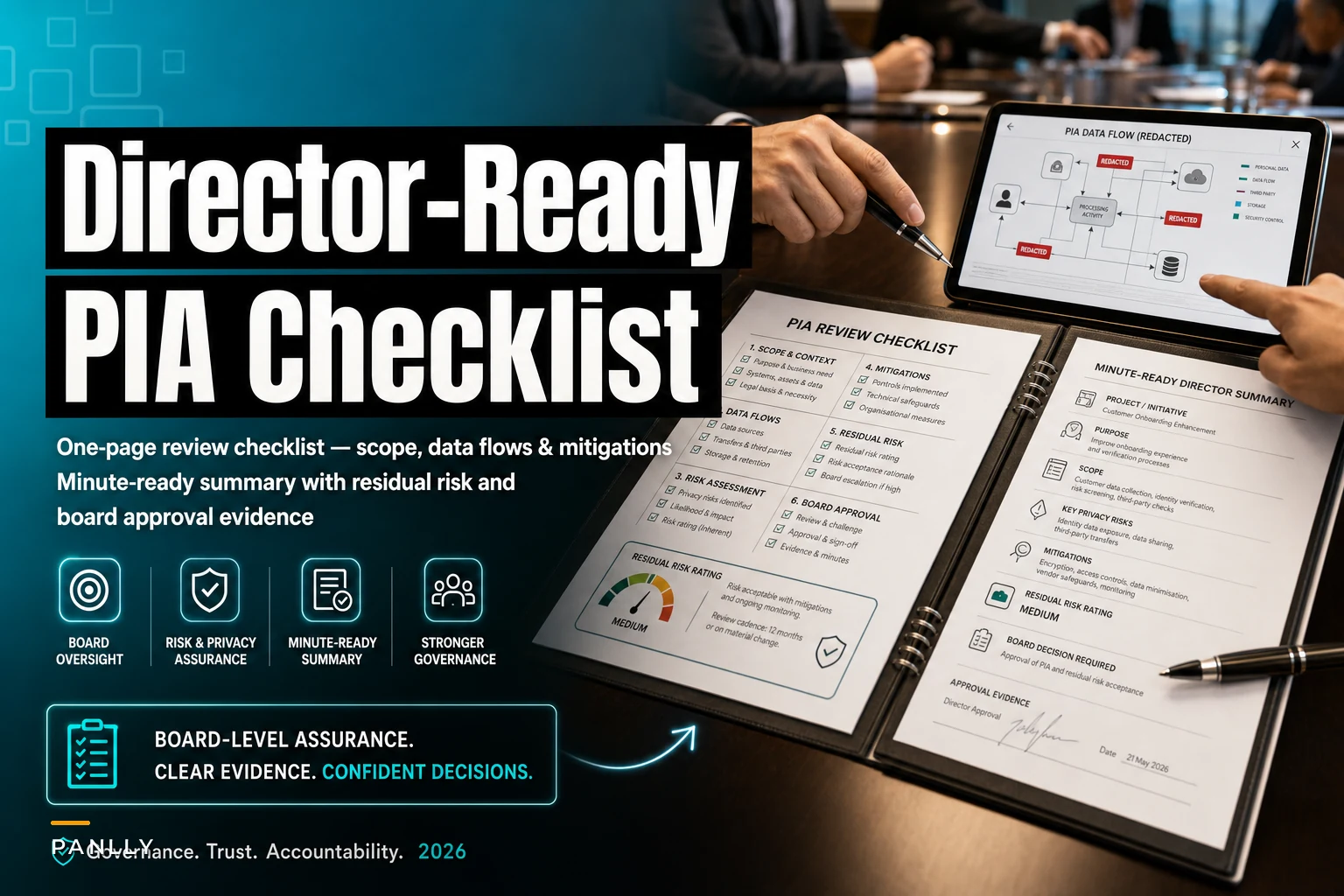
This piece is about building both: a one-page director review checklist and a minute-ready summary template that holds up when someone comes looking.
Why "the Board approved the PIA" is a weak record
Approval of a PIA isn't the same as oversight of a PIA. When the minutes say the board approved the assessment, the implicit claim is that directors understood the scope, saw the data flows, evaluated the mitigations, and consciously accepted the residual risk. In practice, none of that is documented. The record shows an outcome with no reasoning behind it.
Here's where it breaks. A company rolls out a new customer analytics platform. The PIA flags that behavioral data will be shared with two third-party vendors, one of which processes data outside the home jurisdiction. The assessment notes this, proposes contractual safeguards, and rates residual risk as "moderate." The board approves. Eighteen months later there's a breach at the offshore vendor. The investigation asks: did the board know data was leaving the jurisdiction? Did they question the vendor's controls? Did they accept the residual risk knowingly, or did they just approve a document?
If all you have is "the Board approved the PIA," you can't answer any of that. The directors may well have discussed it — but discussion that isn't recorded didn't happen, as far as the evidence pack is concerned. Strong assessments get undermined by thin board records all the time. The assessment survives scrutiny. The governance around it doesn't.
This is the same failure mode that shows up whenever boards rely on narrative minutes instead of structured decision records. A compliance-first approach to board records treats the reasoning as the thing worth preserving, not just the vote.
What a director actually needs to review — not what the PIA contains
The data team writes a PIA to document the assessment. A director needs something narrower: enough to form an independent judgment and record it. Those aren't the same information set.
Eliminate boardroom chaos with seamless coordination.
Panlly simplifies scheduling, collaboration, and follow-ups for every board meeting.
- Centralized meeting scheduling
- Secure document sharing
- Task assignment & tracking
No credit card required
A PIA will tell you the technical mitigations in detail. A director needs to know whether the mitigations are proportionate to the risk and who owns them. A PIA maps every data element. A director needs the three or four flows that actually create exposure. The full document is the evidence. The director review is the judgment applied to that evidence.
The one-page board PIA review checklist
Work through these in the meeting, not before it. The point is to generate a record of the board's reasoning, which means the questions have to be asked live.
-
- Scope clarity. What processing activity is this PIA covering, and what is explicitly out of scope? If the scope is vague, the approval is meaningless — you can't accept risk on an undefined activity. Confirm one sentence: "This assessment covers X and does not cover Y."
-
- Data flows that matter. Not every flow — the ones that create exposure. Where does personal data go that it didn't go before? Which flows cross borders, touch third parties, or involve special-category data? Expect a diagram or a short list, not prose.
-
- Lawful basis and necessity. On what basis is this processing lawful, and is it actually necessary for the stated purpose? This is the question boards skip most. "Could we achieve the business goal with less data?" is a one-line question that regulators love and directors rarely ask.
-
- Mitigations and owners. For each significant risk, what's the control, and who is accountable for it operating? A mitigation with no named owner is a plan, not a control. The board should see the owner's name.
-
- Residual risk — stated and accepted. After mitigations, what risk remains, how is it rated, and is the board accepting it? This is the single most important line in the whole exercise. The board isn't approving the PIA. It's accepting a defined residual risk. Say so explicitly.
If a director can't get a clear answer to any of these in the room, that's the signal to defer approval — and the deferral itself should be minuted, because a documented pause is stronger evidence of oversight than a smooth approval.
The minute-ready summary template
The second half of the fix is a structured summary that drops straight into the minutes. Not a paragraph of narrative — a short, fielded record that captures the board's conclusion on each of the five review points. This is what auditors want, and it's the thing almost nobody produces.
| Field | What goes here | Example entry |
|---|---|---|
| Assessment reference | PIA ID, version, date | PIA-2024-017, v2.1, reviewed 14 Nov |
| Scope (in/out) | One line each | In: new loyalty-app behavioral tracking. Out: existing POS data. |
| Material data flows | The exposure-creating flows only | Behavioral data to Vendor A (EU) and Vendor B (offshore) |
| Lawful basis | Basis + necessity note | Consent; necessity confirmed, data minimized vs. v1 |
| Key mitigations + owners | Control and accountable person | Encryption in transit (CISO); DPA with Vendor B (GC) |
| Residual risk rating | Post-mitigation rating | Moderate |
| Board decision | Accept / defer / reject + conditions | Approved, conditional on Vendor B DPA signed before go-live |
| Conditions & review date | Follow-ups and next review | Re-review residual risk at Q2 board; GC to confirm DPA execution |
That last row matters more than people expect. Conditional approvals are common and completely reasonable — but if the condition isn't tracked, the board has effectively approved something unconditionally and nobody noticed. The "Vendor B DPA signed before go-live" condition needs to become an action item with an owner and a deadline, not a hopeful sentence buried in the minutes.
The review workflow, start to finish
Here's how the pieces fit together operationally, so the board review isn't a bottleneck and the evidence pack assembles itself rather than getting reconstructed in a panic later.
-
Data team completes the full PIA and prepares the one-page director summary alongside it. This is the key discipline — the summary is drafted by the people who did the work, so the board reviews their characterization and can challenge it. If the summary and the full PIA disagree, that's a finding.
-
Summary and checklist go into the pre-read, but the checklist stays blank. Directors read to prepare questions, not to pre-fill conclusions.
-
The board works the checklist live. Each of the five areas gets discussed. Directors push on anything unclear. The corporate secretary captures conclusions directly into the summary template as the discussion happens.
-
The board records a decision — accept, defer, or reject — with any conditions. The residual risk acceptance is stated explicitly.
-
Conditions convert to tracked action items with owners and deadlines. Nothing conditional closes until the condition is evidenced.
-
The evidence pack is bundled
full PIA, completed director summary, the minute extract, and the closure evidence for any conditions. That bundle is what you hand an auditor.
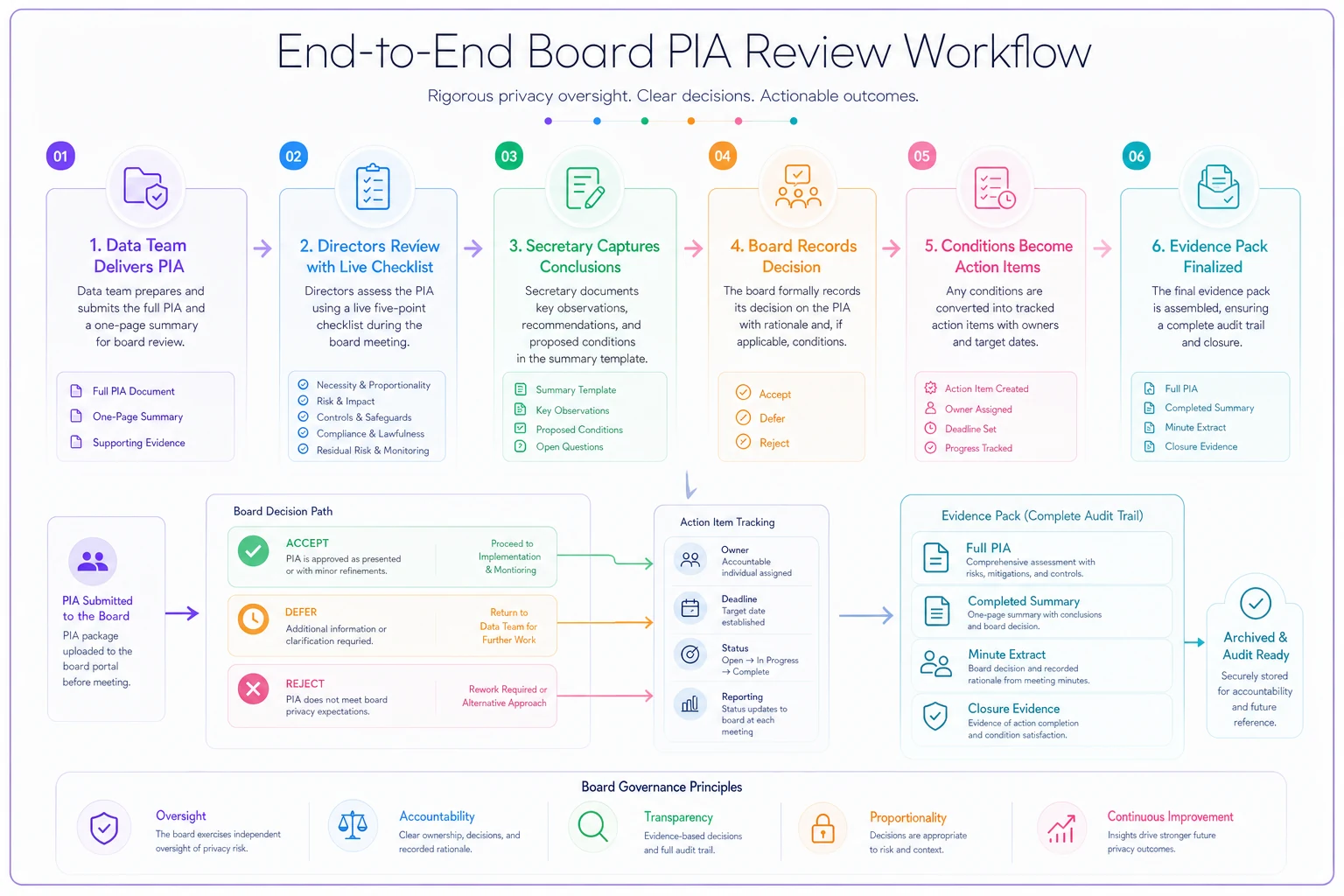
A simple diagram of the end-to-end review workflow.
The difference between this and the typical process is that the reasoning gets captured at the moment it exists, in a structure that maps directly to what reviewers will later ask. You're not writing minutes to describe a meeting. You're producing an evidence artifact as a byproduct of running the meeting well.
A real scenario: a mid-size retailer's loyalty program
A regional retail chain — roughly 40 stores, in-house marketing team — rolled out a loyalty app with behavioral tracking. The data team produced a solid PIA, around 30 pages. The board's privacy committee reviewed it the old way: pre-read, brief discussion, "approved" in the minutes. Residual risk was buried on a page nobody referenced.
When a data subject complaint later escalated to a regulator inquiry, the committee spent close to three weeks reconstructing what it had actually considered. Director emails pulled in multiple directions, a scramble to confirm whether the offshore vendor's data processing agreement had been signed before launch (it had — barely), and a materially weaker position than the facts deserved, purely because the record was thin.
After that, they moved to the checklist-and-summary approach. The next significant PIA — a new in-store camera analytics pilot — ran through the same board, same committee. The live review took about 25 minutes. The completed summary was in the minutes before the meeting ended. When the pilot's offshore processing raised a flag, the condition ("DPA executed before any footage leaves the store systems") was a tracked action item, closed and evidenced two weeks later. The evidence pack for that decision was a four-item bundle, assembled in under an hour. No reconstruction.
The assessments were comparably good in both cases. The governance record was the only thing that changed — and it was the only thing that had failed them the first time.
Where tooling quietly helps — and where it doesn't
The checklist and template work on paper. What they don't do on paper is stay connected to everything else: the action items, the vendor oversight register, the next review date, the audit bundle. That's where the manual version starts leaking. The conditional approval gets minuted but the condition never becomes a tracked item. The residual risk gets rated "moderate" but there's no link back to the risk register, so it never surfaces again.
The practical fix is keeping the decision record structured and linked rather than locked in a PDF. When the board's PIA conclusions live as fields rather than prose, they can connect to action tracking, feed the review calendar, and pull into an evidence pack on demand. This is the same logic behind turning board records into actionable data — decisions recorded as structured fields are usable later; decisions recorded as paragraphs are archaeology.
A disciplined corporate secretary with a good template beats a sophisticated system used sloppily.
That said, don't over-tool this. A disciplined corporate secretary with a good template beats a sophisticated system used sloppily. The tooling earns its place when you're running enough PIAs that manual tracking of conditions and review dates starts to slip — not before.
When this level of rigor makes sense — and when it's overkill
When it makes sense: any processing that involves new third parties, cross-border transfers, special-category or children's data, large-scale behavioral profiling, or anything that would make headlines if it went wrong. These are the assessments where "the Board approved the PIA" will not survive scrutiny, and where the residual risk acceptance genuinely needs a conscious board decision.
When it's overkill: low-risk, routine processing where a DPO sign-off is the appropriate level of governance and board involvement would just be theater. Not every PIA needs board review at all. Part of good oversight is knowing which assessments belong in the boardroom and which should be handled below it. Pushing routine PIAs up to the board dilutes attention on the ones that actually matter.
Who should not do this: boards that won't commit to working the checklist live. If the plan is to pre-fill the conclusions and rubber-stamp them in the meeting, you've built a more elaborate version of the weak record you started with. The entire value is in the real-time interrogation and the honest capture of what the board concluded — including the times it concluded "not yet."
The connection to broader risk oversight matters too. A board that's sharp on cyber and data exposure in its director briefings will ask better PIA questions, because the two overlap constantly — most meaningful privacy risks are also security risks wearing different clothes.
The point most boards miss
A PIA is evidence. The board review is judgment. The minutes are the record of that judgment.
Three different things, and the failure almost always comes from collapsing them into one — treating "approved the PIA" as if it captured the reasoning, the data flows considered, and the residual risk consciously accepted.
Separate them. Give the data team a one-page summary to draft. Give directors a five-point checklist to work live. Capture the conclusions in a fielded template that drops into the minutes and links to the follow-ups. Do that, and the evidence pack stops being something you assemble under pressure and becomes something you already have — which is the entire difference between a defensible approval and a line in the minutes you'll come to regret.
Ready to enhance your board's productivity?
Join 500+ organizations using Panlly to save time, improve governance, and streamline board operations.