

Board members get cyber briefings backwards. CISOs show up quarterly with 47-slide decks packed with vulnerability scores, patch percentages, and threat intelligence heat maps. Directors nod politely while mentally calculating whether their D&O insurance is adequate. Then three months later, a ransomware incident hits and everyone discovers the board never understood what actually mattered.
The disconnect runs deeper than technical literacy. Most boards receive cyber updates designed for security practitioners, not fiduciaries making resource allocation decisions. CISOs present phishing simulation results when boards need to know if customer data protection meets regulatory standards. They share incident counts when directors need visibility into business continuity risks.
The translation problem destroying board cyber oversight
Watch any board meeting where cyber gets on the agenda. The CISO launches into network segmentation updates while directors mentally translate: "Does this mean we're safer than last quarter?" Technical teams report on security control implementations. Board members wonder: "What happens if this fails?"
This translation burden creates three destructive patterns.
First, directors stop asking questions to avoid looking uninformed. A Fortune 500 board member once admitted they'd approved $12 million in security investments without really understanding what half the tools did. The presentations looked thorough. Nobody wanted to slow down the meeting with basic questions.
Second, CISOs misinterpret silence as understanding. They assume boards grasp the implications when directors simply lack the context to push back. One healthcare CISO discovered their board thought "99.9% patch compliance" meant zero risk — they had no idea the remaining 0.1% included internet-facing systems.
Third, critical risks hide behind technical metrics. Boards track mean time to detect dropping from 72 to 48 hours and feel like progress is happening. Nobody mentions that regulatory notification requirements kick in at 24 hours, making that "improvement" legally meaningless.
When cyber blindness becomes board liability
Delaware courts increasingly scrutinize board cyber oversight. The Caremark doctrine requires boards to demonstrate good faith efforts to monitor compliance and risk. Generic cyber updates that directors can't reasonably act upon fail that standard.
Eliminate boardroom chaos with seamless coordination.
Panlly simplifies scheduling, collaboration, and follow-ups for every board meeting.
- Centralized meeting scheduling
- Secure document sharing
- Task assignment & tracking
No credit card required
Look at what happened at SolarWinds. Their board received regular cyber updates showing improving metrics. Post-breach investigations revealed those metrics masked fundamental security gaps. Directors couldn't identify warning signs buried in technical presentations. The SEC's subsequent charges against their CISO sent shockwaves through boardrooms nationwide.
The legal exposure compounds when boards can't demonstrate informed decision-making. A retail chain's board approved delaying security upgrades based on a risk assessment they didn't fully understand. When customer payment data got compromised six months later, plaintiff attorneys had a field day in depositions asking directors to explain their reasoning. The minutes couldn't capture the nuance because directors never really grasped the tradeoffs.
Insurance carriers now audit board cyber governance during D&O renewals. They specifically examine whether boards receive actionable intelligence versus technical reports. One carrier declined renewal for a tech company whose board packets showed three years of identical cyber slides with updated dates. Static reporting signals either willful blindness or ineffective oversight — neither is a good look.
Building a cybersecurity board briefing template that drives decisions
Effective cyber reporting to boards requires structure that connects technical reality to business impact. After analyzing board packets from dozens of breaches and near-misses, patterns emerge around what actually enables oversight versus what creates false comfort.
Start with a two-page executive dashboard limited to five core metrics:
-
Regulatory Exposure Status
Not compliance percentages — specific regulatory requirements and current gaps. "GDPR Article 33 requires 72-hour breach notification. Current detection capabilities identify 67% of incidents within this window." Directors immediately grasp the risk.
-
Crown Jewel Protection Level
Identify the 3-5 systems that would cripple operations if compromised. Rate each red/yellow/green based on current safeguards. Skip the technical controls discussion. Focus on business impact if compromised.
-
Third-Party Risk Concentration
List the top five vendors with production system access. Note which lack cyber insurance or recent audits. One board discovered their entire customer database was accessible to an offshore call center vendor with no security assessment on file.
-
Incident Response Readiness
Don't report drill statistics. State plainly: "If ransomware hit today, recovery would take X days with Y% data loss." Include assumptions. Let directors challenge whether 72-hour downtime is acceptable.
-
Investment Efficiency
Show security spending as a percentage of IT budget and per-employee. Compare to industry benchmarks. But also include: "Current investments protect against 78% of likely attack vectors based on our threat model." That frames spending in risk reduction terms boards actually understand.
The template forces translation of technical metrics into business language. CISOs often resist the oversimplification at first. But forcing this distillation frequently surfaces gaps the security team hadn't recognized themselves.
Keep the executive dashboard to two pages to force prioritization.
CISOs often resist the oversimplification at first. But forcing this distillation frequently surfaces gaps the security team hadn't recognized themselves.
Red-flag escalation checklist that prevents surprise breaches
Quarterly updates aren't enough when threats evolve daily. Boards need escalation triggers that bypass regular reporting cycles for material developments. Yet most escalation policies focus on active incidents, missing the warning signs that make prevention possible.
Build explicit escalation triggers beyond traditional breach notification:
Vendor Compromise Affecting Your Stack: If any technology vendor in your environment suffers a breach, escalate within 48 hours with an impact assessment. A logistics company learned about a supplier breach through customer complaints — three weeks after their vendor already knew.
Regulatory Investigation of Peers: When regulators investigate similar companies for cyber practices, boards need an immediate briefing on comparative posture. Don't wait for quarterly updates to mention the industry is under scrutiny.
Security Tool Failures: If core protection mechanisms fail audit or testing, escalate immediately. One bank's board discovered their AI-based threat detection had been offline for six weeks only after attackers exploited the gap.
Key Personnel Changes: CISO departure or security team turnover above 30% triggers escalation. Boards often learn about security leadership gaps only after replacement searches stall.
Cyber Insurance Changes: Premium increases above 25% or coverage restrictions require immediate board visibility. These market signals often precede material risk discoveries.
The escalation checklist should specify the exact format for emergency updates — not lengthy reports, but structured one-pagers: what happened, business impact, immediate actions taken, board decision required (if any).
Director cyber-metrics dashboard design
Most boards receive lagging indicators dressed up as cyber metrics. Patch rates from last month. Incidents from last quarter. Training completion from six months ago. By the time trends appear in these numbers, the damage is usually done.
Design a forward-looking dashboard with predictive value:
Attack Surface Trajectory: Show monthly changes in internet-facing assets, not total counts. A 10% monthly increase in exposed systems matters more than having 1,000 total assets. One board discovered their "digital transformation" had doubled attack surface in six months without corresponding security investment.
Security Debt Accumulation: Track the age of unpatched critical vulnerabilities. A growing backlog of 30+ day old critical patches signals process breakdown. Frame it financially: "Security debt remediation would require roughly 400 hours of engineering time at current staffing."
Third-Party Hygiene Scores: Monitor security ratings of critical vendors monthly. Declining scores often predict supply chain compromises. Show trends, not snapshots.
Threat Intelligence Relevance: Skip global threat statistics. Show threats specifically targeting your industry that your current controls don't address. "Three peer companies hit by this ransomware variant. Our endpoint detection lacks specific signatures."
Recovery Time Objectives vs. Reality: Display the gap between promised recovery times and actual test results. Most boards assume IT can restore operations in hours when the real answer is days.
Format matters as much as content. Use visual indicators directors recognize from financial dashboards. Red/yellow/green is universal. Trend arrows communicate direction. Avoid security acronyms that require a glossary.
Q&A scripts that extract decision-ready intelligence from CISOs
Directors often default to generic questions about "keeping us safe" that produce equally generic reassurances. Structured Q&A scripts help boards probe for actionable intelligence without requiring technical expertise.
| Instead of asking... | Ask this instead |
|---|---|
| "Are we secure?" | "What would it take for an attacker to access our customer data today, and how would we know it happened?" |
| "How's our cyber program?" | "Which security investments from last year haven't delivered expected risk reduction and why?" |
| "Any concerns?" | "If you had to cut security spending by 20%, what would break first?" |
| "How do we compare to peers?" | "Which specific security practices do our competitors do better, and what would it cost to match them?" |
| "What keeps you up at night?" | "What security assumption are we making that's most likely wrong?" |
These rewrites aren't just semantic. Each one forces a different kind of answer. "Are we secure?" gets you reassurance. "What would it take for an attacker to access our customer data?" forces the CISO to explain actual attack paths and detection gaps in plain language. One board discovered their customer database had 47 different access paths, with monitoring on only 12 of them.
The spending cut question tends to produce the most revealing answers. One CISO admitted cutting security awareness training would have minimal impact — which redirected funds toward technical controls. A regional bank board discovered competitors required multi-factor authentication for all customer accounts while theirs remained optional.
Distribute these scripts to directors before cyber discussions. Rotating who asks which questions keeps the conversation from becoming predictable. The goal isn't catching anyone off-guard — it's forcing translation of technical realities into board-level decisions.
Operational burden of manual cyber governance
Running effective cyber oversight through manual processes burns enormous organizational energy. Corporate secretaries spend days assembling board packets with cyber updates that arrive in incompatible formats. CISOs waste hours building presentations directors skim. Critical escalations get buried in email threads someone might miss.
The logistics multiply when cyber spans multiple committees. Audit committees need compliance focus. Risk committees want threat assessments. Full boards require strategic overview. Each demands different metrics pulled from the same underlying data. One corporate secretary tracked roughly 70 hours monthly just managing cyber-related board materials across committees.
Manual processes also create dangerous gaps. Excel-based dashboards go stale between meetings. Email escalations get lost in inbox overflow. Decisions lack documentation for later review. When incidents hit, boards scramble to reconstruct what they knew and when they knew it.
Those decision log gaps become liability magnets during litigation. Plaintiff attorneys love finding board cyber discussions with no recorded rationale. One director faced personal liability when they couldn't explain why the board delayed security investments despite escalated warnings. The warnings existed across various emails, but there was no consolidated record showing the board's reasoning.
Centralizing cyber intelligence with operational software
Modern boards need operational platforms that transform cyber chaos into structured intelligence. Instead of quarterly fire drills assembling presentations, automated dashboards pull real-time metrics from security tools. Rather than email chains for escalations, workflow automation ensures critical alerts reach directors immediately with the right context attached.
AI-powered platforms can now translate technical security data into board-ready intelligence automatically — monitoring threat feeds for industry-relevant risks, tracking security tool performance against service levels, flagging anomalies that need human review. This isn't about replacing human judgment. It's about eliminating the administrative overhead that obscures critical signals.
There's also an institutional knowledge angle that gets overlooked. Centralized platforms preserve context that survives personnel changes. New directors can access historical cyber decisions with full background. Departing CISOs leave structured handoffs rather than institutional memory walking out the door. Regulatory inquiries get answered with comprehensive audit trails rather than reconstructed narratives.
Below is a workflow showing how an operational platform centralizes data, triggers escalations, and logs board decisions.
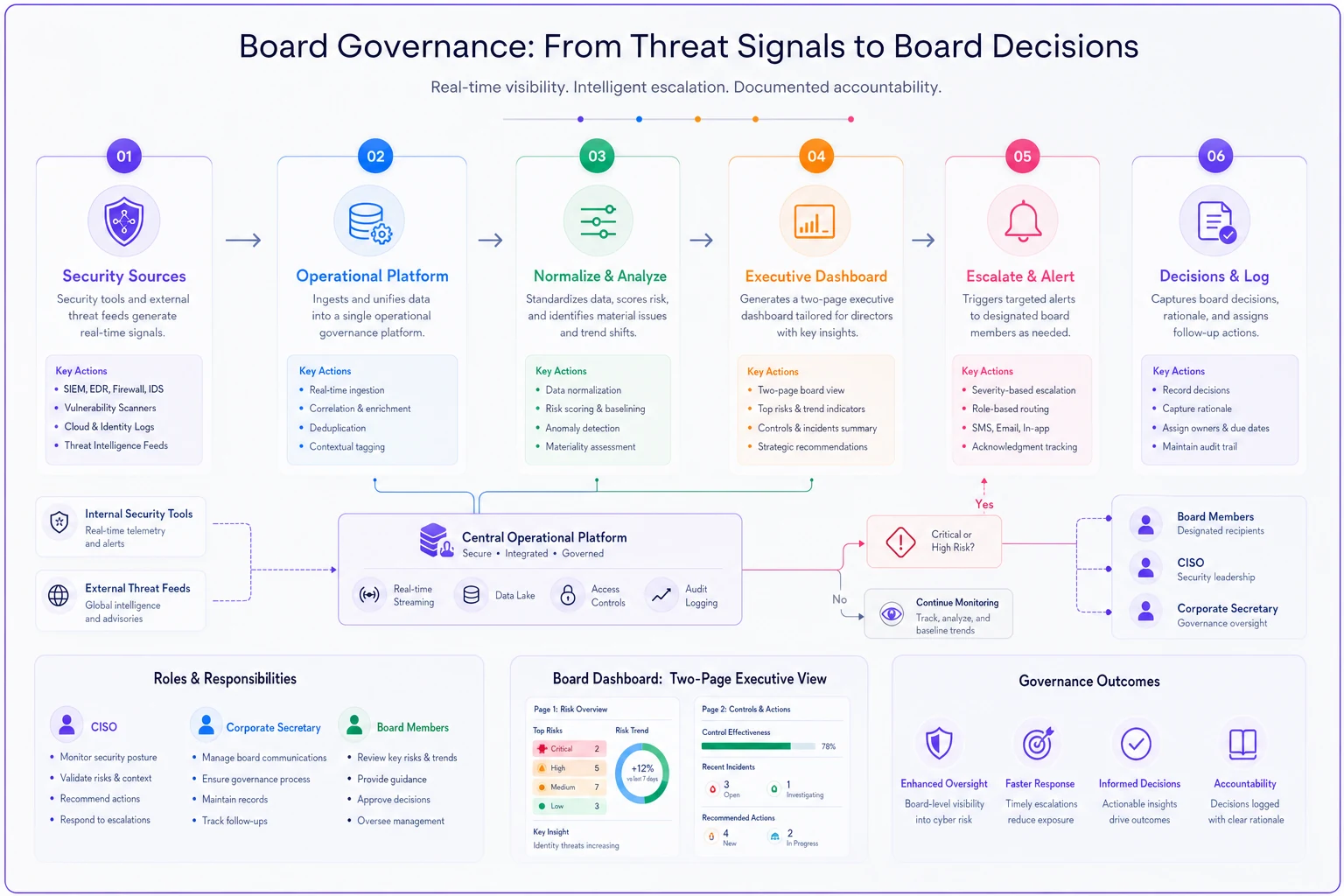
One manufacturing conglomerate restructured cyber governance with operational software after their board spent years receiving quarterly 50-slide presentations that took the CISO two weeks to prepare — and that directors retained maybe 10% of. Critical escalations arrived via email with no tracking. After the shift, directors accessed a live dashboard showing five key metrics with weekly updates. Escalation triggers automatically notified relevant directors with pre-formatted summaries. All cyber decisions got logged with rationale and supporting data.
When ransomware hit a subsidiary, the board had complete visibility into prior risk assessments, mitigation decisions, and response protocols within minutes. The CISO reclaimed around 30 hours monthly from presentation prep. Directors spent less time in meetings but made more informed decisions. When regulators investigated their incident response, the documentation deflected liability concerns quickly.
Making cyber oversight sustainable
Cyber governance isn't optional anymore. Regulators expect it. Insurers require it. Shareholders demand it. But sustainable oversight requires more than good intentions and quarterly presentations.
The templates and frameworks outlined here aren't theoretical. They come from analyzing what actually enabled boards to prevent incidents versus what created false comfort before breaches. The patterns are consistent: successful cyber oversight requires translation layers, escalation triggers, and decision documentation that connects technical reality to business impact.
Manual processes can't scale with how fast the threat landscape moves. Threats change daily. Regulations expand quarterly. Board composition shifts. Without operational platforms managing this complexity, cyber governance becomes either overwhelming or superficial — and neither actually serves shareholders.
When ransomware locks down operations or regulators investigate response times, "we didn't understand the presentation" isn't a defense. Courts expect boards to demonstrate informed oversight. That requires operational discipline in translating cyber risk into board decisions — and the boards that build this capability now will look very different from those still hoping technical problems stay technical.
Ready to enhance your board's productivity?
Join 500+ organizations using Panlly to save time, improve governance, and streamline board operations.