

Most boards treat investor engagement like a fire drill. It gets intense for about six weeks before the annual meeting, then everyone goes quiet until the next proxy adviser report lands and someone forwards it around with a "we need to talk about this" note. By then it's already late.
The problem isn't that boards don't engage. It's that the engagement lives in people's heads, their sent-mail folders, and a handful of decks nobody can find twelve months later. When a proxy adviser recommends against your say-on-pay vote, or an activist starts quietly building a position, the board scrambles to reconstruct what was said, by whom, to which investor, and when. That reconstruction is where things fall apart.
This piece is about fixing that one specific thing: turning ad-hoc investor engagement into a documented, repeatable workflow that survives staff turnover, holds up under scrutiny, and doesn't depend on the memory of whoever ran the roadshow last year.
The reconstruction problem nobody talks about until it's too late
A pattern that shows up more than it should: a proxy adviser issues an adverse recommendation on a compensation proposal. The comp committee chair insists she explained the new metric design to the top five holders months earlier. Great — but where's the record? There's a calendar invite, maybe. A deck someone emailed. No notes on what was actually discussed, no record of which concerns investors raised, no follow-up tracking.
The IR team then spends a frantic week pulling email threads, texting the general counsel, and trying to remember whether the conversation with the pension fund happened before or after the draft proxy went out. Half the engagement that genuinely occurred becomes effectively invisible because it was never captured in a way anyone else can use.
This happens because investor engagement sits across three or four different owners — IR runs the logistics, the corporate secretary owns the record-keeping, a committee chair does the actual talking, and legal reviews it after the fact. Each one keeps their own fragments. Nobody owns the whole picture.
The cost isn't abstract. A board that can't demonstrate it engaged proactively looks reactive and defensive when challenged. Proxy advisers and large institutional stewardship teams explicitly weight whether a company engaged before a problem, not just after. If you can't show the timeline, you don't get credit for the work you actually did.
Start with the calendar, not the message
The single highest-leverage fix is boring: an operational calendar that maps engagement to the full governance year, not just the pre-AGM window.
Eliminate boardroom chaos with seamless coordination.
Panlly simplifies scheduling, collaboration, and follow-ups for every board meeting.
- Centralized meeting scheduling
- Secure document sharing
- Task assignment & tracking
No credit card required
-
Post-AGM debrief (weeks 1–6 after the meeting) Review voting results, identify any proposal that got meaningful dissent, and flag which holders voted against management. This is your target list for the next cycle.
-
Off-season listening (roughly months 2–6) Scheduled conversations with top holders and governance teams, focused on hearing concerns on comp, board composition, and strategy. No asks.
-
Pre-draft alignment (months 7–9) Before the proxy is drafted, test proposed changes — especially pay design and director slate — against what you heard.
-
Proxy season execution (final 8–10 weeks) Formal solicitation, proxy adviser engagement, and rapid-response to any adverse recommendations.
The insight most boards miss: the calendar should assign a named owner and a backup to every window, so a departure or a sick leave doesn't create a gap. When the person who "owned the relationship" with your largest holder leaves, the relationship shouldn't leave with them.
Segment investors before you build a single briefing
Treating all investors the same is the fastest way to waste engagement capacity. A board doesn't have unlimited director time, and the committee chair who needs to make the calls has maybe a dozen real conversations in her before she's tapped out.
Segmentation sounds like a marketing concept, but for board engagement it's an operational necessity. The practical split that works:
| Segment | Who they are | What they want | Who engages |
|---|---|---|---|
| Strategic holders | Top 10–15 by position, long-term | Strategy, capital allocation, board quality | Chair / Lead director + CEO |
| Governance-sensitive | Large index and pension funds with stewardship teams | Pay design, independence, ESG oversight | Committee chairs + corporate secretary |
| Proxy advisers | ISS, Glass Lewis and similar | Policy alignment, disclosure clarity | IR + GC, with committee chair on substance |
| Transactional / short-term | Momentum and arbitrage holders | Near-term catalysts | IR only, or no direct board time |
| Watch list | Accumulating positions, potential activists | Varies — needs monitoring | Legal + IR, escalate to Lead director |
The mistake here is letting proxy advisers absorb all the attention because their recommendations feel like the scoreboard. They matter, but large stewardship teams increasingly make their own voting decisions independent of adviser recommendations — and those are the conversations a director's time is best spent on.
Standard briefing packs so every conversation starts from the same facts
When a director walks into an investor call, the worst outcome isn't disagreement. It's contradiction — the comp chair describing the new LTIP one way and the CEO describing it differently two weeks later. Investors notice. Stewardship teams compare notes across companies and across calls.
-
A one-page summary of the proposals and the rationale behind each change
-
The three or four hardest questions each proposal invites, with agreed answers
-
Current ownership snapshot and recent voting history for the investor being met
-
Any prior engagement notes with that specific investor
-
Clear boundaries on what cannot be discussed (material nonpublic information, selective disclosure lines)
The briefing pack and the compensation narrative inside it should trace directly back to the committee's own work. If you've built a proper link between pay outcomes and performance — the kind of structure covered in operational remuneration governance — the briefing pack almost writes itself, because the rationale already exists in a defensible form. Same logic applies to your strategic narrative: if your board already maps decisions to KPIs, directors can speak to outcomes with numbers instead of adjectives.
Pre-approved Q&A: the part that keeps directors out of trouble
This is where selective disclosure risk lives. A director in an investor meeting is one unscripted answer away from a regulatory headache or an inconsistent message that gets quoted back at them.
They separate "can discuss freely" from "redirect to IR" from "do not touch." Board process on CEO succession is usually fine to discuss at a high level. Specific internal candidates are not. Draw that line before the call, not during it.
They give agreed language for the predictable hard questions. Every comp cycle brings the same handful: Why did the CEO's pay rise when the stock didn't? Why change the metric now? Why no clawback trigger here? If three different directors answer these three different ways, you've manufactured a credibility problem that didn't need to exist.
They flag questions that require a counsel check before answering. Anything touching M&A, litigation, or guidance belongs in this bucket.
A pattern worth copying: hold a 30-minute prep call before any significant investor meeting where directors run through the pre-approved Q&A against the specific investor's known concerns. It takes almost no time and prevents the vast majority of off-message moments.
The evidence log that ties it all together
Everything above is useless if it isn't recorded. The evidence log is the piece that turns scattered engagement into something you can actually point to.
The log is deliberately simple. Each entry captures:
-
Date and format of the engagement
-
Investor and segment
-
Who attended from the company and from the investor
-
Topics raised, especially concerns
-
Any commitments made or follow-ups required
-
Whether follow-up was completed, and when
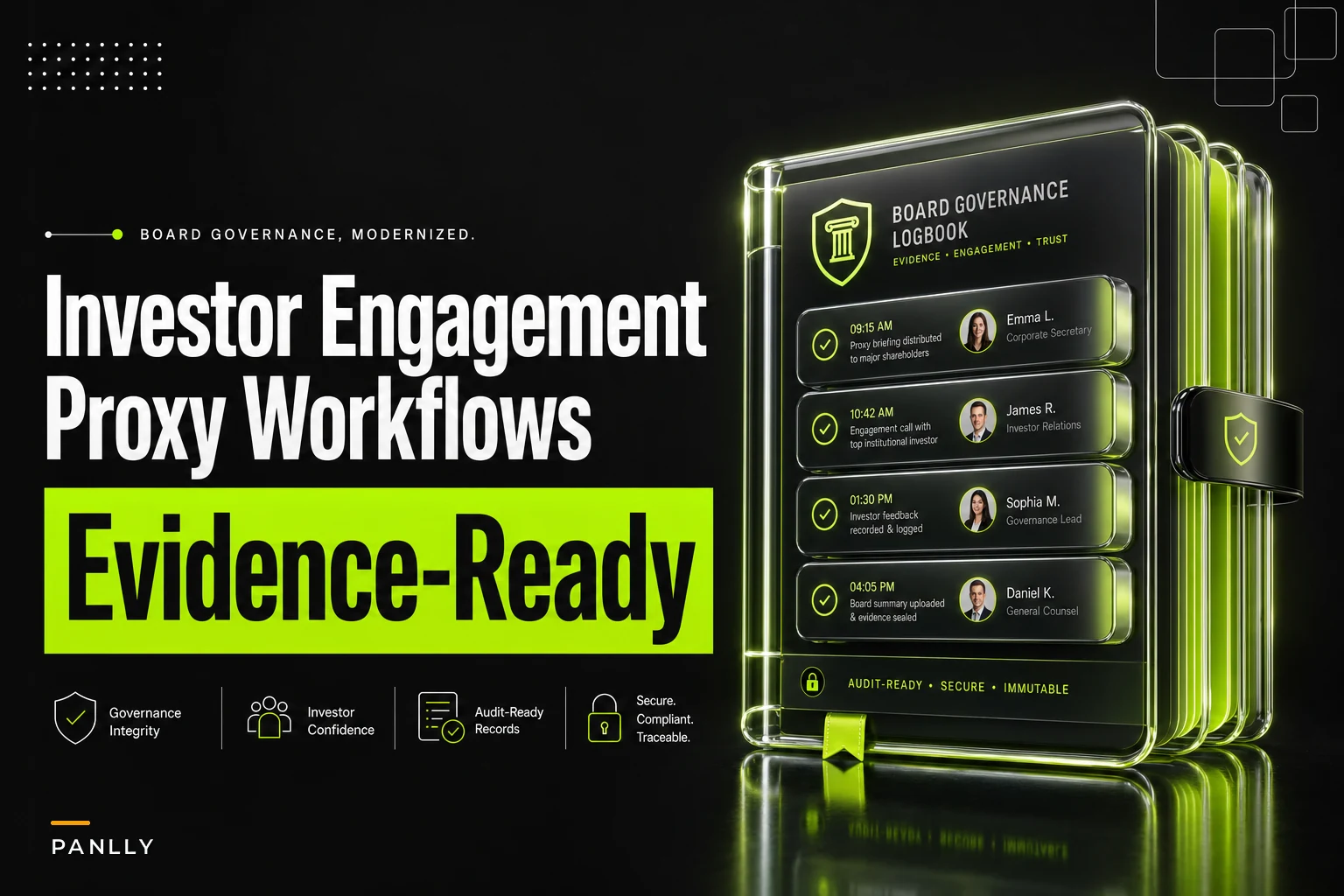
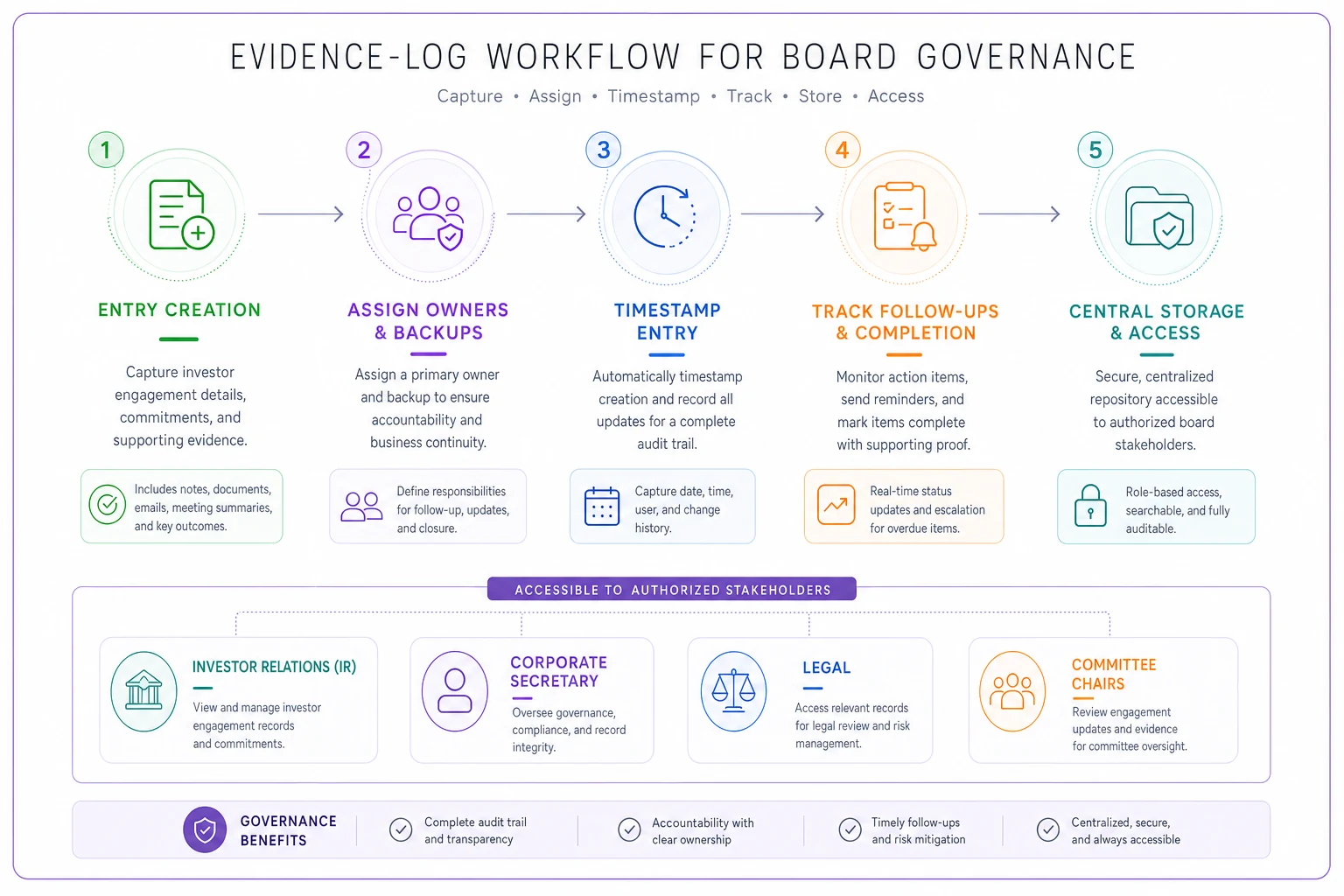
What makes this hold up isn't complexity — it's discipline and timing. The entry gets made within a day or two of the meeting, while memory is fresh, not reconstructed at proxy season. The log should be a single shared record, not a dozen private note files, so the corporate secretary can produce a complete engagement timeline on demand.
A simple workflow helps ensure entries are made promptly and consistently.
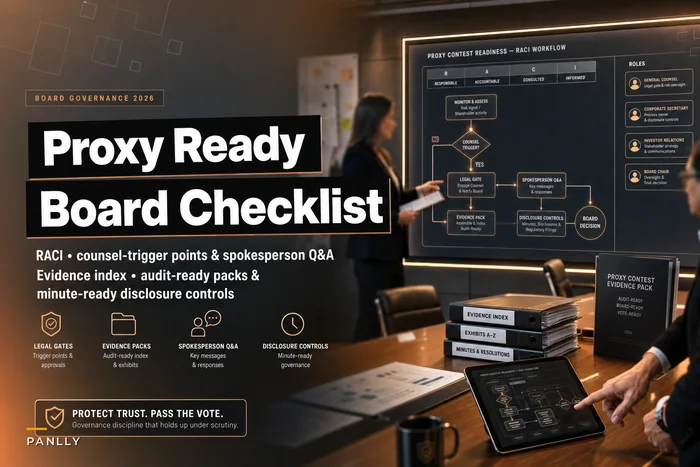
This matters enormously when a contest looms. If you've ever had to assemble an evidence pack under pressure — the scramble described in avoiding losing a proxy contest — you already know the difference between a log you maintained all year and one you tried to build over a weekend. One is credible. The other looks exactly like what it is.
Require the person who runs the meeting to draft the log entry within 48 hours and route it for quick sign-off so the record captures details while they're fresh.
The log should be a single shared record, not a dozen private note files, so the corporate secretary can produce a complete engagement timeline on demand.
A real scenario
A mid-cap industrial company — roughly $1.2B market cap — kept getting adverse say-on-pay recommendations despite doing what the board genuinely believed was proactive outreach. The comp chair was engaging. The problem was that none of it was documented, and the proxy adviser kept noting "limited evidence of shareholder engagement."
They rebuilt the process over one off-season. An operational calendar with named owners. Investors segmented into five buckets. A standard comp briefing pack tied to the committee's actual metric design. Pre-approved Q&A for the three questions that came up every single year. And an evidence log the corporate secretary updated within 48 hours of every call.
The following proxy season, they ran around 30 documented engagements across the off-season and pre-draft windows. When the adviser report came out, it shifted to acknowledging "substantive engagement with major holders." Say-on-pay support moved from the low 70s into the high 80s. The board didn't say anything dramatically new — they just made what they'd always done visible and consistent.
When this level of structure makes sense — and when it doesn't
Worth building when: you have institutional ownership concentration that makes proxy outcomes genuinely contestable, you've had an adverse recommendation in the last two cycles, or you're approaching a contentious vote like a major pay redesign or a board refresh.
Overkill when: you're a tightly held company where a founder or family controls the vote, or a nonprofit without a shareholder base at all. The documentation discipline still has value, but the full segmentation-and-Q&A machinery doesn't earn its keep.
Who should be careful: boards tempted to treat the pre-approved Q&A as a script that replaces judgment. Investors can tell when a director is reading talking points, and it damages exactly the credibility you're trying to build. The materials exist to align facts and draw disclosure lines — not to turn directors into spokespeople.
Where the tooling fits, lightly
None of this requires expensive software. A disciplined corporate secretary with a shared drive and a well-structured template can run the whole thing. The reason boards eventually move the calendar, segmentation, briefing packs, and evidence log into a board management or governance platform is simpler than vendors make it sound: it keeps the record in one place, timestamps entries automatically, and means the engagement history doesn't evaporate when a key person leaves.
The value is continuity and retrievability, not automation for its own sake. If your current record is three people's inboxes, almost anything centralized is an upgrade.
The point
Investor engagement isn't failing at most boards because directors aren't talking to investors. It's failing because the talking isn't being captured in a form that's repeatable across years and defensible when someone pushes back.
An operational calendar tells you when. Segmentation tells you who. Briefing packs and pre-approved Q&A keep the message consistent. The evidence log proves it all happened. Build those five pieces once, maintain them with modest discipline, and you stop reconstructing your engagement history every proxy season — because you never lost it in the first place.
An operational calendar tells you when. Segmentation tells you who. Briefing packs and pre-approved Q&A keep the message consistent. The evidence log proves it all happened. Build those five pieces once, maintain them with modest discipline, and you stop reconstructing your engagement history every proxy season — because you never lost it in the first place.
Ready to enhance your board's productivity?
Join 500+ organizations using Panlly to save time, improve governance, and streamline board operations.