


Most compensation committees are operating in permanent firefighting mode. They scramble through proxy season, rush peer group analysis two days before the meeting, and debate the same pay principles every quarter because nobody documented what was decided last time. Then the auditors show up asking for evidence of "robust governance processes" and everyone's searching through email threads from six months ago.
The real problem isn't that boards don't care about remuneration governance—it's that pay decisions happen across multiple touchpoints with nothing connecting them. Philosophy statements sit in one document, KPI scorecards live in another spreadsheet, committee materials are scattered across SharePoint, and disclosure calendars go untouched until the lawyers start panicking.
After watching compensation committees across tech, financial services, and industrial companies struggle with this fragmentation, one pattern becomes impossible to ignore: without an operational framework tying these pieces together, even well-intentioned boards end up with compliance gaps that surface at the worst possible moments.
The hidden complexity of modern executive compensation
Executive compensation has evolved into something far more complex than base-plus-bonus. A typical public company CEO package now includes:
-
Base salary (the easy part)
-
Annual incentive with 4–6 weighted KPIs
-
Long-term incentive split across performance shares, restricted stock, and options
-
Relative TSR modifiers
-
ESG adjustment factors
-
Clawback provisions across multiple triggers
-
Change-in-control provisions with double-trigger vesting
-
Retirement eligibility calculations
-
Good leaver/bad leaver determinations
Each component requires different governance touchpoints throughout the year. The annual incentive needs quarterly KPI tracking. Long-term awards need peer group updates. ESG metrics need sustainability committee input. Clawback provisions need legal review whenever there's a restatement.
Meanwhile, shareholders and proxy advisors have gotten genuinely sophisticated about spotting governance weaknesses. They're looking for clear linkage between pay philosophy and actual awards, consistent application of performance metrics, evidence that discretion was exercised appropriately, documented rationale for adjustments, and proper recusal procedures when conflicts arise. Miss any of these and you risk a negative ISS recommendation or a failed say-on-pay vote.
Why traditional approaches break down
Most boards treat compensation as an annual event rather than an ongoing governance process. They dust off last year's proxy, update some numbers, and hope the compensation consultant's benchmarking holds up to scrutiny.
Eliminate boardroom chaos with seamless coordination.
Panlly simplifies scheduling, collaboration, and follow-ups for every board meeting.
- Centralized meeting scheduling
- Secure document sharing
- Task assignment & tracking
No credit card required
This creates several recurring failures.
Inconsistent KPI tracking: Without systematic scorecarding, performance discussions turn into subjective debates. One director remembers the revenue target being $47M, another thinks it was $45M, and nobody can find the original committee resolution. By the time you're calculating payouts, you're reconstructing history instead of tracking against clear benchmarks.
Ad hoc peer group management: Companies typically revisit peer groups once a year, right before benchmarking. But peers change throughout the year—one gets acquired, another's market cap diverges significantly, a third shifts industries. Without ongoing monitoring, your benchmarking goes stale fast, and you're left explaining to shareholders why you're comparing against companies that no longer make sense.
Reactive disclosure planning: Most companies start thinking about proxy disclosures in January for a May annual meeting. That leaves minimal time for thoughtful narrative development, useful graphics that explain pay-for-performance, and coordination with other governance disclosures. The result is generic boilerplate that satisfies legal requirements but doesn't actually communicate anything.
Informal recusal processes: When CEO compensation is discussed, everyone knows they should leave the room. But what about when discussing peer companies where a director sits on their board? Or when setting metrics that touch a director's other investments? Without formal protocols, you're one conflicted decision away from a serious governance problem.
Building a remuneration governance framework that actually works
Pay philosophy as the operational foundation
Your pay philosophy shouldn't be a document that gets referenced once a year. It needs to translate into specific operational parameters:
| Philosophy Element | Operational Translation | Governance Checkpoint |
|---|---|---|
| "Pay for performance" | 70% of total comp tied to metrics | Quarterly KPI review against targets |
| "Market competitive" | 50th–75th percentile of peer group | Semi-annual peer group validation |
| "Long-term focus" | 3-year performance periods | Annual LTIP design review |
| "Shareholder alignment" | TSR modifier on PSUs | Monthly TSR tracking vs peers |
| "Risk-appropriate" | Clawback triggers defined | Quarterly risk event monitoring |
Each philosophy statement becomes a measurable parameter that feeds into your committee workflows. When the committee says "we believe in pay for performance," that should translate into specific KPI weightings, threshold/target/max payouts, and documentation requirements—not just a sentence in the proxy.
KPI scorecarding that creates accountability
The biggest governance failures happen when KPI tracking stays informal. The committee approves metrics in February, then doesn't systematically revisit them until calculating payouts in January.
Metric definition packages: For each KPI, document the precise calculation methodology, data sources and ownership, adjustment protocols for acquisitions, divestitures or FX, and committee pre-approval requirements for any modifications.
Quarterly scorecard updates: Don't wait until year-end. Every quarter, produce a scorecard showing year-to-date performance vs. target, projected full-year achievement, any measurement issues or disputes, and recommended adjustments with rationale.
Performance certification process: Before any payout, management certifies the calculations, internal audit validates the data, the committee formally approves the results, and external auditors review for disclosure purposes.
This approach eliminates the year-end scramble and gives you clear evidence of oversight when shareholders or regulators come asking.
Committee workflow standardization
Compensation committees typically meet four to six times per year, but without standardized workflows, each meeting becomes an exercise in document hunting and last-minute prep.
Pre-meeting evidence packs: Standardize what materials the committee receives—current scorecard vs. targets, peer group performance update, consultant recommendations with alternatives considered, draft resolutions with specific numbers, and a recusal matrix for each agenda item.
-
current scorecard vs. targets
-
peer group performance update
-
consultant recommendations with alternatives considered
-
draft resolutions with specific numbers
-
a recusal matrix for each agenda item
In-meeting documentation: Capture more than just minutes. Document specific rationale for discretionary decisions, alternatives considered and rejected, independent director executive sessions, and advice received from consultants and counsel.
Post-meeting follow-through: Document the implementation. Award agreements executed, disclosure updates drafted, regulatory filings submitted, participant communications sent.
Disclosure calendar with embedded checkpoints
Proxy season always feels like a fire drill because companies treat disclosure as an afterthought. A proper disclosure calendar embeds checkpoints throughout the year:
Q1 (Post-proxy season):
-
Shareholder feedback analysis
-
Proxy advisor engagement planning
-
Prior year say-on-pay results review
-
Governance enhancement roadmap
Q2 (Design phase):
-
Next year's program design
-
Peer group refresh
-
KPI selection and calibration
-
Consultant independence confirmation
Q3 (Testing phase):
-
Preliminary pay-for-performance testing
-
Scenario modeling for year-end
-
Disclosure narrative development
-
Graphics and visualization preparation
Q4 (Finalization):
-
Performance certification
-
Payout calculations
-
CD&A drafting
-
Say-on-pay response planning
This rhythm means you're never more than a quarter away from the next disclosure milestone, and you're building your governance story throughout the year rather than reconstructing it under pressure.
Remediation and recusal templates
When governance issues arise—and they will—having templates ready prevents panic and ensures consistency.
Recusal protocols should cover conflict identification checklists, documentation of the recusal decision, meeting participation guidelines, and post-meeting information flow rules.
Remediation procedures need to address clawback trigger assessment, recovery calculation methodology, board notification requirements, and a public disclosure decision tree.
Investigation frameworks should include misconduct allegation protocols, independent investigation triggers, compensation suspension procedures, and final determination documentation.
These templates turn crisis moments into manageable processes with clear documentation trails.
What this looks like in practice
Take a mid-cap technology company that recently went public—roughly $340M in revenue, five named executive officers, and a compensation committee getting increasingly nervous about ISS scrutiny.
Their previous approach was typical: hire a consultant in January, benchmark in February, approve plans in March, then largely forget about it until the following year. The CEO's target compensation was around $2.3M, with about 65% tied to performance metrics nobody tracked systematically.
The transformation started by mapping compensation decisions to a KPI framework. They built a straightforward scorecard with four metrics: revenue growth (30% weighting) tracked monthly against plan, adjusted EBITDA margin (25%) tracked quarterly with clear adjustments, product development milestones (25%) tracked against specific launches, and customer retention (20%) tracked monthly with cohort analysis.
Every committee meeting now opens with a scorecard review showing exactly where they stand. No more debates about what the targets were or how to calculate achievement.
They also standardized evidence packs for each meeting—current performance dashboard, peer group stock performance, consultant recommendations with rationale, draft resolutions with specific approval language, and required recusal notifications.
In the first year operating this way, their say-on-pay support increased from 76% to 91%. More importantly, when a whistleblower allegation triggered a compensation review several months later, they had every committee decision documented with clear rationale and evidence. What could have been a governance nightmare became a straightforward review.
Technology's role in scaling remuneration governance
Manual remuneration governance breaks down as complexity increases. When you're tracking 15 KPIs across 8 executives with quarterly updates, spreadsheets become a liability rather than a tool.
The diagram below shows how operational governance flows from philosophy through to disclosure across the annual cycle:
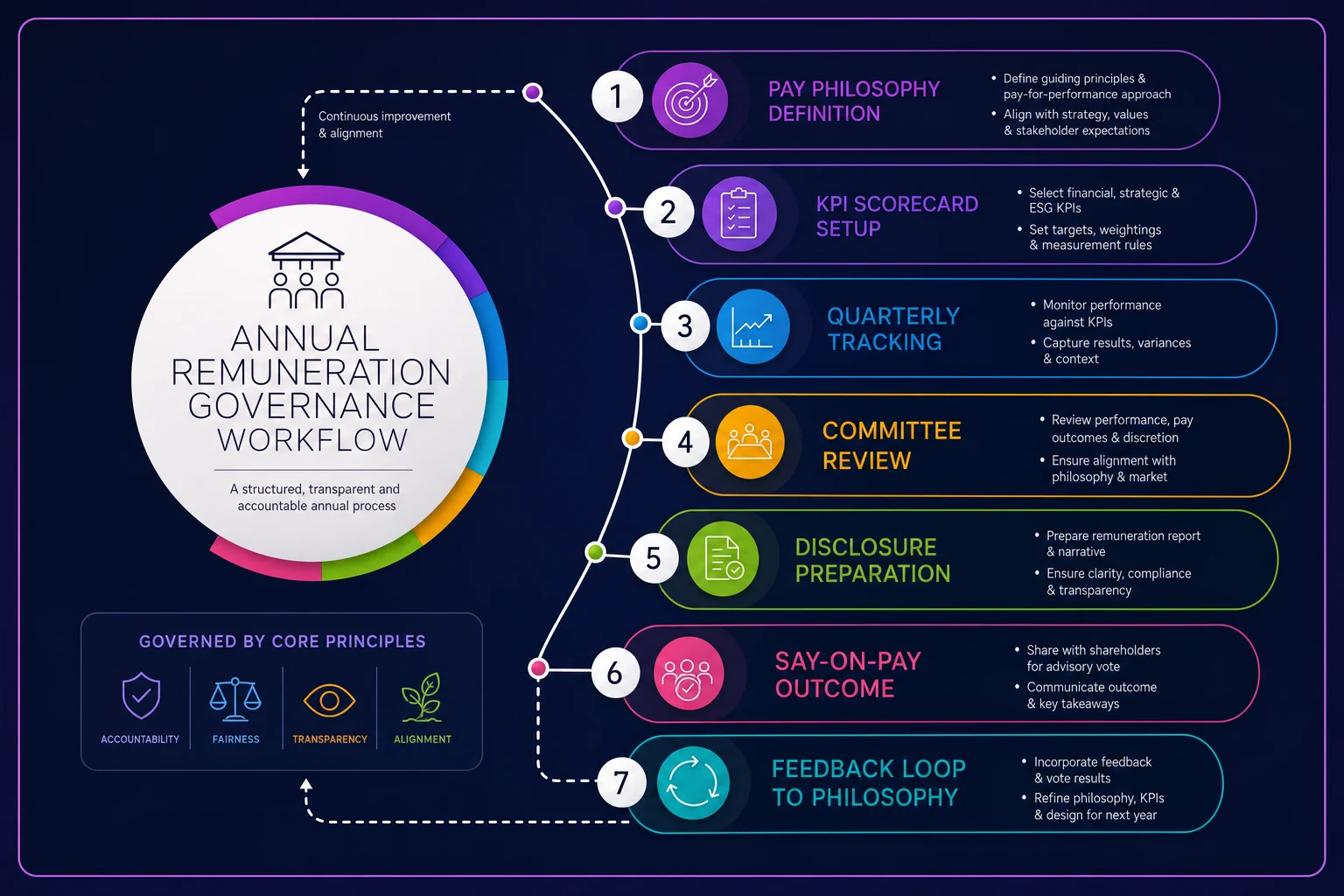
Modern operational software addresses the underlying fragmentation by centralizing data flows. Instead of chasing down monthly revenue figures, the platform pulls directly from source systems. KPI scorecards update automatically, eliminating version control issues and calculation disputes.
It also standardizes committee workflows—materials generate from templates, recusal notifications trigger based on predetermined conflicts, and disclosure deadlines appear on everyone's calendar with appropriate lead times. Every decision, adjustment, and approval lives in one place. When auditors ask for evidence of oversight, you're pulling reports rather than reconstructing email threads.
Scenario modeling is another area where the right platform pays for itself. Before finalizing any compensation decision, you can model outcomes—what happens if revenue comes in 5% below target, how the TSR modifier affects payouts under different scenarios. That kind of real-time analysis prevents year-end surprises.
AI automation can layer on top of this by identifying patterns that are easy to miss manually—flagging when KPIs are trending off-target early enough to course-correct, identifying peer companies that have become statistical outliers, or surfacing disclosure language based on successful say-on-pay outcomes at comparable companies. The goal isn't to automate judgment. It's to automate the operational infrastructure so the committee can focus on actual compensation decisions rather than spreadsheet management.
Common implementation pitfalls
Even with a solid framework, implementation is where things typically go sideways.
Over-engineering the scorecards: Some companies create 20+ KPIs with complex interdependencies. This precision theater actually reduces governance effectiveness. Stick to four to seven meaningful metrics that genuinely drive behavior.
Stick to four to seven meaningful metrics to avoid precision theater.
Under-documenting discretion: Committees sometimes exercise positive discretion (paying above formula) or negative discretion (reducing payouts). Both require thorough documentation—rationale, alternatives considered, precedent analysis. "It felt right" doesn't survive regulatory scrutiny.
Ignoring international complexity: Multinational companies often focus on U.S. executive compensation while overlooking international subsidiaries. Different tax regimes, regulatory requirements, and cultural expectations require localized approaches within your global framework.
Delaying bad news: When KPIs are trending below threshold, there's a tendency to wait and hope for recovery. Early transparency with executives about likely outcomes reduces year-end conflict and actually demonstrates consistent governance.
Making remuneration governance sustainable
The best remuneration governance framework is one that actually gets used. That requires balancing comprehensiveness with practicality.
Start with the highest-risk areas. Don't try to perfect everything at once—focus first on CEO compensation, KPI tracking, and disclosure preparation, then build from that foundation. Align your remuneration governance framework with your broader board governance calendar. If you're already running quarterly committee workplans, embed compensation reviews into that rhythm rather than building a parallel process nobody has time for.
Also worth tracking whether the framework is actually working: say-on-pay support percentage, ISS and Glass Lewis recommendation alignment, time spent on compensation discussions, number of post-meeting clarifications required, and audit findings related to compensation. These metrics tell you whether your framework is improving governance or just generating paperwork.
Beyond compliance to strategic value
A robust remuneration governance framework does more than prevent problems—it creates space for better compensation design. When you're not scrambling to document last year's decisions or calculate basic achievement levels, the committee can focus on questions that actually matter: How do our compensation programs drive long-term value creation? What behaviors are we actually incentivizing? What risks are embedded in our incentive structures?
Companies that get this right treat remuneration governance as a competitive advantage. They attract better executives because their programs are clear and fair. They maintain shareholder support because pay-for-performance alignment is demonstrable, not just claimed. They avoid regulatory scrutiny because their processes are documented and consistent.
Most importantly, they spend less time on compensation mechanics and more time on compensation strategy. The committee can debate whether customer satisfaction should be a metric—not whether last year's target was $47M or $48M. In today's governance environment, that distinction matters more than most boards realize.
Ready to enhance your board's productivity?
Join 500+ organizations using Panlly to save time, improve governance, and streamline board operations.