

The worst time to figure out who owns what is the morning a dissident files their nomination notice. By then the clock is already running against you, and every hour spent asking "wait, who approves this statement?" is an hour the other side is using to shape the narrative.
Most boards that lose contests don't lose on the merits. They lose because their internal machinery jammed at the exact moment it needed to move fast and clean. Statements went out that contradicted the last filing. A director talked to a portfolio manager without counsel knowing. Someone deleted a Slack thread that later became Exhibit 14. None of that is strategy — it's readiness failure.
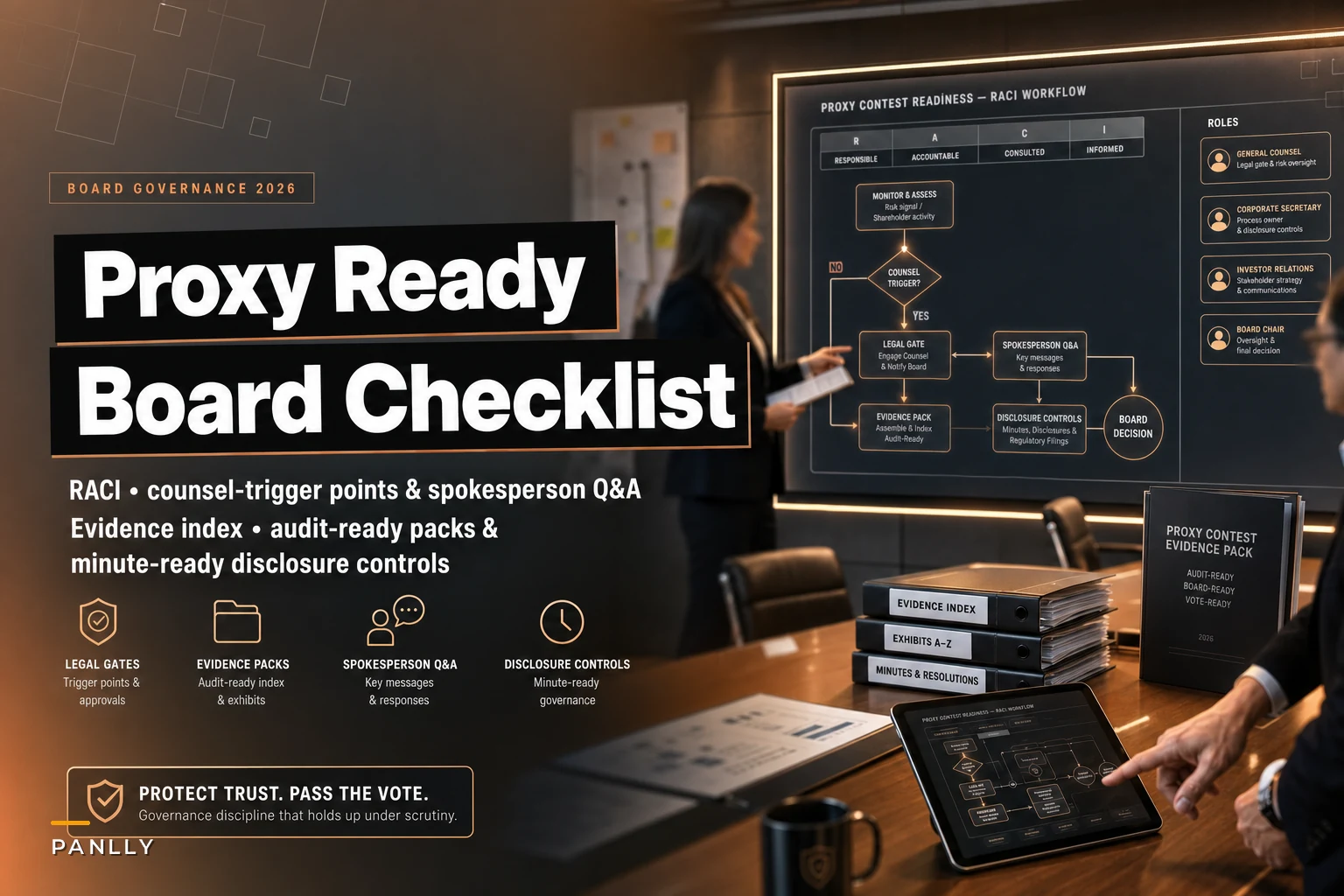
This is a proxy contest preparedness checklist built for the operational layer: not the campaign playbook, but the control system underneath it. Roles, evidence, legal gates, and message discipline. The stuff that decides whether your response looks coordinated or looks like a fire drill.
The failure pattern nobody wants to admit
Here's what actually happens in the first 72 hours after an activist surfaces, and why it goes sideways.
An activist accumulates a position quietly, files a 13D, then sends a private letter with three demands and a deadline. The GC forwards it to the board chair. The chair loops in the CEO. The CEO mentions it to the CFO, who mentions it to head of IR, who — trying to be helpful — takes a call from a friendly analyst and "clarifies the company's position." Except there is no agreed position yet. There's a forwarded email and four people improvising.
By the time counsel drafts a coordinated response, three inconsistent messages are already in the market. Now you're not just defending against the activist. You're reconciling your own contradictions.
This happens because boards treat proxy readiness as a legal problem owned entirely by outside counsel, when it's actually a coordination problem that outside counsel can't fix from the outside. Counsel can tell you the rules. They can't tell you who at your company is allowed to speak, what evidence exists and where, or whether your disclosure committee even knows a triggering event occurred.
That gap — between legal advice and internal operational control — is where contests get lost.
Gate 1: A RACI that actually names humans
Every board says it has clear roles. Almost none can produce, in under a minute, the name of the person Responsible for approving a public statement during a live contest. "The GC and the chair, together, probably" is not an answer. It's the reason the analyst call happened.
Eliminate boardroom chaos with seamless coordination.
Panlly simplifies scheduling, collaboration, and follow-ups for every board meeting.
- Centralized meeting scheduling
- Secure document sharing
- Task assignment & tracking
No credit card required
A proxy-readiness RACI has to be built before the event and cover the workflows that only exist during a contest. Not your normal governance roles — the contest-specific ones.
| Workflow | Responsible | Accountable | Consulted | Informed |
|---|---|---|---|---|
| Approving public statements | Head of IR (draft) | Board Chair | Outside counsel, CEO | Full board |
| Direct investor/PM contact | Designated IR lead only | GC | Outside counsel | CEO, Chair |
| SEC filing sign-off | GC | CEO/CFO | Outside counsel, auditor | Disclosure committee |
| Evidence preservation hold | GC | GC | IT, records custodian | Executive team |
| Employee communications | Head of HR/Comms | CEO | Counsel | Board |
| Regulator or exchange contact | GC | Board Chair | Outside counsel | Full board |
The insight most boards miss: the Consulted column is where deals die. If outside counsel isn't a mandatory consult before any public statement, someone will eventually say something helpful and legally reckless. And the "Direct investor contact" row needs to be brutally narrow — one named person. The moment two people are allowed to talk to shareholders, you get two positions.
A common mistake is building the RACI for a hypothetical and never pressure-testing it. Run a 30-minute tabletop: the chair reads a fake demand letter aloud, and everyone has to say, without notes, what they do next. The confusion in that room is exactly the confusion you'll have live — better to find it in a conference room than in a proxy filing.
A simple process diagram helps people see the handoffs and the single points of failure.
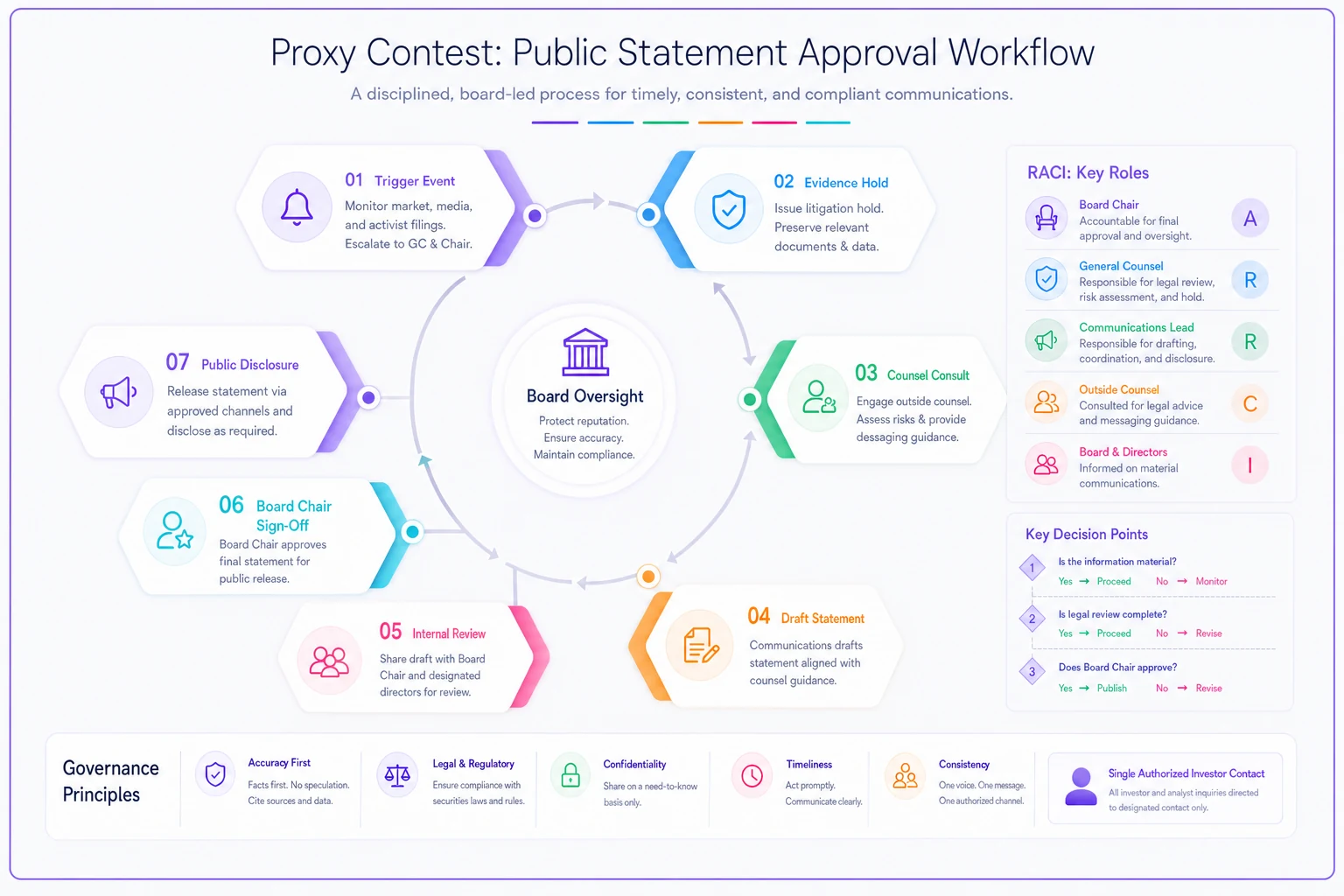
Use the diagram in tabletop exercises so everyone recognizes where they sit in the flow.
Gate 2: The evidence index — because deletion is the real risk
Once a contest starts, your documents stop being internal records and become discoverable evidence. The problem is boards rarely know what they have or where it lives until litigation forces an inventory. By then people have been "cleaning up" for weeks.
An evidence-index template solves the "where is everything" problem before you need it. It's not a document dump — it's a map. What categories of records exist, who owns them, where they physically sit, and what the retention rule is.
A practical evidence index tracks, at minimum:
-
Board and committee minutes for the prior 24–36 months, plus all associated pre-read packs
-
Decision logs tied to any strategy the activist is attacking (a rejected sale, a comp decision, a capital allocation call)
-
Director communications — including the personal-email and text-message problem nobody wants to talk about
-
Advisor engagement records — when bankers and counsel were retained, and on what mandate
-
The paper trail behind contested decisions — the analysis that supported the choice the activist calls value-destroying
The decisions activists attack hardest are usually the ones with the thinnest documentation. The board discussed a sale for months, decided against it in a hallway consensus, and the minutes say "the board considered strategic alternatives." That single vague line, with no supporting analysis, is a gift to a dissident arguing the board was asleep. This is exactly why disciplined minute practices and evidence-preservation habits matter long before a contest ever starts — the same discipline that protects you in a regulator inquiry protects you here.
The operational move: the moment a contest looks credible, GC issues a litigation hold and the evidence index becomes the checklist for confirming that hold actually reached every custodian — including the director who does board business from a personal Gmail account. If your hold doesn't cover personal devices, it doesn't cover anything.
Gate 3: Counsel-trigger points, written down in advance
The most expensive delays in a contest come from not knowing when to call the lawyer. People wait, hoping the situation resolves, and by the time counsel is engaged, a disclosure window has already narrowed the options.
Counsel triggers should be concrete events, not judgment calls. When one of these happens, the phone gets picked up automatically — no debate about whether it's "serious enough yet."
-
Any 13D filing naming the company, or any accumulation crossing 5% by a holder signaling intent to influence.
-
A private demand letter with named demands, regardless of how "friendly" the tone reads.
-
A director being contacted directly by an activist or their representative — the director reports it before responding, not after.
-
Any request to nominate directors or any signal of a nomination window approaching.
-
Media inquiries referencing shareholder dissatisfaction, board composition, or strategy.
-
An employee or insider leak relating to board deliberations.
Boards over-index on trigger #1 (the filing) and completely miss triggers #3 and #6. A director takes a "casual" call from a fund and doesn't mention it for a week because it "didn't seem official." That week is when your options quietly close. The trigger sheet exists precisely to remove that individual judgment from the moment.
Write these on one page. Tape it to the inside of the board portal. The value isn't sophistication — it's removing the hesitation.
Gate 4: Spokesperson Q&A that survives contact with a hostile analyst
Message discipline collapses under pressure because people improvise when they get a question they weren't prepped for. The fix is a Q&A script that anticipates the hard questions and gives approved language and clear "do not answer, refer to counsel" boundaries.
A usable script has three columns: the likely question, the approved answer, and the hard stop.
| Likely question | Approved response | Hard stop |
|---|---|---|
| "Is the board considering the activist's proposals?" | "The board reviews all shareholder input and is focused on long-term value creation." | Do NOT confirm/deny specific proposals. |
| "Are you exploring a sale?" | "We don't comment on speculation about strategic alternatives." | No hints, no "not at this time." |
| "Has any director met with the activist?" | Refer to counsel before answering. | Never confirm meetings ad hoc. |
| "Will you settle?" | "We're committed to the process outlined in our proxy materials." | No settlement speculation. |
The mistake that keeps recurring: companies script the answers but not the refusals. Under pressure, "no comment" feels weak, so the spokesperson adds a sentence to sound cooperative — and that sentence becomes the story. The "hard stop" column exists to make silence the trained, comfortable default rather than the awkward one.
Rehearse the Q&A in live role-play so spokespeople can deliver the hard stop without sounding defensive.
Every person on the approved-contact list rehearses this out loud, not just reads it. The difference between reading "we don't comment on speculation" and saying it three times to a colleague playing a pushy reporter is the difference between it coming out smooth and it coming out defensive.
Gate 5: Minute-ready disclosure controls
During a contest, the board will make decisions fast, and each one may need to survive a hindsight review by regulators, plaintiffs, and the activist's own lawyers. If your minutes don't capture why a decision was made and what the board considered, you've handed the other side an argument.
Minute-ready disclosure controls mean that before any contest-related board decision, three things are pre-loaded:
-
The motion language is drafted before the meeting, tied to a specific decision and evidence reference.
-
The evidence map — which document supports which conclusion — is attached to the pre-read.
-
The disclosure committee has a standing check on whether the decision itself is a reportable event.
This is the same discipline that makes M&A approvals defensible when a deal decision gets challenged later — the templated decision records and conflict checks that let a board show its work under scrutiny. A contested proxy fight applies that same standard to routine-looking decisions that suddenly aren't routine anymore.
The pattern to avoid: minutes written after the pressure passes, reconstructed from memory, sanitized to look tidy. Reconstructed minutes read as reconstructed. Contemporaneous, specific minutes — even messy ones — read as genuine deliberation.
A short real scenario
A mid-cap industrials company, roughly $600M market cap, gets a 13D from a fund holding about 6%, demanding two board seats and a strategic review. Historically this board had no contest playbook — governance was competent but reactive.
In their first version of readiness (before the kit), a similar-sized peer in their sector had lost 12–14 days in the opening window just aligning on messaging, and put out two inconsistent statements in the process. The activist used those inconsistencies in their next letter.
This board had spent one afternoon the prior year building the RACI, the trigger sheet, and a draft Q&A. When the 13D hit, the designated IR lead was the only person taking investor calls within a few hours. Counsel was engaged the same day the letter arrived because it hit a written trigger, not a judgment call. The evidence hold reached all custodians — including the two directors using personal email — inside 48 hours.
They didn't "win" in some dramatic sense. They settled to a one-seat outcome on terms the board found acceptable. But they never contradicted themselves publicly, never had a preservation gap, and negotiated from a position of visible control rather than scramble. The prep didn't cost them much. The absence of it would have.
When this level of readiness actually makes sense
Not every company needs a fully drilled contest kit sitting in a drawer. If you're a tightly held company with a controlling shareholder, the RACI matters less because the outcome is largely predetermined.
This makes sense when:
-
You have a dispersed shareholder base and no controlling block
-
You've underperformed peers for several quarters (activists screen for this)
-
You've made a large, contestable strategic decision recently
-
Your board has vague minutes and thin decision documentation
This is lower priority when:
-
A founder or family controls the vote
-
You're pre-IPO or newly public with a locked-up base
-
Your governance and disclosure records are already tight and contemporaneous
Who should not treat this as optional: any board that can't currently name, in one sentence, the single person authorized to speak to shareholders during a crisis. If that answer isn't instant, the rest of this checklist is where you start.
The one-page readiness checklist
Print this. Confirm each line has a real answer with a real name attached.
-
- [ ] RACI names a single authorized investor-contact person
-
- [ ] Outside counsel is a mandatory consult before any public statement
-
- [ ] Counsel-trigger sheet exists and every director has seen it
-
- [ ] Directors know to report activist contact before responding
-
- [ ] Evidence index maps all board records to owners and locations
-
- [ ] Litigation-hold process covers personal email and devices
-
- [ ] Spokesperson Q&A includes approved answers and hard stops
-
- [ ] Approved spokespeople have rehearsed out loud, not just read
-
- [ ] Disclosure committee has a standing reportable-event check
-
- [ ] Contest-related motions and evidence maps are drafted pre-meeting
-
- [ ] The whole kit has been tabletop-tested at least once
Use this as the pre-call checklist when a trigger occurs. If any line is blank, fill it before the next investor season.
The point
A proxy contest tests two things: your strategy and your operational discipline. Boards spend almost all their prep on the first and almost none on the second, then lose on the second.
The readiness kit — RACI, evidence index, trigger points, Q&A scripts, disclosure controls — isn't about outsmarting the activist. It's about making sure that when the pressure hits, your own people move in one direction, your records tell a clean story, and nobody says the thing that becomes the headline. Build it before you need it, drill it once, and keep it current. The contest you're most ready for is usually the one that stays a quiet negotiation instead of a public fight.
A proxy contest tests two things: your strategy and your operational discipline. Boards spend almost all their prep on the first and almost none on the second, then lose on the second.
The readiness kit — RACI, evidence index, trigger points, Q&A scripts, disclosure controls — isn't about outsmarting the activist. It's about making sure that when the pressure hits, your own people move in one direction, your records tell a clean story, and nobody says the thing that becomes the headline. Build it before you need it, drill it once, and keep it current. The contest you're most ready for is usually the one that stays a quiet negotiation instead of a public fight.
Ready to enhance your board's productivity?
Join 500+ organizations using Panlly to save time, improve governance, and streamline board operations.