


Most board-level digital transformation programs don't fail because the technology doesn't work. They fail because the board approved a vague promise — "modernize governance," "digitize the boardroom" — and then had no framework to measure whether the money produced anything. Eighteen months later, someone asks the audit committee what the program delivered, and the honest answer is a shrug and a vendor invoice.
The problem isn't ambition. It's sequencing. Boards tend to approve transformation as a single lump — one big budget line, one go-live date, one fuzzy ROI story — when the value actually arrives in distinct stages, each with its own owner, its own metrics, and its own failure mode. If you don't separate those stages, you can't tell the difference between "the program is working slowly" and "the program is quietly dying."
This playbook covers how a board should frame the case, stage the value, assign accountability, and track the whole thing without needing a PhD in project management. The structure that works in practice follows a predictable arc: efficiency first, then risk reduction, then audit-readiness. Each stage builds on the last. Skip ahead and you end up with expensive tooling nobody trusts.
Why boards approve transformation they can't later measure
The approval conversation and the measurement conversation almost never use the same language. The CFO pitches cost savings and productivity. The corporate secretary wants fewer frantic Sunday-night pack assemblies. The audit chair wants cleaner evidence trails. General counsel wants defensibility. Everyone says yes to the same budget for four different reasons — and because nobody wrote those reasons down as measurable outcomes, nobody can later check them off.
A pattern that comes up repeatedly across governance teams: the business case gets built around features instead of outcomes. The paper says "implement a board portal with voting, annotation, and secure document distribution." That's a shopping list, not an investment case. A director reading it has no way to know what good looks like in twelve months.
The second reason measurement breaks is that transformation benefits are lumpy and lagged. Efficiency gains show up fast — within a quarter you can see meeting prep time drop. Risk reduction shows up slower, usually when a near-miss doesn't turn into an incident. Audit-readiness value sometimes doesn't materialize until a regulator or litigation request lands, which might be two years out. If the board expects a clean ROI number by the next AGM, the program looks like a failure precisely when it's working as designed.
There's a third, quieter reason too: executive sponsorship gets assumed rather than assigned. A program with a "steering committee" but no single accountable sponsor tends to stall the moment priorities compete. Someone has to own the outcome, not just chair the meetings.
The staged value model: efficiency, then risk, then audit-readiness
The reason this sequence works is that each stage funds the credibility of the next. Efficiency gains are visible and fast, which buys patience for the slower risk and audit work. If you try to lead with audit-readiness — the thing boards say they care about most — you'll spend six months building evidence architecture nobody feels in their day-to-day, and the program loses momentum before it proves anything.
Eliminate boardroom chaos with seamless coordination.
Panlly simplifies scheduling, collaboration, and follow-ups for every board meeting.
- Centralized meeting scheduling
- Secure document sharing
- Task assignment & tracking
No credit card required
Here's how the three stages break down in terms of what changes, who feels it, and how you measure it.
| Stage | What changes operationally | Who feels it first | Primary metrics | Typical timeline |
|---|---|---|---|---|
| 1. Efficiency | Pack assembly, distribution, scheduling, action-item tracking move from manual to structured | Corporate secretary, admin team, directors | Prep hours per meeting, time-to-distribute, action-item closure rate | 0–6 months |
| 2. Risk reduction | Access controls, version integrity, conflict tracking, confidentiality boundaries tighten | General counsel, risk, audit chair | Access incidents, stale-document rate, late conflict disclosures | 6–15 months |
| 3. Audit-readiness | Decision trails, evidence maps, retention and export become defensible and query-ready | Audit committee, external auditors, regulators | Time-to-produce evidence, completeness of decision records, audit findings | 12–30 months |
The mistake directors make is reading this table top-to-bottom and assuming the stages are sequential phases where one finishes before the next starts. They overlap. Stage 1 keeps running while Stage 2 builds. What's sequential is where you put the emphasis and the measurement attention — not the work itself.
One more thing worth naming: these stages map onto how the actual digitization program should be run. If you're planning the underlying rollout, a phase-based governance migration roadmap gives you the operational sequencing that sits underneath this value model. The value staging is the board's view; the migration roadmap is the execution view. You need both, and they have to agree on the order.
Building the investment case the board will actually sign
A board-ready investment case is short, specific, and framed around decisions directors can revisit. The feature list belongs in an appendix. The front page should answer three questions: what are we buying in terms of outcomes, what does each stage cost, and how will we know at each gate whether to keep going.
Here's a simple ROI framing that holds up in a boardroom better than a single blended number:
Stage 1 — Efficiency ROI. Count the fully-loaded hours currently spent assembling, reviewing, distributing, and chasing board materials across all committees. In a mid-sized organization with four committees meeting quarterly plus a full board, that's often somewhere around 25–40 hours of coordination per meeting cycle once you include the secretary, legal review, and executive prep. Multiply by meeting cadence, multiply by loaded cost. A realistic efficiency case lands in the range of recovering 300–500 hours a year — not a revenue number, but a capacity number the CFO understands.
Stage 2 — Risk-reduction value. This one is harder because you're pricing avoided events. Don't fake precision. Frame it as exposure reduction: how many confidentiality-sensitive documents currently sit in personal email or shared drives with no access log? What's the cost of a single leaked M&A deliberation or a conflict that surfaces after a vote? You can't put an honest point estimate on it, so present it as risk-exposure narrowing plus a few concrete control improvements — access logging, enforced version control, revocable distribution.
Stage 3 — Audit-readiness value. Price this against real past pain. Ask the audit chair and GC: the last time a regulator, auditor, or litigant requested board records, how long did it take, how many people got pulled in, and how confident were you in completeness? If the honest answer is "three weeks and a lot of anxiety," the value is turning that into days with confidence. That's a defensibility and time-to-produce story, not a dollar figure.
Keep the front page limited to outcomes, per-stage costs, and the gate criteria so skeptical directors can check claims at each decision point.
The reason to split ROI this way is simple: it survives contact with a skeptical director. Nobody believes a single "$1.2M in value" line. People believe "we recover roughly 400 coordination hours, we close three named control gaps, and we cut evidence-production time from weeks to days." Each claim is checkable at a gate.
Stakeholder accountability: a RACI that actually assigns ownership
The fastest way to kill a transformation is to make it everyone's responsibility, which means it's no one's. A board digital transformation playbook needs a clear RACI across the roles that always end up involved — and the single most important cell is the Accountable column, which should have exactly one name per decision.
-
Executive sponsor (usually CFO or Chair) Accountable for the overall business case and stage-gate decisions. This person defends the program when budgets tighten.
-
Corporate secretary / governance lead Responsible for operational rollout, adoption, and day-to-day running. This is where the efficiency value is actually captured or lost.
-
General counsel Responsible for the risk-reduction stage — access models, confidentiality boundaries, retention policy.
-
Audit committee chair Consulted on the audit-readiness design, and the eventual judge of whether evidence trails hold up.
-
IT / security Responsible for integration, access controls, and the technical side of data integrity.
-
Directors as a body Consulted on workflow design, informed on progress against gates.
The pattern that breaks programs: the corporate secretary is handed responsibility for adoption but has no authority over directors' behavior and no air cover from the sponsor when a senior director refuses to stop emailing documents to a personal account. Responsibility without authority is just blame waiting to happen. The sponsor's real job is to close that gap — to make the new way the only way, from the top.
Adoption KPIs that tell you the truth early
Most adoption dashboards measure login counts and call it a day. Logins tell you almost nothing. The question isn't whether directors opened the portal; it's whether the governance workflow actually moved into the system and stayed there.
Track these instead, grouped by what they actually reveal:
Behavior migration (are we actually using it?)
-
Share of board materials distributed through the system vs. side channels like email or shared drives. This is the single most honest adoption metric. If 30% of packs still go out by email, you don't have adoption — you have a parallel system.
-
Percentage of votes and consents captured in-system vs. on paper or verbally.
-
Action items logged and closed in-system vs. tracked in someone's private spreadsheet.
Workflow health (is it making things better or just different?)
-
Time from pack-ready to pack-distributed.
-
Prep hours per meeting cycle, tracked over time.
-
Late-document rate — materials added after the distribution deadline.
Trust signals (do people believe the system?)
-
Director-reported confidence in finding past decisions — a quick quarterly pulse, not a survey marathon.
-
Number of "can you just email me that" requests to the secretary. When this drops, the system has won.
Adoption is a leading indicator and value is a lagging one. If behavior-migration numbers are stalling at month four, your Stage 2 and Stage 3 value will never arrive, regardless of how the technology performs. Watch adoption closely early, because it's the cheapest problem to fix before it compounds.
For the broader measurement structure — how these program KPIs connect to overall governance performance rather than just the transformation project — it's worth aligning with a proper board effectiveness measurement system so the transformation metrics live inside the board's existing scorecard instead of floating as a separate vanity dashboard.
The staged benefits roadmap directors can approve against
A benefits roadmap isn't a Gantt chart. It's a set of gates where the board explicitly decides to continue, adjust, or stop. Each gate has an owner, a small number of checkable outcomes, and a decision.
Here's the sequence that works:
-
Gate 0 — Approval with defined outcomes. The board approves not a budget but a staged outcome set. Each stage has named metrics and a named sponsor. Nothing proceeds until the efficiency metrics are agreed and the baseline is captured. You cannot prove improvement without a before-number.
-
Gate 1 — Efficiency proven (month 4–6). Decision
has pack preparation and distribution time measurably dropped, and are materials flowing through the system rather than around it? If behavior migration is below target, fix adoption before funding Stage 2. Don't pour risk-reduction money onto a system half the board is ignoring.
-
Gate 2 — Risk controls live (month 10–15). Decision
are access controls, version integrity, and confidentiality boundaries actually enforced and tested? GC owns this gate. The test isn't "did we configure it" — it's "did we try to break it and fail."
-
Gate 3 — Audit-readiness demonstrated (month 18–30). Decision
run a live evidence-production drill. Pick a past decision, request the full trail, and time how long it takes to produce a complete, defensible record. Audit chair owns the verdict.
-
Gate 4 — Steady-state and reassessment. The program becomes business-as-usual, and the board sets a cadence to re-test the drills annually so audit-readiness doesn't quietly decay.
The underrated move here is Gate 1's stop condition. Boards almost never build a real "stop or fix" trigger into transformation, so a struggling program limps forward on sunk-cost momentum. Writing the efficiency gate as a genuine checkpoint — with explicit permission to pause and fix adoption — is what separates a managed program from a hopeful one.
A visual can help boards and sponsors see the gates, owners, and decision flow at a glance.
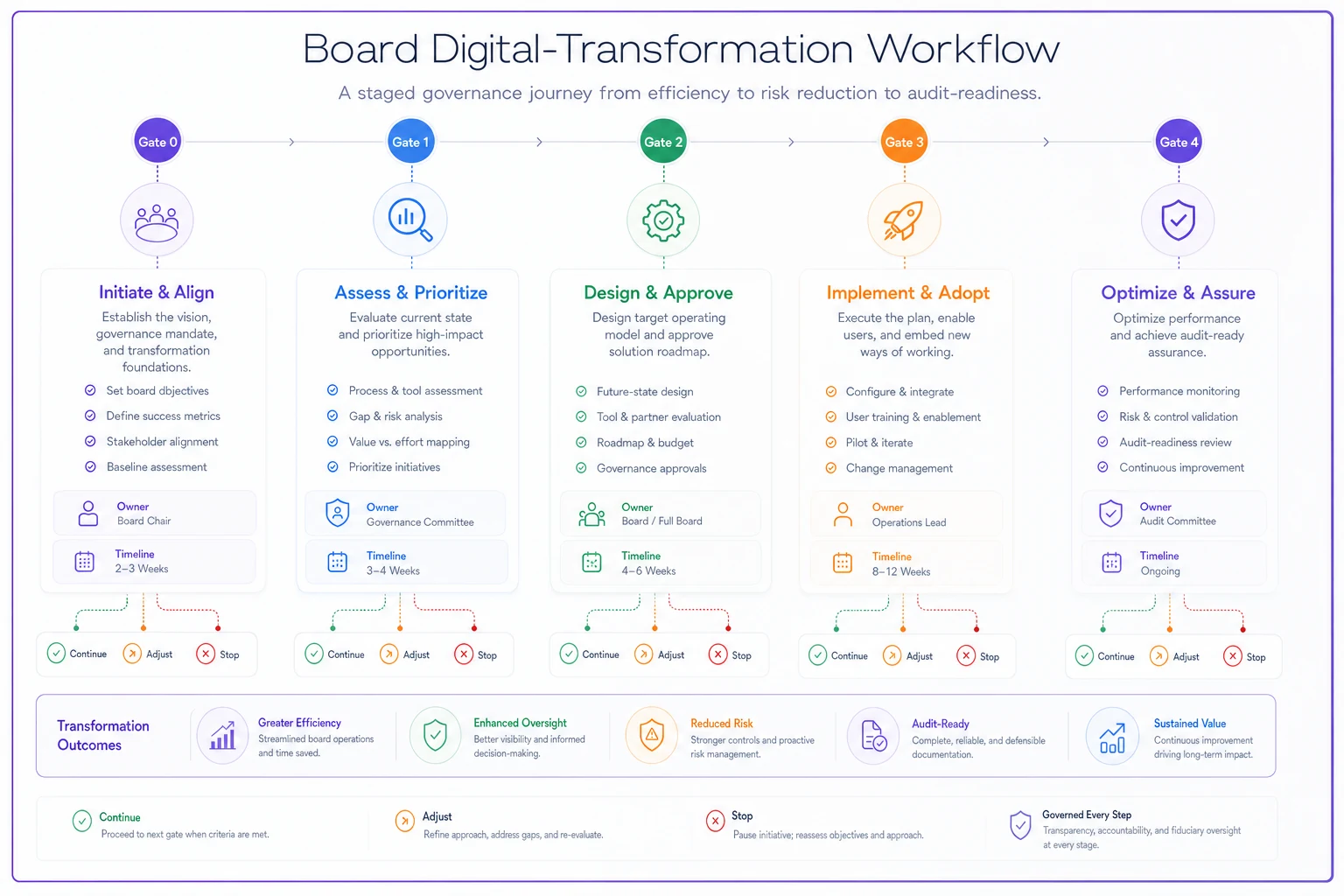
Use the diagram to anchor the board paper so directors can literally point at the gate where they will ask for evidence.
A real scenario: mid-market company, four committees
Consider a regional financial-services firm, roughly 600 employees, with a full board plus audit, risk, remuneration, and nominations committees. Before the program, materials went out as PDF email attachments, votes happened over email threads, and the corporate secretary kept action items in a personal spreadsheet. The last regulator document request had taken close to three weeks to fulfill and pulled four people off their day jobs.
They staged it. In the first two quarters they focused purely on efficiency — getting every pack into one system and killing email distribution. Prep per meeting cycle dropped from 30-plus hours to the high teens once the secretary stopped rebuilding packs by hand. By month five, roughly 90% of materials were flowing through the system, which confirmed adoption was real.
Only then did they move to the risk stage — access logging, enforced version control, and a clean confidentiality boundary for deal-sensitive papers. The audit-readiness stage came last. When they ran their first evidence drill near month twenty, pulling the full trail on a past credit-policy decision, it took under two days with complete records. The three-week scramble had become a Tuesday-afternoon task.
What made it work wasn't the software choice. The CFO acted as a genuine sponsor, the efficiency win bought credibility for the slower stages, and every gate had a real decision attached. Nobody had to guess whether it was working.
When this staged approach makes sense — and when it doesn't
When it makes sense: You have multiple committees, meaningful regulatory exposure, and a governance team currently drowning in manual coordination. The staging is especially valuable when the board is skeptical and needs to see fast wins before committing to the slower, less visible work.
When it's overkill: A very small board — say a single-committee nonprofit meeting a few times a year — doesn't need a three-stage program with formal gates. The overhead of the playbook would exceed the problem. For those organizations, capturing the efficiency stage and basic record integrity is usually enough.
Who should not do this: Any organization that hasn't secured a real executive sponsor. If the CFO or Chair isn't personally accountable and willing to enforce the new workflow from the top, don't start. A sponsorless transformation will produce exactly the parallel-system mess the program was meant to eliminate — except now you'll also have a license fee.
A related caution on tooling: don't let the staged value case quietly become a procurement decision made by enthusiasm. Run the vendor side with the same discipline as the value side. A proper governance-tech procurement checklist keeps you from locking into a platform you can't exit, which matters quite a bit when audit-readiness depends on your ability to export clean records years later.
Where automation genuinely helps — and where it's just noise
It's worth being honest about where modern tooling actually moves the needle. The real operational gains from AI-assisted governance platforms show up in the unglamorous coordination layer: automatically chasing overdue action items, flagging documents that changed after distribution, surfacing related past decisions when a similar item returns to the agenda, and assembling evidence trails without someone manually stitching them together. Those are the tasks that eat the secretary's week and introduce the errors that later become audit findings.
Where it's mostly noise is any pitch promising the software will "make better decisions" for the board. It won't, and directors shouldn't want it to. The value of AI automation here is removing the manual grind and the version-control mistakes that creep in at scale — not replacing judgment. A platform that quietly keeps your decision log complete, your access trail intact, and your action items from falling through the cracks is doing exactly the right job. The board's job stays the board's job.
The practical test for any feature: does it reduce manual coordination, prevent a specific error, or shorten evidence production? If yes, it serves one of your three stages. If it doesn't map to efficiency, risk reduction, or audit-readiness, it's a feature looking for a problem.
A board digital transformation playbook isn't really about technology — it's about making the investment legible enough that directors can govern it like any other decision: approve against outcomes, measure at gates, continue or stop with evidence. Stage the value so the fast wins fund patience for the slow ones. Give every stage one accountable owner. Build a genuine stop condition into the efficiency gate so a failing program gets fixed instead of funded.
Do that, and eighteen months from now, when someone asks the audit committee what the program delivered, the answer won't be a shrug. It'll be a number, a closed control gap, and a two-day evidence drill that used to take three weeks.
Ready to enhance your board's productivity?
Join 500+ organizations using Panlly to save time, improve governance, and streamline board operations.