

Most boards don't have an AI oversight problem. They have an AI routing problem. Someone in the room knows the company deployed a credit-scoring model last quarter. Someone else vaguely recalls that marketing is using a generative tool for customer emails. The CFO mentions a vendor "with some machine learning in it." And nobody can answer the one question that actually matters when a regulator or plaintiff shows up: who was accountable for checking that this thing works, and where's the evidence?
That's the gap. The technology is moving faster than the governance plumbing, and directors are being asked to sign off on risks they can't see, can't measure, and often don't know exist. The fix isn't for directors to learn how neural networks work. It's to build a board AI oversight framework that turns fuzzy algorithmic risk into a small number of concrete, routable decisions — each with a named owner, a minimum evidence standard, and a triage lane.
This article walks through how that system actually fits together: the taxonomy that tells you which AI uses matter, the minimal explainability checks a director can reasonably demand, the evidence packs that make assurance real instead of theatrical, and the cadence that routes issues to the right people before they become crises.
Why AI oversight breaks in the boardroom (and it's not the technology)
The failure almost never looks like a dramatic model malfunction. It looks like drift in ownership.
Here's the pattern. A company has maybe a dozen AI or automated-decision uses scattered across functions. HR has a resume screener. Finance has a fraud-flagging tool. Operations has a demand-forecasting model. Customer service has a chatbot drafting responses. Each one was procured or built by a different team, at a different time, under a different budget line. None of them went through a common gate. So when the board asks "what's our AI exposure?", the honest answer is nobody knows — because the information was never designed to roll up.
This is a coordination failure, not a competence failure. The people running each tool often understand it fine. What's missing is a shared classification — a way to say this one is high-stakes and needs assurance, this one is trivial and doesn't. Without that, boards do one of two unhelpful things: they treat every AI use as a five-alarm governance event (which burns committee time and trains everyone to tune out), or they treat none of them seriously until something breaks.
What actually breaks at scale is the connective tissue. A single AI tool is manageable by the team that owns it. Twelve tools across five functions, each with its own vendor, data pipeline, and failure mode, is an oversight problem — and the board only finds out it had one when a model denies a protected class, a chatbot promises something legally binding, or a vendor quietly changes their underlying model and nobody notices the output shifted.
Start with a use-case taxonomy, not a technology inventory
The most common early mistake is cataloguing AI by what it is instead of what it decides. A list of "machine learning models in use" tells a board almost nothing. A list organized by decision consequence tells them everything they need to triage. The useful dimension is: how much does a wrong output cost, and who absorbs it? Group every AI use into tiers based on that.
Eliminate boardroom chaos with seamless coordination.
Panlly simplifies scheduling, collaboration, and follow-ups for every board meeting.
- Centralized meeting scheduling
- Secure document sharing
- Task assignment & tracking
No credit card required
| Tier | What it covers | Consequence of error | Board attention |
|---|---|---|---|
| Tier 1 — Rights-affecting | Hiring, lending, insurance pricing, benefits eligibility, anything affecting a person's access or legal standing | Discrimination claims, regulatory action, individual harm | Full assurance pack + committee review |
| Tier 2 — Material business | Pricing, demand forecasting, fraud detection, supply allocation | Financial loss, operational disruption, reputational hit | Assurance pack + periodic committee reporting |
| Tier 3 — Operational assist | Internal drafting, summarization, scheduling, routing | Rework, minor errors, efficiency loss | Management-level monitoring, exception reporting only |
| Tier 4 — Low-stakes | Spellcheck-grade tools, non-decision automation | Negligible | No board involvement |
Most of the AI noise in an organization lives in Tiers 3 and 4, and most of the risk lives in Tier 1 and a chunk of Tier 2. A good taxonomy doesn't govern everything equally — it concentrates scarce board attention where the consequences are real and pulls everything else off the board's plate entirely. That subtraction is the point. A framework that makes the board review the chatbot summarizer is one nobody will sustain.
Assign a named owner to re-classify tools after any material change.
One practical note: the tier isn't permanent. A Tier 3 drafting tool becomes Tier 1 the moment someone wires its output directly into a customer-facing decision. So the taxonomy needs a re-classification trigger — any material change in how an AI output is used forces a re-tier. That's where most frameworks quietly fail, because reclassification is nobody's job unless you make it somebody's job.
Minimal explainability checks a director can actually demand
Directors get intimidated by explainability because it sounds like a technical discipline. At the board level, it isn't. You're not asking to understand the math. You're asking whether the people operating the model can answer a short set of plain-language questions — and whether their answers are documented.
-
What decision does this influence, and how much weight does it carry? Is it advisory, or does it auto-execute? A human-in-the-loop model and a fully automated one carry completely different risk profiles.
-
What data trained it, and what data does it run on now? If the training data is three years old and the market shifted, you have silent drift.
-
How would we know if it started producing biased or wrong outputs? If the answer is "a customer would complain," that's not monitoring.
-
Who can override it, and how often do they? Override rates are one of the most underused signals in board oversight — a model that's never overridden is either perfect or ignored, and it's almost never perfect.
-
What's the fallback if it goes offline or fails a check? Business continuity for an algorithm is still business continuity.
You don't need model interpretability to get most of the oversight value. You need operational explainability — a clear account of how the thing is used, watched, and corrected. A board that can get crisp answers to those five questions is governing better than one that commissioned a 40-page technical fairness audit it can't interpret.
The mistake to avoid is accepting vendor assurances as explainability. "Our model is fair and tested" is a marketing claim, not evidence. Which brings us to the part that makes the whole framework real.
Evidence packs: the difference between oversight and theater
Governance that isn't documented didn't happen — that's as true for AI as it is for anything else the board touches. The way you keep AI oversight from becoming a quarterly discussion that evaporates is by standardizing what evidence each tier must produce, so assurance owners know exactly what to hand up and the board knows exactly what to expect.
-
A one-page model summary
purpose, decision weight, owner, tier, last re-classification date
-
The intended-use statement and the explicit list of prohibited uses
-
Latest bias/performance test results with pass/fail against pre-set thresholds
-
Override and exception rates for the period
-
Any material change log — model version changes, data source changes, vendor updates
-
Sign-off from the named assurance owner and the relevant function head
Notice what's not in there: no raw model weights, no incomprehensible technical appendices. The pack is designed to be read by a director in a few minutes and to survive a regulator asking "show me how you oversaw this." That second purpose matters enormously. When these packs are captured in a structured, searchable system rather than scattered across email and slide decks, you get the same benefit boards get when they turn board records into actionable data — the evidence rolls up, trends become visible, and you can answer a regulator inquiry without a scramble.
Tier 2 packs can be lighter — performance summary, change log, exception reporting. Tier 3 and 4 produce nothing routine; they surface only by exception.
The pattern that distinguishes strong boards from weak ones: strong boards fix the evidence template first and let the content follow. Weak boards debate the content case-by-case and never standardize, which means every AI issue starts from zero and consumes disproportionate committee time.
Third-party assurance: deciding what you can't check yourself
A lot of a company's AI risk lives in tools it didn't build. A vendor's underlying model, a SaaS feature with embedded ML, an API that silently got "upgraded." The board can't inspect these directly, so the question becomes: what independent assurance do we require before trusting them, and what contractual rights do we need?
-
Change notification rights. The contract must require the vendor to notify you of material model changes. The quiet model swap is the single most common way outsourced AI risk sneaks past oversight.
-
Right to audit or to receive audit results. Either you can assess it, or you get the results of someone credible who did.
-
Documented testing against your use case — not the vendor's generic benchmark, which may bear no resemblance to how you actually use it.
-
Defined liability allocation for algorithmic errors. Who pays when the model discriminates — you or them?
-
Exit and data-portability terms, so a failed assurance review doesn't trap you.
The decision guide is simple. Require full third-party assurance for Tier 1 vendor tools. For Tier 2, require change notification and contractual audit rights but accept the vendor's own testing if it's credible and specific to your use case. Below that, don't bother — you'll exhaust goodwill and budget chasing assurance on tools that can't meaningfully hurt you.
Committee triage lanes and who owns what
An AI issue with no clear home drifts until it becomes an incident. The routing question — which committee, which owner, which cadence — is where most frameworks either click into place or fall apart.
The cleanest approach maps AI oversight onto the assurance structure you already have rather than inventing a new committee. This connects naturally to a functioning three lines of assurance architecture: the first line owns and operates the models, the second line sets standards and monitors, and internal audit or independent review provides the third. AI oversight doesn't need a parallel universe — it needs to plug into that spine.
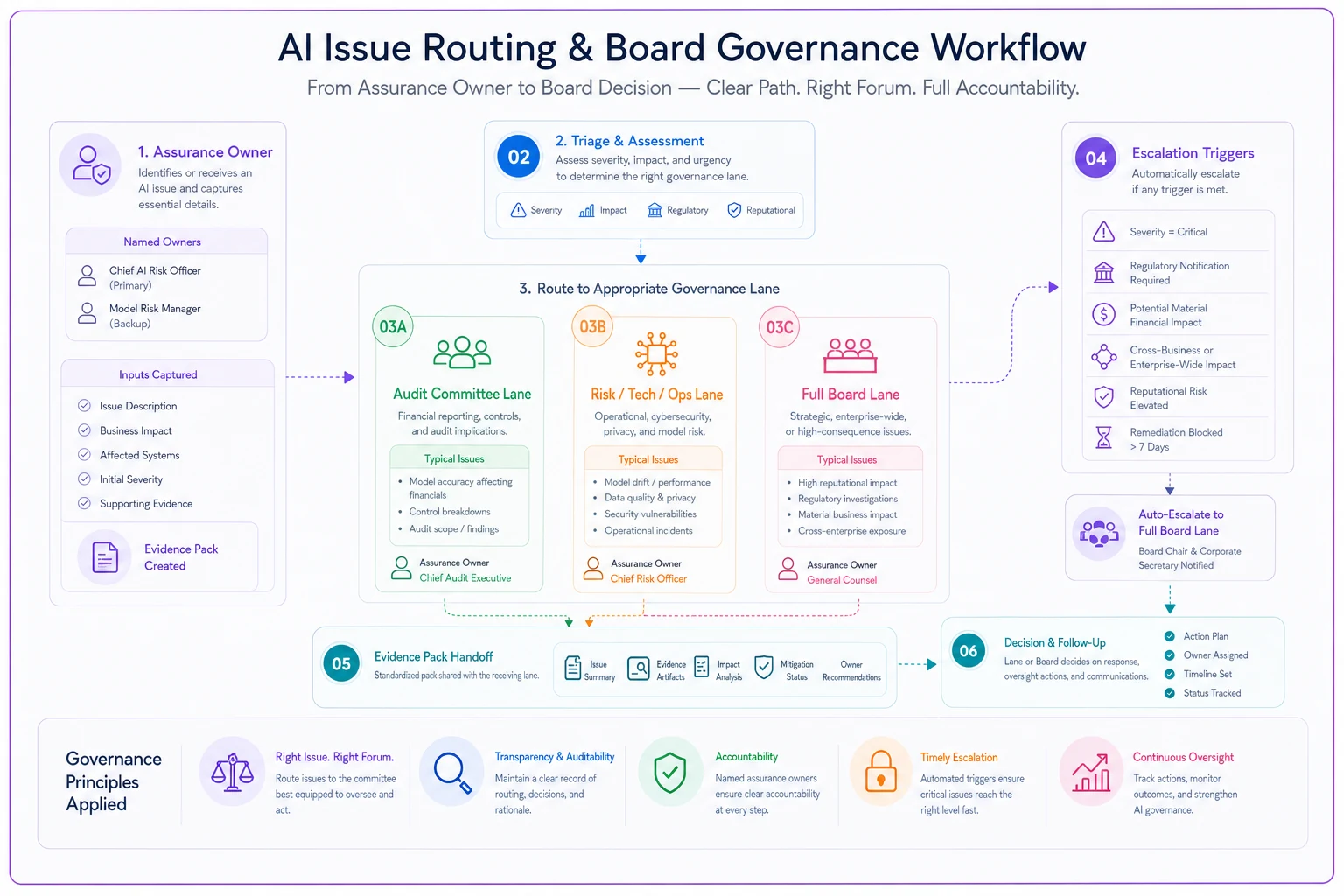
This diagram shows the routing of an AI issue from assurance owner to the appropriate committee.
-
Audit Committee — Tier 1 rights-affecting uses, evidence pack integrity, third-party assurance results
-
Risk Committee (or Audit, if combined) — Tier 2 material business models, aggregate AI risk exposure, drift and incident trends
-
Technology/Operations — Tier 3 monitoring, exception escalation
-
Full board — only policy-level decisions and Tier 1 incidents that cross a materiality threshold
Each lane needs a named assurance owner at the management level who prepares the pack and stands behind it. The board's job isn't to produce the evidence — it's to receive it, test it, and route exceptions. When a Tier 1 bias test fails, the lane is pre-decided: assurance owner flags it, it goes to Audit within a defined window, and the board sees it at the next meeting with a minute-ready brief. No improvisation under pressure.
This is the same discipline that works for cyber oversight with director-facing briefings and escalation checklists — the escalation path is agreed before the incident, so when something breaks, routing is automatic instead of political.
A realistic cadence
Oversight dies when it's purely event-driven. A rhythm keeps it alive without overloading agendas:
-
Quarterly — Audit/Risk receives a tiered AI exposure summary
count of models by tier, any re-classifications, exception and override trends, open assurance items.
-
Semi-annually — Full Tier 1 evidence pack review for each rights-affecting use.
-
Annually — Taxonomy refresh and third-party assurance renewal review.
-
Event-driven — Any Tier 1 test failure, vendor model change on a Tier 1 tool, or regulatory development triggers an out-of-cycle brief through the pre-set lane.
What makes this sustainable is the minute-ready brief: a one-page document per issue that states the decision needed, the evidence behind it, the owner, and the recommended motion. Directors read it in a few minutes, the discussion stays focused, and the decision gets recorded cleanly.
A short real scenario
A mid-sized regional lender — somewhere around 400 employees — had quietly accumulated AI across underwriting, collections prioritization, and marketing. No one had a complete list. When a state regulator opened a routine inquiry into automated decisioning, the general counsel spent close to three weeks just assembling what tools existed and who owned them. There was no consistent evidence of testing. The underwriting model had been re-tuned by a vendor roughly eight months earlier, and nobody on the board had been told.
They rebuilt oversight around a tiered taxonomy and standardized evidence packs. Within the first full cycle, they'd classified eleven AI uses, found that only three were genuinely Tier 1, and discovered the collections model was being used in a way that had quietly pushed it from Tier 3 into rights-affecting territory — a reclassification nobody had flagged. The next time a regulator asked, counsel pulled the current evidence packs in about a day. The board stopped treating AI as a mysterious category and started treating it like any other governed risk: owned, measured, routed.
The real change wasn't technical. It was that algorithmic risk finally had somewhere to go.
When this framework makes sense — and when it doesn't
When it makes sense: You have more than a handful of AI uses, at least one that touches people's rights or material money, and vendors embedding ML in tools you depend on. If regulators in your sector are signaling interest in automated decisioning, build this now rather than during an inquiry.
When it's overkill: A small organization with one or two low-stakes tools doesn't need committee triage lanes. A lightweight log and a named owner is proportionate. Don't import a 400-person lender's framework into a 15-person shop — the taxonomy exists precisely so you govern in proportion to consequence.
Who should not do this: Boards that won't commit a named management-level assurance owner. The framework runs on accountability. Without an owner who prepares and stands behind each pack, you've built a filing system, not oversight — and a filing system nobody maintains is worse than nothing, because it creates the paper appearance of governance without the substance a regulator or court will actually test.
The hard part of AI oversight was never the algorithms. It's building the routing, ownership, and evidence discipline so that when something algorithmic goes wrong — and eventually something will — the board can show exactly who was watching, what they checked, and how they decided. Get the plumbing right first, and the technology stops being scary.
Ready to enhance your board's productivity?
Join 500+ organizations using Panlly to save time, improve governance, and streamline board operations.