

Most boards discover their crisis protocols are broken at the worst possible moment — when a ransomware attack hits at 2am on a Saturday, when a whistleblower complaint drops during quarterly earnings, or when regulators show up unannounced asking about customer data practices.
The difference between companies that navigate these moments smoothly and those that stumble into prolonged investigations, shareholder lawsuits, and regulatory penalties usually comes down to what happens in the first 72 hours. Not the quality of their lawyers, not the severity of the incident — the operational mechanics of how information flows from first detection to board awareness to coordinated response.
After watching boards handle everything from data breaches affecting millions of customers to surprise regulatory raids to social media firestorms that tank stock prices, the pattern is pretty clear: boards that have pre-built trigger matrices with defined escalation thresholds make better decisions faster. Those operating with generic "notify the board of material events" language in their charters end up in circular debates about whether something is material while the crisis compounds.
The escalation threshold problem that creates board exposure
Corporate secretaries and general counsels face an impossible balancing act. Alert the board too early about every potential issue and you'll quickly develop a reputation as the person who cries wolf, causing directors to tune out when real crises emerge. Wait too long and you've potentially breached fiduciary duties, created D&O exposure, and handed plaintiff attorneys ammunition about the board being kept in the dark.
The traditional approach — relying on judgment calls and informal conversations — falls apart under pressure. A CISO discovers suspicious network activity at 11pm. Should they wake the CEO? The CEO learns about it at 6am. Should they convene an emergency board call? By noon, the security team confirms it's ransomware affecting 15% of systems. Now it's obviously material, but six hours have passed without board notification.
Those six hours become Exhibit A in the shareholder derivative suit. "Why didn't the board know immediately? What were they hiding?" Plaintiff attorneys practically write those briefs themselves.
What makes this worse is that different incident types require fundamentally different escalation velocities. A data breach affecting customer payment cards needs board awareness within hours because of notification deadlines and fines that compound daily. An employment discrimination claim might develop over weeks before requiring board intervention. A social media controversy can destroy market cap in minutes or blow over by lunch.
Generic crisis protocols that treat all incidents the same create both over-escalation fatigue and under-escalation exposure. The board ends up either micromanaging operational issues or discovering material events through news alerts.
Building the operational trigger matrix
Companies that handle crisis escalation well build detailed trigger matrices before incidents occur. Not generic frameworks — specific thresholds tied to measurable indicators that remove subjective judgment from the heat of the moment.
Eliminate boardroom chaos with seamless coordination.
Panlly simplifies scheduling, collaboration, and follow-ups for every board meeting.
- Centralized meeting scheduling
- Secure document sharing
- Task assignment & tracking
No credit card required
Start with incident categories that map to your actual risk profile. For most companies, this breaks into five core types:
Cyber incidents range from suspicious activity to confirmed breaches. The escalation trigger shouldn't be "is this bad?" but specific thresholds: any ransomware detection triggers immediate notice, any confirmed data exfiltration over 1,000 records triggers a call within two hours, any system outage affecting revenue-generating operations for more than 30 minutes requires notification.
Regulatory incidents span from routine inquiries to dawn raids. The matrix differentiates: any criminal investigation triggers immediate escalation, civil investigations trigger notification within 24 hours unless they involve senior executives (then immediate), routine audits follow standard reporting unless specific red flags appear.
Reputational incidents cover media crises, social media storms, and activist campaigns. Triggers tie to measurable impact: trending negative hashtags in the top 10 nationally, mainstream media coverage by two or more tier-1 outlets, or organized boycott campaigns with demonstrated traction.
Operational incidents include accidents, supply chain failures, and service outages. The matrix uses business impact thresholds: any incident causing over $1M in direct losses, any event likely to miss quarterly guidance by 5%, any safety incident requiring regulatory notification.
Legal incidents encompass litigation threats, employment claims, and intellectual property disputes. Clear triggers remove guesswork: any claim over $5M, any class action filing, any claim involving board members or C-suite executives, any criminal investigation of employees at director-level or above.
These aren't suggestions or guidelines — they're operational triggers that automatically initiate specific protocols. When the threshold hits, the escalation happens. No debate, no second-guessing.
The intervention level framework
Not every triggered incident requires the same board response. A minor data breach might need notification but not intervention. A CEO misconduct allegation requires immediate special committee formation. The intervention framework prevents both under-response and over-response.
Level 1 incidents require notification only. The board receives a templated brief within defined timeframes but takes no immediate action. Management handles the response with regular updates flowing to directors through established channels. Think routine litigation, minor regulatory inquiries, or contained operational issues.
Level 2 incidents trigger committee involvement. The relevant committee chair gets looped in immediately and may convene the committee within 24–48 hours. The full board receives notification but the committee leads initial response. This covers moderate cyber incidents, significant regulatory matters, or operational issues requiring oversight but not full board action.
Level 3 incidents demand full board engagement. An emergency session convenes within 4–12 hours. All directors clear their calendars. Management presents situation briefs, outside counsel joins, and the board makes real-time decisions. Reserved for existential threats, criminal investigations, or crises requiring immediate strategic pivots.
Level 4 incidents initiate special committee formation. The board immediately appoints independent directors to investigate and respond, typically with separate counsel. Used for CEO misconduct, material accounting issues, or situations with inherent conflicts. The special committee operates with delegated authority to act quickly without full board consensus on every decision.
Each level has specific documentation requirements, briefing templates, and decision authorities. Directors know exactly what their role is — which prevents the chaos of everyone trying to help while actually making things worse.
Briefing templates that accelerate understanding
Board members receiving crisis notifications need specific information in digestible formats — not 50-page reports or stream-of-consciousness emails. Pre-built templates for each incident type ensure consistent, complete information flow even when the general counsel is managing seventeen simultaneous fire drills.
The cyber incident brief follows a strict format: systems affected (specific counts, not "multiple systems"), data compromised (record counts by type), containment status (percentage contained with timeline), business impact (revenue, operations, customers affected), regulatory obligations (specific deadlines), and recommended board actions (specific decisions needed).
Regulatory briefings structure differently: agency involved, specific allegations or areas of inquiry, document preservation status, potential penalties, comparable enforcement actions, privilege considerations, and required board determinations.
The templates force precision when emotions run high. Instead of "we've been hacked and it's bad," the board receives "ransomware affecting 127 servers (12% of infrastructure), no evidence of data exfiltration, 67% contained as of 2pm, $2.3M estimated recovery cost, notification obligations trigger in 58 hours."
Templates also prevent information gaps that create liability. Every template includes a section for what we don't yet know, stopping directors from assuming they have complete information when they don't. That "information gaps" section often proves more valuable than the "what we know" section in the early hours.
Legal checkpoint timelines that prevent missteps
Every crisis creates legal obligations with specific deadlines. Miss them and penalties compound, insurance coverage evaporates, and director liability expands. The board crisis governance playbook needs to embed legal checkpoints into the operational response so critical deadlines don't get lost in the chaos.
The table below outlines standard checkpoint timelines across the two most common incident types:
| Checkpoint | Cyber Incident | Regulatory Incident |
|---|---|---|
| Privilege protocols established | Within 1 hour | Within 2 hours |
| Forensics or investigation initiated | Within 4 hours | Within 6 hours |
| Law enforcement / agency notification decision | Within 12 hours | Response deadline confirmed |
| Insurance carrier notified | Within 24 hours | Within 24 hours |
| Board oversight committee formed (if needed) | Within 24 hours | Within 24 hours |
| State / regulatory notifications | Per breach law deadlines | Per agency timeline |
| Public disclosure (if material) | Per SEC rules | Per SEC rules |
The checkpoint system operates independently of the business response. While operations focuses on containment and recovery, the legal track ensures compliance obligations get met. Missing a 72-hour breach notification deadline because everyone was focused on system recovery becomes a separate regulatory violation — one that adds millions in fines on top of everything else.
Each checkpoint includes specific owners, typically alternating between general counsel, outside counsel, and compliance officers. The board receives confirmation as each checkpoint clears, maintaining evidence of proper oversight.
Rehearsal scripts for the first 72 hours
The middle of a crisis is the wrong time to figure out who calls whom, which systems to use for secure communication, or how to convene an emergency board meeting across five time zones. Companies that respond effectively have rehearsed the mechanics until they're automatic.
The first-72-hour flow generally breaks into four phases:
-
Hour 1–3
Assessment and containment.
The incident commander (predetermined by type) activates the response team, initiates the assessment protocol, and makes the escalation determination. If triggered, the corporate secretary begins board notification using the secure channel. The talking points for that first call are pre-scripted: "We have a Level [X] [type] incident, initial brief to follow within [timeframe], emergency session scheduled for [time] unless you direct otherwise." -
Hour 4–12
Coordination and decision-making.
The board receives its first templated brief, outside counsel joins if required, and committee chairs begin their protocols. The rehearsal covers specific scenarios — what if the CEO is unreachable? What if board members are traveling internationally? What if primary communication systems are compromised? Each scenario has a pre-determined fallback. -
Hour 13–24
Rhythm and documentation.
Update cadence is set (every 2, 4, or 6 hours depending on incident level), decision logs initiate, and minute-taking protocols activate. The minute-taking standards that survive regulatory scrutiny become especially critical during crisis response when decisions happen quickly and documentation often gets overlooked. -
Hour 25–72
Maintaining momentum.
Rotation schedules activate for 24-hour coverage, committee work streams separate from full board updates, and external communication protocols engage. The rehearsal includes handoff procedures, ensuring continuity as exhausted team members rotate out.
Actually convene an emergency board call at an inconvenient hour during rehearsals so you test real-world availability and tech failovers.
These aren't desktop exercises where everyone pretends. Effective rehearsals include real system tests: actually convening an emergency board call at 6am on a Saturday, working through secure channels when email is "compromised," and making decisions with incomplete information under time pressure. The first time general counsel tries to upload board materials to the secure portal shouldn't be during an actual ransomware attack.
When good protocols meet reality
Even with solid protocols, several things typically go wrong the moment an incident triggers.
Management's instinct is to solve first and notify later, believing they're protecting the board from unnecessary worry. That helpful intention creates massive liability when the situation escalates and directors learn they were kept uninformed during the critical early hours.
Communication systems assumed to be reliable fail exactly when needed most. The primary board portal goes down during the cyber incident it's supposed to help coordinate. International directors can't access secure channels from their current locations. The general counsel's phone dies right as they're coordinating the response.
Board members themselves sometimes undermine protocols despite best intentions. The director with cybersecurity expertise starts directing the technical response, breaking the line between oversight and management. The former CEO on the board begins calling executives directly for updates, creating parallel information flows that confuse rather than clarify. Well-meaning directors share updates with advisors or colleagues, inadvertently expanding the circle of knowledge before privilege protocols are established.
This is why the best protocols include circuit breakers for common failure modes. Duplicate notification channels ensure single points of failure don't break escalation. Clear role boundaries prevent helpful directors from creating liability through over-involvement. Pre-negotiated outside counsel stands ready to remind everyone of their duties when judgment gets clouded by crisis fog.
The compound effect of delayed escalation
A manufacturing company discovered anomalous network activity on a Thursday afternoon. IT investigated quietly, not wanting to alarm anyone about what might be nothing. By Friday morning they'd confirmed unauthorized access but believed it was contained. The CISO mentioned it to the CFO at lunch. The CFO decided to wait until Monday's executive meeting to brief the CEO.
Monday arrived with ransomware encrypting production systems. The CEO immediately called the board chair, who convened an emergency session that afternoon. But four days had passed since initial detection — four days during which the attackers exfiltrated customer data, planted additional backdoors, and mapped the entire network.
The regulatory investigation focused less on the breach itself and more on the governance failure. Why did IT not have clear escalation triggers? Why didn't the CISO know to immediately notify senior management? Why didn't the CFO recognize this as requiring board notification? The compliance-first approach to board records they'd ignored would have flagged these gaps months earlier.
The company settled shareholder lawsuits for around $47 million — not because of the breach but because of the delayed board notification. Plaintiff attorneys successfully argued directors couldn't fulfill their oversight duties when management kept them uninformed during the critical early period. The D&O insurance carrier disputed coverage, claiming late notice violated policy terms.
Automating the mechanics of rapid response
The mechanical aspects of crisis response — notification workflows, document assembly, checkpoint tracking, update distribution — shouldn't depend on someone remembering to do them under extreme stress. AI-powered operational software handles these mechanics automatically, letting humans focus on judgment and actual decision-making.
When an incident triggers, the platform initiates the notification cascade according to the pre-configured matrix. Board members receive alerts through multiple channels with failover redundancy. Briefing templates pre-populate with data from integrated systems — pulling user counts from databases, system statuses from monitoring tools, and timelines from incident logs. The general counsel reviews and approves, but doesn't waste precious time formatting or calculating.
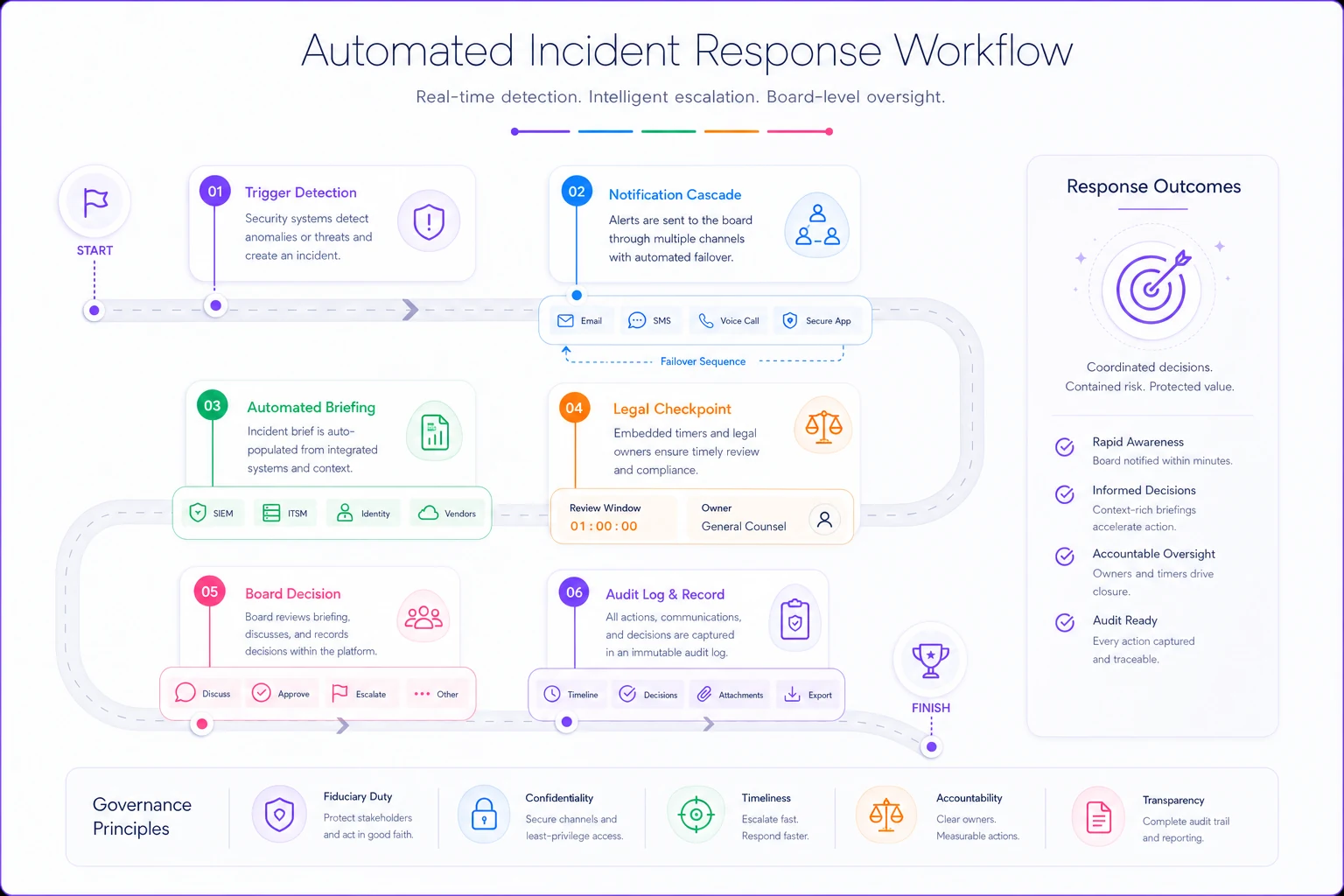
A simple diagram of the workflow helps teams see handoffs and timers at a glance.
Legal checkpoint timelines embed into the workflow with automated reminders and escalations. The system tracks each deadline, sends alerts at defined intervals, and maintains evidence of completion. When someone asks "Did we notify the insurance carrier within 24 hours?" the answer exists in the audit log, not someone's fuzzy recollection.
The real value shows up in documentation and coordination. Every decision, update, and communication flows through the platform, creating contemporaneous records that prove proper governance. Board members access a single source of truth rather than piecing together information from emails, calls, and texts. The minute-by-minute decision log builds automatically, ready for regulatory review or litigation discovery.
These platforms also enable realistic rehearsals without operational disruption. Teams practice response protocols using historical scenarios, with the system simulating incident conditions and tracking response metrics — so the board can actually evaluate their crisis governance effectiveness rather than just discussing it theoretically.
Conclusion
Boards that navigate crises successfully don't have better lawyers or calmer directors — they have operational systems that turn chaos into process. The trigger matrix removes subjective judgment about when to escalate. Intervention levels clarify what kind of response each situation requires. Briefing templates ensure complete, consistent information flow. Legal checkpoints prevent missed deadlines that compound liability. Rehearsal scripts make mechanical execution automatic when stress peaks.
Companies still dealing with crises through heroics and all-nighters will eventually face an incident that exceeds their informal capacity. When regulatory investigators ask why the board wasn't notified for 72 hours, "we were trying to understand the situation first" doesn't satisfy anyone. When shareholders sue over a botched response, "our general counsel did their best" doesn't limit damages.
Building your board crisis governance playbook before you need it transforms emergency response from scramble to system. The next time something triggers at 2am on a Saturday, you won't wonder who to call or what to say — you'll execute the playbook while competitors figure out their process in real-time.
Ready to enhance your board's productivity?
Join 500+ organizations using Panlly to save time, improve governance, and streamline board operations.