


Most boards don't fail privacy oversight because they ignore it. They fail because privacy lives in seven different places at once — a GDPR clause the general counsel tracks, a state breach law the CISO half-remembers, a vendor DPA sitting in procurement's inbox, and a "we should probably review consent flows" comment buried in last spring's minutes. When a regulator or auditor shows up, nobody can produce a single map that says: here is what we owe, here is who owns it, here is the proof we're doing it.
That gap is the whole problem. Privacy obligations aren't a topic. They're a system that touches legal, IT, HR, marketing, and vendor management simultaneously — and the board is the only body positioned to see whether all those threads connect or just dangle.
This playbook is built for the people who don't write the code and don't file the regulatory submissions: directors, corporate secretaries, and executives who need to govern privacy without pretending to be data engineers. The goal is a board privacy oversight playbook you can actually run — an assurance matrix that maps obligations to owners, a sane DPO reporting cadence, breach-brief templates that hold up under scrutiny, and evidence lanes an auditor can walk without a scavenger hunt.
Why privacy oversight quietly falls apart
The pattern that shows up again and again in mid-sized organizations goes something like this. Privacy starts as a legal project — someone maps the applicable regulations, drafts policies, everyone signs off, and the board checks a box. Two years later the company has doubled its vendors, added a data-heavy product line, expanded into a new jurisdiction, and the original map is fiction.
-
Ownership goes fuzzy. The policy says "Data Protection Officer owns consent management," but the DPO left, marketing quietly took over consent banners, and now nobody formally owns whether those banners are legally valid.
-
Cadence collapses into event-driven panic. The DPO reports to the board only when something goes wrong. Between incidents, the board hears nothing, so it has no baseline to judge whether "nothing" means "healthy" or "nobody's looking."
-
Evidence becomes tribal knowledge. The proof that a data-mapping exercise happened lives in one person's laptop. When that person is out — or gone — the organization can't demonstrate compliance even though the work was done.
-
Breach response is improvised. The first serious incident reveals there's no template, so the general counsel drafts a board brief at midnight, missing half the facts a regulator will later demand.
None of these are technical failures. They're coordination failures. And coordination is exactly what a board is supposed to oversee.
The assurance matrix: obligations mapped to owners
The single most useful artifact a board can demand is an operational assurance matrix — one document that ties every privacy obligation to a named owner, a cadence, and an evidence source. Not a policy binder. A live map.
Eliminate boardroom chaos with seamless coordination.
Panlly simplifies scheduling, collaboration, and follow-ups for every board meeting.
- Centralized meeting scheduling
- Secure document sharing
- Task assignment & tracking
No credit card required
Think of it as answering four questions for every obligation you carry:
-
What do we owe? (the obligation)
-
Who is accountable? (a named role, not a department)
-
How often is it checked? (cadence)
-
Where's the proof? (evidence lane)
A simplified version looks like this:
| Obligation | Accountable owner | Review cadence | Evidence lane |
|---|---|---|---|
| Lawful basis for processing customer data | General Counsel | Annual + on new product | Processing register, DPIA files |
| Consent management (marketing) | CMO | Quarterly | Consent logs, banner audit screenshots |
| Data subject access requests (DSARs) | DPO | Monthly volume review | DSAR log with response timestamps |
| Vendor data processing agreements | Head of Procurement | On onboarding + annual | Signed DPAs, vendor risk register |
| Breach notification readiness | DPO + GC | Semi-annual tabletop | Tabletop reports, notification templates |
| Cross-border transfer safeguards | GC | Annual + on jurisdiction change | Transfer impact assessments |
| Retention and deletion schedules | CISO | Annual | Deletion logs, retention policy version |
The value isn't in the table itself — it's in what building it forces you to confront. The first time an organization fills this out honestly, three or four rows come back with "owner: unclear" or "evidence: none." That's the audit finding you want to discover yourself, before someone external does.
One thing worth flagging: assign obligations to roles, not people. When you write "Sarah in legal," the matrix dies the day Sarah leaves. When you write "General Counsel," it survives turnover — and turnover is precisely when privacy programs are most exposed.
Assign obligations to roles, not people.
Here's a simple workflow to visualize the process.
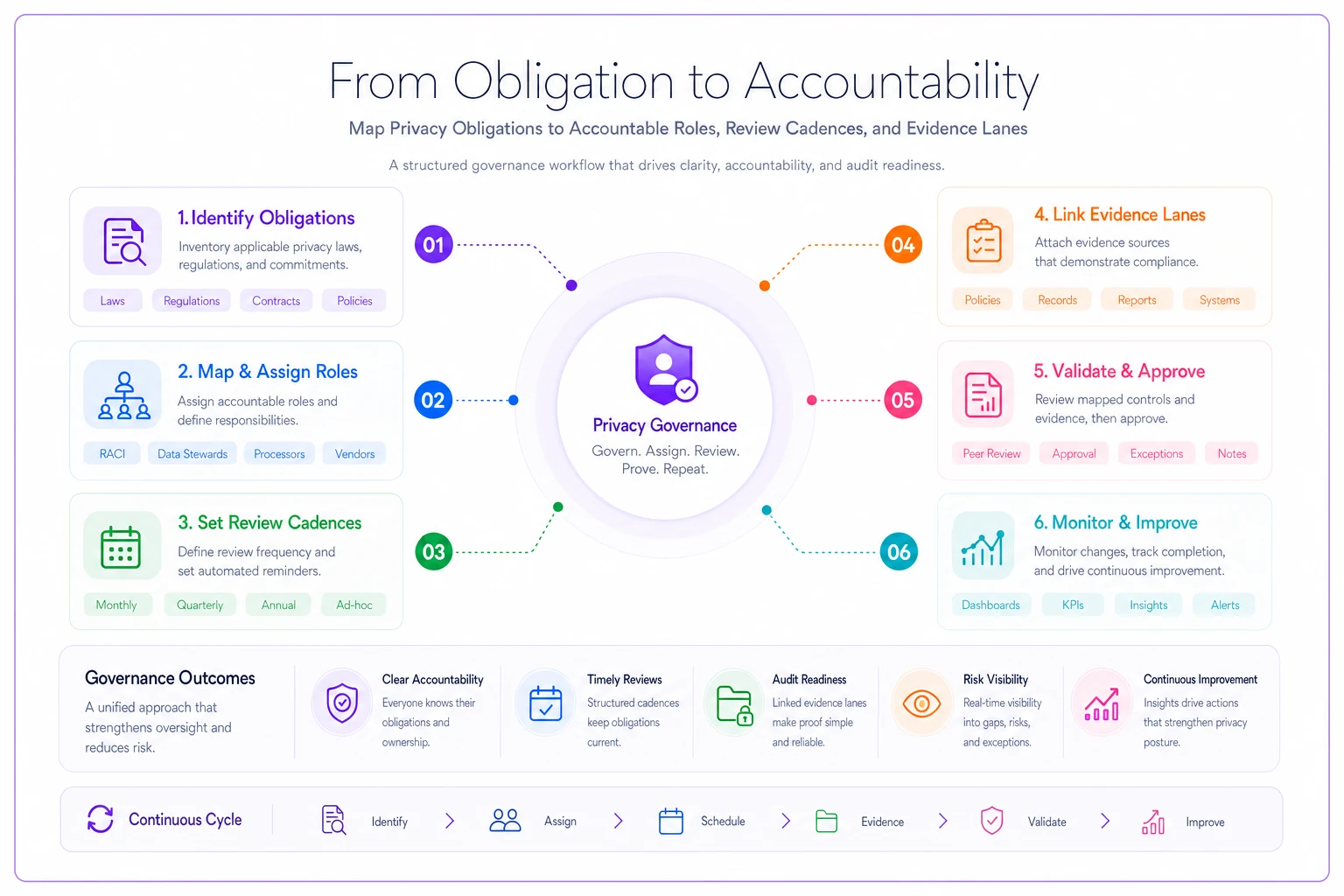
This shows the flow from identifying obligations to assigning owners, setting cadence, and linking evidence.
Getting the DPO cadence right
The relationship between the board and the Data Protection Officer (or whoever holds that function) is where most oversight either works or quietly rots. The two extremes are both common and both bad.
On one end, the DPO reports only in crisis — so the board's entire mental model of privacy is "list of things that went wrong." On the other end, the DPO drowns the audit or risk committee in a 40-page quarterly deck full of DSAR ticket counts that no director actually reads.
Quarterly rhythm report to the relevant committee — one page, four things:
-
Volume and trend on DSARs, complaints, and consent metrics
-
Status of the assurance matrix (any obligations now unowned or overdue)
-
Open remediation items with due dates
-
Regulatory or legal changes on the horizon
Immediate exception report — triggered, not scheduled:
-
Any breach meeting the notification threshold
-
Any regulator contact or inquiry
-
Any material change in obligations (new law, new jurisdiction, new data-heavy product)
The trend line matters more than the snapshot. A board that sees DSAR response times creeping from 12 days to 19 days over three quarters can ask questions before a missed statutory deadline becomes a violation. This is the same discipline that separates strong cyber oversight from box-ticking — the director-facing cyber briefings and escalation checklists approach applies almost identically to privacy: give directors trends and thresholds, not raw telemetry.
Breach-brief templates that survive the aftermath
When a breach hits, the worst time to design your board communication is at 11pm on day one. Yet that's exactly when most organizations write their first breach brief — and the gaps in that first draft tend to become the gaps a regulator later fixates on.
A breach brief for the board serves a specific purpose: it's the record that the board was informed, understood the facts available, and directed a response. It is not a technical incident report. Keep it to a single structure, pre-built, so the team fills it in rather than inventing it under pressure.
Board breach-brief template — the fields that matter:
-
What happened — plain-language summary, no jargon
-
When we knew — discovery time and how it was detected
-
Scope so far — data types, approximate record count, individuals affected (with confidence level: confirmed vs. estimated)
-
Regulatory clock — which notification deadlines are running and when they expire
-
Actions taken — containment, forensics engaged, counsel engaged
-
Decisions needed from the board — the actual asks, if any
-
Open unknowns — what we don't yet know, honestly stated
That last field is the one people leave off, and it's the most important. Boards get in trouble not for incomplete knowledge on day one but for briefs that implied certainty the organization didn't have. "We believe roughly 8,000 customer records were exposed, pending forensic confirmation" is defensible. "8,000 records were exposed" — later revised to 40,000 — looks like the board was misled.
The confidence-level habit is what separates a clean record from a messy one. The same evidence discipline underpins why a compliance-first approach to board records prevents audit surprises: what you can prove you knew, and when, is often more important than the underlying facts themselves.
Evidence lanes an auditor can actually walk
"Evidence lane" is just a plain term for: the specific, findable place proof lives. The failure mode here is nearly universal — the work gets done, but the proof is scattered across email threads, a shared drive with no version control, and someone's memory.
A defensible evidence lane has three properties:
-
Predictable location. An auditor should be able to ask "show me your DSAR responses for Q2" and get them in minutes, not days.
-
Timestamped and versioned. When a policy was updated and who approved it should be unambiguous.
-
Linked to the obligation. Each row in the assurance matrix points to its evidence, so there's no guessing about which document proves what.
In practice, the difference between a smooth audit and a brutal one is almost entirely evidence retrievability. Two organizations can have identical actual compliance and completely different audit outcomes purely based on whether their proof is organized. This is where treating board records as structured, retrievable data pays off — when decision logs, approvals, and evidence are queryable rather than buried in PDFs, the "prove it" moment stops being a fire drill.
Committee signoff flow
Oversight without a decision trail is just conversation. The signoff flow is how privacy governance leaves a footprint that survives director turnover and litigation.
A clean flow looks like this:
-
DPO submits the quarterly rhythm report and flags any matrix gaps or overdue remediations.
-
Committee reviews at the audit or risk committee meeting; questions and management responses are captured in minutes.
-
Committee directs — approves the report, requests remediation with owners and deadlines, or escalates to the full board.
-
Actions logged with owners, due dates, and next-review dates.
-
Follow-up verified at the next meeting; unresolved items don't quietly vanish.
-
Annual full-board attestation that the privacy program was reviewed and material items addressed.
The step most boards skip is step 5. An item gets flagged, assigned, and then never checked again — until it resurfaces as an audit finding. A simple standing agenda line ("open privacy remediations, aging report") closes that loop.
A real scenario
A regional healthcare services company — roughly 400 employees, handling a significant volume of sensitive patient-adjacent data — ran privacy the way most do at that stage. Policies existed, a part-time DPO handled requests, and the board heard about privacy maybe once a year, usually as a line item.
Then a subcontractor misconfigured a storage bucket. The exposure was modest — somewhere around 6,000 records — but the response revealed the real problem. There was no breach-brief template, so the first board update took two days to assemble and had to be corrected twice. Nobody could quickly identify which state notification deadlines applied because the obligations were never mapped by jurisdiction. And the audit committee had no baseline to judge whether this was an isolated slip or a symptom of something wider.
The cleanup took about four months. What changed afterward wasn't more spending on security tools — it was structure. They built an assurance matrix, which immediately surfaced three obligations with no clear owner. The DPO moved to a quarterly one-page cadence with defined exception triggers. The breach-brief template was pre-built and sitting ready. The next incident — smaller, around 200 records — was reported to the committee within hours, with the regulatory clock already mapped. The difference wasn't fewer incidents. It was a board that could demonstrate control instead of scrambling to invent it.
When this level of structure makes sense — and when it doesn't
When it's worth building the full matrix:
-
You process regulated or sensitive personal data at meaningful volume
-
You operate across multiple jurisdictions with different notification rules
-
Your vendor footprint is growing faster than your oversight
-
You've had one near-miss and got lucky on the timeline
When a lighter touch is fine:
-
A very small organization with minimal personal data and a single jurisdiction can run a simplified matrix — maybe five rows and an annual review — without the full committee cadence.
Who should be careful not to over-engineer this:
Early-stage companies sometimes build elaborate privacy governance before they have data worth governing. A 15-person business does not need a semi-annual tabletop exercise. Match the machinery to the actual exposure — an over-built program that nobody maintains is worse than a simple one that's actually followed, because it creates evidence of obligations you're visibly failing to meet.
What holds it together
The through-line across all of this is coordination. Privacy oversight breaks not because any single person fails but because the connections between legal, IT, procurement, and the board go undocumented and unowned.
The assurance matrix names the owners. The DPO cadence keeps the board informed on rhythm, not just crisis. The breach-brief template turns panic into a fill-in-the-blank exercise. The evidence lanes make "prove it" a five-minute answer. And the signoff flow leaves a trail that survives the day the DPO resigns.
None of this requires directors to become technical. It requires them to insist on a system where obligations, owners, cadence, and evidence are visible in one place — and to notice, quarter over quarter, whether that system is holding or quietly eroding. That's the actual job. The playbook just makes it possible to do it without a scavenger hunt every time someone asks a hard question.
The playbook just makes it possible to do it without a scavenger hunt every time someone asks a hard question.
Ready to enhance your board's productivity?
Join 500+ organizations using Panlly to save time, improve governance, and streamline board operations.