


Most boards think their biggest problem is getting directors in the same room. After mapping operations across corporate boards of all sizes, the real bottleneck almost never happens there—it happens in the prep handoffs, decision capture, and post-meeting implementation. The actual meeting is just the middle act.
The board meeting lifecycle breaks down into five distinct operational phases, each with different owners, timelines, and failure points. When companies treat these as disconnected events instead of an integrated workflow, you get the classic symptoms: decisions that take three meetings to finalize, action items that disappear into email threads, and executives scrambling to recreate context six months later.
The five-phase board meeting lifecycle that actually works
A properly functioning board meeting lifecycle operates like a supply chain—each phase feeds the next, with clear handoffs and quality gates. Miss a handoff, and the whole system backs up.
Phase 1: Preparation (roughly three weeks out) The corporate secretary orchestrates this phase, but execution is spread across departments. Finance prepares board packs, legal reviews resolutions, operations compiles metrics. The mistake most orgs make is treating prep like document collection rather than decision staging.
Phase 2: Pre-meeting circulation (one to seven days before) Directors need time to digest materials, but more importantly, they need structured pathways to raise concerns before the meeting. This phase determines whether your board spends meeting time on clarification questions or actual decisions.
Phase 3: Meeting execution The chair runs the room, but the corporate secretary captures decisions in real-time. Not notes about decisions—actual decision language that can translate directly into implementation directives.
Phase 4: Implementation cascade (first thirty days after) Decisions flow from the boardroom through executive sponsors to operational teams. Each level needs different information formats and tracking mechanisms.
Phase 5: Review and closure (roughly day thirty to forty-five) The audit trail closes when implementation is verified and outcomes are documented. This feeds back into Phase 1 for the next cycle.
Here's a simple workflow view of the five phases.
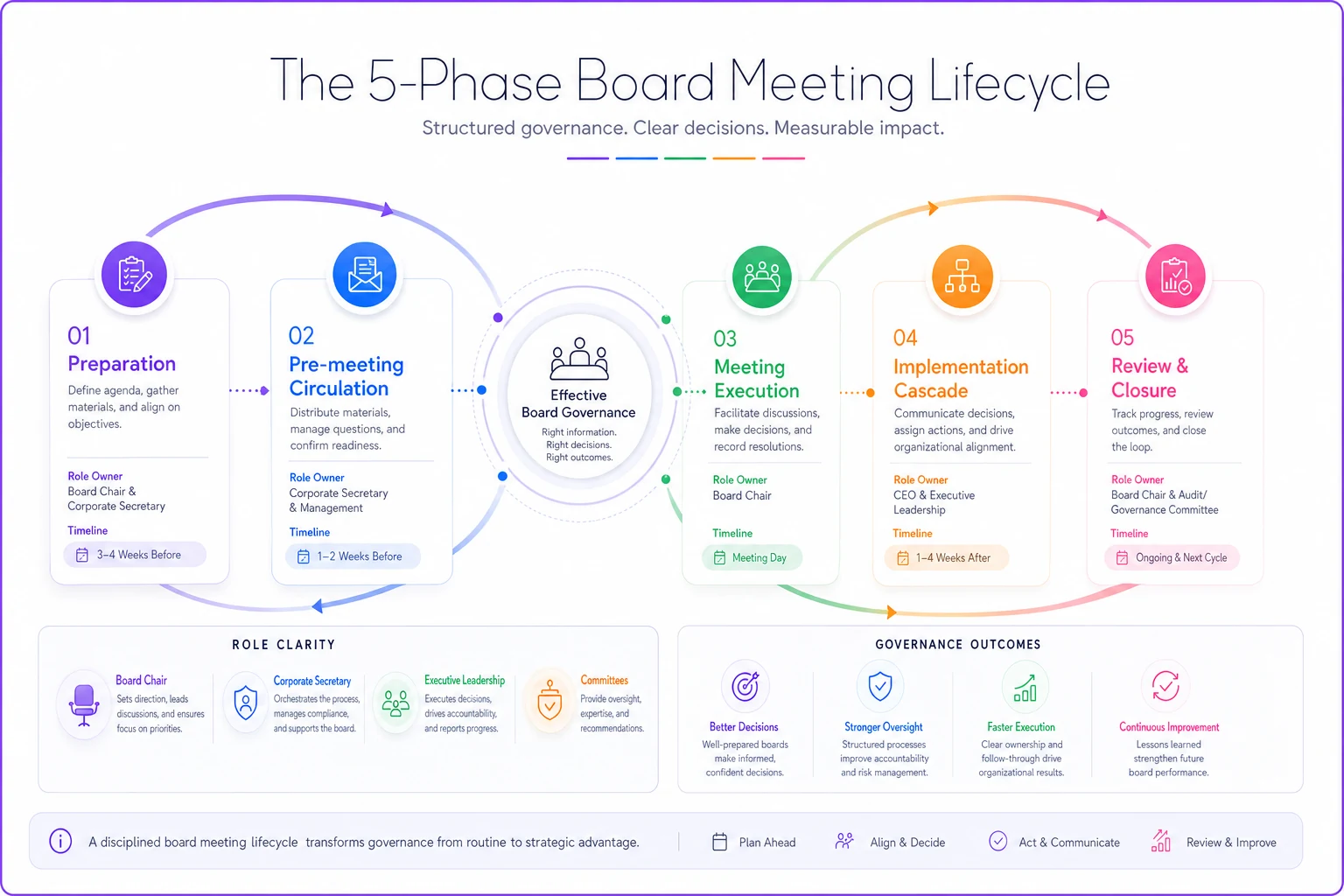
This visualization emphasizes handoffs and timing across phases.
Why traditional board operations create decision gridlock
Walk into most corporate secretary offices and you'll see the problem immediately: sticky notes tracking action items, email chains with a dozen versions of the board pack, spreadsheets trying to manage who owes what by when.
Eliminate boardroom chaos with seamless coordination.
Panlly simplifies scheduling, collaboration, and follow-ups for every board meeting.
- Centralized meeting scheduling
- Secure document sharing
- Task assignment & tracking
No credit card required
The operational breakdown tends to cluster in three places.
Unclear ownership transitions When the CFO sends financials to the corporate secretary, who validates completeness? Who ensures the audit committee chair got their pre-read version? Who tracks whether last quarter's budget revision actually got implemented? These handoff gaps create shadow work—someone always scrambling to fill the void, usually without anyone officially acknowledging they're doing it.
No standardized decision capture Board minutes record that "management was directed to explore strategic alternatives." Three months later, nobody agrees what "explore" meant, which alternatives were in scope, or what constitutes completion. Without structured decision templates, every implementation becomes an interpretation exercise.
Missing implementation machinery The board makes twelve decisions. The corporate secretary sends an email summary. Executives forward pieces to their teams with added context. By the time it reaches operational managers, the original decision has been translated four times. Without a systematic cascade mechanism, board decisions become corporate telephone games.
Building role-specific operational guardrails
Each role in the board meeting lifecycle needs different tools, timelines, and checkpoints. Generic board portal solutions miss this entirely—they're built for document storage, not operational workflow.
Corporate Secretary guardrails
The corporate secretary orchestrates the entire lifecycle but shouldn't own content creation. Their operational boundaries:
-
Material assembly SLA
All inputs due around two weeks before the meeting
-
Quality review gate
completeness check roughly ten days out
-
Circulation deadline
one week before (non-negotiable)
-
Decision capture
real-time during the meeting
-
Minutes distribution
draft within two days, final within five
Build a submission tracker that shows department-by-department status. When finance is late with quarterly numbers, everyone sees it. Transparency drives accountability in a way that reminder emails never will.
Make the circulation deadline non-negotiable in calendar invites to reduce last-minute submissions.
Executive team handoffs
Executives bridge board decisions to operations. Their critical responsibilities:
-
Pre-meeting
supply accurate, decision-ready materials
-
During meeting
present recommendations, not just information
-
Post-meeting
translate decisions to operational directives
-
Implementation
provide progress updates at defined milestones
Each executive needs a board interaction protocol. The CFO, for example, should always provide multi-year comparisons, explain material variances, and include specific recommendation language for any financial decision—not just data dumps.
Director engagement windows
Directors need structured opportunities to engage without creating chaos:
-
Material review window
one week to two days before the meeting
-
Question submission
via portal, not email, at least two days out
-
Pre-meeting discussions
scheduled calls for complex topics
-
Post-meeting clarifications
within one day only
Set these expectations in your board charter. A director who surfaces major concerns during the meeting—rather than during the review window—is violating process, not exercising diligence.
The preparation phase: Setting up decision success
Preparation determines whether your board makes decisions or delays them. The operational goal is simple: zero surprises in the boardroom.
Start with a decision forecast template. Three weeks before each meeting, department heads submit:
-
Decisions needed from the board
-
Background materials required
-
Risk factors or dissent points
-
Success criteria for implementation
This forecast drives the entire prep machinery. The corporate secretary builds the agenda around decisions, not updates. Department heads know exactly what to prepare. Directors see what's coming.
The material assembly workflow runs on strict timelines—approximate, but they need to be held:
| Department | First Draft Due | Review Cycle | Final Version | Distribution |
|---|---|---|---|---|
| Strategy | T-17 days | T-16 to T-13 | T-12 days | T-7 days |
| Finance | T-16 days | T-15 to T-12 | T-11 days | T-7 days |
| Operations | T-15 days | T-14 to T-11 | T-10 days | T-7 days |
| Legal | T-14 days | T-13 to T-10 | T-9 days | T-7 days |
| HR | T-14 days | T-13 to T-10 | T-9 days | T-7 days |
Strategy goes first because their materials often trigger questions for other departments. Legal goes last in the draft phase because they need to review everything else for consistency before signing off.
Build in a pre-mortem checkpoint around ten days out. The executive team reviews all materials asking: "What would cause the board to delay this decision?" Address those gaps before distribution, not during the meeting.
Meeting execution: From discussion to documented decision
The meeting itself should be execution, not exploration. If directors are seeing information for the first time during the meeting, the prep phase already failed.
Real-time decision capture protocol
The corporate secretary maintains a decision log during the meeting—not after. A structure that actually works in practice:
Decision ID: 2024-Q3-BD-007 Topic: Acquisition of TechCo Decision: Approved management to proceed with acquisition of TechCo for up to $45M, subject to:
-
Satisfactory completion of technical due diligence
-
Financing terms not exceeding 6% annual rate
-
Key employee retention agreements covering at least 85% of the engineering team
Implementation Owner: CFO (primary), General Counsel (support) Reporting Requirement: Update at next board meeting or earlier if conditions cannot be met Success Metrics: Closing within 60 days, integration plan approved within 30 days
This isn't meeting minutes—it's an implementation directive. Everyone knows exactly what was approved, under what constraints, who owns it, and how success gets measured. That distinction matters more than most boards realize until they're six weeks into a misaligned implementation.
The consent agenda accelerator
For routine decisions, implement a consent agenda with strict operational rules:
-
Items must be circulated at least two weeks out (earlier than regular materials)
-
Any director can pull items until three days before
-
Pulled items move to the regular agenda with full discussion time
-
Consent items get approved in a single vote, under two minutes
Track consent agenda efficiency: what percentage of proposed consent items actually stay on consent? Below 80% means you're being too aggressive with what belongs there. Above 95% might mean you're leaving efficiency on the table—or that nobody's reading the materials closely enough.
Post-meeting implementation cascade
The 48 hours after a board meeting determine whether decisions become actions or get lost in translation.
The implementation cascade protocol
Within a couple hours: Executive debrief CEO holds a standing debrief with all executives who attended. Review each decision, clarify implementation expectations, identify resource needs. This should be short and direct—not a re-run of the meeting.
Next day: Cascade communications Each executive sends a structured communication to their teams covering:
-
Decisions affecting their department
-
Specific actions required
-
Timelines and dependencies
-
How progress will be tracked
By day three: Implementation plans submitted For major decisions, responsible executives submit brief implementation plans:
-
Key milestones and dates
-
Resource requirements
-
Risk factors
-
Early warning triggers
Day seven: Corporate secretary validation Corporate secretary reviews all implementation plans against board decisions. Gaps or misinterpretations get corrected before work proceeds—not after weeks of misdirected effort.
One thing worth noting: this validation step gets skipped more than any other. Usually because everyone assumes someone else caught the discrepancy. Nobody did.
Building accountability into the cycle
Create an implementation tracker visible to all executives:
| Decision | Owner | Status | Next Milestone | Due Date | RAG Status |
|---|---|---|---|---|---|
| Approve $2M IT upgrade | CTO | Planning | Vendor selection | Oct 15 | Green |
| Launch eastern expansion | COO | Executing | Site lease signed | Oct 22 | Yellow |
| Revise credit facility | CFO | Blocked | Bank approval | Oct 10 | Red |
Update it weekly. Review it at every executive team meeting. When something goes red, the owner presents a recovery plan within 48 hours—not at the next board meeting.
Sample templates that accelerate the lifecycle
Decision Request Template (for executives preparing board items)
Decision Requested: [One sentence, specific]
Context: [Three bullets maximum]
Options Considered:
-
Option A
[Description, pros, cons]
-
Option B
[Description, pros, cons]
-
Recommended Option
[Which and why]
Resource Requirements: [Budget, headcount, time]
Risk Assessment: [Top 3 risks and mitigation]
Success Criteria: [How we'll measure success]
Implementation Timeline: [Key milestones]
Force executives to think through implementation before requesting board approval. Half-baked requests are one of the most reliable sources of multi-meeting delays—and they're almost entirely preventable.
Board Action Item Register
| Item # | Meeting Date | Decision/Action | Owner | Original Due Date | Current Status | Revised Date | Completion Evidence |
|---|---|---|---|---|---|---|---|
| 24-017 | Sept 15 | Approve audit firm rotation | CFO | Oct 31 | On track | - | RFP issued Sept 20 |
| 24-018 | Sept 15 | Review cyber insurance coverage | CRO | Nov 15 | Delayed | Nov 30 | Waiting on broker quotes |
This isn't just tracking—it's institutional memory. When the board asks "didn't we discuss this last year?" you have the complete history.
Warning signs your board meeting lifecycle is broken
Watch for these operational failures:
Pre-meeting chaos
-
Materials distributed less than five days before the meeting
-
Directors asking basic clarification questions during the meeting itself
-
Executives still editing presentations the night before
-
Regular requests for deadline extensions
Meeting inefficiency
-
More than 20% of time spent on administrative items
-
Rehashing previous decisions
-
Consistently running over scheduled time by more than half an hour
-
Deferring more than one decision per meeting
Post-meeting confusion
-
Executives asking "what exactly did the board approve?"
-
Multiple versions of action items circulating
-
Implementation starting more than a week out from the meeting
-
No systematic progress reporting
Systemic problems
-
Same topics appearing three or more meetings in a row
-
Directors surprised by implementation failures
-
Audit committee discovering undocumented decisions
-
Regulatory inquiries requiring meeting reconstruction
If you're seeing three or more of these, you need a complete operational overhaul—not minor adjustments.
The compound effect of operational discipline
A board director said something to me that stuck: "We spent the better part of eighteen months making basically the same capital allocation decision over and over. Not because it was complex—because our process couldn't capture and build on incremental decisions. Every meeting started from roughly the same place."
That's the hidden cost of a broken board meeting lifecycle. Not just wasted time in meetings. It's the compound effect of delayed decisions, repeated discussions, and implementation uncertainty that never fully resolves. The board wasn't dysfunctional—the process was.
When you implement disciplined lifecycle management, decision velocity increases meaningfully, implementation begins days faster, fewer decisions require multiple meetings, and directors spend time on strategy rather than administration.
Making the lifecycle work with automation
The volume of coordination required for a proper board meeting lifecycle is genuinely hard to manage manually. This is where AI-enhanced operational platforms make a real difference—not in replacing judgment, but in enforcing the process consistently so people aren't doing it by hand every cycle.
Modern board management software tracks every handoff, enforces SLAs, and automatically escalates delays. When the CFO's materials are late, the system sends reminders and eventually escalates without anyone having to make an awkward phone call. The discipline gets enforced by the platform, not by whoever has the most patience.
AI automation also standardizes decision capture. The corporate secretary records decisions in structured templates during the meeting, and the system automatically generates implementation assignments, populates the action register, and creates follow-up reminders. What used to take hours of post-meeting cleanup happens in real-time.
There's also a useful pattern recognition layer that builds over time. If the board repeatedly discusses but doesn't decide on certain topics, the system flags it. If implementation consistently stalls at specific handoff points, it surfaces the bottleneck rather than waiting for someone to notice.
That said, automation only works if the underlying process is sound. You can't automate chaos. Define your lifecycle, clarify the handoffs, then let technology enforce the discipline.
Your next steps for lifecycle implementation
Start with a current-state assessment. Map your actual board meeting lifecycle—not the one in your governance manual, but what really happens. Time each phase. Document every handoff. Identify where decisions actually get stuck.
-
Define phase boundaries When does prep actually start? When must implementation plans be submitted?
-
Assign clear owners Who owns each phase? Who manages transitions?
-
Create SLA agreements Every handoff needs a deadline and a consequence for missing it
-
Build tracking infrastructure Manual or automated, you need visibility into the entire lifecycle
-
Implement gradually Start with one committee, prove the model, then expand
-
Measure improvement Track decision velocity, implementation speed, and director satisfaction
Don't try to fix everything at once. Pick your worst bottleneck—usually either material preparation or implementation tracking—and fix that first. Once it's flowing, address the next constraint.
The lifecycle is the system
Most governance improvements focus on the meeting itself—better agendas, shorter presentations, clearer minutes. But the meeting is just one phase of a complex operational cycle.
The real governance upgrade comes from treating the entire board meeting lifecycle as an integrated system. Clear handoffs between phases. Defined roles at each stage. Enforcement mechanisms that ensure consistency. Tracking that creates accountability.
When the lifecycle runs properly, board meetings become decision points rather than discussion forums. Directors focus on judgment, not information gathering. Executives know exactly what's expected. Decisions actually turn into implemented outcomes rather than half-remembered directives.
That's the difference between boards that talk and boards that drive results. It's not about having better directors or smarter executives. It's about having an operational system that channels their expertise into executed decisions. The board meeting lifecycle isn't just process documentation—it's the operational backbone that determines whether your governance creates value or just creates meetings.
Ready to enhance your board's productivity?
Join 500+ organizations using Panlly to save time, improve governance, and streamline board operations.