

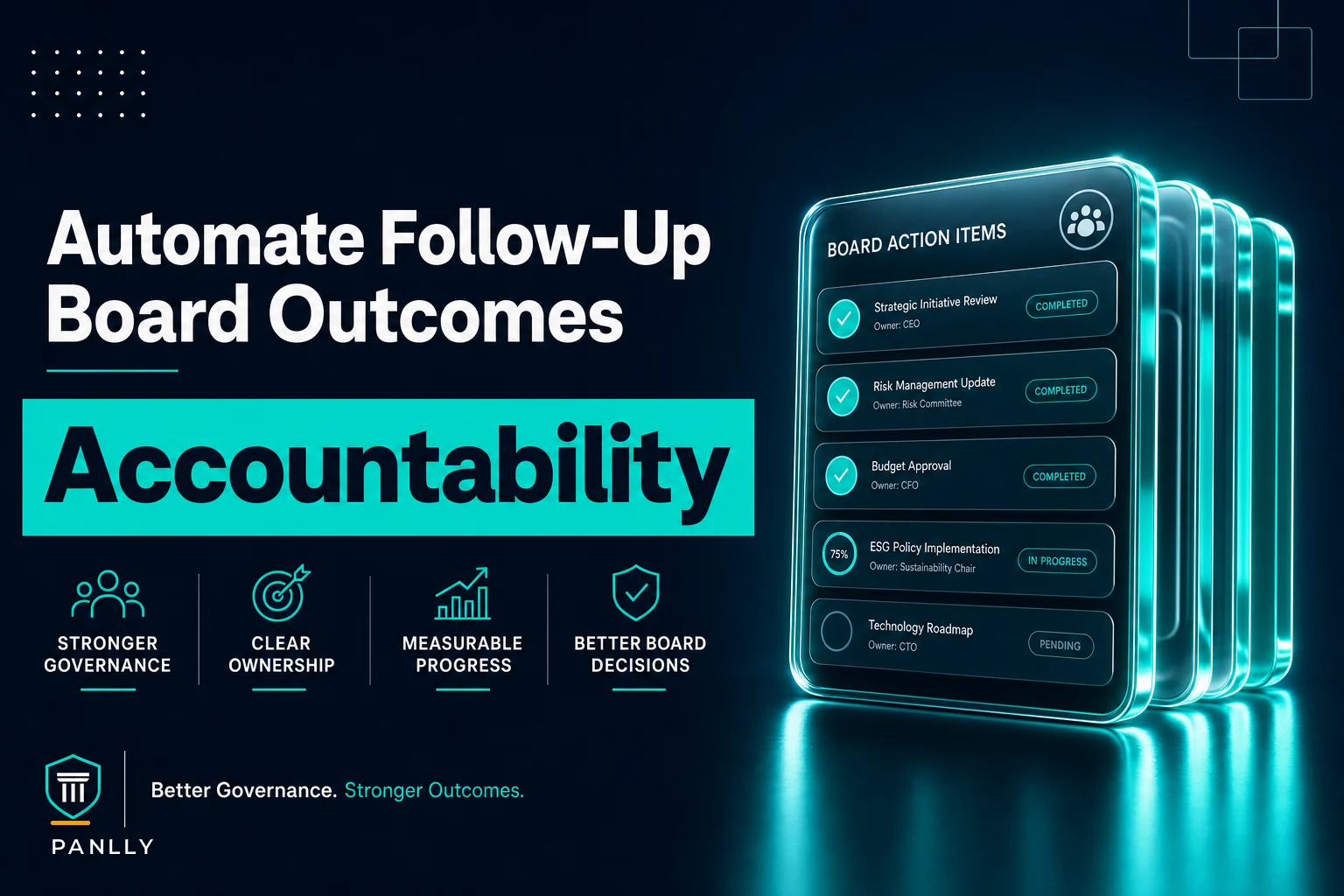

Board meetings end with clarity. Everyone agrees on the strategic acquisition, the new risk framework, the technology investment. Minutes capture the decision. Assignments get distributed. Then three months later, the board asks for an update and discovers the acquisition due diligence stalled in week two, the risk framework never left legal review, and IT hasn't even started vendor evaluations.
This pattern kills board effectiveness more than poor agendas or weak presentations ever could. The gap between decision and execution becomes a graveyard for strategic initiatives that felt urgent in the boardroom but had no operational infrastructure keeping them alive.
The Assignment Convention Problem
Traditional board action item tracking runs on email chains, spreadsheet updates, and corporate secretaries chasing executives for status. A typical Fortune 500 board generates somewhere around 40 to 60 action items per quarter across committees and full board meetings. Mid-cap companies average 25 to 35. Even smaller public companies track 15 to 20 items quarterly.
Each item involves multiple stakeholders. The cybersecurity assessment assigned to the CTO requires input from IT, legal, compliance, and often external consultants. The compensation benchmarking study touches HR, finance, and the compensation committee chair. Strategic initiatives rope in business unit leaders who weren't even in the board meeting.
Without clear assignment conventions, these items float in organizational limbo. The board thinks the CFO owns the financial risk assessment. The CFO thinks the risk committee chair is leading it. The risk committee chair assumes management is handling it. Three months pass. Nothing happens.
Modern board action item automation starts with explicit assignment protocols:
-
Primary Owner — Single point of accountability, typically C-suite or direct report
-
Executive Sponsor — Board-facing responsibility, updates committees
-
Subject Matter Experts — Technical execution, provides input
-
Review Authority — Sign-off before board presentation
-
Board Champion — Director who tracks progress between meetings
These aren't just labels in a system. They trigger different workflows, notification sequences, and escalation paths. The Primary Owner gets daily reminders after SLA breaches. The Executive Sponsor receives weekly summaries. The Board Champion gets alerts before committee calls.
SLA Windows That Match Board Rhythms
Service Level Agreements for board items can't mirror standard IT ticket systems. Board work runs on quarterly cycles with monthly committee meetings and annual strategic reviews. SLAs need to account for board meeting schedules, committee calendars, earnings blackouts, and regulatory filing deadlines.
Eliminate boardroom chaos with seamless coordination.
Panlly simplifies scheduling, collaboration, and follow-ups for every board meeting.
- Centralized meeting scheduling
- Secure document sharing
- Task assignment & tracking
No credit card required
A pharmaceutical company board requesting competitive analysis needs it before the strategic planning session, not just "within 30 days." A bank board mandating stress test reviews needs results aligned with regulatory submission windows, not arbitrary deadlines.
Effective board SLAs use milestone-based windows:
-
Immediate Actions (24–72 hours) - Regulatory response preparations - Crisis management protocols - Material disclosure decisions - Trading halt evaluations
-
Committee Cycle Actions (2–4 weeks) - Risk assessment updates - Audit finding responses - Compensation analysis - Governance policy reviews
-
Quarterly Actions (6–12 weeks) - Strategic initiative progress - Market analysis updates - Operational improvement plans - Technology implementation reviews
-
Annual Actions (3–6 months) - Succession planning updates - Long-term strategic reviews - Major transaction evaluations - Enterprise risk reassessments
These windows automatically adjust based on board calendars. If the audit committee moves from the third Tuesday to the second Thursday, every audit-related SLA shifts accordingly. If the board adds a special strategy session, strategic items compress their timelines.
Escalation Triggers Beyond Simple Delays
Basic escalation sends an email when deadlines pass. Board-level escalation needs something more nuanced — triggers that understand context, stakeholder dynamics, and governance implications.
Consider a board requesting vendor risk assessment after a competitor's data breach. Days one through five might stay within management. Day six through ten triggers the risk committee chair. Day eleven and beyond alerts the full board. But if media picks up the competitor's breach story, escalation accelerates. If regulators announce investigations, it jumps straight to board level.
Multi-factor escalation evaluates:
-
Temporal Factors - Days past deadline - Proximity to board meetings - Time until regulatory deadlines - Earnings blackout periods
-
Stakeholder Factors - Executive availability - Committee chair engagement - External advisor involvement - Regulatory attention
-
Business Factors - Stock price volatility - Media coverage intensity - Competitor actions - Market conditions
-
Risk Factors - Regulatory exposure - Litigation potential - Reputation impact - Financial materiality
The escalation path changes based on these factors. A delayed IT security audit normally escalates through IT → CTO → Audit Committee. But if a breach occurs at a peer company, it jumps IT → CTO → Full Board immediately.
Real organizations see roughly 30 to 40% of board action items trigger some form of escalation. Around 10 to 15% require board-level intervention. The key is catching the right ones, not flooding directors with every minor delay.
Reporting Cadences That Inform Without Overwhelming
Directors typically serve on two or three boards while maintaining executive roles or other commitments. They can't track 40 action items daily. But quarterly updates leave too much room for surprises. The reporting cadence needs to match director engagement patterns and committee workflows.
Common reporting cadences include:
-
Weekly Executive Summaries Management receives consolidated status across all assigned items. Red/yellow/green status, blockers identified, resource needs flagged. Automated from task management systems, not manually compiled.
-
Bi-Weekly Committee Dashboards Committee chairs see items within their purview. Audit committee tracks financial reporting improvements, control implementations, audit responses. Compensation committee monitors benchmark studies, policy updates, equity grant implementations.
-
Monthly Board Digest Full board receives high-level progress on strategic initiatives, critical risk items, and any escalated issues. Focus on trajectory changes, not static status. "Cybersecurity assessment moved from on-track to delayed due to vendor contract disputes" rather than listing all 15 items in progress.
-
Quarterly Completion Reports Comprehensive review of completed items, outcomes achieved, lessons learned. Links decisions to results. "February board decision to expand Asian operations resulted in Singapore entity establishment (March), local partnership signed (April), first customer acquired (May)."
-
Ad-Hoc Escalation Alerts Immediate notification when escalation triggers fire. Not every delay, but material impacts. "Regulatory compliance review delayed — may impact quarterly filing" goes immediately. "Employee handbook update pushed one week" doesn't.
The automation layers handle routing and formatting. Management updates task systems. Directors receive formatted reports. No manual compilation, no version control confusion, no "please see attached spreadsheet" emails.
How These Automations Actually Work in Practice
The theoretical framework means nothing without practical implementation. Here are automation patterns deployed across real boardrooms:
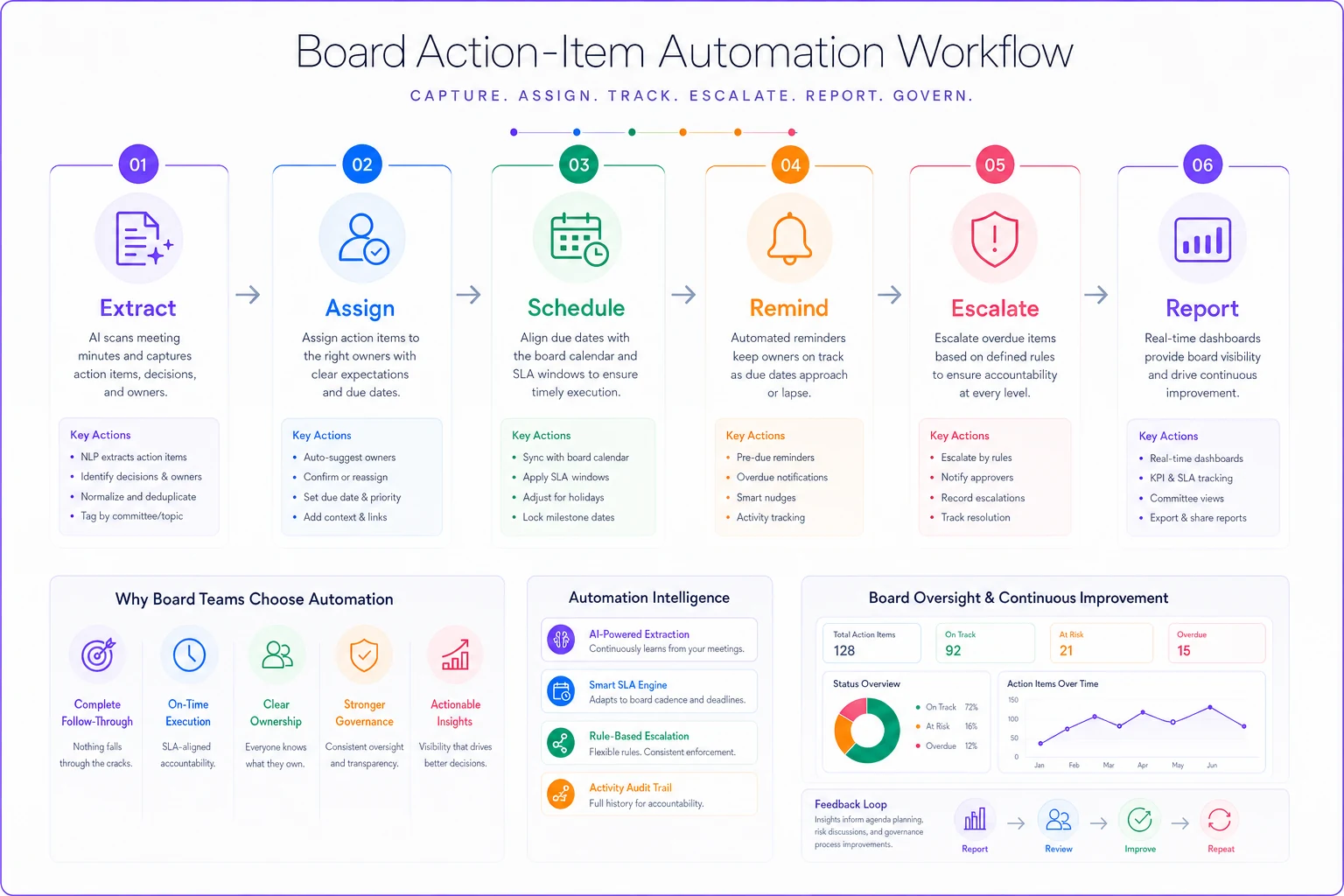
This diagram shows a typical automation workflow from meeting minutes to assignment, SLA enforcement, escalation, and reporting.
Acquisition Due Diligence Tracker
Trigger: Board approves exploring acquisition
Automation Sequence:
-
Creates project with 47 standard diligence tasks
-
Assigns based on functional area (legal, financial, operational, cultural)
-
Sets SLAs based on deal timeline (letter of intent, definitive agreement, close)
-
Establishes daily standup cadence for deal team
-
Weekly summary to transaction committee
-
Escalates blockers to CEO after 48 hours
-
Alerts board if timeline slips more than one week
One healthcare company tracked 12 acquisition evaluations this way. Previously, three or four would stall without board visibility. With automation, all 12 progressed through go/no-go decisions within planned timelines.
Regulatory Response Coordinator
Trigger: Regulatory inquiry received
Automation Sequence:
-
Notifies legal, compliance, and relevant business unit
-
Creates response tasks with regulatory deadline minus 5 days
-
Assigns document collection to legal ops
-
Schedules review meetings at 25%, 50%, 75% completion
-
Escalates to GC after 20% timeline consumption
-
Alerts audit committee chair at 50% timeline
-
Notifies full board if deadline risk emerges
A financial services firm handling 8 to 10 regulatory requests quarterly cut response time from 22 days average to 14 days. More importantly, they eliminated the two deadline misses that had previously occurred almost every year.
Committee Follow-Up Engine
Trigger: Committee meeting concludes
Automation Sequence:
-
Extracts action items from meeting notes
-
Assigns based on discussion attribution
-
Sets SLAs based on next committee meeting
-
Sends confirmation requests to assignees within 24 hours
-
Creates status dashboard visible to committee members
-
Generates pre-meeting status report one week before next meeting
-
Highlights incomplete items in meeting materials
This eliminated the scramble in the 48 hours before committee meetings when corporate secretaries would frantically chase updates.
Strategic Initiative Tracker
Trigger: Board approves strategic initiative
Automation Sequence:
-
Creates initiative with milestones from board presentation
-
Assigns executive sponsor and working team
-
Establishes monthly business review cadence
-
Triggers resource allocation requests to finance
-
Schedules quarterly board updates
-
Monitors leading indicators (budget consumption, milestone completion, risk scores)
-
Escalates when indicators trend negative for two consecutive periods
A technology company tracking digital transformation through this system caught early warning signs of scope creep, preventing a significant budget overrun that traditional reporting would have revealed only at quarter-end.
The patterns above show how automation maps governance events to operational workflows and keeps stakeholders aligned without manual intervention.
Integration Points That Close the Loop
Board action item automation can't exist in isolation. It needs to pull from and push to the systems where real work happens. The typical enterprise runs dozens to hundreds of business applications. The board action system becomes an orchestration layer, not another silo.
| Integration Type | Tools | What It Does |
|---|---|---|
| Meeting Management | Diligent, BoardVantage, Nasdaq Boardvantage | Extracts action items from minutes automatically |
| Project Management | Asana, Monday, Smartsheet, MS Project | Creates real projects, not duplicate tracking |
| Communication Platforms | Slack, Teams, Email | Pushes notifications where people actually work |
| Calendar Systems | Board and executive calendars | Drives SLA calculations and deadline adjustments |
| Document Management | SharePoint, Box, Google Workspace | Links to source documents with appropriate permissions |
| Business Intelligence | Power BI, Tableau, Looker | Visualizes trends beyond red/yellow/green status |
When the corporate secretary finalizes minutes noting "Board approved management recommendation to evaluate European expansion," the action item auto-generates with appropriate context — no manual re-entry required. The CFO doesn't log into another system to check board action status. Updates flow to existing channels, but with intelligence. Urgent escalations go to text. Routine updates go to email digests.
Map integrations starting with calendars and project management tools — they yield the biggest immediate value.
Calendar integration handles the scheduling complexity that usually breaks these systems. When the CFO is at an investor conference, their action items adjust deadlines. When board meetings shift, all dependent timelines recalculate. The system knows not to escalate during pre-announced absences.
The Accountability Architecture
A lot of organizations figure out pretty quickly that their board action item problem isn't technical — it's cultural. Executives treat board requests as suggestions. Middle management doesn't understand board priority. The automation only works when paired with real accountability.
Start with visibility. Every board action item should be visible to the assignee's direct reports. Not public shaming, but organizational awareness. When the CFO owns a board action item, their entire finance leadership team sees it. This creates positive peer pressure and clearer resource allocation priority.
Link to performance management. Not every delayed item should impact compensation, but patterns matter. One retail company added "board action item completion rate" to executive scorecards. Completion jumped from 72% to 94% within two quarters.
Establish review rituals. Monthly management meetings should open with board action item status — not buried in slide 47, but agenda item one. The CEO asks about blockers, resource needs, and timeline confidence. This rhythm maintains momentum between quarterly board meetings.
Create escalation consequences. When items escalate to board level, require root cause analysis. Why did the initial timeline fail? What organizational barrier emerged? How do we prevent recurrence? This turns failures into system improvements rather than just bad outcomes.
Measuring What Matters
Board effectiveness isn't measured by action item count. It's measured by strategic impact. The automation needs to capture both operational metrics and outcome indicators.
Operational Metrics:
-
Completion rate by category (strategic, compliance, operational)
-
Average cycle time by complexity
-
Escalation rate by department
-
Resource allocation by initiative
-
Timeline predictability scores
Outcome Indicators:
-
Strategic initiatives launched vs. completed
-
Regulatory findings reduced
-
Risk events prevented
-
Market opportunities captured
-
Operational improvements realized
A manufacturing company tracked these metrics across 18 months and found their 87% task completion rate was misleading. Strategic initiatives had 94% completion but delivered only 60% of expected outcomes. Compliance items achieved 91% completion and 95% effectiveness. That insight shifted board focus from task tracking to outcome management — which is where it should have been all along.
Warning Signs You're Doing It Wrong
Bad board action item automation often looks successful on paper while failing in practice. Watch for these patterns:
-
Over-Automation — Every discussion point becomes an action item. The Q3 board meeting generates 73 tasks. Directors stop paying attention. Management treats them as bureaucracy. Focus on decisions requiring follow-through, not every comment made.
-
Under-Integration — The system exists in isolation. Executives update the board system separately from their real work. Data grows stale. Reports show false precision. True automation connects to where work actually happens.
-
Rigid Escalation — Every item follows the same path. A typo in meeting minutes escalates like a regulatory violation. Context-aware escalation understands materiality and adjusts accordingly.
-
Overwhelming Reporting — Daily status reports to directors. Forty-seven-page appendices on minor items. Board members disengage from the noise. Directors need judgment-level information, not task-level details.
-
Gaming the Metrics — Teams mark items complete without achieving outcomes. They hit timeline metrics by reducing scope. Success requires measuring both completion and effectiveness.
Success requires measuring both completion and effectiveness.
Building Your Board Action Framework
Start with your next board meeting. Not a six-month implementation project — just immediate operational improvement. Track the decisions made. Assign clear owners. Set realistic deadlines. Follow up systematically.
Most organizations discover 20 to 30% of board decisions lack clear ownership. Another 20 to 30% have unrealistic timelines. The remaining 40 to 60% suffer from poor visibility and inconsistent follow-through. That's a significant amount of room for improvement before any software enters the picture.
Map your current state. How many board decisions from the last year actually achieved their intended outcome? How many stalled? How many transformed into something unrecognizable? This baseline reveals your real automation opportunity.
Design for your governance rhythm. Public companies operate differently than private equity portfolios. Non-profits have different stakeholder dynamics than family enterprises. Your automation should match your governance reality, not force artificial structure onto it.
The Path Forward
Board action item automation isn't about replacing human judgment with algorithms. It's about creating operational infrastructure that turns board decisions into organizational outcomes. When directors make strategic choices, those choices should flow through the organization with clarity, accountability, and momentum.
The companies getting this right treat board decisions as organizational commitments, not executive suggestions. They build systems that connect governance to operations. They measure outcomes, not just activities. And they create accountability without burying people in bureaucracy.
AI-powered operational platforms make this kind of automation accessible without massive IT projects. Natural language processing can extract action items from minutes. Workflow engines handle complex stakeholder sequences. Intelligent escalation evaluates context beyond simple deadline math. Integration APIs connect governance to the business systems already in use.
The question isn't whether to automate board action item follow-up. It's whether your board decisions will drive strategic outcomes or disappear somewhere in the execution gap.
Board action item automation isn't about replacing human judgment with algorithms. It's about creating operational infrastructure that turns board decisions into organizational outcomes. When directors make strategic choices, those choices should flow through the organization with clarity, accountability, and momentum.
The question isn't whether to automate board action item follow-up. It's whether your board decisions will drive strategic outcomes or disappear somewhere in the execution gap.
Ready to enhance your board's productivity?
Join 500+ organizations using Panlly to save time, improve governance, and streamline board operations.