

There's a specific kind of panic that hits a corporate secretary about three weeks after a distributed vote closes. Legal is prepping a filing, someone asks "who actually authorized the proxy for Director Chen," and the answer lives in a forwarded email chain, a Slack message, and a phone call nobody logged. The vote passed. The quorum was fine. But the evidence that it passed cleanly is scattered across four systems and one person's memory.
This is the problem worth solving. Not "how do we vote remotely" — most boards have figured that part out. The harder question is how to build a proxy voting electronic consent workflow where every delegated vote, every e-consent, and every quorum calculation leaves a clean, timestamped trail that a regulator or opposing counsel can't pull apart.
The failures here are almost always procedural, not technological.
Where distributed votes actually break
The vote itself is rarely the weak point. The delegation around the vote is.
A typical failure looks like this: a director is traveling and can't attend, so they authorize the chair to vote their proxy. Fine. But the authorization comes in as a two-line email — "Please vote my shares in favor of items 3 and 5, John." No scope limits. No expiry. No confirmation the director understood item 4 was being pulled. Six months later during a dispute, that email is the entire evidentiary basis for a delegated vote on a material transaction.
The second common break is the quorum edge case. When you mix in-person attendance, live remote participants, and pre-submitted e-consents, the count gets fuzzy fast. Who counts toward quorum — the director who submitted written consent but dropped off the call before the vote? The proxy holder representing an absent member? Boards have approved resolutions that later turned out to be one vote short of a valid quorum because someone double-counted a proxy holder as both themselves and their principal.
The third break is timing. E-consents and proxies have to be effective at the moment of the vote, not floating vaguely "sometime that week." A consent submitted after a resolution's wording was amended doesn't cover the amended version. This is where a lot of otherwise careful boards trip.
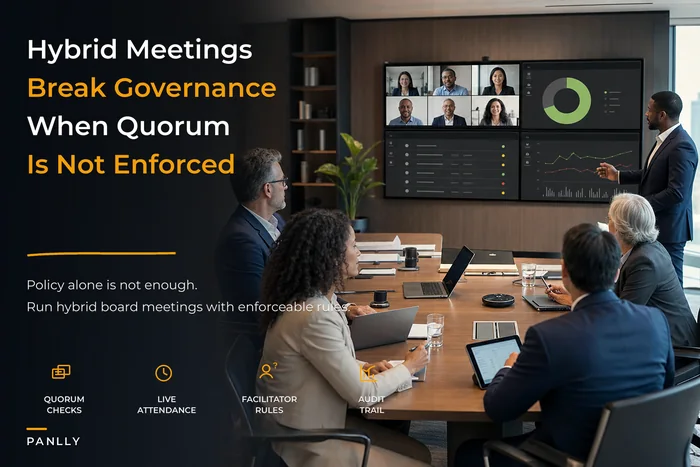
If your remote and hybrid governance still has structural gaps around quorum and confidentiality, it's worth reading our breakdown of how hybrid meeting habits quietly break governance before you layer proxy mechanics on top — the two problems compound.
The three documents every delegated vote needs
Before any workflow, you need to know what "complete evidence" actually looks like. A defensible delegated vote rests on three artifacts. Miss one and the whole vote becomes contestable.
Eliminate boardroom chaos with seamless coordination.
Panlly simplifies scheduling, collaboration, and follow-ups for every board meeting.
- Centralized meeting scheduling
- Secure document sharing
- Task assignment & tracking
No credit card required
| Artifact | What it proves | Common failure |
|---|---|---|
| Proxy/consent instrument | The principal authorized a specific person to act, on specific items, within a specific window | Vague scope, no expiry, no item-level detail |
| Verification record | The instrument genuinely came from the authorized director (identity + intent) | Reliance on an unverified email address; no confirmation step |
| Vote-effectuation record | The proxy was actually cast as instructed, on the final wording, and counted correctly | No link between the instruction and the recorded vote |
Most boards stop at the first document. They have an authorization but nothing tying it to who verified it and how it was ultimately cast. All three have to be present and cross-referenced.
A step-by-step proxy and e-consent workflow
Below is the sequence for a distributed vote where some directors attend live, some send proxies, and some approve by written consent. Each step produces an artifact, so you're never reconstructing anything after the fact.
-
Lock the resolution wording before soliciting any consent. No proxy or e-consent goes out until the exact motion language is final. If wording changes later, every affected instrument is void and must be reissued. This single rule prevents the most common evidentiary gap.
-
Issue the proxy/consent instrument with item-level scope. Each instrument names the principal, the delegate (for proxies), the exact resolutions covered, the direction of the vote (for or against, or "at delegate's discretion" if permitted by your bylaws), and an expiry tied to the meeting date.
-
Verify identity and intent separately. Confirm the instrument came from the director and that the director understood what they were authorizing. A reply-confirmation to a verified email plus a one-line intent restatement ("You are authorizing the chair to vote FOR items 3 and 5 only") satisfies both.
-
Log receipt against a quorum register. As each instrument arrives, record it in a running register that flags: does this person count toward quorum, and are they voting directly, by proxy, or by written consent? This is where double-counting gets caught.
-
Freeze the quorum count at vote-open. At the moment voting opens, snapshot who is present (live), who is validly represented by proxy, and whose written consent is on file for this exact wording. That snapshot is your quorum evidence.
-
Cast and record proxy votes explicitly. When the proxy holder votes, the minute record notes: "The chair, holding proxy for Director X dated [date], cast that vote FOR item 3." The instruction and the cast are linked in one line.
-
Reconcile the count before declaring the result. Total direct votes + proxy votes + written consents. Cross-check against the quorum snapshot. Confirm no principal was counted twice. Then declare.
-
Route the assembled evidence to counsel for signoff on material items. For anything above a defined threshold — transactions, related-party matters, anything filed — counsel confirms the delegation chain is complete before minutes are finalized.
Steps 1 and 5 are the ones that get skipped most often, and they're the two that matter most when a vote gets challenged.
Workflow diagram:
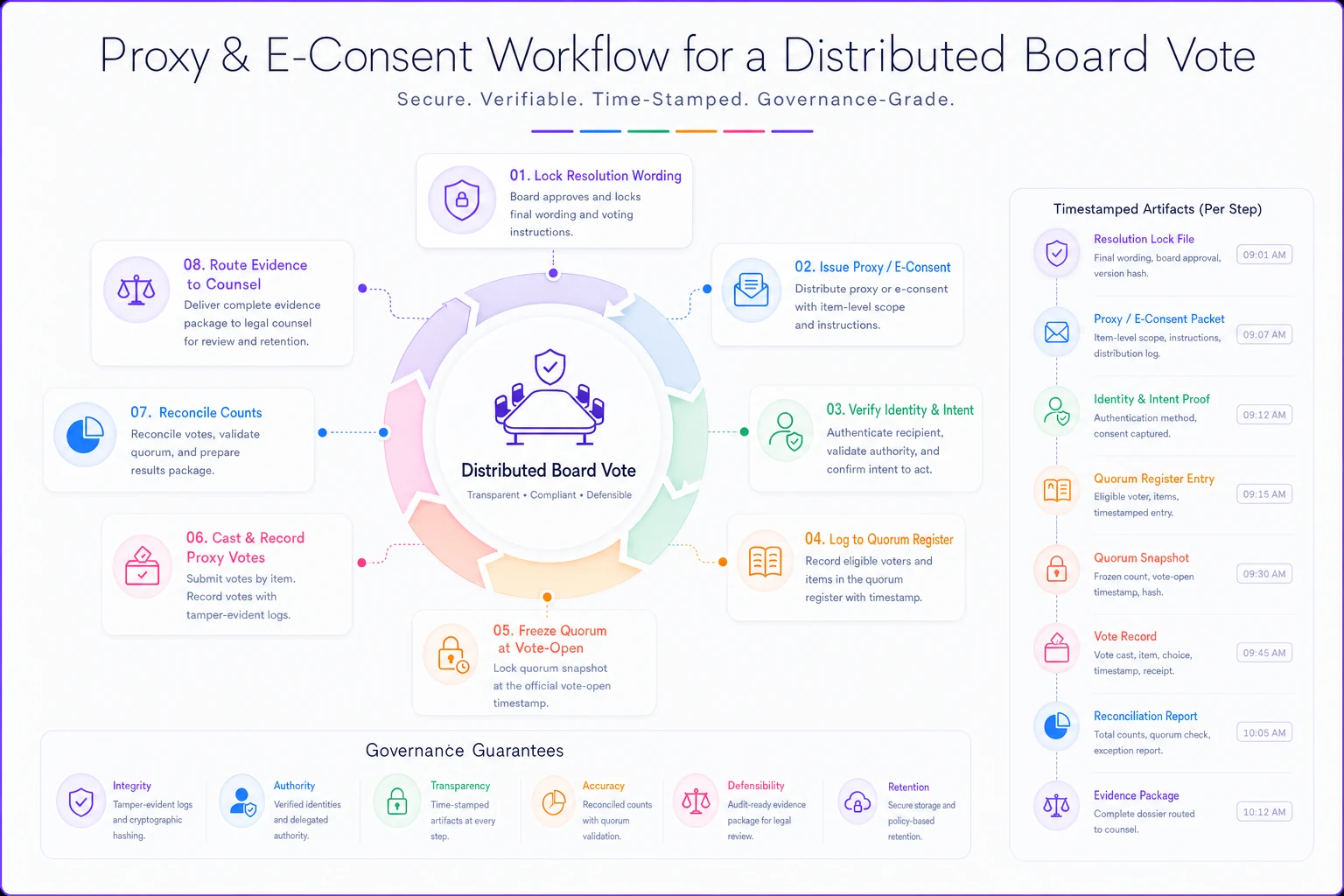
That diagram maps each step to a timestamped artifact.
Verification templates that hold up
The verification step is where most e-consent workflows are dangerously thin. An email address is not identity. Here's the language worth baking into templates so verification actually produces evidence.
Proxy instrument — core fields:
-
Principal (director name and role)
-
Delegate (name and role)
-
Meeting date and reference
-
Resolutions covered (listed individually by number and short title)
-
Voting direction per resolution (FOR / AGAINST / delegate's discretion)
-
Effective from / expiry (must not survive the meeting)
-
Principal's confirmation statement and verified signature/e-signature
Intent-confirmation reply (sent back to the principal before the vote):
> "We've recorded your authorization for [delegate] to vote your proxy at the [date] meeting on the following items only: [list with direction]. This authorization does not extend to any other item and expires at the close of this meeting. Please reply 'CONFIRMED' if this is correct."
That confirmation reply is small, but it's the difference between "we assumed the director meant this" and "the director explicitly confirmed this in writing before the vote."
Written-consent block for minutes:
> "Director [name] submitted written consent to Resolution [X], in the wording adopted and circulated on [date/time], received [date/time] and verified via [method]. This consent applies solely to the wording as finalized."
The emphasis on wording and timing in every template is deliberate — that's the detail that gets attacked.
Timeline checklist for a clean distributed vote
Timing discipline is half the battle. Here's the cadence, working backward from the vote.
-
T-10 to 14 days Circulate draft resolutions. Flag which items will require delegated/e-consent votes.
-
T-7 days Freeze final wording. No further edits without a full reissue.
-
T-5 days Issue proxy and consent instruments with item-level scope and expiry.
-
T-3 days Verify each returned instrument (identity + intent confirmation). Log to the quorum register as they come in.
-
T-1 day Reconcile the register. Identify any gaps, missing confirmations, or quorum risks while there's still time to fix them.
-
Vote day, at open Freeze the quorum snapshot.
-
Vote day, at close Reconcile counts, cross-check for double-counting, declare result.
-
T+1 to 2 days Assemble the evidence package; route material items to counsel.
-
T+3 to 5 days Finalize minutes with linked delegation records.
The T-1 reconciliation is the step that saves boards. Catching a missing confirmation the day before is a phone call. Catching it the day after is a governance problem.
Counsel signoff checkpoints — and where to place them
You don't need counsel reviewing every routine consent. That creates bottlenecks and trains the board to route around legal. The trick is defining which votes actually trigger review.
Signoff makes sense when:
-
The resolution is material — a transaction, financing, related-party matter, or anything that will be filed or disclosed.
-
The vote relied heavily on proxies or written consents rather than live attendance.
-
The quorum was tight, or an edge case (a principal-and-proxy overlap) had to be resolved.
-
Any instrument was verified through a non-standard method.
Signoff is overkill when:
-
The item is administrative and passed with a clear live majority.
-
Delegation played no role in reaching quorum or the outcome.
The checkpoint itself is narrow: counsel isn't re-litigating the decision, they're confirming the evidence chain is complete — instrument, verification, and effectuation all present and consistent for each delegated vote. A short attestation in the record ("Counsel confirmed delegation evidence complete for items 3 and 5") is enough, and it's exactly the kind of thing that shortens a later inquiry.
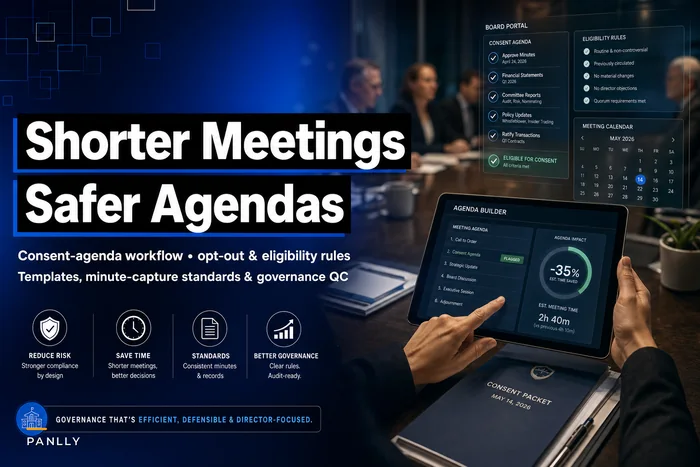
This pairs naturally with disciplined consent-agenda practice — if you're bundling routine approvals, our rules for keeping consent agendas legally clean cover how to separate the routine from the reviewable so counsel checkpoints land in the right place.
A real scenario
A mid-size credit union holding company — nine directors spread across three time zones after a merger — kept running into the same wall on quarterly votes. Roughly a third of their votes each cycle came in by proxy or written consent because in-person attendance had dropped post-merger.
Their problem wasn't outcomes; motions passed. It was reconstruction. When their auditor sampled four board decisions during the year-end review, two of them couldn't be cleanly evidenced. In one, a proxy authorization existed but there was no record confirming the resolution wording hadn't changed after the proxy was granted. In the other, a director's written consent had arrived about 40 minutes after the amended motion was adopted — technically covering the wrong version. Neither vote was actually invalid, but proving it took the corporate secretary the better part of two days digging through email and calendar entries.
They rebuilt the workflow around three rules: freeze wording at T-7, send an intent-confirmation reply on every delegated instrument, and snapshot quorum at vote-open. The next audit cycle, the auditor sampled five decisions and cleared all five in a single sitting. The secretary estimated the change cut somewhere around 8–10 hours of evidence reconstruction per quarter — and more importantly, removed the low-grade anxiety of not being sure whether a passed vote would hold up under scrutiny.
Nothing exotic changed. They just stopped producing votes that couldn't be evidenced.
Who should not lean on this
If your board almost always votes live and in full attendance, building out heavy proxy machinery is solving a problem you don't have — a light e-consent template for the occasional absentee is plenty. And if your bylaws don't clearly permit delegated or discretionary proxies, no workflow fixes that; that's a charter question to resolve first, not a process one.
The boards that genuinely need this are ones where a meaningful share of votes routinely arrives remotely, members are distributed, or materiality is high enough that a contested vote would be expensive. If that's you, the workflow above isn't bureaucracy — it's the difference between a two-hour audit sample and a two-day scramble.
Where the automation quietly helps
Most of this is procedural discipline, and you can run it with templates and a shared register if you're rigorous. The reconciliation and cross-checking steps are exactly the kind of thing people get wrong when they're tired and rushing before a meeting. That's where governance platforms with built-in consent tracking earn their place — automatically flagging a consent that arrived after wording changed, catching a proxy holder being double-counted toward quorum, or holding a vote's evidence package together so counsel signoff is a five-minute confirmation instead of a document hunt. The value isn't the automation for its own sake; it's that the system won't let you declare a result on an incomplete evidence chain.
The core point stands regardless of tooling: a delegated vote is only as strong as the record proving who authorized it, how that was verified, and that it was cast on the final wording. Build the workflow so every one of those produces evidence as it happens, and the panic three weeks after the vote never comes.
The core point stands regardless of tooling: a delegated vote is only as strong as the record proving who authorized it, how that was verified, and that it was cast on the final wording. Build the workflow so every one of those produces evidence as it happens, and the panic three weeks after the vote never comes.
Ready to enhance your board's productivity?
Join 500+ organizations using Panlly to save time, improve governance, and streamline board operations.