

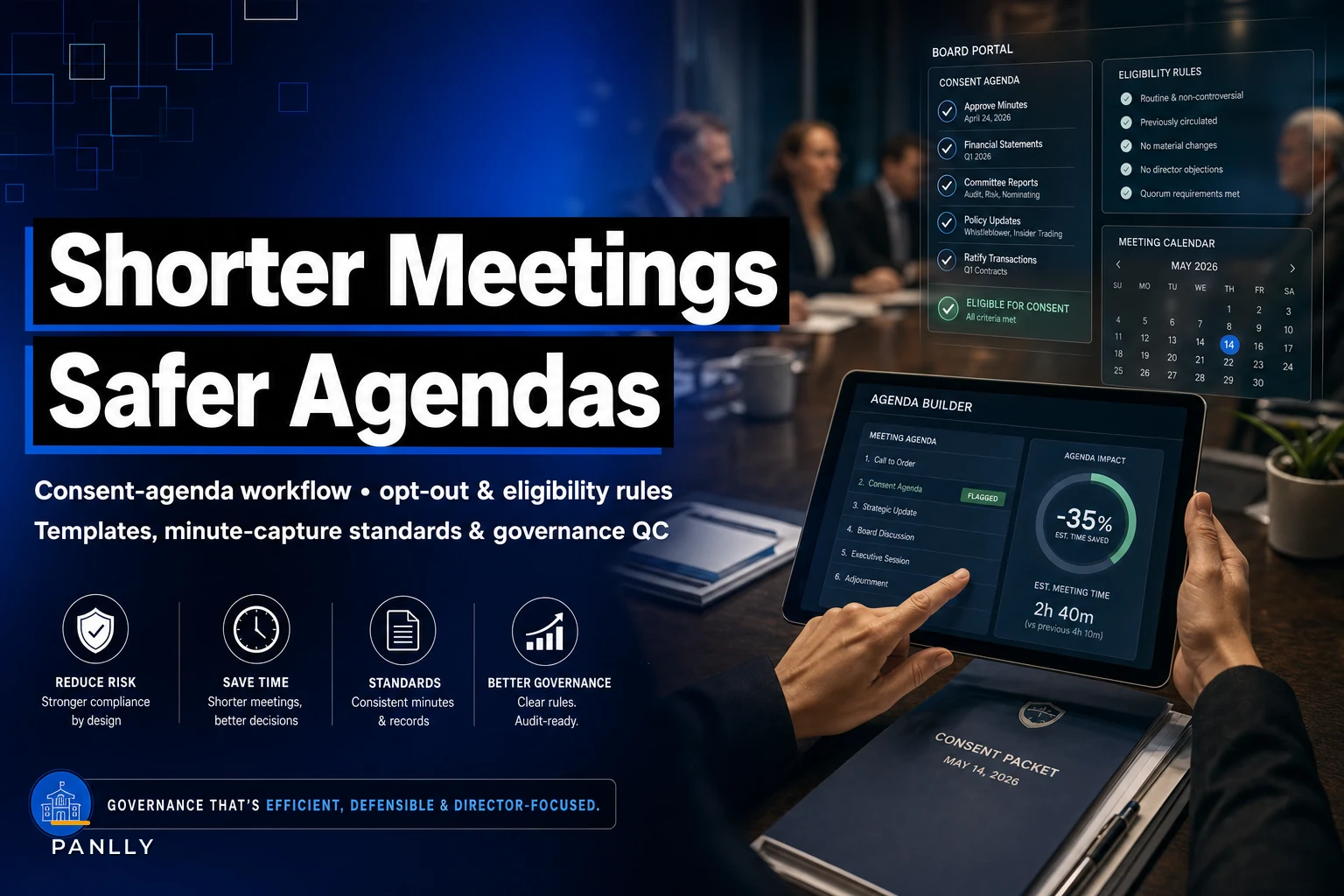

Your quarterly board meeting runs 4 hours. The first 90 minutes? Approving last meeting's minutes, acknowledging committee reports, rubber-stamping routine contract renewals. Meanwhile, your strategic discussion on market expansion gets compressed into 20 rushed minutes at the end when everyone's mentally checked out.
The consent agenda workflow promises to fix this—bundle all routine items for single-vote approval. What corporate secretaries discover the hard way, though, is that a poorly structured consent agenda creates more governance risk than having no consent agenda at all.
The governance trap hidden in consent agendas
Most boards adopt consent agendas after a particularly painful 5-hour meeting where 45 minutes disappeared debating the wording of previous minutes. The logic seems bulletproof—group routine items together, approve them in one motion, focus precious meeting time on strategic decisions.
Then the lawsuit arrives. Or the regulatory inquiry. Or the activist shareholder challenge.
Suddenly that bundled approval from 18 months ago is a problem. Which director actually reviewed the facilities contract buried on page 47 of the consent package? Who confirmed the audit committee charter changes aligned with new SEC requirements? Can you prove directors had adequate time to review materials before voting?
The Delaware Court of Chancery has repeatedly held that consent agenda approval doesn't shield directors from duty of care obligations. Bundled approvals can actually amplify liability exposure when directors can't demonstrate they understood what they were approving.
Building eligibility criteria that actually protect the board
Not everything belongs in a consent agenda. The challenge is creating clear, enforceable criteria that staff can apply consistently without constant board chair intervention.
Eliminate boardroom chaos with seamless coordination.
Panlly simplifies scheduling, collaboration, and follow-ups for every board meeting.
- Centralized meeting scheduling
- Secure document sharing
- Task assignment & tracking
No credit card required
Start with this baseline framework:
Automatically eligible items:
-
Previous meeting minutes (after 72-hour review period)
-
Committee reports marked "for information only"
-
Routine operational reports within pre-set variance thresholds
-
Contract renewals under $500K with no material changes
-
Policy updates for regulatory compliance (non-strategic)
Never eligible items:
-
Anything requiring strategic discussion
-
Items with financial impact exceeding board-set thresholds
-
Contracts with related parties
-
Executive compensation decisions
-
Audit findings requiring remediation
-
Risk matters outside approved appetite
Conditional eligibility (requires committee pre-approval):
-
Operating variances between 5-10% of budget
-
Contract modifications under $250K
-
Routine hiring below VP level
-
Standard vendor agreements using approved templates
The critical element most boards miss: threshold escalation triggers. When three directors request any item's removal from consent, it automatically moves to the regular agenda for the next meeting, not the current one. This prevents last-minute agenda chaos while still respecting director diligence concerns.
Advance notice requirements that balance efficiency with diligence
The typical "materials distributed 5 days before meeting" rule falls apart with consent agendas. Directors need different review timeframes for bundled items versus strategic discussions.
The tiered notice system that actually works:
Consent agenda materials: 7 business days before meeting Supporting documentation: Accessible via board portal 10 days before Opt-out deadline: 48 hours before meeting Strategic agenda materials: 5 business days before meeting
Distribution timing alone doesn't ensure proper review. Your consent agenda package needs structured formatting that enables rapid director assessment.
Each consent item requires a one-page summary with:
-
Item title and reference number
-
Decision required (approve/ratify/acknowledge)
-
Financial impact (exact amount or "under $X threshold")
-
Previous board touch points (when last reviewed/approved)
-
Risk rating (low/medium per enterprise risk framework)
-
Recommended action with rationale
-
Full documentation page reference
Use portal read receipts and timestamps to verify directors had adequate review time for consent items.
This format lets directors scan the consent package quickly, spot items needing deeper review, and pull supporting materials without hunting through a 60-page PDF.
The opt-out process that prevents meeting surprises
Nothing derails a board meeting faster than a director raising concerns about a consent agenda item during the approval vote. "Wait, I didn't realize this contract included that provision..."
Opt-out mechanics need to be frictionless but documented. Email requests create versioning nightmares and missed communications. Phone calls leave no paper trail. Meeting-day surprises waste everyone's time.
The solution is a structured opt-out form in your board portal.
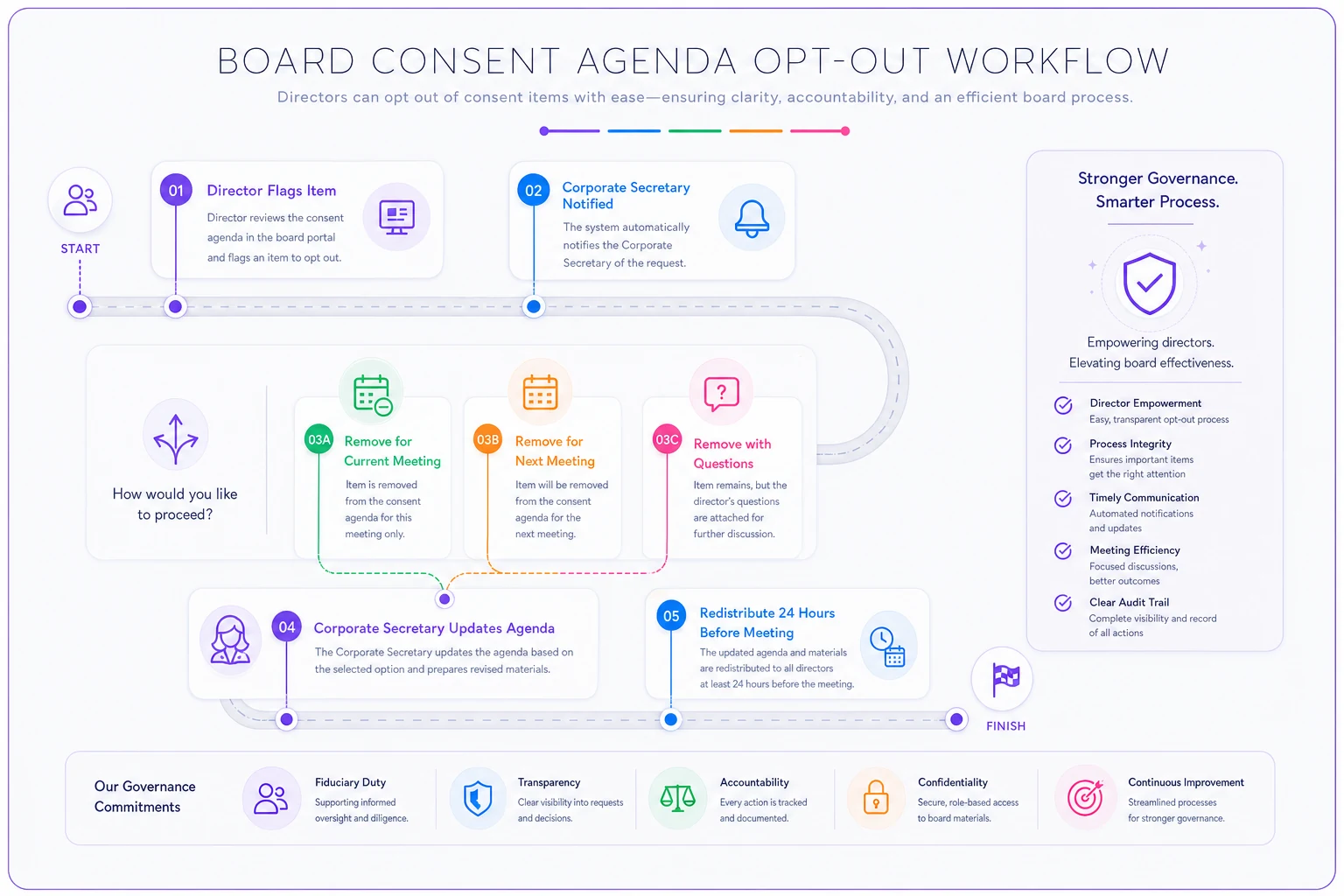
Flowchart of the opt-out workflow described above.
-
Remove for discussion at current meeting
-
Remove for additional information (defer to next meeting)
-
Remove with specific questions (may remain on consent if resolved)
The corporate secretary receives automatic notification, updates the consent agenda, and redistributes the modified version 24 hours before the meeting. No surprises, no scrambling, no governance gaps.
Track opt-out patterns quarterly. When the same director repeatedly removes similar items, you've either got a training gap or eligibility criteria that need adjustment. When multiple directors are removing the same category of items, your thresholds need recalibration.
Minute-capture conventions that survive legal scrutiny
Consent agenda minutes create unique documentation challenges. Too little detail invites challenges about director diligence. Too much detail undermines the efficiency you're trying to achieve.
"The Board reviewed the consent agenda materials distributed [date], containing items [list reference numbers]. Following opportunity for questions and removal requests, upon motion duly made and seconded, the Board approved all items on the consent agenda as presented."
Then attach the full consent agenda as an appendix to the minutes.
Most boards stop there. That's where the problems start.
You also need a secondary record showing:
-
Which directors accessed consent materials (portal analytics)
-
When materials were accessed (timestamp data)
-
Any questions raised during the review period
-
Items removed and their disposition
-
Individual director recusals or abstentions
This secondary record doesn't go in the public minutes—it lives in the corporate secretary's governance files. When litigation discovery or a regulatory inquiry arrives three years later, you can demonstrate a robust process beyond the simple minute entry.
For removed items, capture the complete discussion in regular minute format. Include the rationale for removal, the full board discussion, and final disposition. This creates clear documentation that directors exercised independent judgment rather than rubber-stamping.
Quality control that catches problems before they become liabilities
The best consent agenda workflows include systematic quality control before materials distribute. Most boards discover QC gaps only after something goes wrong—the outdated policy that should have been updated, the contract that quietly exceeded thresholds, the committee report containing strategic recommendations that required actual discussion.
Build a pre-distribution QC checklist:
Eligibility verification:
-
Confirm each item meets written criteria
-
Verify financial thresholds haven't been exceeded
-
Check for strategic implications missed by the submitter
-
Review previous board discussions for relevant context
Completeness check:
-
All supporting documents attached
-
Summary sheets completed fully
-
Risk ratings align with enterprise framework
-
Committee pre-approvals documented where required
Timing validation:
-
Materials meet advance notice requirements
-
Previous removal requests addressed
-
Related items properly cross-referenced
-
Sequential approvals properly ordered
Legal review triggers:
-
Any item involving related parties
-
Contracts with non-standard terms
-
Policy changes affecting compliance
-
Items with potential conflict issues
This QC process takes a couple of hours per meeting cycle but prevents significantly more cleanup time when problems surface later.
Template: Consent agenda decision matrix
Boards often benefit from mapping out item categories against eligibility criteria in a single reference document. The table below gives you a working baseline—adjust the thresholds to match your organization's governance policies and risk appetite.
The table below gives you a working baseline—adjust the thresholds to match your organization's governance policies and risk appetite.
| Item Category | Auto-Eligible | Committee Review | Board Discussion | $ Threshold | Notice Days |
|---|---|---|---|---|---|
| Previous Minutes | Yes | No | If disputed | N/A | 7 |
| Committee Reports (Info) | Yes | No | If questions | N/A | 7 |
| Contract Renewals | If standard | If modified | If > threshold | $500K | 7 |
| Budget Variances | < 5% | 5-10% | > 10% | Per category | 7 |
| Policy Updates (Compliance) | Yes | No | If strategic | N/A | 10 |
| Vendor Agreements | If template | If modified | If sole source | $250K | 7 |
| Operating Reports | Yes | If exceptions | If trends | N/A | 7 |
| Grant Approvals | < $50K | $50-250K | > $250K | Per program | 7 |
A few things worth flagging: the grant approval tiers trip up a lot of nonprofits early on. If your board approves a high volume of smaller grants, consider whether the sub-$50K auto-eligible threshold creates review fatigue or actually helps. Use the table as a starting point, not gospel.
Decision rules that keep consent agendas efficient
Clear decision rules prevent the gradual scope creep that turns consent agendas into regular agendas by another name.
These rules need board approval and consistent enforcement:
-
Rule 1
The Two-Touch Principle
Any item the board has seen twice before—at committee level and in a previous board information session—qualifies for consent agenda if it meets other criteria. -
Rule 2
The Materiality Threshold
Items stay on consent only if financial impact remains under 2% of operating budget or $500K, whichever is lower. -
Rule 3
The Discussion Trigger
If any director requests discussion during the review period, the item moves to regular agenda. No exceptions, no negotiations. -
Rule 4
The Complexity Limit
Consent packages cannot exceed 50 pages total. Force summarization and reference to portal documents. -
Rule 5
The Time Protection
Consent agenda approval cannot exceed 5 minutes of meeting time. If discussion extends beyond that, table remaining items to regular agenda.
Clear decision rules prevent the gradual scope creep that turns consent agendas into regular agendas by another name.
When consent agendas fail: recovery protocols
Even well-designed workflows hit problems. A director misses the opt-out deadline but has serious concerns. Management accidentally includes a strategic item. The board discovers post-approval that something needed more discussion.
Missed opt-out deadline: Director can request a one-meeting deferral during consent approval. Item gets removed from current consent and automatically added to next meeting's regular agenda.
Accidental inclusion: Board chair has authority to remove items until the meeting is called to order. Corporate secretary documents removal rationale in the meeting file.
Post-approval concerns: Board can pass a resolution to reconsider specific consent items at next meeting. Original approval stands but gets reviewed with full discussion.
Pattern problems: When the consent agenda gets pulled or heavily modified three meetings in a row, that triggers an automatic review of eligibility criteria and thresholds at the next governance committee meeting.
The strategic payoff of disciplined consent agendas
One Fortune 500 board spent about 18 months refining their consent agenda workflow after a proxy advisor criticized their "rushed strategic discussions." They went from 4.5-hour quarterly meetings—with roughly 90 minutes consumed by routine matters—to 3-hour meetings with 2+ hours dedicated to strategy.
The real value showed up during an activist campaign. The activist challenged the board's oversight of a specific acquisition integration. Because the board had freed up meeting time through consent agendas, they had extensive documented strategic discussions about integration progress across six consecutive quarters. The activist challenge failed.
That's the paradox of consent agendas—the time you save on routine matters creates space for the deep strategic discussions that actually protect director liability.
Making consent agendas work without software complexity
The traditional approach involves tangled spreadsheets, manual tracking, and constant email chains between corporate secretary and directors. Items get lost, deadlines slip, and the efficiency gains evaporate.
Modern board portal platforms increasingly include consent agenda workflows, but many boards end up fighting the software rather than using it. Rigid processes that don't match your governance culture create friction rather than solving it.
The sweet spot is operational software that adapts to your specific consent agenda rules while automating the repetitive tasks—tracking opt-out patterns automatically, flagging items exceeding thresholds before distribution, generating minute appendices without manual compilation, and building audit trails without extra documentation steps.
Consent agendas as governance evolution, not revolution
The boards that successfully implement consent agenda workflows understand a critical truth: you're not revolutionizing governance, you're evolving it. Start with narrow eligibility criteria and expand gradually as directors gain comfort. Begin with information-only items before adding approval items. Build trust in the process before pushing for efficiency gains.
Your consent agenda workflow will face skepticism. Senior directors worry about liability. New directors fear missing something important. Management dreads the additional preparation work. Each of those concerns needs to be addressed explicitly in your workflow design—not just acknowledged and ignored.
Measure what matters. Track meeting time allocation before and after implementation. Document strategic discussion minutes per meeting. Monitor director engagement. When you can show that consent agendas increased strategic discussion time significantly while maintaining governance standards, skeptics tend to come around.
The boards getting sued aren't the ones using consent agendas. They're the ones that either rubber-stamp everything or spend so much time on minutiae that they miss strategic risks entirely. A properly structured consent agenda workflow protects both efficiency and liability—but only if you build it right from the start.
A properly structured consent agenda workflow protects both efficiency and liability—but only if you build it right from the start.
Ready to enhance your board's productivity?
Join 500+ organizations using Panlly to save time, improve governance, and streamline board operations.