

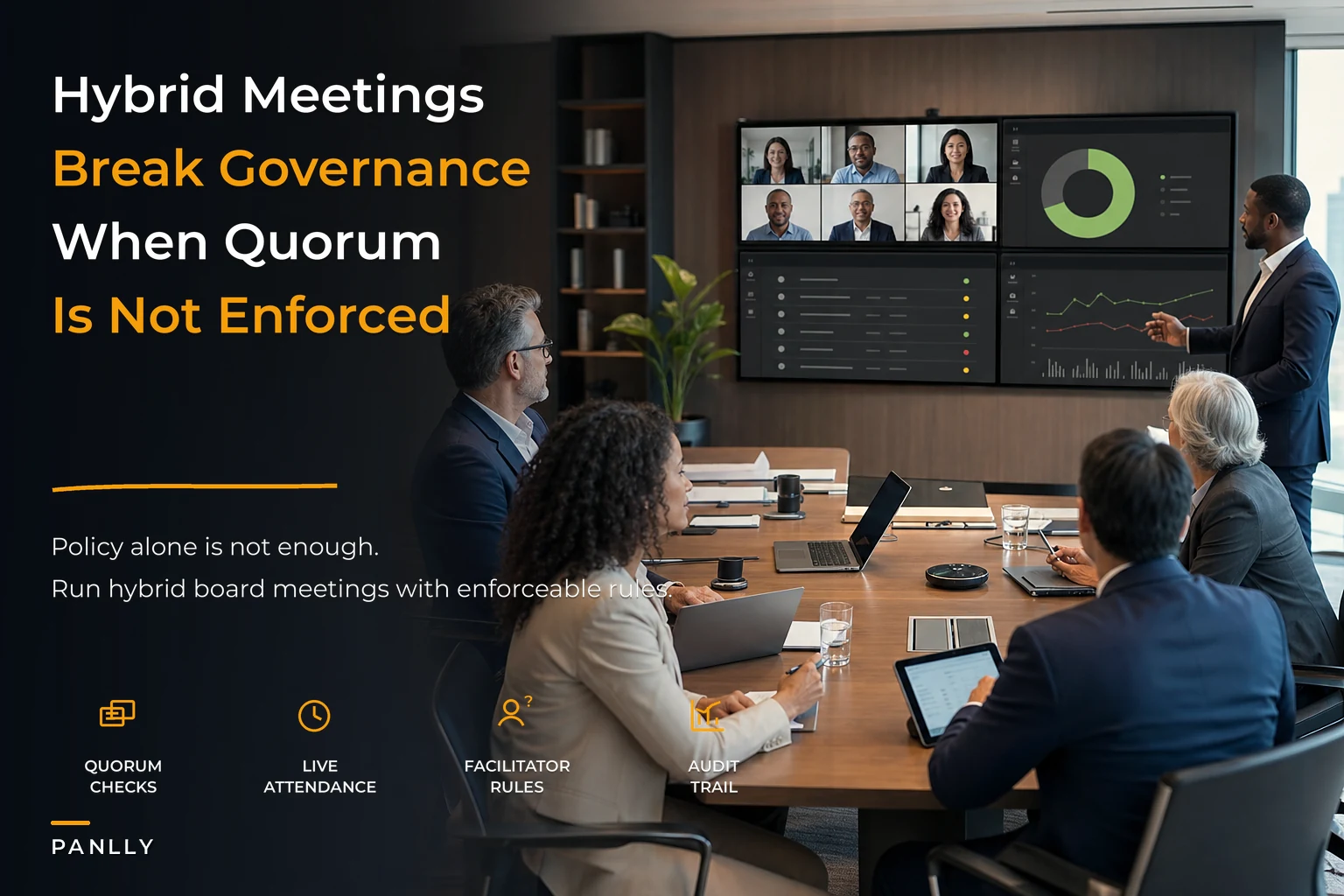

Picture a board meeting where three directors sit in the conference room, four join via video, and one dials in from their car between airport connections. The general counsel starts presenting a sensitive acquisition proposal when someone's unmuted mic picks up background chatter from a coffee shop. Two directors lose connection during the vote. The corporate secretary scrambles to figure out if quorum still holds while the CFO texts asking whether the director who stepped away for another call can vote on a resolution they never finished hearing.
This happens in boardrooms everywhere, multiple times per quarter. The shift to hybrid meetings happened almost overnight in 2020, but most boards are still running governance frameworks written for a world where everyone sat around the same table.
The problem runs deeper than technical glitches. When directors join from different locations using different technologies, fundamental governance mechanics start to break down. Quorum calculations get murky. Voting validity gets questioned. Confidentiality boundaries blur. And corporate secretaries find themselves trying to enforce twentieth-century bylaws in a very different meeting environment.
Why traditional governance frameworks fail in distributed environments
Board governance frameworks were built on physical presence assumptions. Quorum meant bodies in seats. Voting meant raised hands or written ballots. Confidentiality meant closed doors. These assumptions created clear, enforceable standards that courts and regulators understood.
Hybrid meetings complicate every one of these at once.
Physical presence no longer defines participation. A director video-conferencing from their home office might be more engaged than someone physically in the room but answering emails. Yet most bylaws still draw a line between "attendance" and "participation by electronic means," effectively creating two classes of directors in the same meeting.
Voting gets messy fast. In-person directors might vote by voice while remote participants type in chat. Some use polling features, others unmute to speak, and phone-only participants might text votes to the secretary. When five different voting methods happen simultaneously, validating and recording results cleanly is nearly impossible.
Confidentiality is harder to protect when directors join from environments nobody controls. The director in a co-working space might be sharing sensitive financials on a screen visible to strangers nearby. The one working from home might have family members in earshot. Traditional confidentiality agreements assume controlled environments that simply don't exist in distributed meetings.
Even basic meeting mechanics break. Who controls the agenda when the chair is remote but can't read the room? How do you handle sidebar conversations between in-person directors that remote participants can't hear? What happens when connection issues prevent some directors from accessing materials others are already reviewing?
These aren't edge cases. They're standard operating reality for most boards right now. Yet governance policies still pretend everyone gathers in the same conference room.
The operational cascade when hybrid meetings lack proper controls
When boards try to force old governance frameworks onto hybrid meetings, problems compound quickly.
Eliminate boardroom chaos with seamless coordination.
Panlly simplifies scheduling, collaboration, and follow-ups for every board meeting.
- Centralized meeting scheduling
- Secure document sharing
- Task assignment & tracking
No credit card required
Corporate secretaries spend hours after each meeting reconstructing what actually happened. They cross-reference chat logs, video recordings, email threads, and handwritten notes to piece together who was present, who voted, and whether each decision had proper quorum. This forensic reconstruction happens every meeting cycle, consuming time that should go toward actual governance work.
The legal exposure grows with each meeting. A shareholder challenging a major transaction could argue that remote directors weren't properly "present" under the bylaws, or that technical issues during voting invalidated the resolution. Without clear hybrid meeting protocols documented in governance policy, boards have limited defense against those arguments.
Committee work suffers even more than full board meetings. Audit committees reviewing sensitive findings, compensation committees discussing executive packages, nomination committees evaluating director candidates — all of these require heightened confidentiality and careful deliberation. When members join from scattered locations with varying technical setups, maintaining proper governance standards gets genuinely difficult.
The inequality between in-person and remote participants creates subtle but serious dynamics over time. Remote directors often can't read the room, miss nonverbal cues, and struggle to break into discussions naturally. In-person directors might review physical documents or have sidebar conversations that remote participants never access. Gradually, this creates an inner circle and a periphery — which fractures board cohesion in ways that don't always surface until something goes wrong.
And when hybrid meeting chaos disrupts deliberation, decision quality deteriorates. Directors burning mental energy on technical issues aren't focused on the strategic questions in front of them.
Building a hybrid board governance framework that actually works
Creating an effective hybrid board governance framework requires more than adding a video link to meeting notices. You need enforceable policies, operational procedures, and practical tools that reflect how boards actually operate today.
Start with policy language that eliminates ambiguity about hybrid participation.
Attendance and Quorum Standards
"Directors participating in any board or committee meeting through approved electronic communications platforms shall be deemed present for all purposes, including quorum and voting, provided they can: (1) hear all participants, (2) be heard by all participants, and (3) access all materials being discussed. The corporate secretary shall maintain a real-time attendance log noting each director's participation method and any connection interruptions exceeding 60 seconds."
This treats all participation equally while establishing clear technical standards and documentation requirements. No more debates about whether video attendance counts differently than physical presence.
Voting Protocols for Mixed-Mode Meetings
"When directors participate through different modalities, all votes shall be conducted using a single, designated method that provides simultaneous access to all participants. For mixed in-person/remote meetings, this shall be either: (1) roll call vote with verbal confirmation from each director, recorded and transcribed, or (2) electronic polling accessible to all directors regardless of location, with results displayed to all participants. The corporate secretary shall announce the voting method before each resolution and confirm all directors can access it."
This eliminates the chaos of multiple simultaneous voting methods while keeping participation equal.
Confidentiality and Environment Controls
"Directors participating remotely must ensure: (1) participation from a private location where confidential discussions cannot be overheard, (2) no recording devices beyond official meeting recording systems, (3) no other individuals present unless disclosed and approved, (4) screen sharing visible only to the director. Before discussing confidential matters, the chair or corporate secretary shall confirm each remote participant's environment compliance."
Rather than hoping directors self-police, this creates enforceable standards and a verification step.
Operational protocols that support the policy framework
Policy without procedure is just paper. Your hybrid board governance framework needs specific operational protocols that translate policy into practice.
Pre-meeting verification checklists for corporate secretaries before each session:
-
Test primary and backup connectivity for each remote director 24 hours before the meeting
-
Confirm each director has received and can access all meeting materials
-
Verify remote directors' environment compliance with confidentiality requirements
-
Establish backup communication channels (phone, text) for each participant
-
Designate technical support contacts for immediate assistance
-
Document the chosen voting mechanism and confirm all directors can access it
Facilitator scripts also matter more than most boards realize. The chair needs exact language for critical moments:
"Before we begin discussion of the acquisition proposal, I need to confirm that all directors, both in the room and joining remotely, can hear me clearly and have access to the materials in the board portal. Please confirm by saying your name."
"We will now vote on the resolution to approve the Q3 financial statements. All directors will vote using the polling feature in the meeting platform. The poll is now open. Secretary, please confirm when all directors have submitted their votes."
"As we move to executive session, I remind all directors that this discussion is highly confidential. Remote participants, please confirm you are in a private location with no other individuals present."
Use the facilitator scripts verbatim for critical moments to avoid ambiguity during votes and confidential sessions.
Real-time documentation is equally important. The corporate secretary should maintain a live meeting log that tracks:
-
Entry and exit times for each director, with their participation method noted
-
Any technical disruptions and their duration
-
Confirmation of quorum before each vote
-
The specific voting method used for each resolution
-
Directors who recuse themselves or step out during specific discussions
-
Verbal environment confirmations before confidential sessions
That contemporaneous documentation is your clearest evidence of proper governance if questions arise later.
Here's a simple workflow that ties pre-meeting checks, real-time documentation, and voting together into a repeatable process.
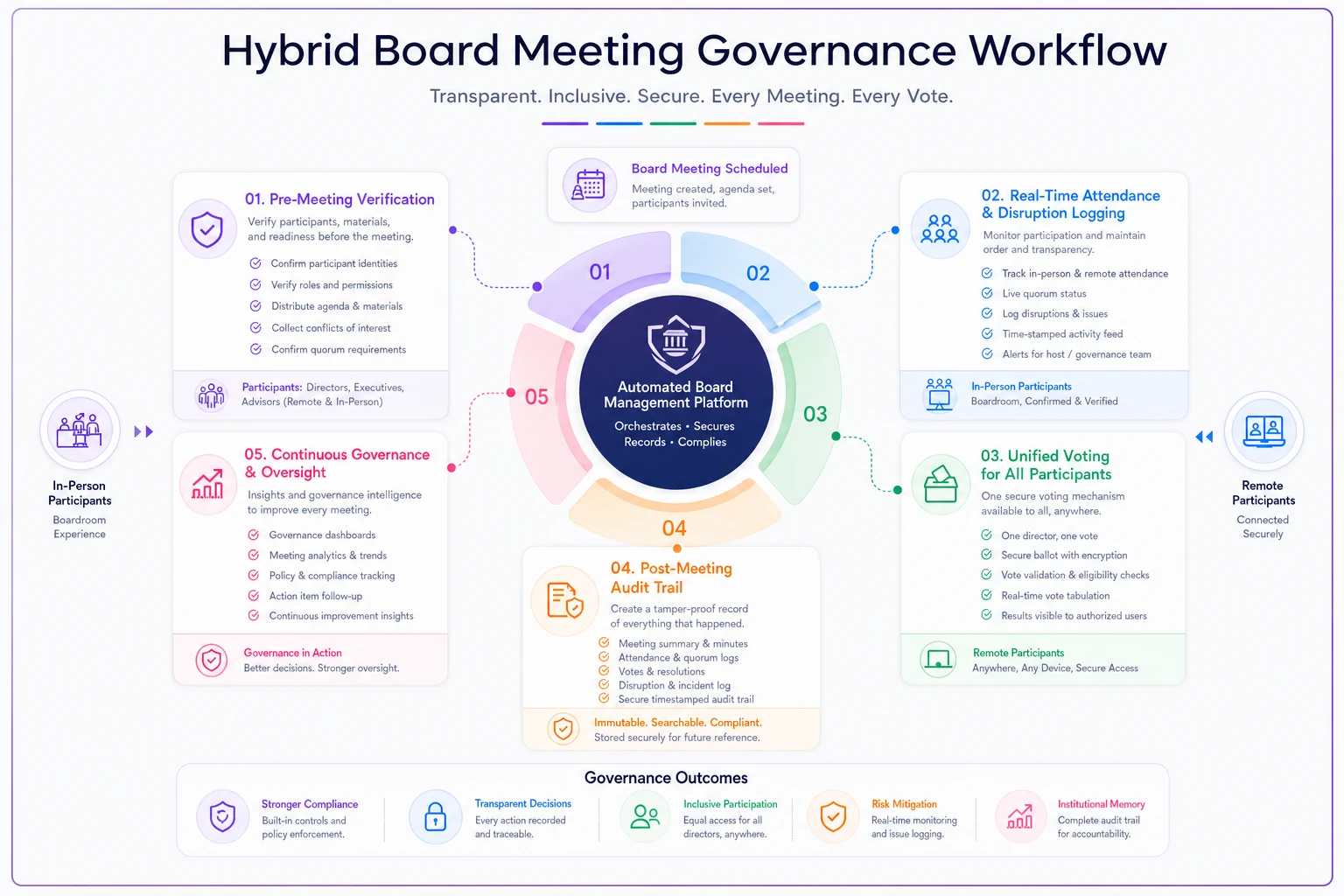
Having that workflow visually mapped makes it easier to train administrators and consistently execute during meetings.
The technology layer that makes hybrid governance manageable
Manual enforcement of hybrid governance protocols is exhausting, and it's error-prone. The corporate secretary can't simultaneously monitor video feeds, track attendance, manage voting, document discussions, and verify compliance while also participating meaningfully in substantive governance work.
This is where AI-powered operational software can genuinely change the picture. Modern board management platforms can handle the mechanical parts of meeting governance, freeing corporate secretaries to focus on substance.
| Feature | Description |
|---|---|
| Automated attendance tracking | The system logs when each director connects, through which medium, and any disconnections. It can alert the secretary if quorum is lost and generate certified attendance records for meeting minutes without anyone having to reconstruct it afterward. |
| Integrated voting | Integrated voting ensures all directors use the same system regardless of location. The platform captures each vote with a timestamp, calculates results instantly, and produces audit trails that hold up to regulatory scrutiny. |
| Smart recording and transcription | Smart recording and transcription captures full meeting context — differentiating speakers, flagging when confidential topics come up, and generating searchable transcripts that make minute preparation dramatically faster. |
| AI-assisted drafting | AI-assisted drafting can pull key decisions, action items, and votes into a structured format while keeping legal compliance intact. |
| Efficiency gains | The efficiency gains are real. Corporate secretaries working with integrated board management platforms consistently report spending significantly less time on meeting logistics and documentation — often cutting that time by more than half. |
The efficiency gains are real. Corporate secretaries working with integrated board management platforms consistently report spending significantly less time on meeting logistics and documentation — often cutting that time by more than half. More importantly, governance quality improves because human attention goes toward strategy and oversight rather than tracking who said what and when.
Real-world implementation: a private equity portfolio company case
A roughly $400 million manufacturing company with private equity ownership was struggling with hybrid board governance across eight quarterly meetings. Board members included PE partners in New York and San Francisco, independent directors scattered across the country, and management at headquarters in Ohio.
Before they put a formal framework in place, the meetings were a mess. The corporate secretary was spending 15-20 hours after each meeting trying to document what happened. Two shareholder resolutions were challenged over unclear voting records. One director seriously considered resigning because they felt shut out of discussions happening among in-person participants.
They implemented a comprehensive hybrid framework over about 60 days.
First, they revised bylaws and board policies to explicitly address hybrid meetings — language that eliminated the distinction between physical and remote attendance while establishing clear technical and environmental standards.
Second, they built detailed operational playbooks for different scenarios: fully virtual, hybrid with majority in-person, hybrid with majority remote, and emergency meetings. Each playbook included pre-meeting checklists, facilitator scripts, voting protocols, and documentation requirements.
Third, they deployed an integrated board management platform that automated attendance tracking, voting, and minute preparation while providing secure document sharing and video conferencing in a single system.
After four quarters, the results were hard to argue with. Meeting preparation dropped from around 25 hours to roughly 8. Post-meeting documentation went from 20 hours to about 3. Director engagement improved noticeably, with remote directors reporting they felt genuinely included in discussions rather than like spectators.
They also avoided what could have been a costly governance failure. During an emergency meeting to approve an acquisition, technical issues knocked three directors offline during the initial vote. Because clear protocols and automated tracking were already in place, they quickly confirmed what had happened, restored quorum, and conducted a valid re-vote. Without those systems, that situation could have invalidated a time-sensitive transaction.
Making the transition without disrupting board operations
Implementing a hybrid board governance framework doesn't require blowing everything up. Smart boards phase in changes over two or three meeting cycles, testing and refining along the way.
Start with policy updates that address the most critical gaps. You don't need perfect bylaws immediately. Clarifying attendance and quorum standards, establishing single voting methods, and defining minimum technical requirements can often be approved in a single meeting.
Run parallel protocols during the transition. Keep existing practices while testing new ones. Conduct traditional voice votes while also running electronic polling, comparing results to make sure the new system is working correctly. This builds confidence without breaking compliance.
Phase in automation gradually rather than digitizing everything at once. Start with attendance tracking and voting, then add minute automation, then expand to full meeting management. Directors and administrators adapt better to incremental change.
Train in short segments before each meeting rather than marathon sessions. Fifteen-minute modules focused on what's being used that day land better than comprehensive overhauls that nobody retains.
After each meeting, document what worked, what caused confusion, and what needs adjustment. Use that feedback to refine protocols before they become entrenched habits.
The competitive governance advantage of getting hybrid right
Boards that master hybrid governance gain real advantages beyond compliance. They can recruit directors regardless of geography. They can convene emergency meetings in hours rather than days. They can maintain continuity through travel disruptions or circumstances that would have derailed a traditional board.
The operational efficiency compounds. When logistics run smoothly, boards spend more time on strategic issues. When documentation is automated and accurate, legal risk decreases. When all directors participate equally regardless of location, decision quality improves.
There's also a signaling effect that matters. Investors see disciplined governance. Regulators see compliance readiness. Potential directors see a board that respects their time and treats participation seriously.
Boards still trying to force twentieth-century governance onto modern meeting realities will keep falling behind — wasting time on logistics, accumulating legal exposure, and struggling to attract directors who expect something better.
The path forward starts with honest assessment
Most boards know their hybrid meeting governance needs work. The question is whether they'll address it before a crisis forces their hand. A disputed vote, a confidentiality breach, a regulatory inquiry — any of these can expose exactly how outdated the underlying framework is.
Start by auditing where you actually stand. How many different voting methods do you use? How do you verify quorum with distributed participants? What happens when directors lose connection? How do you ensure confidentiality when people join from uncontrolled environments? If you can't answer these clearly, you need a hybrid board governance framework.
The investment is minimal compared to the risk of governance failure. Updated policies, clear protocols, and modern board management tools cost far less than defending against shareholder litigation or regulatory sanctions. More importantly, they free your board to focus on what it's actually there to do: provide strategic oversight and create value.
Hybrid board meetings aren't going away. The only question is whether your governance framework catches up to operational reality or stays frozen in a pre-digital past. The framework outlined here isn't theoretical — it comes from watching boards struggle with hybrid meeting reality and helping them build systems that actually hold up. The policies, protocols, and tools exist. The only requirement is the willingness to acknowledge that governance has to evolve to match how boards actually operate today.
Ready to enhance your board's productivity?
Join 500+ organizations using Panlly to save time, improve governance, and streamline board operations.