


Corporate board minutes feel harmless enough until they become exhibit A in a securities lawsuit. Or when regulators start asking uncomfortable questions about a decision made three years ago. Or when shareholders challenge a merger based on what the board "should have known."
The problem isn't that boards make bad decisions. Poor board minutes create unnecessary vulnerabilities through sloppy documentation practices — turning defensible business decisions into litigation targets.
The Delaware court test that catches unprepared boards
Delaware courts have a surprisingly specific way of evaluating board decisions when shareholders challenge them. They don't just look at what the board decided. They examine the record to understand how the board reached that decision.
A pharmaceutical company learned this the hard way last year. Their board approved a $450 million acquisition that later failed spectacularly. The decision itself wasn't the problem — failed acquisitions happen. But when shareholders sued, the board's minutes became a liability. The minutes showed:
"Board approved acquisition of TechCo for $450M. Motion carried 8-2."
That was it. No discussion of alternatives. No mention of financial advisors. No record of dissenting views. No documentation of the analysis presented.
The Delaware court found the board potentially breached its duty of care. Not because the acquisition failed, but because the minutes couldn't demonstrate the board had engaged in a reasonable decision-making process. The sparse documentation made it impossible to invoke business judgment rule protection.
What should have been documented? The court wanted to see evidence of:
-
Alternative deals considered
-
Financial advisor presentations reviewed
-
Risk factors discussed
-
Dissenting director concerns
-
Time spent deliberating
-
Questions asked by directors
-
Information requested and provided
The absence of that detail turned defensible judgment into potential liability.
Why general counsel hate discovering their own minutes
Most board minutes create problems not through what they say, but through what they leave ambiguous. Corporate secretaries, trying to keep minutes concise, often create interpretive nightmares.
Eliminate boardroom chaos with seamless coordination.
Panlly simplifies scheduling, collaboration, and follow-ups for every board meeting.
- Centralized meeting scheduling
- Secure document sharing
- Task assignment & tracking
No credit card required
Consider this actual minute entry from a technology company:
"The CEO presented concerning developments in the Asian market. After extensive discussion, the board directed management to take appropriate action."
Eighteen months later, when the company faced an SEC investigation about disclosures related to their Asian operations, this vague minute became a problem. What were the "concerning developments"? What constituted "extensive discussion"? What "appropriate action" did the board actually authorize?
The investigation team spent weeks deposing board members, trying to reconstruct what actually happened in that meeting. Directors gave conflicting accounts. The CEO remembered it differently than the CFO. The lack of specificity in the minutes turned a routine business discussion into potential evidence of inadequate oversight.
The redaction paradox that creates more problems
Many boards try to protect themselves by heavily redacting sensitive discussions from minutes. They'll mark entire sections as "privileged" or simply note "legal discussion occurred."
This approach backfires during litigation. Opposing counsel sees redactions and assumes the worst. Judges become suspicious. What started as prudent legal protection becomes evidence of concealment.
A retail chain discovered this when facing a wrongful termination lawsuit from their former CMO. The board minutes from the meeting where they discussed the termination contained multiple redacted sections. The plaintiff's attorneys argued these redactions hid discriminatory discussions. The company claimed attorney-client privilege.
The court ordered in-camera review. The redacted sections turned out to be mundane legal procedural discussions. But the heavy redactions had already damaged the board's credibility. The case settled for significantly more than it should have because the minutes looked suspicious.
Building legally sufficient minutes without creating exposure
The solution isn't writing novels or leaving everything vague. It's understanding what legally sufficient documentation actually requires.
Document the process, not the details
Minutes should show the board engaged in a deliberative process without recording every comment. Focus on:
-
Information presented to the board
-
Time allocated for discussion
-
Questions raised (not who asked them)
-
Alternatives considered
-
Factors weighed in the decision
-
External advisors consulted
Use structured documentation for high-risk decisions
For decisions likely to face scrutiny — mergers, executive compensation, related-party transactions — use a standard framework:
| Decision Element | What to Document | Example Language |
|---|---|---|
| Information Basis | Materials reviewed | "Board reviewed management presentation, fairness opinion from [Advisor], and comparative market analysis" |
| Deliberation Time | Duration of discussion | "Following 45-minute presentation, board discussed for approximately 90 minutes" |
| Key Considerations | Factors evaluated | "Discussion addressed strategic rationale, integration risks, financing alternatives, and shareholder impact" |
| Dissent/Concerns | Opposing views | "Certain directors expressed concerns regarding integration timeline and cultural alignment" |
| Decision Rationale | Basis for approval | "Board determined transaction furthers long-term strategic objectives based on factors discussed" |
Structured entries like these give future reviewers a clear map of why the board reached its conclusion without recording every speaker.
The QC workflow that catches problems before they become permanent
Most minute problems could be prevented with proper quality control. But the typical process — secretary drafts, maybe legal reviews, board approves at next meeting — misses critical issues.
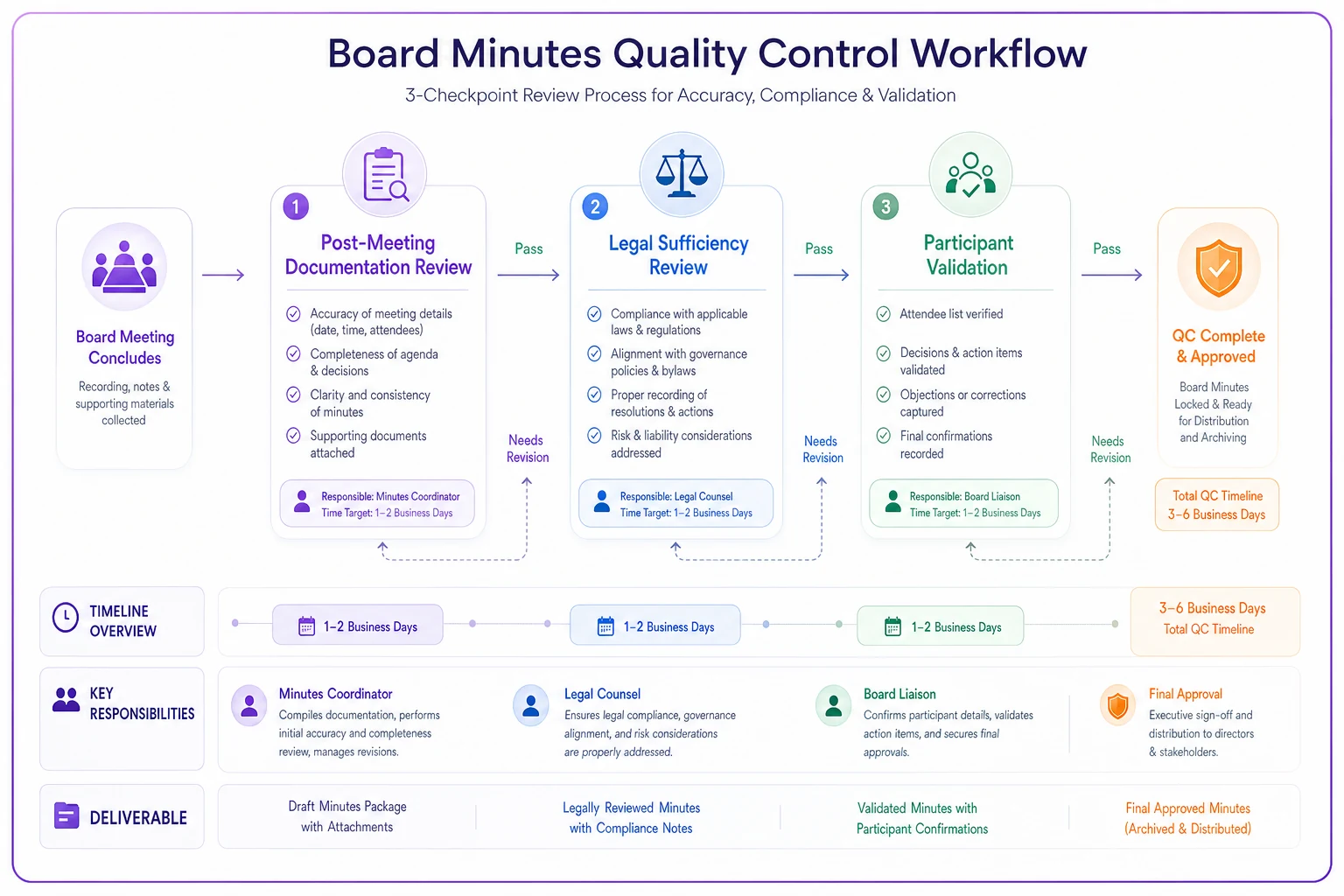
An effective QC process operates at three checkpoints:
Checkpoint 1: Post-meeting documentation review (within 48 hours)
-
The corporate secretary reviews their notes against
-
The agenda (was everything covered documented?)
-
Pre-read materials (do minutes reference the information provided?)
-
Known sensitive issues (are these handled appropriately?)
Checkpoint 2: Legal sufficiency review (within one week)
-
Legal counsel evaluates
-
Business judgment rule requirements satisfied?
-
Regulatory documentation needs met?
-
Privilege properly preserved?
-
Litigation hold implications addressed?
Checkpoint 3: Participant validation (before finalization)
-
Key participants confirm
-
Critical decisions accurately captured
-
No material omissions
-
Context sufficiently clear
This might seem excessive for routine meetings. But consider that these minutes might be scrutinized years later, when memories have faded and participants have moved on.
This workflow outlines the QC checkpoints described above.
Rotate reviewers so a fresh pair of eyes checks minutes for missing context before finalization.
An organized QC process prevents small omissions from becoming major liabilities.
Mapping minutes to common legal standards
Different types of board actions require different documentation standards. A compensation committee approving routine equity grants needs different documentation than a special committee evaluating a hostile takeover.
For routine operational decisions:
Document that the board received and reviewed appropriate information. Show the decision was made with proper authority. Avoid unnecessary detail that could be misinterpreted later.
For transactions with heightened scrutiny:
Create a clear record of independence, information, and deliberation. Document the board's understanding of alternatives. Show active engagement with the decision.
For crisis response decisions:
Balance the need for swift action with documentation requirements. Note time constraints explicitly. Document information available at time of decision, not what became known later.
For compliance and risk oversight:
Show regular engagement with risk topics. Document follow-up on identified issues. Create clear record of board directives to management.
Red flags that guarantee scrutiny
Certain minute patterns virtually guarantee regulatory or litigation attention:
The rubber stamp pattern
Multiple significant decisions approved with no discussion noted. Every motion passing unanimously. No questions or concerns documented. This pattern suggests the board isn't actually engaging in oversight.
The missing middle
Minutes that jump from problem identification to resolution without documenting the board's role. "Management reported cyber incident. Incident was resolved." What did the board actually do?
The retroactive revision
Attempting to "clarify" old minutes when litigation looms. Courts and regulators see through this immediately. If minutes need context, provide it through testimony, not revision.
The privilege overreach
Marking entire meeting segments as privileged without legitimate basis. This undermines credibility and may waive privilege entirely.
Technology solutions for defensible documentation
Modern board management platforms can enforce documentation standards automatically. Most organizations use these tools purely for document distribution, missing their compliance capabilities.
Effective platforms should provide:
-
Templates mapped to legal requirements
-
Automated flagging of high-risk decisions requiring enhanced documentation
-
Version control with clear audit trails
-
Secure redaction tools that preserve underlying data
-
Integration with legal hold systems
The key is configuring these systems to match your organization's risk profile and regulatory requirements, not using generic templates.
Creating your minute review checklist
Every organization needs a minute review checklist tailored to their industry and risk profile. But certain elements apply universally:
Structural completeness:
-
All agenda items addressed
-
Attendance properly recorded
-
Conflicts of interest noted
-
Recusals documented
Legal sufficiency:
-
Decision-making process evident
-
Information basis documented
-
Board's role clear
-
Proper approvals recorded
Clarity for future readers:
-
Acronyms defined
-
Context provided for significant decisions
-
References to external documents specific
-
Technical terms explained
Protective elements:
-
Privilege properly designated
-
Confidentiality preserved
-
Personal information appropriately handled
-
Trade secrets protected
Tailor this checklist to your legal environment and board composition.
The reality of minute scrutiny
Board minutes will be scrutinized. Not if, but when. Maybe during routine regulatory examination. Maybe in litigation discovery. Maybe during due diligence for a major transaction.
The minutes that survive scrutiny aren't the ones that try to hide everything or document everything. They're the ones that consistently demonstrate a board engaged in thoughtful oversight, making informed decisions through proper processes.
This doesn't require perfect minutes. It requires minutes that accurately reflect a functioning board governance process. Minutes that would allow a reasonable reader, years later, to understand not just what the board decided, but that the board fulfilled its duties in reaching that decision.
The boards that get this right treat minute-taking not as administrative burden but as protective documentation. They understand that good minutes don't create liability — they prevent it by showing the board did its job.
Start with your next board meeting. Review your current minute template against the legal standards that matter for your organization. Build quality control into your process. Create minutes that protect rather than expose.
Because when scrutiny comes — and it will — your minutes become your defense. Make sure they're up to the task.
Ready to enhance your board's productivity?
Join 500+ organizations using Panlly to save time, improve governance, and streamline board operations.