

M&A transactions create a unique pressure cooker for board governance. Unlike regular board decisions that develop over multiple meetings, acquisition approvals compress months of strategic deliberation into weeks or sometimes days. The stakes multiply when you consider that deal failures often trace back to governance missteps during the approval phase—inadequate conflict disclosure, rushed diligence reviews, or incomplete decision documentation that later becomes litigation fodder.
The operational challenge isn't just making the right call. It's orchestrating a complex approval process while maintaining confidentiality, managing conflicts, preserving privilege, and creating defensible records—all under deal timeline pressure. Most boards discover their governance infrastructure wasn't built for this intensity only after problems surface.
What an approval timeline actually looks like in practice
Mapping an M&A board approval checklist starts with understanding real timeline constraints. Investment bankers and management teams often present boards with artificially compressed schedules, claiming market dynamics require immediate action. Boards that rush through proper governance steps frequently face shareholder litigation, regulatory scrutiny, or deal unwinding.
A functional approval timeline typically spans 45 to 75 days from initial board notification to final vote. That sounds generous until you layer in actual governance requirements.
Pre-notification phase (Days -14 to 0): General counsel initiates conflict checks before the board even knows a deal exists. This means reviewing director affiliations, investment holdings, and professional relationships against the potential target and its ecosystem. One aerospace manufacturer discovered three directors had indirect conflicts through venture portfolios only because they started this process early. Missing those connections would have invalidated their eventual approval.
Initial briefing and NDA phase (Days 1-7): Directors receive notification of potential transaction discussions under attorney-client privilege. Individual NDAs supplement existing confidentiality obligations. The board establishes a transaction committee if conflicts exist or workload demands it. Information flow protocols get defined—who sees what, when, and through which secure channels.
Preliminary diligence review (Days 8-21): Management presents initial deal rationale, valuation ranges, and strategic fit assessment. Directors begin reviewing materials in staged releases rather than document dumps. The audit committee evaluates financial projections separately. Independent directors may engage their own advisors. All of this happens while strict confidentiality protocols limit discussion even among board members.
Deep diligence and negotiation phase (Days 22-45): The board reviews detailed diligence findings, deal structure, financing arrangements, and integration plans. Multiple special meetings occur, often on short notice. Directors submit written questions to preserve privilege. Management responds through counsel to maintain documentation standards. Key assumptions get stress-tested. Alternative transactions get evaluated to satisfy Revlon duties where applicable.
Final approval preparation (Days 46-60): Deal documents near final form. The fairness opinion arrives from financial advisors. Legal counsel walks the board through fiduciary duties and decision standards in detail. Directors receive the complete board book at least 72 hours before the approval meeting—not the night before, as routinely happens under artificial urgency.
Approval meeting and documentation (Days 61-75): The board conducts its final deliberation with all advisors present. The vote occurs with careful minute-taking that documents the basis for the decision. Post-meeting cleanup ensures all amendments, conditions, and follow-up items get captured. Signed resolutions circulate within 24 hours.
Below is a simple workflow visualization of this timeline.
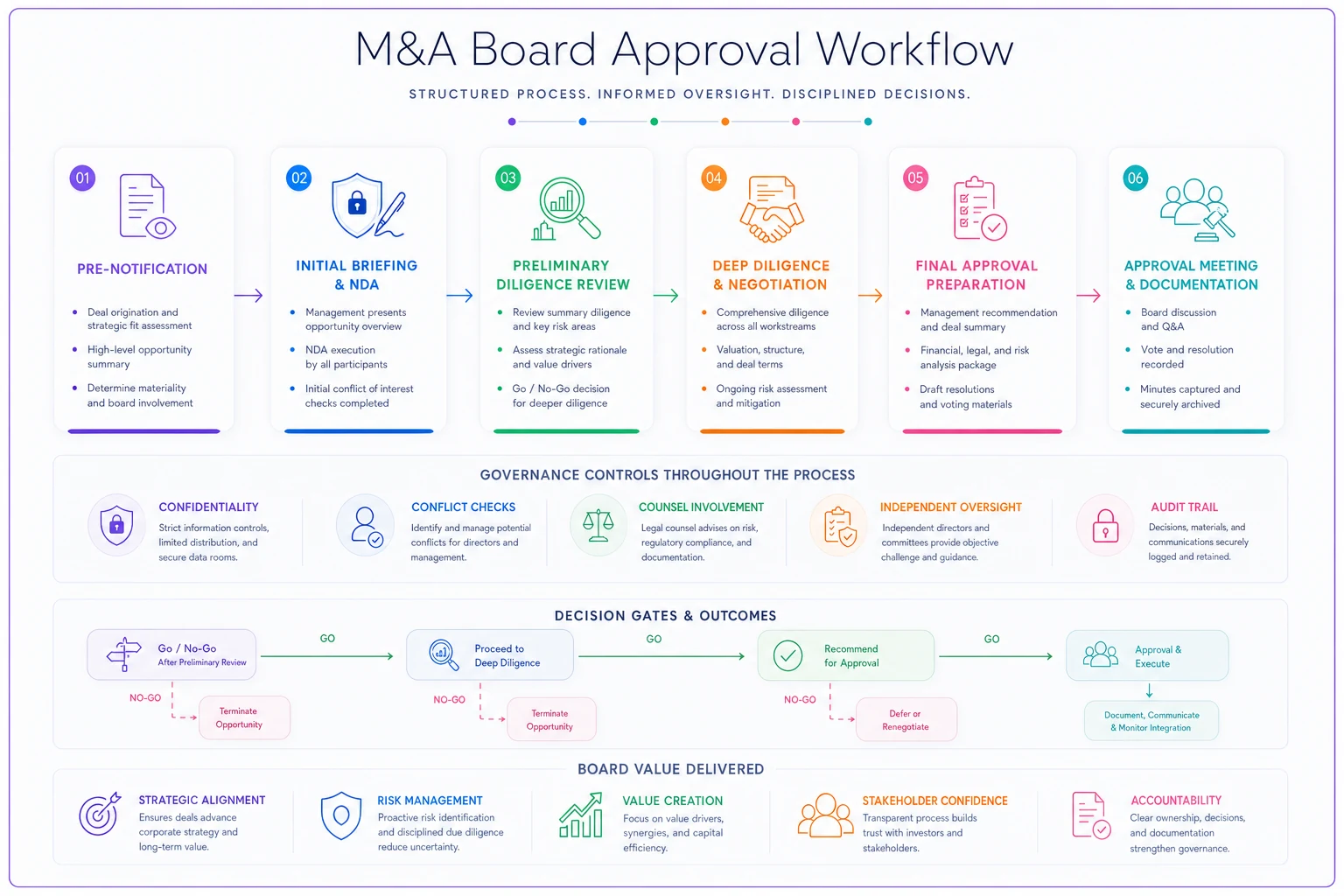
This visual maps the phased workflow and the key controls to apply at each stage.
Conflict identification beyond the obvious connections
Traditional conflict checks focus on direct financial interests—stock ownership, board seats, consulting arrangements. M&A transactions surface subtler conflicts that standard processes miss. A director's spouse serving on a competitor's advisory board becomes material when that competitor might bid. A director's former employer having litigation against the target creates perception issues even without a legal conflict.
Eliminate boardroom chaos with seamless coordination.
Panlly simplifies scheduling, collaboration, and follow-ups for every board meeting.
- Centralized meeting scheduling
- Secure document sharing
- Task assignment & tracking
No credit card required
The identification process needs multiple detection layers.
Start with comprehensive questionnaires that probe beyond current affiliations. Include questions about immediate family members' professional roles, significant social relationships with target executives, and indirect economic interests through funds or partnerships. Update these questionnaires specifically for the transaction rather than relying on annual D&O filings.
Update director questionnaires for each transaction rather than relying on annual filings.
Run systematic database searches against director backgrounds. Public company boards often discover connections through news archives, litigation databases, and regulatory filings that directors forgot about or didn't consider material. A retail company found their lead independent director had testified as an expert witness against their acquisition target eight years earlier—a fact that would have undermined the entire approval process if discovered post-closing.
Create safe channels for voluntary disclosure. Directors sometimes hesitate to raise marginal conflicts that might remove them from an interesting transaction. A process where directors can confidentially discuss potential issues with counsel before formal conflict determination allows for proper evaluation without premature recusal.
Document not just identified conflicts but the search process itself. When plaintiff attorneys challenge deal approvals, they scrutinize whether the board conducted adequate conflict diligence. Showing systematic conflict identification—even when nothing turns up—strengthens the approval record considerably.
Building privilege walls that survive discovery
M&A litigation almost guarantees extensive document discovery. Emails between directors, texts during meetings, annotated board materials—all become potential evidence. Boards that don't establish proper privilege protocols from day one hand ammunition to challengers.
The privilege architecture requires deliberate construction. Designate specific counsel for transaction advice separate from regular corporate counsel. This creates cleaner privilege lines. Route all substantive communications through counsel rather than direct director-to-director channels. When directors email each other directly about deal concerns, those communications rarely maintain privilege.
Create separate document repositories for different privilege holders. The full board, transaction committee, and management team each need distinct confidential workspaces. Materials shared across groups lose targeted privilege protection. One technology company's entire deal communication archive became discoverable because they used a single shared folder where privileged and non-privileged documents were mixed together.
Meeting practices determine privilege sustainability. Require counsel presence for all substantive transaction discussions. When directors pre-meet without counsel or continue discussions after lawyers leave, those segments typically lose protection. Document attorney involvement clearly in minutes and attendance records.
Train directors on privilege-preserving communication habits. No forwarding legal advice to outside parties. No using personal email for board business. No informal deal discussions at social events. These seem basic, but privilege logs from M&A litigation repeatedly show protection failures from simple protocol breaches.
The diligence package that satisfies both speed and scrutiny
Board-level diligence differs fundamentally from management's operational review. Directors need materials that enable strategic judgment without drowning in details. Yet post-transaction challenges often claim the board rubber-stamped management's recommendation without independent evaluation.
Structure diligence materials in escalating detail levels. Start with executive summaries that highlight key risks, synergies, and integration challenges—with specific metrics the board should track, not generic categories. Then provide supporting schedules that directors can explore based on their expertise and concerns.
Focus on assumption documentation over conclusions. When management presents "$50 million in identified synergies," the board needs to see the build-up: which costs get eliminated, which revenues grow, what integration expenses offset the benefits. A pharmaceutical board avoided a problematic acquisition by dissecting synergy assumptions and finding that roughly 60% depended on regulatory approvals management had rated as "uncertain."
Separate advocacy from analysis. Management naturally champions deals they've developed. The board needs unfiltered risk assessments, dissenting views from diligence teams, and specific failure scenarios. Create formal channels for diligence team members to raise concerns directly with directors, bypassing management filters.
Require competitive analysis beyond the target itself. Understanding who else might bid, how the target fits competitors' strategies, and potential market reactions shapes negotiation leverage and timing. Boards frequently approve deals without realizing superior offers were developing until after announcement.
Minute-capture that reconstructs deliberation without creating liability
M&A minutes face opposing pressures: document enough to show informed deliberation, but not so much that you create liability hooks. The standard "directors discussed" language fails both tests—it neither proves careful consideration nor avoids challenge.
Effective M&A minutes capture the analytical framework without recording every comment. Document what information directors reviewed, which alternatives they considered, and how they evaluated key decisions. Skip the blow-by-blow discussion narrative that plaintiff lawyers mine for contradictions.
| Strong Minute Language | Risky Minute Language |
|---|---|
| "Directors reviewed management's analysis of three strategic alternatives" | "Director Smith questioned whether management properly evaluated alternatives" |
| "The board considered valuation ranges from $X to $Y based on comparable transactions" | "Several directors expressed concern that the price seemed low" |
| "Following discussion of integration risks, directors requested additional information on IT system compatibility" | "Directors debated whether integration risks were adequately addressed" |
| "The board evaluated the fairness opinion methodology and underlying assumptions" | "Director Jones challenged certain assumptions in the fairness opinion" |
Structure minutes to show systematic evaluation. Group discussion by topic—strategic rationale, financial terms, due diligence findings, fairness opinion, alternatives analysis. This demonstrates comprehensive review better than chronological narratives.
Include specific references to reviewed materials without incorporating them wholesale. "Directors examined the Data Room Index dated [date] containing [number] diligence documents" provides evidence of review without making every document part of the official record. Poor minute practices that invite scrutiny often come from over-inclusion of working documents rather than under-documentation.
Time-stamp critical decision points. When did directors receive final deal documents? When did they get responses to their questions? When did various advisors present? This temporal framework helps reconstruct the decision process if challenges come later.
Decision templates that keep the approval process intact
M&A approvals involve dozens of micro-decisions beyond the headline vote. Which representations to require. What conditions precedent to demand. Which closing conditions allow termination. How to handle interim operations. Standard board resolutions miss these nuances entirely.
A well-structured approval process works through several distinct layers:
-
Transaction Authorization Matrix — Covers purchase price and structure approval, acceptable adjustment mechanisms, termination fee parameters, financing arrangement blessing, representation and warranty boundaries, and indemnification caps and baskets.
-
Delegation Framework — Defines what management can adjust without returning to the board, which changes trigger re-approval, who can waive conditions, how closing date movements get handled, and when a committee can act for the full board.
-
Post-Signing Governance — Establishes integration oversight structure, synergy tracking requirements, risk monitoring protocols, communication boundaries until closing, and regulatory filing responsibilities.
Each component needs specific approval language, not blanket authorization. "Management is authorized to finalize purchase price adjustments within 5% of base price provided net debt doesn't exceed $X" beats "Management is authorized to finalize transaction terms."
Build escalation triggers into the template. If integration costs exceed estimates by 20%, automatic board notification. If regulatory approval delays surpass 60 days, special meeting required. If financing terms deteriorate beyond specified thresholds, re-approval mandated. These pre-set triggers prevent drift from approved parameters without requiring constant board involvement.
Develop these templates before deals are on the table—not during one. Customizing an existing template under deadline takes hours. Starting from scratch under pressure takes days and invites errors that create problems long after closing.
The signoff matrix that clarifies exactly who approved what
Complex transactions involve multiple approval layers—full board, committees, individual officers. Post-closing disputes often center on whether proper authorization existed for specific actions. A clear signoff matrix prevents finger-pointing when problems surface.
Map every decision to its required approvers. The full board approves the transaction. The audit committee blesses purchase price adjustments. The CEO signs core deal documents. The CFO approves working capital methodologies. The general counsel clears disclosure documents. Without this mapping, critical decisions fall into authorization gaps.
Build the matrix before negotiation starts, not at closing. Define who can approve deal term changes during negotiation. Specify which economic modifications need board blessing versus management discretion. Determine committee versus full board thresholds. Retroactive authorization breeds litigation risk.
Document actual signoffs, not just requirements. Track when each approver reviewed materials, raised questions, and provided consent. Electronic workflows that capture timestamps and comments create far better records than email chains and verbal approvals.
A medical device company avoided post-closing purchase price litigation because their signoff matrix clearly showed the CFO approved the working capital calculation methodology before signing, with audit committee confirmation. The seller's challenge failed against that documented authorization chain.
Managing information asymmetry without breaking confidentiality
M&A transactions create natural information imbalances. Management knows more than directors. Transaction committee members see details the full board doesn't. Some directors have conflicts requiring information restrictions. These asymmetries need active management without compromising decision quality.
Establish clear information tiers from the start. Full board members get strategic summaries and material terms. Committee members receive detailed diligence. Conflicted directors see only what's legally required. Each tier needs sufficient information for their decision scope without unnecessary exposure.
Create "need to know" protocols that actually work in practice. Rather than restricting everything by default, identify specific sensitive items—other bidder identities, negotiation tactics, pricing waterfall. Share everything else broadly to maintain board cohesion. Over-restriction breeds suspicion and undermines collective decision-making.
Document information firewalls carefully. When directors recuse themselves from portions of discussions, minute exactly when they left and returned. When certain materials go only to committee members, log who received what. This precision prevents later claims about improper information sharing or inadequate disclosure.
Balance transparency with practicality. A director with a minor conflict might receive redacted materials rather than complete exclusion. The full board might get anonymized competitive analysis that protects specific identities while conveying market dynamics. These compromises maintain governance quality within confidentiality constraints.
Real scenario: biotech board navigates competitive acquisition
A biotech company with around $180 million in revenue faced an unexpected acquisition opportunity when a competitor entered bankruptcy. The target held complementary patents and manufacturing capacity worth potentially $300 to $400 million. Three other bidders were circling, timelines were compressed, and two board members had indirect conflicts through venture portfolios.
The board initiated their M&A approval checklist immediately. Conflict checks revealed not just the known venture connections but also that one director's brother-in-law worked for another potential bidder. They established a transaction committee of unconflicted directors while keeping the full board informed through privileged summaries.
Over 52 days, the committee met eleven times, reviewing increasingly detailed diligence. They discovered the target's key patents faced challenges that management had initially downplayed. The purchase price assumption dropped from $400 million to $275 million based on that finding. The committee also identified integration costs running roughly 40% higher than management projected.
The approval vote came with specific conditions: maximum price of $285 million, minimum patent warranty period, and a mandatory regulatory approval escape clause. Detailed minutes showed systematic evaluation of alternatives including partial asset purchase and partnership structures. When a losing bidder later challenged the sale process, the board's documented decision framework defeated the challenge.
The disciplined approval process took seven weeks versus management's hoped-for three. But it avoided overpayment by approximately $75 million and prevented the post-closing litigation that plagued similar rushed transactions in their sector.
Operational infrastructure for repeated deal execution
Companies pursuing growth through acquisition need repeatable M&A governance processes. Building this infrastructure during live deals guarantees mistakes. The foundation needs to exist before opportunity knocks.
Start with evergreen conflict monitoring. Update director questionnaires quarterly, not annually. Track evolving affiliations, new board appointments, and investment changes. When deals arise, you're updating existing data rather than starting from scratch. This ongoing maintenance catches conflicts early enough to manage them properly.
Maintain template libraries that pre-solve standard issues. Approval resolutions, committee charters, information handling protocols, minute formats—all should exist in draft form before you need them. Customizing templates takes hours; creating documents from scratch under pressure takes days and invites errors.
The operational challenge compounds when boards rely on manual processes to track all these moving pieces. Email chains fragment. Version control fails. Critical documents get buried in overstuffed folders. The precision required for proper M&A governance struggles against organizational chaos.
This is where AI-powered operational software shifts the approval process from scramble to system. Instead of general counsel manually tracking conflict questionnaires, automated workflows collect and flag potential issues. Rather than searching through email threads for the latest diligence materials, centralized repositories maintain clear version control with access logging. The software handles routine governance tasks—scheduling special meetings, distributing materials with appropriate redactions, capturing attendance and voting records—while boards focus on strategic evaluation.
For organizations executing multiple acquisitions annually, this infrastructure difference determines whether governance scales or becomes the bottleneck. Manual processes that barely hold together for one deal can collapse entirely when managing several simultaneous transactions.
The documentation that survives post-closing challenges
Every M&A approval faces potential challenge—from shareholders claiming inadequate price, regulators questioning competitive impact, or counterparties disputing terms. The board's approval documentation becomes the primary defense. Most boards discover their records' inadequacy only when under attack.
Build documentation explicitly for future defense. Assume every email gets scrutinized. Expect all meeting minutes to be questioned. Prepare for advisors' work to be dissected. That defensive mindset shapes better real-time documentation practices.
Focus documentation on process quality over outcome justification. Courts evaluate whether boards followed proper procedures more than whether they made perfect decisions. Showing systematic evaluation of alternatives, careful consideration of conflicts, and reasonable reliance on advisors defeats most challenges—even when deals underperform.
Create comprehensive closing sets immediately after approval. Collect all approval-related documents—minutes, resolutions, presentations, questionnaires, disclosures—into a single indexed set. Add a timeline showing when key events occurred. Include a summary of who made which decisions. This package becomes your defense toolkit before you need it.
The investment in proper M&A approval processes pays dividends beyond litigation protection. Clear governance frameworks accelerate future deals. Documented decision rationales inform integration strategies. Systematic conflict management preserves board cohesion. Companies that build this infrastructure execute acquisitions faster and more successfully than those recreating processes under pressure every single time.
The difference between boards that navigate M&A smoothly and those that struggle often isn't experience or expertise. It's infrastructure—the templates, processes, and systems that transform complex approvals from governance gauntlets into manageable procedures. With acquisition activity resurging across industries, boards that build this foundation now position themselves to capture opportunities while others scramble through preventable governance crises.
The difference between boards that navigate M&A smoothly and those that struggle often isn't experience or expertise. It's infrastructure—the templates, processes, and systems that transform complex approvals from governance gauntlets into manageable procedures. With acquisition activity resurging across industries, boards that build this foundation now position themselves to capture opportunities while others scramble through preventable governance crises.
Ready to enhance your board's productivity?
Join 500+ organizations using Panlly to save time, improve governance, and streamline board operations.