


The restatement almost never comes from the number itself. It comes from the fact that nobody in the room could produce the workpaper that supported it — and by the time anyone went looking, the version they found didn't match what went into the disclosure.
That's the pattern worth understanding before your next audit committee meeting. Weak audit packs don't fail because the underlying accounting is wrong. They fail because the pack circulated to the committee is a polished summary sitting on top of a pile of reconciliations, signoffs, and supporting exhibits that nobody has actually cross-checked against each other. The committee approves. The auditor asks a follow-up. Now the pack and the answer point in two different directions.
This piece is about building a forensic pre-meeting QC gate — a checkpoint that runs before materials reach the audit committee — so the pack that lands in front of directors is internally consistent, fully sourced, and mapped to the questions the auditor is almost certainly going to ask.
The gap between what's in the pack and what's behind it
The specific failure looks like this. The finance team assembles a quarter-end pack: a summary of results, a few schedules, a going-concern memo, maybe a revenue recognition narrative for a new contract type. It looks complete. It reads well. Everyone assumes the supporting detail exists because the summary sounds confident.
What's missing is the reconciliation layer — the proof that the number in the summary ties to the general ledger, ties to the subledger, ties to the signed workpaper. In practice, this usually happens because three different people own three different pieces: one owns the disclosure narrative, one owns the schedule, one owns the reconciliation. Nobody owns the connection between them.
A typical example: a company books a $2.4M revenue adjustment for a multi-element contract. The disclosure narrative describes the judgment. The schedule shows the allocation. But the reconciliation tying the allocation back to the executed contract terms lives in a spreadsheet on someone's drive, last touched two weeks before the terms were amended. The pack says one thing. The evidence says a slightly older thing. That gap — small, boring, procedural — is exactly what turns into a restatement when the auditor pulls the thread.
The audit committee can't catch this by reading the pack more carefully. It's not a reading problem. It's a reconciliation problem, and it has to be caught before the pack is finalized.
Why polished packs are more dangerous than messy ones
A messy pack invites questions. A polished pack invites trust. That's the counterintuitive part.
Eliminate boardroom chaos with seamless coordination.
Panlly simplifies scheduling, collaboration, and follow-ups for every board meeting.
- Centralized meeting scheduling
- Secure document sharing
- Task assignment & tracking
No credit card required
When a committee receives rough materials, directors ask where the support is. When they receive a clean, well-formatted pack with confident narratives, they assume the underlying work is equally clean. Formatting quality becomes a proxy for evidentiary quality — and those two things have almost nothing to do with each other.
This pattern shows up most in companies with a strong FP&A team and a thinner controllership function. The presentation is excellent, the narrative is sharp, but the audit trail underneath — the reconciliations, the version control, the signoff timing — is held together by individual memory rather than a documented process. Everything works until someone leaves, a system changes, or an auditor asks a question in a slightly different order than expected.
The same discipline gap shows up in board records more broadly. A compliance-first approach to board records prevents audit surprises precisely because it forces evidence to exist independently of the person who prepared it. The audit pack deserves the same treatment — arguably more, because the consequences land directly on the financial statements.
The exhibits an audit pack must carry — and why each one exists
A forensic pre-pack isn't a longer pack. It's a pack where every summary claim has a required exhibit behind it, and that exhibit is attached, versioned, and reconciled. Here's the exhibit set that separates a defensible pack from a fragile one.
| Exhibit | What it proves | Common failure |
|---|---|---|
| GL-to-subledger reconciliation | The reported number ties to the detail | Reconciled at a stale date, not quarter-end |
| Journal entry support for manual adjustments | The adjustment was authorized and documented | Entry booked, memo written later or never |
| Estimate/judgment memo | The basis for reserves, allowances, impairments | Conclusion stated, methodology not shown |
| Disclosure-to-workpaper crosswalk | Every disclosure claim maps to a source | Narrative written from prior period, not refreshed |
| Contract/agreement extracts | Revenue and commitment terms match the executed document | Extract predates the last amendment |
| Signoff log with timestamps | Preparer, reviewer, and approver each cleared it in sequence | Signoffs backfilled after the meeting |
The crosswalk is the one most companies skip, and it's the one that saves you. Every sentence in a disclosure that makes a factual or quantitative claim should point to a specific workpaper reference. When the auditor asks "how did you arrive at this," the answer is a document number, not a conversation.
The reconciliation steps that actually close the gap
Reconciliation in a QC gate isn't just "does the schedule foot." It's a sequence that confirms the pack is internally consistent across every layer. Run it in this order:
-
Tie each summary figure to its schedule. Every number in the executive summary must appear, unchanged, in a supporting schedule. Rounding differences get documented, not ignored.
-
Tie each schedule to the GL. Pull the trial balance as of the reporting date and confirm the schedule agrees. Note any post-close adjustments and confirm they're reflected.
-
Tie manual adjustments to authorization. Every non-system journal entry above threshold needs a memo, an approver, and a date that precedes the close signoff.
-
Tie disclosures to workpapers. Walk the crosswalk. Any disclosure sentence without a workpaper reference gets flagged and either sourced or cut.
-
Tie estimates to methodology. Confirm each reserve or judgment has a memo showing inputs, assumptions, and the reasoning — not just the conclusion.
-
Tie versions together. Confirm the schedule, the memo, and the narrative all reference the same version of the underlying data. Mismatched versions are the single most common restatement trigger.
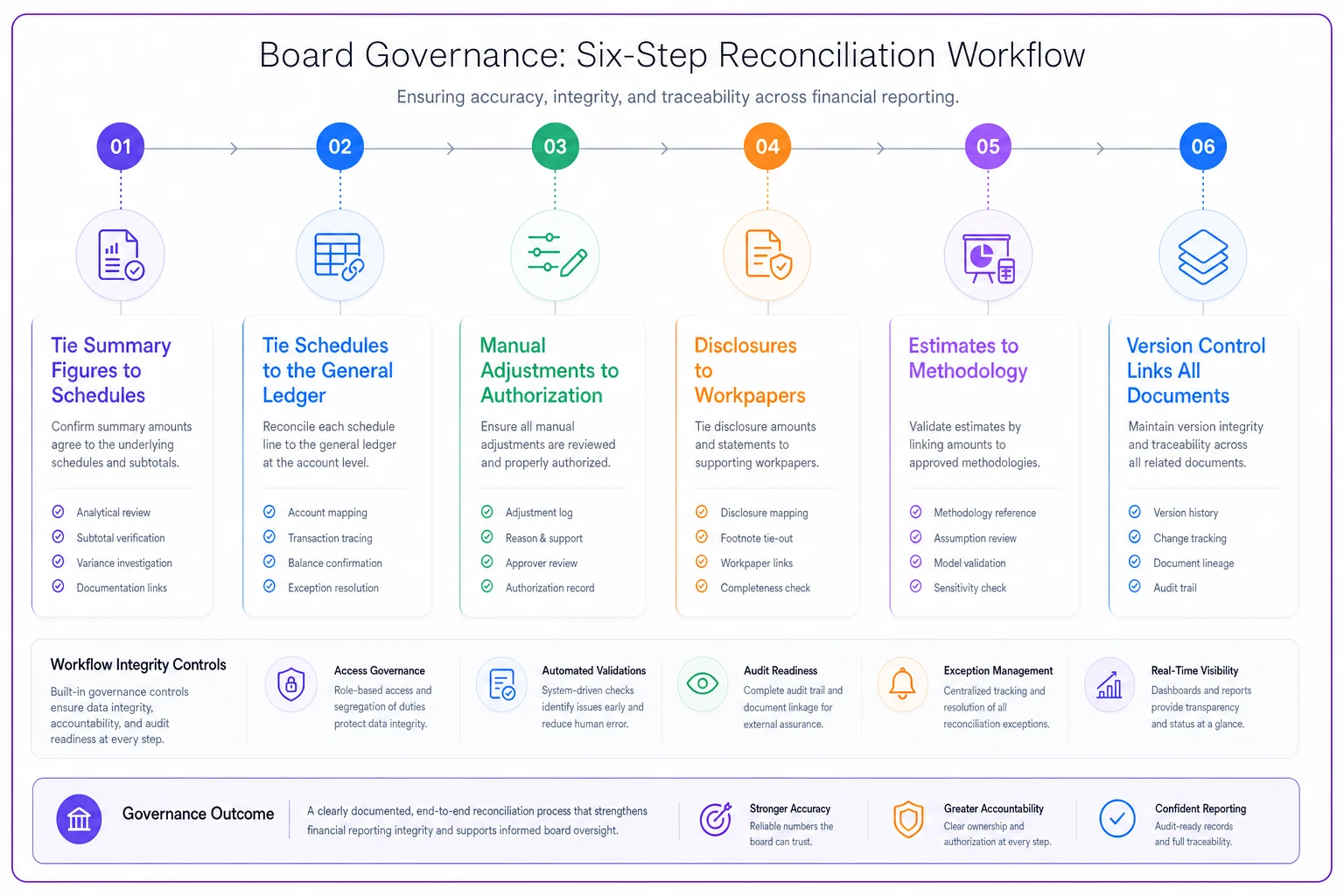
This diagram illustrates the sequence and highlights why step six is critical.
Step six is where most packs quietly fail. The narrative was written Monday off draft numbers, the schedule was finalized Wednesday off revised numbers, and nobody re-read the narrative against the final schedule. It reconciles to nothing, and it looks perfect.
Signoff timing: the sequence matters as much as the signatures
A signoff that happens in the wrong order isn't evidence — it's decoration. Auditors and litigators both look at when a review happened relative to when the number was finalized. A reviewer who signed off before the final adjustment was booked didn't actually review the final number.
Require the preparer to timestamp and lock the exhibit before routing to reviewers to prevent post-signoff edits.
-
Preparer signoff locks the exhibit. After this point, changes require a new version and re-review, not an edit.
-
Independent reviewer signoff happens after the preparer locks, and confirms the reconciliation steps above. This can't be the same person who prepared it.
-
Controller/CFO signoff confirms the pack is internally consistent and complete, and happens after all exhibit-level reviews close.
-
Counsel signoff on disclosure language — where litigation or regulatory sensitivity exists — happens after the numbers are locked, never in parallel with number changes.
-
Auditor coordination point is scheduled before the committee meeting, not after, so open items are known going in rather than discovered live.
The mistake that comes up repeatedly: signoffs collected all at once, at the end, in a rush, with timestamps suggesting everyone reviewed a 90-page pack in the same eleven-minute window. That timing pattern is itself a red flag. Spread the signoffs across the actual review sequence and let the timestamps tell an honest story.
This is the same reason timing discipline matters for D&O claim readiness: the sequence of who knew what and when is the story that gets reconstructed if anything goes wrong. Build the timeline correctly the first time and there's nothing to reconstruct.
Mapping the pack to likely auditor requests
The best pre-packs are built backward from the auditor's likely questions. You already know most of them — they don't change dramatically quarter to quarter, and the sensitive areas are the sensitive areas.
-
New or unusual revenue arrangements → "Show me the contract, the performance obligations, and the allocation." Attach the extract and the allocation schedule.
-
Significant estimates (reserves, impairment, allowances) → "Walk me through the methodology and the sensitivity." Attach the estimate memo with inputs.
-
Manual or top-side adjustments → "Who authorized this and why." Attach the JE support with approver and date.
-
Going concern / liquidity → "What's the basis for the forecast." Attach the forecast, the assumptions, and the covenant analysis.
-
Related-party transactions → "How were terms determined." Attach the terms and the independence assessment.
-
Prior-period items or reclassifications → "Why did this change." Attach the before/after with the reason.
When the pack already answers these before the auditor asks, two things happen. The audit moves faster, and the committee's oversight looks — and is — genuinely diligent rather than reactive.
Minute language that evidences real committee oversight
The minutes are where oversight either gets documented or gets lost. Vague minutes — "the committee reviewed the financial statements and recommended approval" — prove nothing about whether the committee actually engaged with the hard areas.
-
"The committee discussed the $2.4M revenue adjustment for [contract type], reviewed the allocation methodology in Exhibit 4, and questioned management on the treatment of the amended terms. Management confirmed the allocation reflected the executed amendment dated [date]."
-
"The committee reviewed the going-concern assessment, including the covenant headroom analysis in Exhibit 7, and asked management to confirm the sensitivity assumptions. The committee was satisfied with the basis for the assessment."
-
"The committee noted the following open items with the external auditor and confirmed a follow-up date of [date]."
The pattern: name the issue, reference the exhibit, record the question asked, record the answer. That structure proves the committee didn't just receive the pack — it interrogated the parts that mattered. When a regulator or plaintiff later asks whether the committee exercised real oversight, minutes written this way answer the question on their own.
A real scenario: mid-market manufacturer, quarter-end pack
A mid-market manufacturer with roughly $180M in revenue ran quarter-end the usual way — a strong FP&A team assembling a clean pack, controllership stretched thin. Their audit packs looked excellent and consistently triggered a cluster of auditor follow-up requests, usually somewhere between twelve and fifteen open items per quarter, most of them "please provide the support for X."
Each round of follow-up cost the finance team roughly a week of scramble, and twice in two years those scrambles surfaced a version mismatch serious enough to require a correcting entry before the statements were filed. No restatement — but two close calls, and an auditor growing increasingly skeptical of the pack's reliability.
They introduced a pre-meeting QC gate: a required exhibit set, the six-step reconciliation, sequenced signoffs, and a disclosure-to-workpaper crosswalk built before the pack was finalized. The first quarter under the gate, auditor follow-up requests dropped to around five, all of them substantive rather than "where's the support." By the third quarter the version-mismatch problem had effectively disappeared, because the crosswalk forced the narrative and schedule to reference the same locked version.
The pack didn't get longer. It got sourced. That was the whole difference.
The QC checklist to run before the pack is finalized
Run this before anything reaches the audit committee. If any item fails, the pack isn't ready.
-
Every summary figure ties to a supporting schedule
-
Every schedule ties to the GL/trial balance as of the reporting date
-
Every manual adjustment above threshold has a memo, an approver, and a date preceding close signoff
-
Every disclosure claim maps to a specific workpaper reference (crosswalk complete)
-
Every estimate has a methodology memo showing inputs and assumptions
-
Narrative, schedules, and memos all reference the same data version
-
Preparer signoff locked before reviewer signoff
-
Independent reviewer is not the preparer
-
Counsel signoff on sensitive disclosure language occurred after numbers locked
-
Signoff timestamps reflect the actual review sequence, not a single end-of-process batch
-
Each high-risk area has its likely auditor request already answered with attached support
-
Contract and agreement extracts reflect the most recent executed amendment
-
Open auditor items listed with a scheduled follow-up date
-
Draft minute language names each sensitive judgment, references its exhibit, and records the question and answer
If any item fails, the pack isn't ready.
When a formal QC gate is worth it — and when it's overkill
A full forensic pre-pack process makes sense when you have complex judgments, recent system or personnel changes, prior audit findings, or any heightened regulatory or litigation exposure. If your quarter-end involves meaningful estimates, unusual transactions, or a new disclosure area, the gate pays for itself the first time it catches a version mismatch.
It's less necessary for a small, stable company with simple, repetitive accounting and a controller who genuinely owns the full reconciliation chain end to end. If one person can honestly reconcile the entire pack and produce every workpaper on demand, a heavy gate adds process without adding much protection. The real risk there is assuming that person will always be around — which is exactly when even a lightweight version of the gate becomes cheap insurance.
Where a formal gate becomes actively counterproductive is when it's treated as pure checkbox theater — signoffs collected without real review, a crosswalk that points to workpapers nobody updated. A gate followed mechanically is worse than no gate, because it manufactures the appearance of diligence without the substance, and that gap is precisely what gets exposed under scrutiny.
Keeping the evidence chain intact without living in spreadsheets
The practical challenge is that most of this — exhibit management, version control, signoff sequencing, the disclosure crosswalk — gets held together manually, and manual chains break under deadline pressure. The reconciliation was fine until someone edited the schedule after the reviewer signed and forgot to reset the signoff.
This is where a governance and board-records platform earns its place: keeping every exhibit versioned, timestamping signoffs in their actual sequence, holding the disclosure-to-workpaper crosswalk in one place, and preserving the whole pack as a locked, searchable record after the meeting. The value isn't automation for its own sake — it's that the evidence chain stays intact even when the quarter-end is chaotic, because the system maintains the sequence the humans are too busy to track. When the auditor asks or the regulator inquires two years later, the pack that gets pulled is the exact pack the committee reviewed, with every exhibit and signoff exactly as they stood.
The goal is straightforward: make the pack that reaches the audit committee something that can survive being pulled apart. A forensic pre-pack QC gate doesn't make the accounting harder — it makes the accounting provable. And provable is the entire difference between a follow-up question and a restatement.
Ready to enhance your board's productivity?
Join 500+ organizations using Panlly to save time, improve governance, and streamline board operations.