

The dangerous whistleblower report is rarely the one that arrives with a lawyer's letterhead. It's the one that comes in as a two-line email to a general manager, gets forwarded twice, discussed casually in a hallway, and by the time it reaches anyone with authority, three people already know the complainant's identity and someone has "just checked" the accounting system to see if the allegation holds water. That casual checking is often the exact moment the investigation becomes indefensible.
This article deals with a narrow problem: how a report moves from the moment it lands to the moment the board decides whether it deserves board attention — and how each step either preserves or destroys your ability to defend the decisions later. Most organizations have a hotline. Very few have a defensible pipeline behind it.
Where the intake actually breaks
Intake failures don't usually look like failures. They look like helpfulness. Someone receives a concern, wants to be responsive, and immediately starts acting on it. That instinct is exactly what corrupts the chain.
Three breakdowns show up consistently.
The first is identity leakage at intake. A report comes in through email or a manager conversation, and the complainant's name, department, or role gets captured in a way that spreads. Once four people can reasonably guess who raised the concern, retaliation risk becomes a live legal exposure — regardless of whether retaliation actually happens.
The second is premature substantiation. Whoever receives the report pulls a file, checks a transaction, or asks a "quick question" to confirm the allegation before anyone has decided who should be investigating or whether the subject of the complaint has access to that same data. This tends to happen when the receiver is operationally senior but has no investigation training. They treat it like a problem to solve rather than a matter to preserve.
The third is the routing gap. The report ends up with someone who is either implicated, adjacent to the implicated party, or simply not authorized to see it. A finance complaint landing on the CFO's desk when the allegation touches finance leadership is the version that comes up most often.
A defensible pipeline assumes that any given report might be true, might involve someone senior, and might end up in front of a regulator or a court. If your intake process only works well for reports that turn out to be nothing, it isn't really a process.
Stage one: an intake form that anonymizes by design
The intake mechanism needs to do two contradictory things at once — capture enough detail to act on, while structurally limiting who can connect that detail back to a specific person.
Eliminate boardroom chaos with seamless coordination.
Panlly simplifies scheduling, collaboration, and follow-ups for every board meeting.
- Centralized meeting scheduling
- Secure document sharing
- Task assignment & tracking
No credit card required
A workable intake form separates the report into layers:
-
The allegation layer — what happened, when, where, which systems or accounts or people are involved (by role where possible, not name).
-
The identity layer — who is reporting, captured separately and access-restricted, ideally optional.
-
The routing metadata — category (financial, HR, safety, data, conflict of interest), business unit, and a system-generated case ID that becomes the only reference used in downstream discussion.
The anonymization check is the part people skip. Before a report moves anywhere, someone — or a system rule — should screen the allegation text for details that de-anonymize the reporter even when the name has been stripped. "I'm the only one who processes the Tuesday reconciliations and I saw…" identifies a person as clearly as a signature. Anonymized intake that ignores contextual identifiers is theater.
A practical anonymization checklist at intake:
-
Name, initials, and direct contact details moved to the restricted identity layer
-
Job title replaced with function unless the title is unique
-
Self-identifying phrasing flagged ("as the only person who…", "in my 20 years here…")
-
Small-team situations flagged where category plus business unit narrows the reporter to two or three people
-
Any attachment scanned for embedded metadata that reveals authorship
The pattern worth noticing: organizations obsess over the channel being anonymous and largely ignore whether the content is. The channel is the easy 20%.
Stage two: the counsel-trigger matrix
The single most consequential early decision is whether the matter is handled under privilege from the start. Get this wrong and you either waste privilege on trivial concerns or — far worse — build the entire early record of a serious matter in discoverable emails.
The most common mistake is treating this as binary: either "call the lawyers" or "handle it internally." That framing pushes people to under-escalate, because involving counsel feels like a big step. What actually works is a matrix that maps allegation characteristics to a specific counsel response, so no one has to make a judgment call under pressure.
| Allegation characteristic | Counsel involvement | Privilege posture |
|---|---|---|
| Minor policy/process issue, no senior involvement | None at intake; internal handling | Standard internal handling |
| Financial misstatement or accounting concern | Counsel notified within 48 hrs | Investigation privileged from start |
| Alleged misconduct by an officer or director | External counsel engaged before any interviews | Privileged; work product protection sought |
| Regulatory, bribery, sanctions, or data-breach exposure | External counsel + likely regulator-notification analysis | Privileged; preservation hold immediate |
| Retaliation claim tied to a prior report | Counsel review of both matters | Privileged; conflict screen on original handlers |
The value of a matrix isn't that it removes judgment. It converts a scary discretionary decision into a defensible rules-based one. When a regulator later asks why you did or didn't bring counsel in, "we followed our documented trigger matrix and this fell into category X" is a far stronger answer than "it didn't feel serious at the time."
For the mechanics of how counsel triggers, evidence preservation, and internal notices fit together once an external body gets involved, the workflow overlaps heavily with what we covered in the board playbook for handling regulator inquiries — the intake matrix feeds directly into that process upstream.
Stage three: evidence preservation before anyone investigates
Almost everyone gets the ordering backwards. People want to investigate first and preserve as they go. Preservation has to come before investigation, because the act of investigating changes systems — access logs get created, files get opened, someone gets tipped off.
The moment a report crosses a preservation trigger (anything in the financial, officer-misconduct, or regulatory rows above), a small set of steps should fire immediately and in sequence:
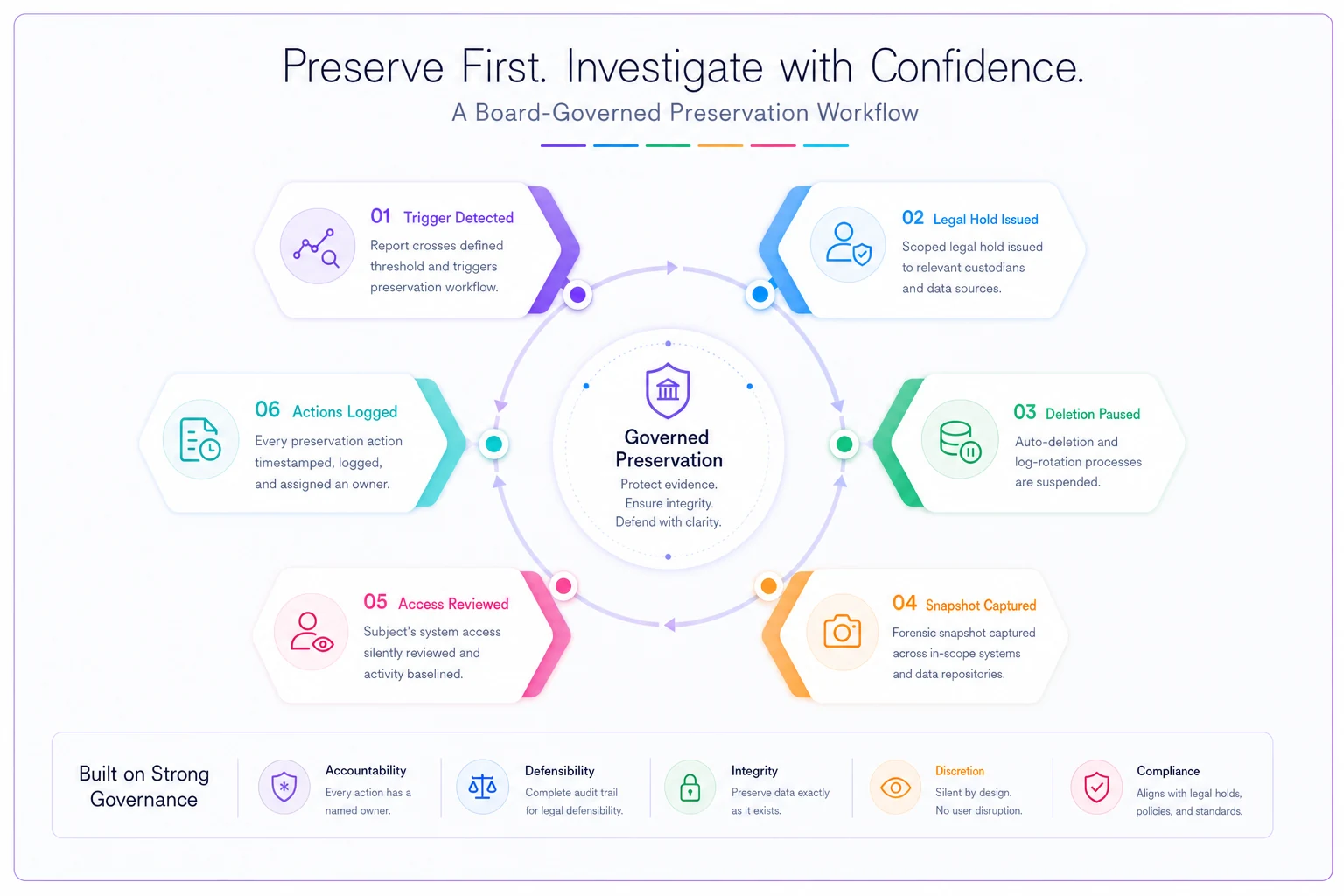
> Preservation workflow: Report crosses trigger threshold → Scoped legal hold issued to relevant custodians → Auto-deletion and log-rotation suspended → Forensic snapshot captured → Subject's system access quietly reviewed → Every action timestamped and logged with owner assigned
A simple visual of this preservation workflow.
-
Issue a scoped legal hold. Identify custodians and systems tied to the allegation — not a company-wide hold that alerts everyone, but a targeted one. Document who received it and when.
-
Suspend auto-deletion. Email retention rules, chat purges, log rotation, and CCTV overwrite cycles are the silent evidence killers. Log-overwrite windows are often just 30 to 90 days, which is shorter than most investigations run.
-
Snapshot, don't touch. Capture the relevant systems in a forensically sound way rather than browsing them live. Every file you open leaves a trace that a defense lawyer will later argue was tampering.
-
Control access to the subject's own data. If the allegation involves someone who administers the very systems holding the evidence, their access needs quiet review — before they know a report exists.
-
Log every preservation action with a timestamp and an owner. This log is the spine of your defensibility.
That last point connects directly to minute-taking discipline. The habits that make preservation defensible in an investigation are the same ones that protect directors later, which is why the evidence-preservation minute practices used to prepare for D&O claims are worth aligning your investigation log against from day one — same standard, same rigor.
Preservation failures are almost never malicious. They happen because nobody owns the calendar. The CCTV overwrites on day 31 because it always overwrites on day 31, and no one flipped the switch. Ownership, not intent, is the variable.
Stage four: the investigation brief the board actually needs
Boards get two bad versions of investigation reporting. One is the raw data dump — 40 pages of interview notes directors can't realistically process. The other is the over-sanitized summary that buries facts management finds inconvenient. Neither is defensible, and neither helps the board discharge its oversight duty.
A board investigation brief should be short, structured, and consistent across every matter so directors learn to read it quickly. A workable template:
-
Case ID and category — no reporter identity, ever, in the board brief
-
Allegation summary — the concern in three or four sentences, stated as allegation, not finding
-
Counsel status — who is engaged, privilege posture, external vs internal
-
Preservation status — holds issued, custodians identified, any preservation gaps or risks
-
Investigation status — steps taken, steps outstanding, expected timeline
-
Preliminary risk assessment — financial exposure range, regulatory exposure, reputational exposure
-
What the board is being asked to do — note only, decide something specific, or approve a resource or counsel expansion
-
What the board is explicitly not yet being told — because it's unverified
That last field is unusual, and it's the one that earns the most trust. Stating plainly what remains unverified stops the board from acting on soft facts and creates a clean record that management didn't oversell the situation.
The consistency matters more than people expect. When every brief follows the same structure, a director can spot the anomaly — the matter where "preservation status" is suspiciously blank, or where "what the board is being asked to do" jumps from note-only to approve-a-settlement without an intermediate step.
Stage five: the board-triage rubric
Not every substantiated concern belongs in front of the board, and not every trivial-sounding one can be safely kept away. Over-escalation buries the board in operational noise and, ironically, weakens oversight because directors stop reading carefully. Under-escalation is how a board ends up learning about a material matter from a regulator instead of its own management.
-
Seniority of the subject — the more senior, the higher the escalation, regardless of dollar amount. A small fraud by a director is a board matter; a larger one by a junior clerk may not be.
-
Financial materiality — against a defined threshold, not a vibe.
-
Regulatory or legal exposure — anything touching disclosure, sanctions, safety, or data breach escalates.
-
Systemic vs isolated — a one-off error differs meaningfully from a pattern that implies a control failure.
-
Retaliation or cover-up indicators — these escalate hard, because the second problem is often worse than the first.
When a matter should rise to the board
-
The subject is an officer, director, or someone who reports directly to the CEO
-
Financial exposure crosses the defined materiality threshold
-
There's a plausible regulatory notification obligation
-
The allegation implies a failure of a control the board relies on
-
Media, regulator, or litigation attention is reasonably foreseeable
When it should stay at management level
Isolated, low-value, no senior involvement, and no regulatory angle — with a periodic aggregate report to the audit committee so the board still sees the pattern of small matters even when no single one rises
The audit-committee aggregate report is what most rubrics miss. Twelve individually trivial expense complaints in one department is not twelve trivial matters — it's one governance signal. A triage rubric that only evaluates matters one at a time will never surface it.
A realistic scenario
A mid-sized manufacturing company — roughly 600 employees, one internal auditor, no dedicated investigation function — received an anonymous report alleging a plant manager was approving inflated invoices from a vendor. It came in as an email to the head of HR.
Under the old handling, HR forwarded it to the ops director, who happened to golf with the plant manager, who "asked around." Within about a week the complaint was effectively dead, the reporter had been informally identified, and roughly $180k in questionable invoices kept flowing for another two quarters before an external audit caught it. The cleanup — forensic accounting, external counsel, a retaliation claim from the original reporter who'd been quietly sidelined — ran well into six figures and consumed most of an audit committee's year.
After they rebuilt the pipeline, a structurally similar report the following year ran differently. Intake stripped identity and flagged the vendor-approval category, which hit the financial trigger. Counsel was engaged inside two days. A scoped hold froze the vendor files and approval logs before anyone spoke to the plant manager. The board brief reached the audit committee in about three weeks with a clean preservation log and a defined exposure range. The matter was still serious — but it was contained, and every decision the board made was documented against the rubric.
The difference wasn't better people. The ops director was the same person. The difference was that the pipeline no longer depended on him making the right call in the hallway.
Who should be careful with this
A full counsel-trigger matrix and forensic preservation protocol is overkill for a ten-person company where the board is the founders. If your "board" is three people who see every transaction, a heavyweight triage rubric adds ceremony without protection. What that organization needs is just the intake anonymization and a single clear rule about when to call an outside lawyer.
The organizations that genuinely need the full pipeline are ones where there's real distance between where reports originate and where decisions get made — enough layers that a concern can get quietly redirected, and enough at stake that a mishandled report becomes a governance failure rather than an inconvenience.
Where tooling fits — and where it doesn't
Most of what makes this pipeline defensible is discipline, not software. That said, a few points genuinely benefit from a system rather than a spreadsheet: enforcing the identity-allegation separation at intake so nobody can casually see the reporter, timestamping preservation actions in a log that can't be quietly backdated, and generating consistent board briefs that follow the same structure every time.
Board and governance platforms that handle secure intake, immutable logging, and templated reporting remove the failure modes that come from things living in individual inboxes. The value isn't automation for its own sake — it's removing the hallway conversation and the untracked deletion as options. The judgment calls still belong to people.
The one thing to fix first
If you change nothing else, separate identity from allegation at the moment of intake and put a documented counsel-trigger matrix behind the categories. Those two moves prevent the two most expensive failures — retaliation exposure and un-privileged early records — and they cost almost nothing to implement.
The full rubric, the preservation choreography, the board-brief template all build on top of those two foundations. A pipeline that gets the first thirty minutes right survives almost everything that comes after it.
If you change nothing else, separate identity from allegation at the moment of intake and put a documented counsel-trigger matrix behind the categories. Those two moves prevent the two most expensive failures — retaliation exposure and un-privileged early records — and they cost almost nothing to implement.
Ready to enhance your board's productivity?
Join 500+ organizations using Panlly to save time, improve governance, and streamline board operations.