
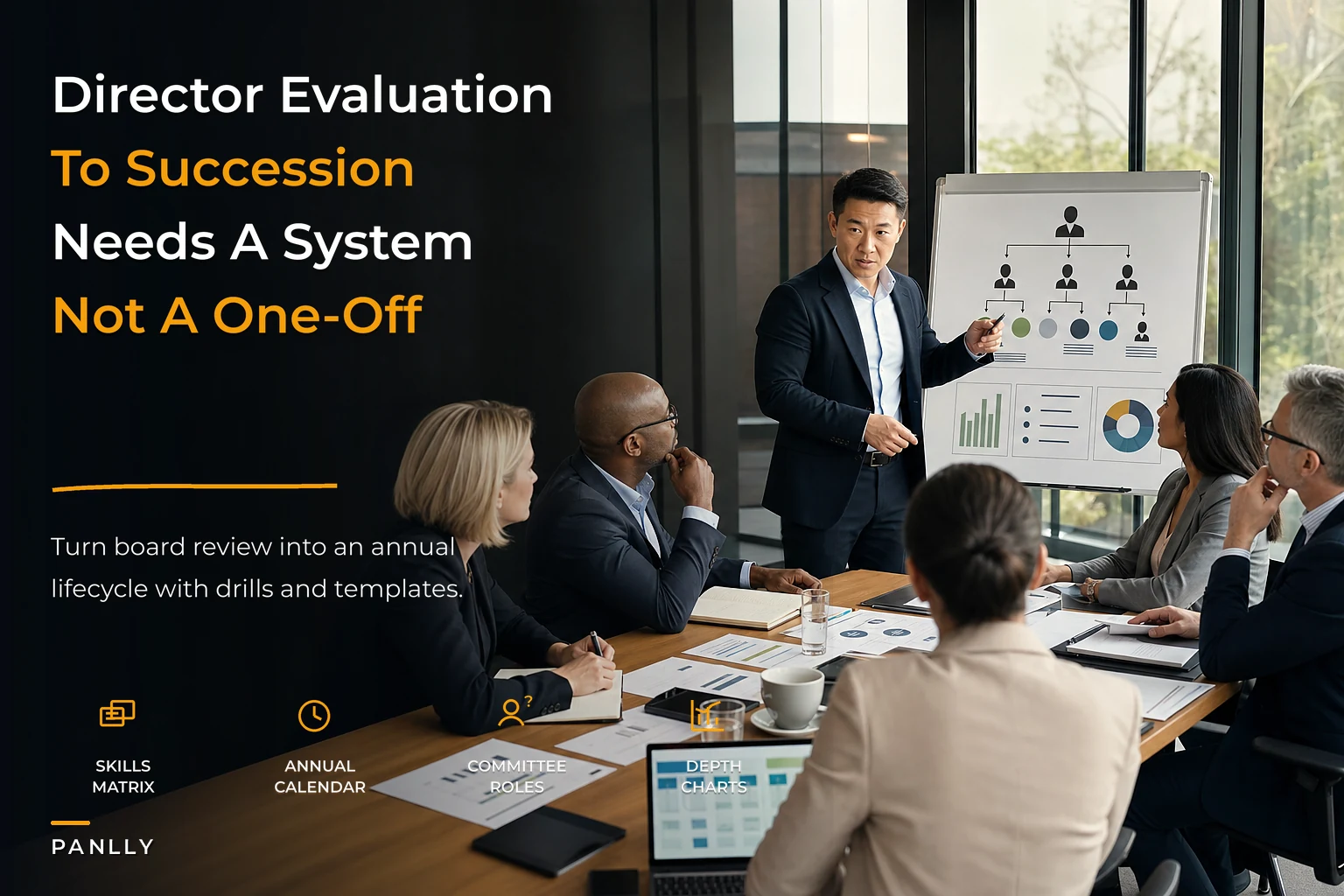

Most boards treat director evaluation and succession as separate, disconnected events. Annual skills assessments sit in one spreadsheet. Performance feedback lives in email threads. Development plans scatter across committee notes. Succession scenarios exist only in the Nom/Gov chair's head. Then a director unexpectedly resigns or a critical skill gap surfaces during a crisis, and suddenly the board is scrambling to piece together who can fill what role.
The pattern is predictable. Boards that connect skills mapping, evaluations, development planning, and succession exercises into one integrated program make better renewal decisions and handle transitions far more smoothly. Those that treat each piece separately end up with capability gaps, rushed appointments, and boards that slowly drift from the expertise the business actually needs.
Why Boards Fail at Systematic Director Management
Board composition management breaks down for structural reasons, not because directors don't care about governance. The typical board runs maybe eight formal meetings a year. Directors juggle multiple boards plus their primary careers. The corporate secretary manages dozens of other governance tasks. Without an integrated system, director lifecycle management becomes a series of reactive decisions.
Think about what actually happens at a mid-size public company. The annual evaluation runs in Q4 — usually a basic survey about meeting effectiveness and committee performance. Results get summarized in a board deck, discussed for twenty minutes, then filed away. Six months later, during renewal discussions, nobody remembers the specific feedback. The skills matrix hasn't been updated since the IPO. Development conversations happen informally, if at all.
The real breakdown shows up when succession becomes urgent. A director announces retirement with ninety days' notice. The Nom/Gov committee suddenly needs someone with audit committee financial expertise, international market experience, and cybersecurity knowledge. They scramble through networks, engage a search firm, and still end up compromising on skill requirements because they're searching reactively instead of building bench strength systematically.
Connecting Skills Assessment to Actual Board Needs
An effective board succession planning framework starts with dynamic skills mapping that reflects what the business actually needs — not generic governance competencies. Most boards use static matrices listing things like "financial expertise" or "industry experience." These tell you almost nothing about whether your board has the right capabilities for your specific strategic challenges.
Eliminate boardroom chaos with seamless coordination.
Panlly simplifies scheduling, collaboration, and follow-ups for every board meeting.
- Centralized meeting scheduling
- Secure document sharing
- Task assignment & tracking
No credit card required
A properly structured skills framework maps director capabilities against three horizons: current operations, strategic initiatives over the next 18–24 months, and emerging risks that could materialize in years three through five. This creates a living document that drives real decisions rather than a compliance checkbox.
Quarterly capability review process:
-
Strategy team identifies top five operational priorities for the next six quarters
-
Risk committee defines emerging threat vectors requiring board expertise
-
CEO and board chair translate these into specific capability requirements
-
Individual directors complete detailed skills assessments (not just yes/no checkboxes)
-
Committee chairs validate assessments based on observed contributions
-
Gaps get mapped to specific development plans or recruitment priorities
The assessment itself needs granularity. Instead of asking "Do you have M&A experience?" you ask "How many transactions have you overseen as a board member? What was your specific role? Deal size? Which industries? Any cross-border complexity?" That level of detail actually matters when you need to staff a special committee for a major acquisition.
Building Evaluation Instruments That Drive Improvement
Traditional board evaluations ask the wrong questions and happen too infrequently to drive meaningful change. Annual surveys about "board culture" and "management communication" produce vague feedback that nobody acts on. The same issues resurface the next cycle because there was no systematic remediation in between.
Continuous performance tracking: Every board and committee meeting includes a five-minute effectiveness check. Three questions: What worked well today? What slowed us down? What do we need differently next time? Responses get logged, creating a pattern database over time.
Quarterly committee assessments: Each committee chair conducts structured reviews with members individually. These focus on specific contributions, preparation quality, and expertise gaps relative to the committee's workload. The output feeds directly into development planning.
Semi-annual peer feedback: Directors evaluate each other on specific behavioral dimensions — preparation, contribution quality, collaborative approach, judgment demonstrated under pressure. This happens through structured interviews, not anonymous surveys, because real feedback requires context.
Annual strategic alignment review: The full evaluation examines whether the board's collective capabilities, time allocation, and focus areas align with enterprise strategy. This drives decisions about committee restructuring, meeting cadence changes, and recruitment priorities.
The key difference from typical evaluations: every assessment links to specific remediation actions with accountability and timelines. When a director consistently shows up underprepared, it triggers a documented conversation with the board chair within 30 days — not vague disappointment that festers until renewal discussions.
Creating Remediation Systems That Actually Work
When evaluations identify performance gaps, most boards handle it through informal conversations that accomplish very little. The director continues the problematic behavior, other directors grow frustrated, and eventually everyone waits for the term to expire rather than address anything directly.
The remediation framework structure:
Level 1 — Coaching intervention (triggered by single evaluation flag)
-
Board chair schedules one-on-one within 14 days
-
Specific behaviors discussed with examples
-
Written development plan created with 90-day milestones
-
Resources provided (training, mentoring, materials)
Level 2 — Formal performance plan (triggered by repeated issues)
-
Written notice documenting specific deficiencies
-
Measurable improvement targets with timelines
-
Monthly check-ins with board chair or lead director
-
Potential committee reassignment to better match skills
Level 3 — Transition planning (triggered by failure to improve)
-
Governance committee formally reviews the situation
-
Options presented
voluntary resignation, non-renewal, or removal
-
Succession planning accelerated for that seat
-
Legal counsel engaged to ensure proper process
Document 90-day milestones clearly and share them with the director to align expectations and avoid ambiguity.
This graduated approach works because it treats performance issues operationally rather than personally. Directors understand the process, see the documentation, and usually self-correct at Level 1. When they don't, you have the paper trail needed to make tough calls without creating liability.
Budgeting for Director Development Beyond Conferences
Most boards allocate nothing for director development beyond conference attendance and maybe a governance publication subscription. This underinvestment shows when complex issues arise and directors lack the specialized knowledge to provide meaningful oversight.
Baseline education (annual per director):
-
Industry conferences and governance forums
$3,500–5,000
-
Professional certifications and courses
$2,000–3,500
-
Subscriptions and research services
$1,500–2,500
Targeted skill building (as needed):
-
Executive education programs
$8,000–15,000 per program
-
Technical training (cyber, AI, ESG)
$5,000–10,000 per director
-
One-on-one coaching for new chairs
$25,000–40,000 annually
Collective board development:
-
Annual board retreat with facilitator
$35,000–50,000
-
Quarterly education sessions with experts
$10,000–15,000 per session
-
Board effectiveness consultant
$75,000–125,000 for a comprehensive program
Emergency response training:
-
Crisis simulation exercises
$25,000–40,000
-
Cyber incident tabletops
$15,000–25,000
-
Succession planning scenarios
$20,000–30,000
A typical mid-cap company should budget somewhere around $350,000–500,000 annually for comprehensive director development. That sounds significant until you compare it to the cost of poor board decisions or the disruption from an unprepared director transition.
The budget also needs allocation protocols. Individual directors get baseline allowances they can direct toward approved programs. Committees receive dedicated funds for specialized training. The board chair controls a discretionary pool for emerging needs. This structure ensures development happens systematically rather than sporadically.
Implementing Staged Succession Scenarios
Succession planning fails when boards treat it as a theoretical exercise rather than an operational drill. Names-in-boxes charts provide false comfort. When actual succession events occur, those theoretical plans rarely hold up because they haven't been stress-tested against anything real.
Quarterly succession scenarios to run:
-
Scenario 1
Sudden departure drill Select one director at random (notify them privately first). Run a committee meeting assuming they're unavailable. How does committee composition change? Who covers their expertise? What board decisions need deferral? This reveals single points of failure quickly.
-
Scenario 2
Graduated transition exercise Simulate a planned six-month transition for your audit committee chair. Map knowledge transfer requirements, overlap periods, and capability development for the successor. Document what institutional knowledge needs capturing before they leave.
-
Scenario 3
Multiple departure stress test Remove your two longest-tenured directors from the skills matrix. Examine how board dynamics shift, what expertise gaps emerge, and whether remaining directors can cover essential committees. This tests true succession depth.
-
Scenario 4
Emergency leadership cascade Practice the communication and decision protocol if your board chair and CEO become simultaneously unavailable. Who leads the board meeting? How do committees maintain oversight? What gets delegated versus deferred?
Each drill produces specific outputs: updated succession depth charts, identified development priorities, refined emergency protocols, and documented handoff procedures. The board decision log captures lessons learned from each exercise, building institutional memory about what actually works.
A simple workflow for running these drills looks like this:
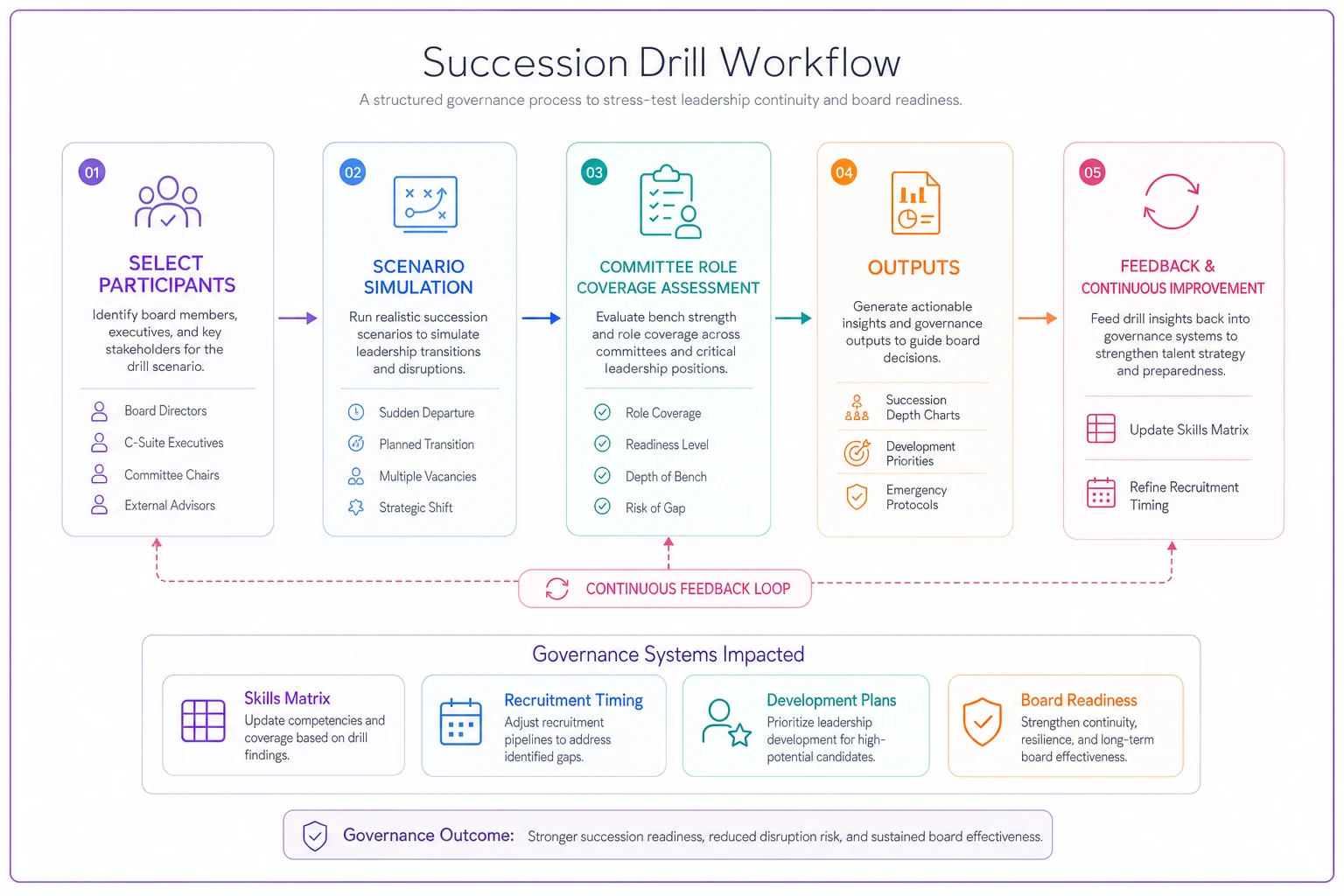
These scenarios also inform recruitment timing. When drills consistently expose cyber expertise gaps, you accelerate recruiting for that capability rather than waiting for an actual departure to force the issue.
Annual Calendar Integration for Lifecycle Management
Director lifecycle management falls apart without calendar integration that makes it automatic rather than episodic. The typical board remembers to do evaluations when renewal decisions loom, rushes through skills assessments when recruiting, and ignores development until someone complains.
Q1 — Strategic alignment phase:
-
Skills matrix update based on strategic plan refresh
-
Development budget allocation for fiscal year
-
Committee succession scenarios for upcoming AGM
Q2 — Performance review phase:
-
Formal evaluation process launch
-
Individual director feedback sessions
-
Remediation plans initiated where needed
Q3 — Development execution phase:
-
Director education programs based on evaluation findings
-
Succession drills for critical roles
-
Recruitment pipeline development for anticipated gaps
Q4 — Renewal planning phase:
-
Succession readiness assessment
-
Director renewal recommendations
-
Onboarding preparation for incoming directors
This calendar integration extends beyond quarterly markers. Monthly governance meetings include standing agenda items: a ten-minute skills gap review, development program updates, succession scenario planning. Committee meetings build in capability assessments specific to their mandate.
The corporate secretary maintains a director lifecycle dashboard tracking the following metrics:
| Metric | Tracking Frequency |
|---|---|
| Days until each director term expires | Continuous |
| Completion rates for mandatory training | Monthly |
| Performance improvement plan milestones | Monthly |
| Succession depth by critical capability | Quarterly |
| Development budget utilization by category | Quarterly |
When these metrics integrate with regular board reporting, lifecycle management becomes operational rather than administrative. Directors see their development paths, understand succession expectations, and engage proactively.
Templates That Make the Framework Operational
Without templates, even well-designed lifecycle frameworks devolve into inconsistent execution. Every evaluation uses different questions. Skills assessments capture different data. Succession plans follow different formats. That inconsistency prevents meaningful tracking and comparison over time.
Essential templates for lifecycle management:
Skills Assessment Matrix V2
-
75 specific capabilities across 8 categories
-
5-point proficiency scale with behavioral anchors
-
Current state vs. required state mapping
-
Individual and collective gap analysis
-
Auto-calculation of succession coverage ratios
Director Development Plan Template
-
Specific capability gaps from assessment
-
Targeted programs with costs and timelines
-
Success metrics and evaluation criteria
-
Budget approval workflow
-
Progress tracking with quarterly updates
Succession Readiness Scorecard
-
Role-specific requirements definition
-
Internal candidates with readiness ratings
-
External pipeline with contact status
-
Development actions to improve readiness
-
Timeline for succession execution
Performance Improvement Protocol
-
Triggering event documentation
-
Specific behavioral expectations
-
Measurable improvement targets
-
Support resources and timeline
-
Escalation triggers and process
Evaluation Interview Guide
-
Structured questions by stakeholder type
-
Behavioral example prompts
-
Rating scales with descriptions
-
Comment capture fields
-
Action item extraction
These templates need version control and regular updates based on usage. What seems comprehensive in design often misses critical elements in practice. The evaluation guide that worked for a stable board may need adjustment when integrating multiple new directors at once.
Technology Infrastructure for Lifecycle Tracking
Manual lifecycle management using spreadsheets breaks down as board composition becomes more complex. You can't reliably track multi-year development paths, map succession scenarios, and maintain evaluation history without proper systems.
Core governance platform capabilities:
-
Director database with skills, experience, and evaluation history
-
Automated evaluation distribution and collection
-
Development program tracking with budget integration
-
Succession planning with scenario modeling
-
Document management for all lifecycle artifacts
AI automation enhancements:
-
Natural language processing of evaluation comments to identify themes
-
Predictive modeling of succession risks based on director demographics
-
Intelligent matching of development programs to capability gaps
-
Automated reporting of lifecycle metrics and trends
-
Early warning systems for performance or attendance issues
Integration requirements:
-
Calendar systems for automated scheduling
-
Learning management systems for training tracking
-
Financial systems for budget monitoring
-
Communication platforms for stakeholder updates
-
Document repositories for centralized access
The AI-assisted features within these platforms handle routine coordination that previously consumed significant administrative time — tracking training completion, flagging evaluation deadlines, identifying succession risks, and generating the reports that help boards make informed decisions about composition and development. Done right, this transforms lifecycle management from a compliance exercise into an actual strategic capability.
Measuring Lifecycle Program Effectiveness
Without measurement, director lifecycle programs become expensive overhead rather than value drivers. You need metrics that demonstrate both compliance success and strategic impact, tracked consistently enough to show meaningful trends.
Operational metrics to track quarterly:
-
Evaluation completion rates and timing
-
Development budget utilization by category
-
Succession coverage ratio for critical skills
-
Performance improvement plan success rates
-
Director preparedness scores from meeting assessments
Strategic metrics to track annually:
-
Alignment between board capabilities and enterprise strategy
-
Time to fill director vacancies
-
Cost per successful director placement
-
Retention rates for high-performing directors
-
Diversity progression across multiple dimensions
Risk metrics requiring continuous monitoring:
-
Single points of failure in succession planning
-
Skills gaps for emerging risk areas
-
Director overboarding impact on performance
-
Related party transaction complexity
-
Independence degradation over tenure
The measurement framework needs both leading and lagging indicators. Lagging indicators like successful successions tell you what happened. Leading indicators like succession drill performance predict future success. Together, they help boards adjust their lifecycle programs before problems become acute.
These metrics feed into regular board reporting through dashboards that visualize trends and surface concerns. When succession coverage drops below threshold levels, the system alerts the Nom/Gov committee. When development budgets sit unspent, it triggers a review of program relevance.
Common Implementation Failures
Even well-designed lifecycle programs fail during implementation for predictable reasons.
The "set and forget" failure: Boards spend months designing comprehensive frameworks, then assume they'll run automatically. Without dedicated ownership and regular review, these programs atrophy quickly. Evaluations get delayed, development gets deprioritized, and succession planning becomes theoretical again.
The "one-size-fits-all" failure: Applying the same evaluation criteria and development approach to every director ignores the reality that different roles require different capabilities. The audit committee chair needs deep technical knowledge. The compensation committee chair needs market awareness. New directors need foundational grounding. Seasoned directors need emerging risk education. These aren't interchangeable.
The "all stick, no carrot" failure: When lifecycle programs focus entirely on evaluation and remediation without meaningful development opportunities, directors disengage. They view the process as punitive rather than supportive, leading to minimal participation and defensive responses.
The "perfection paralysis" failure: Some boards spend years designing the ideal lifecycle framework without implementing anything. They debate evaluation questions endlessly, wordsmith templates repeatedly, and delay launch until everything is perfect. Meanwhile, they have no systematic approach to managing director performance or succession at all.
The "technology without process" failure: Implementing an expensive governance platform without defining underlying processes wastes money and creates frustration. The technology becomes a digital filing cabinet rather than a system that drives better outcomes.
Making Succession Planning Truly Operational
The difference between theoretical succession planning and operational readiness shows up during actual transitions. Theoretical plans have names in boxes. Operational plans have tested handoff procedures, documented knowledge transfer requirements, and proven capability development paths.
Consider how an operationally mature board handles a planned director retirement. Eighteen months out, they initiate the transition protocol. The departing director begins documenting institutional knowledge — not just committee work, but relationship maps, negotiation history, and the unwritten norms that quietly guide decisions.
The identified successor shadows the departing director through a full annual cycle, observing committee leadership, stakeholder management, and how that person handles pressure. They progressively take on responsibilities: leading meeting segments, drafting committee reports, managing specific stakeholder relationships.
By the time the formal transition occurs, the new director already understands the role's nuances. Other board members have seen their capabilities directly. Stakeholders recognize them. The transition happens without drama because it was operational, not theoretical.
Achieving that level of succession maturity requires cultural acceptance that director roles are stewardship positions requiring active knowledge transfer — not personal positions held until retirement. It also requires identifying successors early enough to enable meaningful preparation.
The integration plan for new directors becomes far more effective when embedded in a comprehensive lifecycle framework. Instead of generic onboarding, new directors receive role-specific preparation based on their expected succession path.
Beyond Compliance to Strategic Value
When director lifecycle management works properly, it stops feeling like governance overhead and starts generating real strategic value. Boards make better decisions because directors have the right capabilities. Transitions happen smoothly because succession is operational. Development investments pay off through improved oversight.
The strategic value shows up in measurable ways. Companies with mature lifecycle programs tend to execute strategic pivots faster because their boards carry relevant expertise. They handle crises better because directors have trained on response scenarios. They attract stronger director candidates because the development commitment is visible.
This value extends beyond the boardroom. Investors increasingly evaluate board composition and refresh practices as governance quality signals. Regulators look for evidence of systematic succession planning. Proxy advisors factor board evaluation processes into voting recommendations.
The most sophisticated boards now treat lifecycle management as a competitive advantage — deeper bench strength, specialized expertise that develops ahead of market expectations, and the ability to handle transitions that would destabilize less prepared boards. That operational maturity in governance becomes a differentiator.
Moving Forward with Lifecycle Implementation
Building a comprehensive director lifecycle framework doesn't require getting everything right before you start. Boards that succeed tend to begin with basic components and evolve based on experience. Start with quarterly skills assessments. Add succession drills after six months. Integrate development planning once the foundation is solid.
The critical factor is making lifecycle management operational rather than theoretical — embedding it into regular governance workflows, measuring progress consistently, and adjusting based on what actually works. Use technology to automate routine tasks while preserving human judgment for strategic decisions.
Most importantly, treat director performance and succession as interconnected systems rather than isolated events. When evaluation informs development, development enables succession, and succession drives recruitment, the board builds governance capability that compounds over time.
The boards that handle the next decade well will be those that professionalize director lifecycle management now — before a succession gap or capability mismatch forces the issue at the worst possible moment.
Building a comprehensive director lifecycle framework doesn't require getting everything right before you start. Boards that succeed tend to begin with basic components and evolve based on experience. Start with quarterly skills assessments. Add succession drills after six months. Integrate development planning once the foundation is solid.
Ready to enhance your board's productivity?
Join 500+ organizations using Panlly to save time, improve governance, and streamline board operations.