

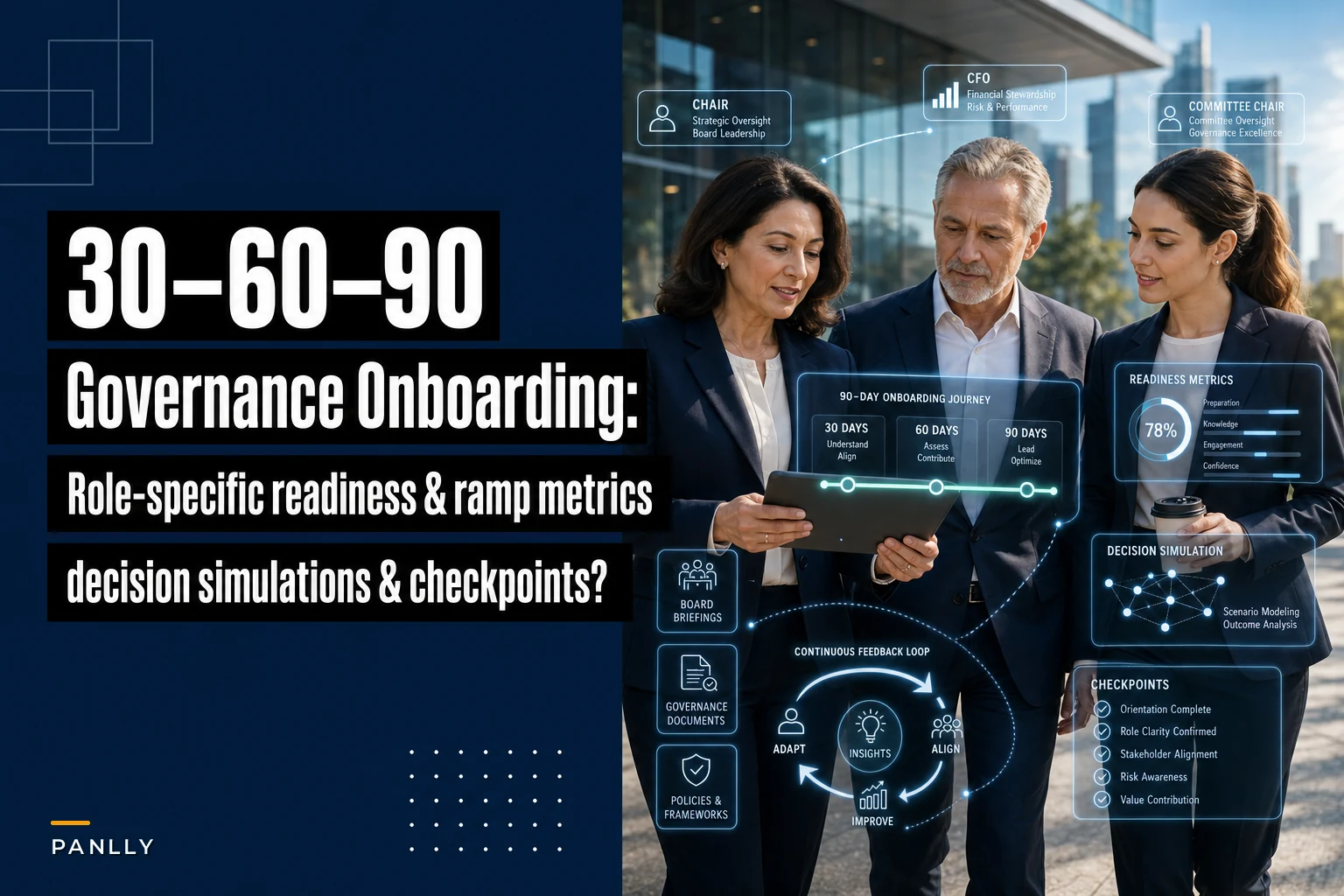

Most companies treat director onboarding like employee orientation — here's your binder, meet the team, good luck with your first vote next quarter. Then they wonder why new directors stay silent for six months, abstain from critical votes, or worse, approve something they don't fully understand because they're too embarrassed to ask questions after three months on the board.
The difference between a director who adds value immediately and one who takes a year to meaningfully contribute comes down to systematic knowledge transfer. Not the 400-page board manual nobody reads. Not the two-day orientation that covers everything and retains nothing. A structured progression that builds competence layer by layer, tied directly to the decisions they'll actually need to make.
Why Traditional Director Onboarding Creates Liability Instead of Leadership
The typical director onboarding goes something like this: Legal sends over governance documents. The corporate secretary schedules meetings with executives. IT sets up portal access. Everyone assumes the new director will somehow synthesize all of it into boardroom readiness.
Three months later, that director faces their first major acquisition vote. They've read the materials. Attended the committee meetings. But they don't know the company's acquisition history, the strategic rationale that failed last time, or why the CFO's projections might be optimistic based on past performance. So they either vote with the majority to avoid looking unprepared, or they ask basic questions that derail the discussion and frustrate seasoned directors.
This creates cascading problems. Unprepared directors slow down decision-making. They ask questions that should have been covered in onboarding, eating into board time. They miss red flags because they lack context. And in worst-case scenarios, they approve transactions they don't understand, creating personal liability and corporate risk.
The 30-Day Foundation: Context Before Content
The first 30 days should establish baseline understanding without overwhelming the new director. This isn't about reading every policy or meeting every executive. It's about understanding the business model, the competitive landscape, and the governance rhythm.
Eliminate boardroom chaos with seamless coordination.
Panlly simplifies scheduling, collaboration, and follow-ups for every board meeting.
- Centralized meeting scheduling
- Secure document sharing
- Task assignment & tracking
No credit card required
Week 1-2: Business Model Immersion Start with a two-page business model summary that explains how the company actually makes money. Not the investor deck version — the operational reality. Include margin structures, customer concentration, and cash flow patterns. Follow with three years of simplified financials showing trends, not minutiae. Schedule a 90-minute session with the CFO focused solely on understanding which numbers drive decisions. What does the board watch monthly? What triggers concern? What improvements would materially impact valuation?
Week 3-4: Governance Rhythm and Recent History Provide a decision log from the past 18 months showing what the board has approved, rejected, or sent back for revision. Include vote tallies and summary rationale. This gives new directors context for the types of decisions they'll face and insight into how the board actually thinks. Map out the committee structure with clear explanations of what each committee does versus what their charter says they do. Include which decisions flow through committees versus straight to the board, and typical timelines from proposal to approval. End the first 30 days with a structured conversation with the board chair about board dynamics, unwritten rules, and how decisions really get made. Which directors drive specific discussions? What topics generate the most debate? How does the board prefer to receive information?
Days 31-60: Committee Readiness and Decision Simulation
Month two shifts from learning to application. New directors should participate in committee meetings as observers first, then contributors. But observation without structure wastes time.
Committee Integration Framework Assign the new director to one committee officially, but have them observe all committees for one full cycle. Provide an observation guide focused on decision dynamics, not just content. How do committee members challenge management? What level of detail do they expect? How do they build consensus?
Before each committee meeting, provide a one-page preview covering:
-
The decision or discussion focus
-
Historical context on this issue
-
What questions the committee typically asks
-
What concerns usually surface
After each meeting, schedule a 15-minute debrief with the committee chair to discuss what happened versus what was expected. This accelerates pattern recognition and builds confidence for actual participation.
Decision Simulation Exercises Around day 45, run a decision simulation based on a real scenario the board faced in the past year. Provide the same materials the board received, give the new director 48 hours to review, then conduct a mock discussion with the corporate secretary or lead independent director.
This surfaces gaps in understanding before they matter. Can the director read a fairness opinion? Can they spot issues in a proposed compensation structure? Do they understand the difference between strategic fit and financial return in an acquisition context?
The simulation should include a voting scenario where the director must explain their rationale — good practice for articulating positions in actual deliberation, and useful for building comfort with dissent or conditional approval.
Days 61-90: Full Integration and Performance Validation
The final month turns observation into participation. The new director should contribute actively in committees, ask substantive questions in board meetings, and demonstrate readiness for fiduciary responsibility.
Progressive Participation Model Start with low-stakes contributions — reviewing routine policies or annual renewals. Have the new director lead one discussion item in their assigned committee, something straightforward like reviewing a regular report or presenting benchmarking data.
By day 75, they should be seconding motions, asking clarifying questions in full board sessions, and contributing to executive session discussions. Graduated involvement builds confidence while giving other directors a chance to assess readiness.
Knowledge Validation Checkpoints Three checkpoints confirm readiness:
-
Regulatory Understanding (Day 70)
Can they explain the board's obligations under relevant governance requirements? Not memorization — practical application. What triggers an 8-K filing? When does a transaction require shareholder approval? What creates a related-party issue?
-
Financial Fluency (Day 80)
Present them with a quarterly earnings draft and ask them to identify three questions they'd ask management. This tests whether they can read beyond the numbers to spot trends, risks, or opportunities.
-
Strategic Alignment (Day 90)
Have them articulate the company's strategy in their own words and identify one area where strategy and execution might be misaligned. This confirms they understand not just what the company says it does, but what it actually does.
By day 75, they should be seconding motions, asking clarifying questions in full board sessions, and contributing to executive session discussions. Graduated involvement builds confidence while giving other directors a chance to assess readiness.
Measuring Integration Success: Beyond Attendance Metrics
Traditional onboarding tracks completion — did they read the documents, attend the meetings, finish the training. But completion doesn't equal comprehension, and comprehension doesn't equal contribution.
Contribution Velocity Metrics
-
First clarifying question that changes the direction of a discussion
-
First challenge to a management assumption
-
First independent insight that influences a decision
-
First committee leadership role
Compare these milestones across directors to identify patterns. Directors with structured 30-60-90 plans typically reach full contribution velocity several months faster than those with traditional onboarding.
Decision Quality Indicators
-
Occasional abstentions with clear rationale (showing judgment, not confusion)
-
Questions that probe assumptions rather than seek basic information
-
Comfort expressing conditional approval or requesting modifications
Track whether questions in months four through six differ substantively from months one through three. Surface-level questions should evolve into strategic challenges and risk assessment.
The Technology Infrastructure That Enables Progressive Onboarding
Manual onboarding coordination across documents, meetings, and assessments creates gaps and inconsistencies. The corporate secretary ends up spending hours tracking progress, scheduling sessions, and chasing document access instead of facilitating actual knowledge transfer.
Modern board management platforms can automate the administrative layer while improving the learning experience. Document workflows ensure materials arrive in sequence, not all at once. Meeting scheduling coordinates availability across multiple stakeholders. Progress tracking surfaces both completion and comprehension metrics.
The bigger value, though, is centralizing institutional knowledge. When decision history, vote records, and discussion summaries live in one searchable system, new directors can self-serve context instead of repeatedly asking for background. They can see how similar issues were handled previously, understand how board thinking has evolved, and prepare more effectively for upcoming decisions.
AI-powered platforms can go further — identifying patterns in board materials, surfacing relevant historical context for upcoming decisions, and flagging areas where new directors might need additional preparation based on agenda items. Not replacing human judgment, but improving preparation and compressing the readiness timeline.
The integration between onboarding workflows and ongoing board operations also means new directors work within the same systems they'll use long-term. No temporary training environments — they build familiarity with actual tools while building governance knowledge.
When Accelerated Onboarding Becomes Essential Versus Optional
Not every director needs the same onboarding intensity. An experienced director joining their fifth board needs different support than a first-timer or someone entering a new industry. But certain situations demand structured, accelerated integration regardless of experience.
Crisis or Turnaround Situations When a company faces immediate pressure — regulatory investigation, activist involvement, leadership transition — new directors can't afford a gentle learning curve. Decision-ready competence within 30 days, not 90. That might mean daily briefings in week one, immediate committee participation, and compressed decision simulations.
Expertise-Critical Appointments When boards recruit directors for specific expertise — cybersecurity, international expansion, digital transformation — the company needs that expertise active immediately. Front-load domain-specific integration while maintaining governance fundamentals.
Majority Board Refreshment Replacing multiple directors simultaneously risks losing institutional memory and decision-making continuity. Staggered but overlapping 30-60-90 plans ensure knowledge transfer from departing directors while building new capability systematically.
The Compound Cost of Inadequate Onboarding
Poor director onboarding creates costs beyond the obvious delays. Unprepared directors can push up D&O insurance premiums when underwriters identify governance gaps. They extend decision timelines, causing missed opportunities in competitive markets. And they create litigation risk when they approve transactions without full understanding.
One technology company faced a shareholder lawsuit after a failed acquisition. Discovery revealed that two directors who voted for the deal had been on the board less than six months and received no structured onboarding about the company's previous acquisition failures. The settlement exceeded $12 million, plus reputational fallout that complicated future board recruitment.
A manufacturing firm lost a strategic partnership opportunity because board deliberation stretched across three sessions instead of one. New directors kept raising foundational questions that should have been covered in onboarding, pushing the decision past the partner's deadline. The competitor who moved faster won a $30 million annual contract and a market position the first company never recovered.
These aren't edge cases. They're predictable outcomes when companies assume smart people will figure out governance through immersion alone. The question isn't whether you can afford structured director onboarding — it's whether you can absorb the consequences of not having it.
Building Your Director Onboarding 90 Day Plan Template
The template below provides structure while allowing customization for your company's specific context, industry requirements, and governance complexity.
Days 1-30: Foundation Building
| Week | Focus Area | Key Deliverables | Success Metrics |
|---|---|---|---|
| 1 | Business Model | 2-page model summary, 3-year financial trends | Can explain how company makes money |
| 2 | Governance Structure | Committee charters, decision authority matrix | Understands decision flow |
| 3 | Historical Context | 18-month decision log, major initiative outcomes | Knows what worked/failed |
| 4 | Board Dynamics | Chair discussion, director interaction map | Understands informal dynamics |
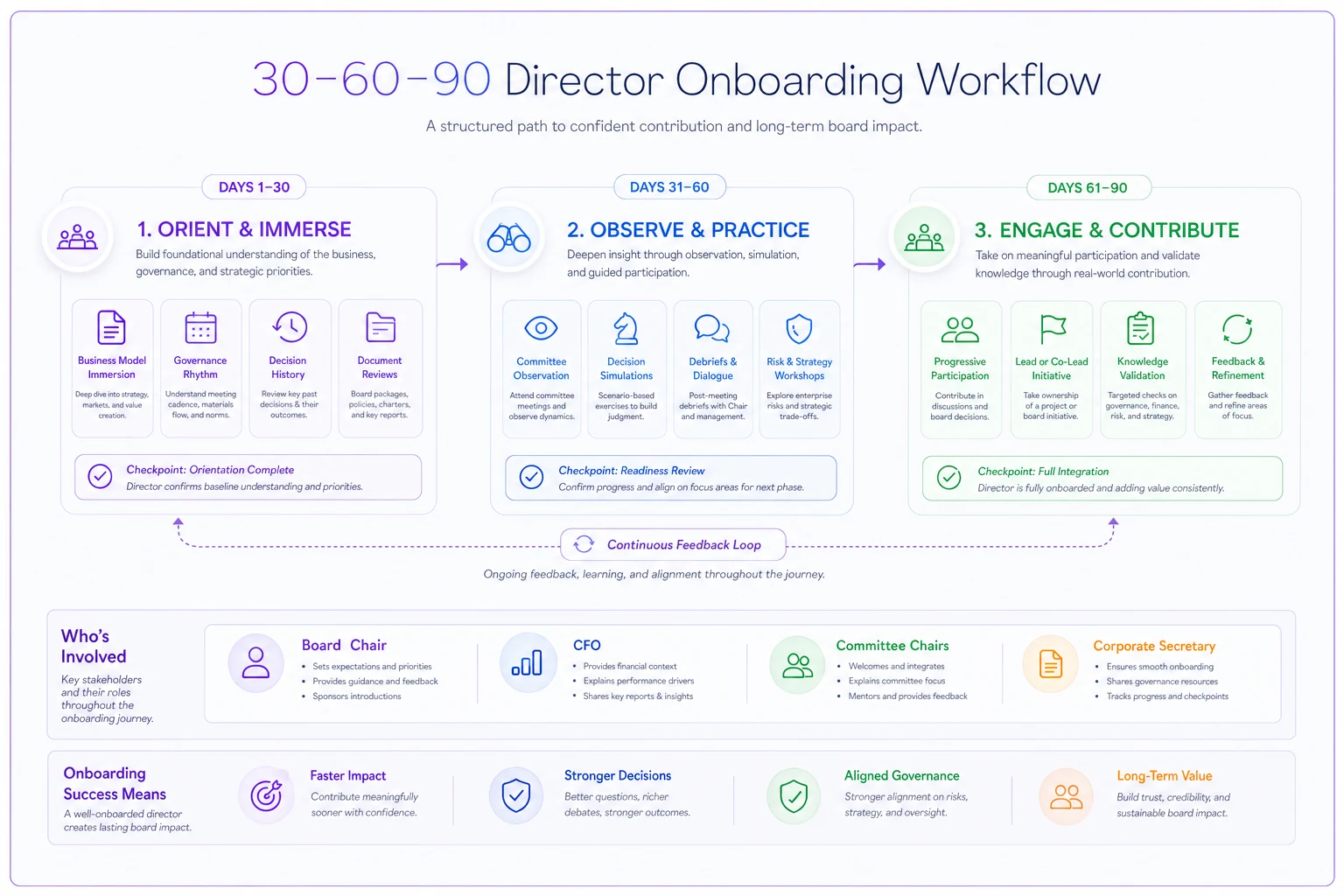
Here's a visual workflow of the 30-60-90 onboarding process to help teams align on timing and responsibilities.
Days 31-60: Applied Learning
-
Committee observation rotation (all committees, one full cycle)
-
Decision simulation exercise (based on real past scenario)
-
First active committee participation (low-stakes item)
-
Mid-point assessment with lead independent director
Days 61-90: Full Integration
-
Lead one committee discussion item
-
Second a board motion with rationale
-
Complete three knowledge validation checkpoints
-
Develop first independent insight or recommendation
Ongoing Support Structure Assign a board buddy — an experienced director — for the first six months. Schedule monthly check-ins with the corporate secretary for the first quarter, then quarterly after that. Provide access to external governance education relevant to the company's industry and stage.
Beyond Onboarding: The Continuous Governance Development Imperative
The 30-60-90 plan creates a foundation, not a ceiling. Director effectiveness requires continuous development as companies evolve, regulations change, and governance standards advance. Without a strong foundation, ongoing development becomes remedial training instead of strategic capability building.
Companies that excel at director integration treat the 90-day plan as the start of a longer development journey. They map director competencies against future strategic needs. They provide targeted education before new initiatives require new expertise. They create forums for directors to share knowledge and challenge thinking beyond formal board meetings.
This approach — structured onboarding continuing through the director's full tenure — transforms boards from oversight bodies into strategic assets. It's the difference between directors who review decisions and directors who improve them. Between boards that react to problems and boards that see them coming.
The investment in structured director onboarding pays back through faster decision-making, better risk assessment, and stronger governance. More importantly, it builds a board culture that values preparation, encourages real questions, and develops collective capability rather than relying on whoever happens to be the most experienced person in the room.
Your next director appointment is a chance to demonstrate that governance excellence starts before the first board meeting. The 30-60-90 framework provides the structure. Consistent, systematic knowledge transfer makes the difference between a new director who eventually finds their footing and one who contributes from day one.
Ready to enhance your board's productivity?
Join 500+ organizations using Panlly to save time, improve governance, and streamline board operations.