


Most boards can describe their culture. Very few can prove it works.
That gap is where governance failures actually live. A board can pass a values resolution, hang a code of conduct in the lobby, and still have no answer when a regulator asks the only question that matters: when something went wrong, what did the board do about it, and how fast? "We take culture seriously" is not evidence. A dated escalation record with a decision, an owner, and an outcome is.
The problem with most culture programs is that they're built as communication exercises when they should be built as enforcement systems. Communication tells people what's expected. Enforcement decides what happens when expectations are ignored — and whether the consequence is consistent enough that it holds up under scrutiny. A boardroom culture playbook that can't answer "what happens next" at every trigger point isn't a playbook. It's a poster.
This article walks through how the whole system connects: the escalation gates that catch problems, the sanctions logic that responds to them consistently, the training cadence that keeps standards fresh, and the accountability ledger that lets directors show — not claim — that oversight actually happened.
Why culture programs collapse under their own vagueness
The most common failure mode isn't malice or negligence. It's ambiguity dressed up as flexibility.
A code says employees should "escalate concerns through appropriate channels." Appropriate to whom? By when? To which committee? If the answer lives in someone's head instead of a documented gate, the program only works when the right person happens to be paying attention. That's not governance. That's luck.
The pattern that shows up repeatedly in organizations that later end up in front of regulators: the values framework is genuinely well-intentioned, but every hard edge got sanded off during drafting to avoid committing the board to anything specific. "Serious matters will be escalated promptly." "Violations will be addressed appropriately." "Directors will exercise appropriate oversight." Every one of those sentences reads fine in a board pack and means nothing when you need to prove a decision was made.
At small scale, this vagueness is survivable because informal coordination fills the gaps. The GC knows to call the chair. The chair knows which director to loop in. Everyone knows everyone. The system runs on relationships, and relationships are fast.
Then the organization grows. New entities, new geographies, new committees, three layers of management between the incident and the boardroom. The informal channels that carried culture for years quietly stop scaling — and nobody notices until an issue that should have hit the audit committee in 48 hours surfaces four months later in a whistleblower complaint. The playbook didn't fail loudly. It eroded silently as headcount and complexity outran the relationships holding it together.
The four connected components (and why they fail separately)
Think of an enforceable culture system as four gears that have to mesh. When boards build them in isolation — which is how most get built, one at a time in response to one bad quarter — the gears spin but don't drive anything.
Eliminate boardroom chaos with seamless coordination.
Panlly simplifies scheduling, collaboration, and follow-ups for every board meeting.
- Centralized meeting scheduling
- Secure document sharing
- Task assignment & tracking
No credit card required
| Component | What it does | Common failure when built alone |
|---|---|---|
| Escalation gates | Route issues to the right level, at the right speed | Triggers exist but have no time limits or named owners |
| Sanctions matrix | Ensure consequences are consistent and defensible | Applied case-by-case, creating disparate-treatment risk |
| Training cadence | Keep standards current and evidenced | Annual box-tick with no record of who actually completed what |
| Accountability ledger | Prove the board did its job | Reconstructed after the fact, which auditors immediately distrust |
The insight most boards miss: these four only produce audit-grade evidence when they feed each other. An escalation gate fires and creates a ledger entry. A sanction decision references the matrix tier that justified it. A recurring issue type triggers a training update. Built as separate documents in separate folders owned by separate people, they generate activity. Built as a connected chain, they generate proof.
Escalation gates: the part everyone under-specifies
An escalation gate is a decision point with three non-negotiable properties: a trigger (what condition activates it), a timebox (how fast it must move), and a named owner (who is accountable for moving it). Miss any one and the gate leaks.
Most codes get the trigger roughly right and then fail on the other two. "Financial irregularities must be escalated" is a trigger. But escalated to whom, and if they're on holiday, then whom? And is "escalated" satisfied by an email nobody reads, or does the clock only stop when the audit committee chair acknowledges receipt?
A workable escalation flow looks less like a policy paragraph and more like a routing table:
-
Detection — Issue identified and classified by severity (Tier 1 routine, Tier 2 significant, Tier 3 material/board-level).
-
Initial routing — Tier 3 goes to GC + committee chair within 24 hours; Tier 2 to management with committee notification within 5 business days; Tier 1 logged and reviewed quarterly.
-
Acknowledgment gate — The clock stops only on documented acknowledgment by the named owner, not on sending.
-
Escalation-on-silence — If no acknowledgment within the timebox, the issue auto-promotes to the next level. Silence becomes escalation, not a dead end.
-
Decision and disposition — Owner records the decision, the rationale, and the follow-up owner.
-
Ledger write — Every step timestamps into the accountability ledger automatically, not as a memo written later.
That fourth step — escalation on silence — is the one boards almost never build, and it's the single most protective feature in the whole flow. Real breakdowns rarely happen because someone actively decided to bury an issue. They happen because a report landed in an inbox during a busy week and quietly died there. A gate that promotes unacknowledged issues upward turns inattention into a visible, dated event instead of a silent gap you discover during litigation.
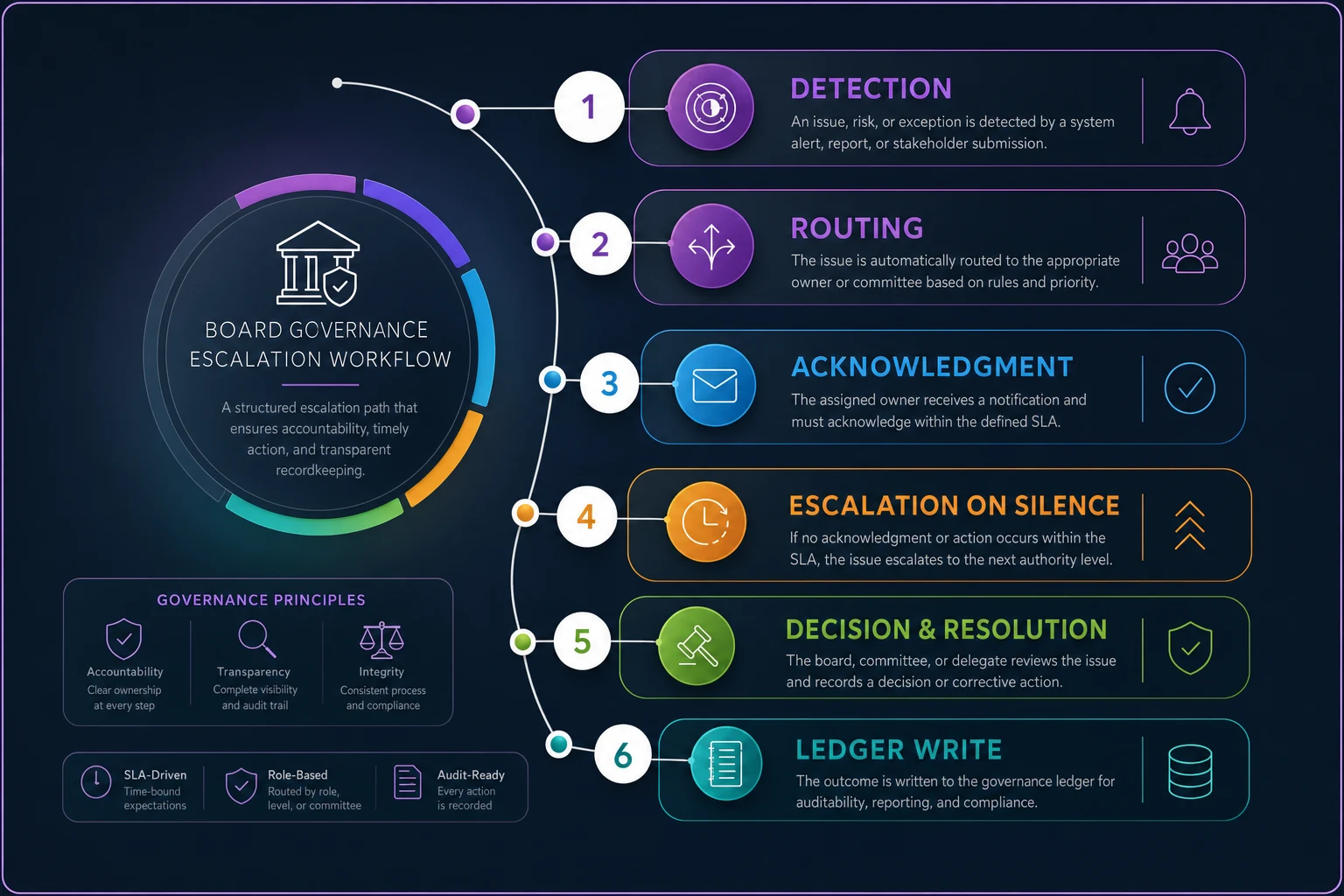
Automate escalation-on-silence so unacknowledged reports advance rather than gather dust.
Because escalation and minutes are joined at the hip, it's worth being deliberate about how these decisions get recorded. Weak documentation at the escalation stage is exactly what turns a defensible response into a liability — a point covered in more depth in how poor minutes invite scrutiny.
The sanctions matrix: consistency is the whole point
The reason to build a sanctions matrix isn't to be punitive. It's to be consistent — because inconsistency is where the real legal exposure sits. Two similar violations handled two different ways is the fact pattern that turns an HR issue into a discrimination claim or a shareholder allegation of selective enforcement.
A sanctions matrix maps violation severity against factors like intent, harm, recurrence, and seniority, and produces a defensible range of responses rather than a single mandated punishment. The range matters — you want structure, not a robot. But the range has to be documented, and any decision landing outside the expected band has to carry a written rationale.
-
Severity axis minor / moderate / serious / egregious
-
Aggravating factors intent, repeat conduct, cover-up attempt, seniority (higher standard, not lower), harm to third parties
-
Mitigating factors self-reporting, cooperation, first occurrence, remediation offered
-
Response band per cell e.g., "serious + repeat" → suspension to termination, with mandatory committee review
The mistake that quietly poisons these systems: applying a lower standard to senior people because they're "too valuable to lose." Auditors and plaintiffs' counsel look for exactly this. If a mid-level employee gets terminated for conduct an executive got a warning for, your matrix doesn't protect you — it becomes the exhibit that convicts you. A defensible matrix explicitly raises the standard with seniority.
When a rigid matrix is actually a bad idea
A hard-coded matrix with no discretion band is dangerous in its own way. Highly context-dependent situations — a genuine judgment call under ambiguous policy, a good-faith error with no harm — can get railroaded into a disproportionate outcome that the board then has to defend anyway. The fix isn't to abandon the matrix; it's to build the discretion into it with a documented override path. Discretion that's designed in is defensible. Discretion that's improvised is not.
Training cadence: proof of "reasonable steps," not attendance theater
Training is where "reasonable steps" gets tested. When a regulator asks whether the board took reasonable steps to embed its standards, "we run annual compliance training" is a weak answer if you can't produce a completion ledger, content version history, and evidence that training was updated after relevant incidents.
-
Baseline — mandatory onboarding within 30 days, all staff, versioned content.
-
Refresh — role-risk-weighted. Finance and procurement on tighter cycles than low-exposure functions.
-
Triggered — after a significant incident or a relevant regulatory change, targeted training within a defined window, with the trigger recorded.
-
Board-level — directors themselves on a documented cadence, because "the board sets the tone" is meaningless if the board can't evidence its own currency.
The pattern that separates real programs from theater: triggered training tied to actual incidents. If a control failure in one region produces targeted retraining across all comparable regions within, say, 45 days — and that link is documented — you've shown a learning system. If every year's training is identical regardless of what actually went wrong, you've shown a checkbox.
The director accountability ledger: the thing auditors actually want
Everything above exists to feed one artifact: a ledger that lets a director demonstrate what the board knew, when it knew it, and what it did. This is the difference between a board that reconstructs its oversight story under pressure and one that simply exports it.
-
Date and trigger — what happened and how it entered the system
-
Classification and severity tier
-
Escalation path taken — with acknowledgment timestamps
-
Decision and rationale — including matrix tier referenced
-
Owner and due date for follow-up
-
Closure evidence — what actually resolved it
-
Exceptions and overrides — flagged, with justification
The measure of whether your ledger is working: pull ten random entries and check whether each one answers "what did the board do and when" without anyone having to explain it verbally. If entries need a translator, they won't survive an audit. Tying these entries back to measurable oversight outcomes is where a proper board effectiveness measurement system with KPIs connects the culture playbook to the rest of the board's reporting.
The KPI scorecard directors can evidence
Culture KPIs get a bad reputation because they're usually vanity metrics — training completion percentage, number of policies published. Those measure activity, not health. The scorecard worth building measures whether the system is functioning.
-
Escalation cycle time — median hours from detection to acknowledgment, per severity tier. Rising times mean the gates are clogging.
-
Escalation-on-silence rate — how often issues auto-promoted because owners didn't respond. A creeping number is an early warning that attention is failing.
-
Sanctions consistency — variance in outcomes for comparable violations. Widening variance is disparate-treatment risk building.
-
Triggered-training closure rate — did post-incident training actually complete within its window.
-
Reopened issues — how many "closed" matters came back. High reopen rates mean closures are cosmetic.
-
Ledger completeness — percentage of entries with all required fields on first write, not backfilled.
Watch the trends, not the snapshots. A single quarter's numbers tell you almost nothing. Escalation cycle time drifting from 30 hours to 70 over three quarters tells you the informal channels are breaking down under growth — usually well before anyone feels it as an incident.
A short real scenario
A mid-market group operating across four subsidiaries had a perfectly respectable code of conduct and annual training. What it didn't have was a connected escalation-to-ledger chain. Conduct issues were handled locally, inconsistently, and recorded in whatever format each subsidiary preferred.
A conduct matter in one subsidiary was handled with a quiet warning; a nearly identical matter in another ended in termination roughly five months later. When the second employee's counsel requested comparable-treatment records, the group had no way to explain the difference — because there was no matrix, no central ledger, and no timestamps showing what anyone knew or decided.
After rebuilding around defined severity tiers, timeboxed escalation gates, a documented sanctions matrix, and a single accountability ledger, the change wasn't dramatic in headline terms — it was structural. Median escalation acknowledgment dropped from somewhere north of a week to under two days. More importantly, when the same group faced a regulator inquiry the following year, the response took days instead of the frantic multi-week scramble the prior structure would have forced. The evidence already existed, dated and in order. That's the entire point.
Who should not build this yet
This system is genuinely overkill for a very small, single-entity organization where the whole board fits around one table and informal coordination still works. Building a full sanctions matrix and multi-tier escalation flow for a five-person company creates process weight with no proportionate risk reduction. Start with a simple decision log and a clear escalation contact, and grow the structure as complexity arrives.
It also makes little sense to build the ledger last. Boards frequently design the escalation gates and sanctions matrix first, run them for a year, and then try to bolt on evidence capture. That's backwards. If the ledger isn't wired in from the start, you get a year of decisions with no defensible record — which is exactly the gap the whole exercise was meant to close.
Where the effort actually pays off
The organizations that get real value from an enforceable culture playbook are the ones scaling across entities, geographies, or headcount fast enough that relationships can no longer carry oversight. That's the inflection point where informal culture quietly stops being enough and the absence of documented gates starts producing surprises.
Keeping these four components connected — and keeping the ledger populated in real time rather than reconstructed under duress — is the kind of coordination work that governance platforms handle far better than a folder of spreadsheets and a shared inbox. When escalation timestamps, sanction rationales, training completions, and ledger entries live in one system that records as events happen, audit-readiness stops being a project and becomes a byproduct. The tool is secondary, though. The discipline is the point: a culture you can enforce, at a speed you can prove, with a record that holds up when someone finally asks the hard question.
The organizations that get real value from an enforceable culture playbook are the ones scaling across entities, geographies, or headcount fast enough that relationships can no longer carry oversight. That's the inflection point where informal culture quietly stops being enough and the absence of documented gates starts producing surprises.
Keeping these four components connected — and keeping the ledger populated in real time rather than reconstructed under duress — is the kind of coordination work that governance platforms handle far better than a folder of spreadsheets and a shared inbox. When escalation timestamps, sanction rationales, training completions, and ledger entries live in one system that records as events happen, audit-readiness stops being a project and becomes a byproduct. The tool is secondary, though. The discipline is the point: a culture you can enforce, at a speed you can prove, with a record that holds up when someone finally asks the hard question.
Ready to enhance your board's productivity?
Join 500+ organizations using Panlly to save time, improve governance, and streamline board operations.