


The problem with director continuing education isn't that boards don't do it. Most do. Directors sit through cyber briefings, attend governance webinars, complete their annual ethics module. The problem is that when a regulator, an activist investor, or opposing counsel in a D&O case asks you to demonstrate it — with dates, hours, topics mapped to committee responsibilities, and proof of who actually attended versus who logged in and walked away — the corporate secretary is suddenly digging through a shared drive, forwarded calendar invites, and three email threads to reconstruct something that should have taken thirty seconds to produce.
That gap between "we did the training" and "we can prove the training was relevant, completed, and current" is where director continuing education tracking quietly falls apart. And it usually falls apart at the worst possible moment.
This post is about building a runnable workflow that closes that gap: a curriculum mapped per committee, credential and attendance logging that actually holds up, assessment checkpoints so completion means something, and a ledger a director can export cleanly when a regulator or investor asks.
Why the folder-of-PDFs approach fails under scrutiny
Most secretaries inherit the same setup. Education happens ad hoc. A director attends a conference, someone maybe saves the certificate. The audit committee gets a cyber briefing, and it lives as a line in the minutes. Compensation committee members do a peer-benchmarking session that never gets logged at all because nobody thought of it as "education."
The result is three separate failures stacked on top of each other:
-
No mapping. There's no link between what a director learned and what their committee is actually responsible for overseeing. An audit committee member's cyber literacy sits in a general folder next to a governance webinar, with nothing showing why it was assigned.
-
No proof of completion. "Attended" usually means "was on the invite list." A logged-in-but-absent director looks identical to an engaged one in most records.
-
No currency check. A cyber briefing from 26 months ago and one from last quarter look the same in a static PDF folder. Nobody flags the stale one until it's a problem.
In practice, this surfaces during a specific trigger: a regulatory inquiry, an investor questionnaire ahead of proxy season, or discovery in litigation. Suddenly the request is "show us the continuing education record for the audit committee for the past three fiscal years, broken out by topic and hours." What comes back is a scramble, and the scramble itself becomes evidence that oversight was informal.
Start with a curriculum map, not a training calendar
The mistake almost everyone makes is treating this as a scheduling problem — "let's book more sessions." It's actually a mapping problem. Before you log a single hour, you need a curriculum map that ties learning topics to specific committee mandates.
Eliminate boardroom chaos with seamless coordination.
Panlly simplifies scheduling, collaboration, and follow-ups for every board meeting.
- Centralized meeting scheduling
- Secure document sharing
- Task assignment & tracking
No credit card required
Think of it as a grid. Rows are committees. Columns are the competency areas each committee is expected to maintain. The cells are the required education for that intersection.
| Committee | Required competency areas | Baseline cadence |
|---|---|---|
| Audit | Financial reporting updates, internal controls, cyber/data risk, whistleblower process | Reporting standards annually; cyber every 12–18 months |
| Compensation | Pay-for-performance frameworks, disclosure rules, say-on-pay dynamics | Annual disclosure refresh; benchmarking as needed |
| Nominations/Governance | Board evaluation methods, succession practice, director independence rules | Annual governance refresh |
| Risk | Enterprise risk frameworks, sector-specific regulation, scenario oversight | Framework review annually; sector updates quarterly |
| Full board | Ethics, conflicts, fiduciary duty basics, industry landscape | Annual ethics; onboarding for new members |
This grid does two things at once. It tells you what to schedule, and — more importantly — it becomes the backbone of what you'll later export. A regulator asking "how do you ensure your audit committee stays current on cyber?" gets a straight answer: here's the competency, here's the cadence, here's the ledger showing completion.
If you're already building committee workplans, this maps cleanly onto that work. The same logic that turns a charter into quarterly deliverables applies here — each competency area becomes a recurring education deliverable with an owner and a due date.
Make "completed" mean something with assessment checkpoints
Attendance logging alone is weak evidence. A director who joined a webinar and left the tab open for 40 minutes generated the exact same record as one who took notes and asked questions. Under real scrutiny, that equivalence is a liability.
The fix isn't a graded exam — directors will rightly push back on being tested like interns. It's a lightweight checkpoint that confirms engagement without being adversarial. A few models that work:
-
Acknowledgment with a specific reference. After a session, the director confirms completion and answers one or two applied questions — not trivia, but something like "which of these disclosure changes affects our next proxy?" Two minutes, and it proves the material landed.
-
Facilitator sign-off. For live sessions, the person delivering the briefing confirms which directors participated substantively. Common for outside-counsel-led sessions, and it carries weight precisely because it's a third party.
-
Applied follow-up in committee. The strongest checkpoint is a reference to the education in a subsequent committee discussion, captured in minutes. "The committee applied the framework from the March risk session to the vendor review" is far better evidence than a certificate.
The point isn't to bureaucratize learning. It's that when you say "completed" in a ledger you export to a regulator, that word should be defensible.
The attendance and credential logging workflow
Here's a workflow that holds up under scrutiny. Deliberately simple, because complexity is what kills adoption — a corporate secretary won't maintain a system that takes an hour per session.
-
Assign the education item from the curriculum map to the relevant directors, with the committee mandate it satisfies attached. This is where the "why" gets recorded up front, not reconstructed later.
-
Deliver the session and capture raw attendance — actual participation, not the invite list. For external sessions, collect the certificate or facilitator confirmation at the same time. Chasing it a week later never works.
-
Checkpoint the completion using one of the lightweight methods above.
-
Log the entry with the fields that matter for export (below).
-
Timestamp and lock the record so it can't be quietly backdated. An immutable log entry is what separates a credible ledger from a spreadsheet anyone could edit after the fact.
Every logged credential should carry, at minimum:
-
Director name and role
-
Committee mandate satisfied
-
Topic and provider
-
Date and duration (hours)
-
Completion status and checkpoint method
-
Currency/expiry flag (when it needs refreshing)
-
Source document reference (certificate, facilitator note)
That last field matters more than people expect. When you export, the regulator or investor doesn't just want a summary line — they want to pull the underlying proof for any row without a second request.
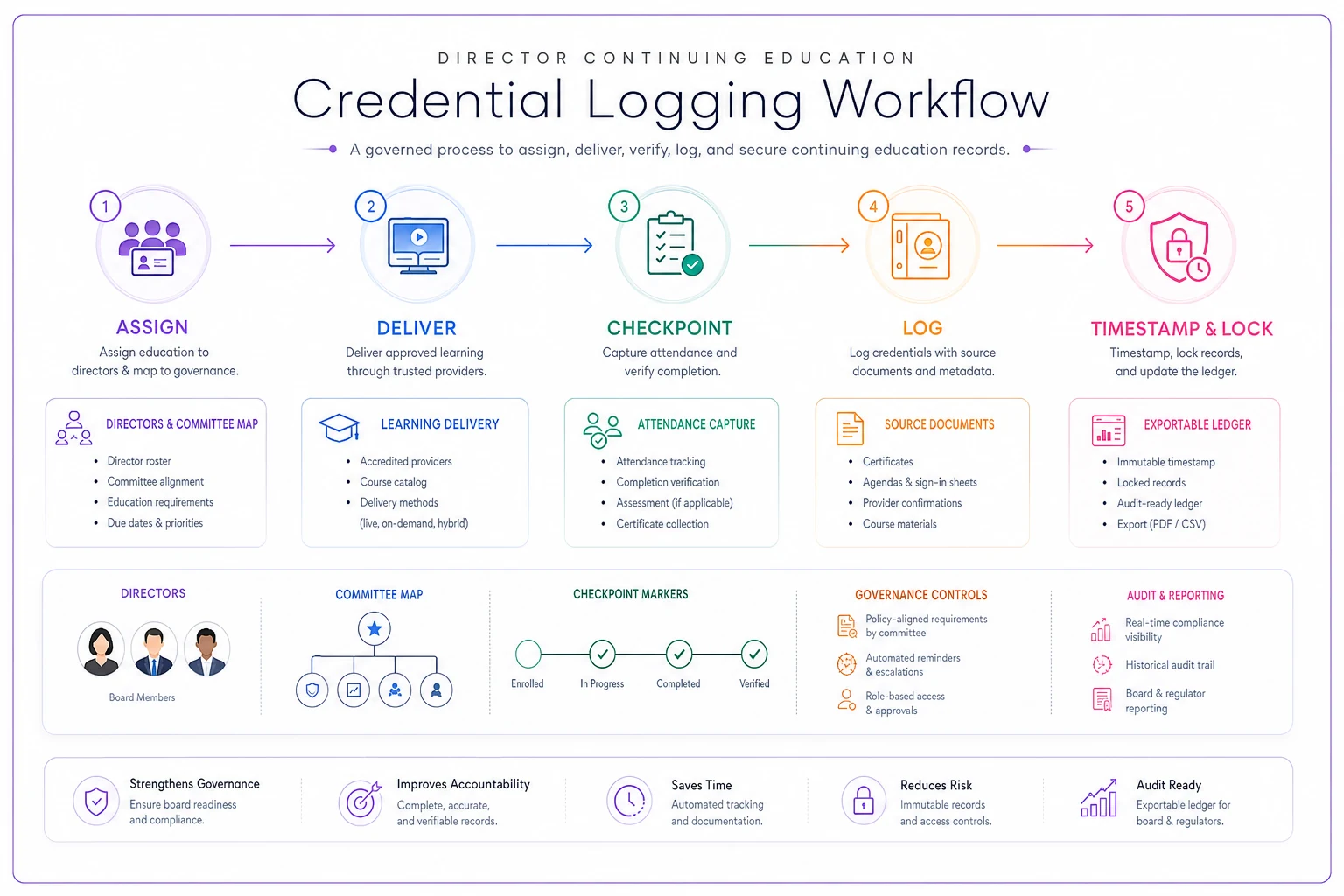
A simple diagram like this makes it obvious where audit points and immutable timestamps belong.
Where reminders and automation quietly earn their keep
The unglamorous truth is that most continuing education records rot because nobody's job it is to notice when something goes stale. A cyber competency with an 18-month cadence goes 20 months, then 24, and no one flags it because the tracking lives in a static document that doesn't do anything.
This is where automation genuinely reduces risk rather than just saving time. When the curriculum map's cadences are loaded into a system that watches dates, the workflow starts surfacing what's overdue instead of waiting for someone to audit it manually. A director whose ethics module is approaching expiry gets a reminder. The secretary sees a dashboard where anything past cadence is flagged before a regulator flags it for them.
Configure cadence reminders to flag items shortly after they pass their required interval (e.g., month 13 on a 12–18 month cycle).
The value isn't the reminder email itself — it's that the currency check stops depending on human memory. Boards that move from a static spreadsheet to a system that tracks cadence and nudges automatically stop having the "wait, when did we last cover this?" conversation entirely. The stale item gets caught at month 13, not month 30.
The same logic applies to the export. The reason a folder of PDFs fails isn't that the data is missing — it's that assembling it on demand is manual and slow. A ledger that's continuously maintained can be exported in the format a regulator expects without a fire drill, because the assembly already happened as you went.
A real scenario: mid-cap board, three-year lookback
A mid-cap manufacturer's audit committee got a request during a routine regulatory review: document the committee's continuing education on cybersecurity and financial reporting over the prior three fiscal years, with hours and topics.
Before they'd built a proper system, this would have been a two-week reconstruction — pulling calendar invites, emailing directors for certificates they may or may not have kept, cross-referencing minutes to figure out what a "briefing" actually covered. And even then, the gaps would have been obvious: one director's cyber training was 27 months old, and nobody had noticed.
After moving to a mapped-and-logged workflow, the corporate secretary produced the export in an afternoon. Each row tied a session to the specific audit committee mandate it satisfied, with duration, provider, checkpoint, and a link to the source certificate. The one stale credential had already been flagged and refreshed four months earlier because the cadence tracker caught it. The regulator's follow-up questions were minimal, because the ledger answered them before they were asked.
The cost difference wasn't dramatic in dollars — maybe a dozen hours of secretary time saved per inquiry. The real difference was that the record looked like the product of a real oversight process, not a scramble. In a regulatory or litigation context, that impression is worth considerably more than the hours.
When this level of rigor makes sense — and when it's overkill
When it's worth building fully:
-
You're in a regulated sector (financial services, healthcare, energy, public companies broadly) where continuing education expectations are explicit or implied.
-
You've had, or reasonably expect, regulator inquiries or investor governance questionnaires.
-
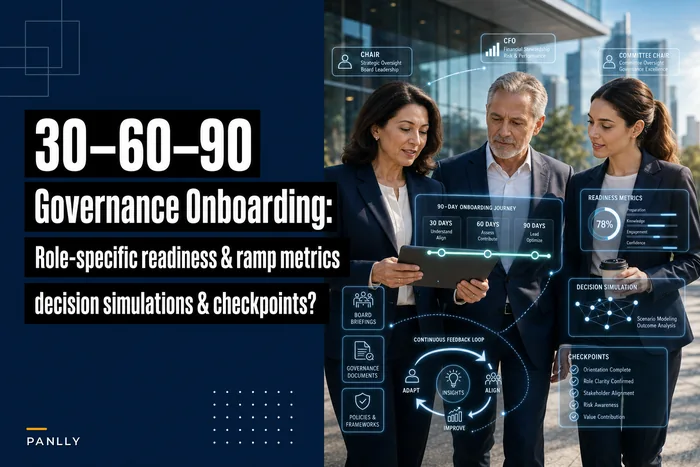
Your board has meaningful turnover and you need onboarding education to be consistent and provable. If you're already running a structured 30–60–90 governance integration plan for new directors, the education log is the natural evidence layer underneath it.
When a lighter version is fine:
-
Small private boards with stable, long-tenured members and no regulatory exposure. You still want a simple log, but the full checkpoint-and-cadence machinery may be more than the situation calls for.
Who should not over-engineer this: early-stage companies where the "board" is three founders and an investor. Track the basics, but don't build a regulator-grade ledger for an audience that doesn't exist yet.
Tie the ledger into the director lifecycle, not off to the side
The last mistake worth naming: treating education tracking as a standalone compliance chore instead of part of how you actually evaluate and develop directors. The credential ledger is genuinely useful input for board assessment — it shows who's keeping current, where competency gaps sit, and which committee mandates are underserved by the current education plan.
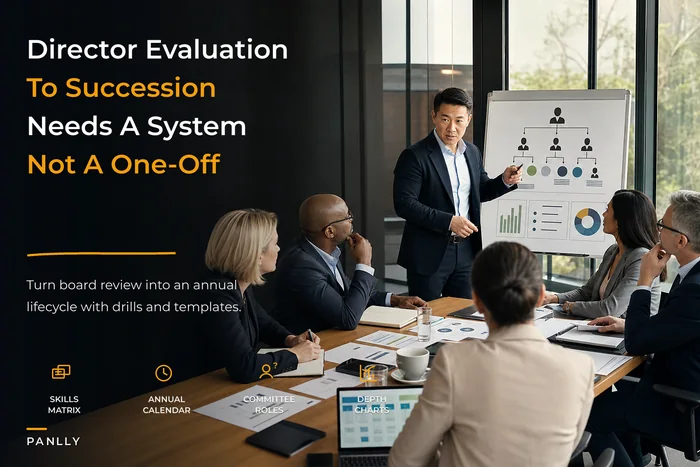
Boards that run a real director lifecycle framework use the education record as one honest signal among several. A director who's consistently completing and applying relevant education looks different in an evaluation than one whose log is a string of overdue flags. That's not a gotcha — it's exactly the kind of concrete, documentable input that makes board evaluations less political and more grounded.
Director continuing education tracking fails not because education doesn't happen, but because the record of it gets assembled reactively, under pressure, from scattered sources. The fix is boring in the best way: map education to committee mandates up front, make "completed" mean something with a lightweight checkpoint, log every credential with the fields you'll actually need to export, and let cadence tracking catch stale items before a regulator does.
Do that, and the request that used to trigger a two-week scramble becomes an afternoon's export — one that reads like proof of a functioning oversight process, because that's exactly what it is.
Ready to enhance your board's productivity?
Join 500+ organizations using Panlly to save time, improve governance, and streamline board operations.