

The problem almost nobody admits out loud: when your board reviews subsidiary reports, you're not comparing apples to apples. You're comparing a 14-page German GmbH report written by a managing director who thinks "compliance" means tax, a two-paragraph email from your Singapore entity, and a Brazilian subsidiary that reports everything through the lens of local labor court exposure because that's what keeps the local CEO up at night.
Each report is technically accurate. Each is useless for board-level comparison. And when a regulator in one jurisdiction starts asking questions, the board discovers it has no consistent way to answer "how does this entity compare to the others, and did we miss an early signal somewhere else?"
This article is narrow on purpose. It's about one thing: building a canonical subsidiary reporting card, a regulator-impact matrix, and a cross-entity evidence index so that board-level comparison is actually possible, and escalation triggers fire before a local problem becomes a group-level crisis.
Why subsidiary reports drift apart in the first place
Nobody designs inconsistency. It accumulates.
A new subsidiary gets acquired or spun up. The local director inherits a reporting format from whatever they did before. The corporate secretary at HQ is drowning, so they accept whatever arrives as long as it arrives. Six entities later, you have six report formats, six definitions of "material," and six different risk vocabularies.
Then there's the translation-of-concept problem, which is sharper than literal language translation. "Regulatory exposure" means something different to a UK entity under the FCA than to a US broker-dealer under FINRA than to an Indian entity worried about RBI and GST simultaneously. When each local team maps its world to its own regulators, the board gets reports that are internally coherent and mutually incomparable.
The last driver is seniority mismatch. In one entity, the person writing the report is a country GM with a full compliance team. In another, it's a finance manager wearing four hats. The depth, candor, and risk-awareness of the two reports will never match, and the board rarely accounts for that gap when reading them side by side.
What tends to happen is the inconsistency stays invisible right up until it's expensive. A quarter looks fine because every report said "no material issues." Then something surfaces in one entity, and in hindsight the early signals existed in two others — they were just described in language the board never standardized enough to catch.
The core idea: one canonical card, not one long report
The instinct when you notice inconsistency is to demand more — longer reports, more detail, more appendices. That makes comparison worse, not better. More volume means more places for the real signal to hide.
Eliminate boardroom chaos with seamless coordination.
Panlly simplifies scheduling, collaboration, and follow-ups for every board meeting.
- Centralized meeting scheduling
- Secure document sharing
- Task assignment & tracking
No credit card required
The fix is a canonical subsidiary reporting card: a fixed, short, board-facing summary that every entity fills out identically, every reporting period, regardless of size or jurisdiction. The local detail still exists — it lives in the entity's own files — but what reaches the board is a standardized card.
| Card Section | What it captures | Why it must be standardized |
|---|---|---|
| Entity identity & scope | Legal entity, jurisdiction, reporting officer, period | Removes ambiguity about who is accountable |
| Regulator status | Each applicable regulator, current standing (green/amber/red) | Lets the board scan exposure across all entities in seconds |
| Financial health flags | 3–5 fixed metrics, same definitions group-wide | Comparability only works with identical definitions |
| Open regulatory matters | Count + severity band + next milestone date | Surfaces slow-burning issues before deadlines hit |
| Changes since last period | New laws, new filings, leadership changes, structure changes | Change is where risk hides |
| Escalation flags | Explicit yes/no against group-defined triggers | Forces a decision instead of a narrative |
| Evidence references | Document IDs backing each flag | Makes every claim auditable |
The discipline is in the constraints. Severity uses the same three or four bands everywhere. The financial flags use group definitions, not local-GAAP interpretations the local team prefers. And "no issues" is not an acceptable entry for the escalation section — it must be an explicit no against each named trigger, because a blank field and a deliberate "no" are very different things when a regulator later asks what the board knew.
Mapping regulators so the board sees one picture
A reporting card is only comparable if the regulator section means the same thing across entities. That requires a regulator-impact matrix — a group-maintained mapping that translates each local regulator into a common set of oversight categories the board already thinks in.
The point isn't to flatten real differences. A data regulator in the EU genuinely differs from one in Singapore. The point is to tag each regulator to the board-level concern it drives, so the board can ask "what's our group-wide data-privacy exposure?" and get an answer assembled from entities that otherwise use entirely different regulator names.
-
Local regulator name (as the entity knows it)
-
Oversight category (financial conduct, data/privacy, labor, tax, environmental, sector-specific)
-
Trigger thresholds (what level of fine, inquiry, or deadline forces a board-level flag)
-
Local reporting owner (named person, not a title)
-
Group equivalent concern (how this rolls up into the board's standing risk categories)
-
Last reviewed date (because regulators and their thresholds change)
The mistake to avoid: treating this matrix as a one-time project. Regulatory regimes shift, new entities arrive, and a mapping that's 18 months stale will quietly misclassify a serious exposure as routine. The matrix needs a review owner and a cadence, or it rots.
This regulator mapping also connects directly to how your group handles inbound regulatory pressure. If you've already built a process for handling regulator inquiries without scrambling, the impact matrix becomes the front end of it — the thing that tells you, the moment an inquiry lands in one jurisdiction, which other entities share the same regulator category and should be checked immediately.
The cross-entity evidence index: the part everyone skips
Most groups fall down here. The board reads a card that says "AML controls remediated, amber." Fine. But six months later a regulator asks for the evidence. Now someone has to reconstruct which document, from which entity, from which period, supported that single word "remediated."
A cross-entity evidence index solves this by assigning every material claim on every card a reference that points to the underlying document, stored consistently across entities. It's a thin layer — not a document repository, but an index — that answers one question reliably: for any flag the board saw, where is the proof, and what state was it in when the board saw it?
-
Local team files its supporting documents in the entity's own system, tagged with a group-standard document ID format.
-
The reporting card references those IDs against each flag, rather than restating the content.
-
The evidence index links card → ID → storage location → date-stamped version, so the board's view of a claim is permanently tied to the exact document behind it.
-
At escalation, the index lets the corporate secretary pull a clean evidence bundle for one entity — or across entities sharing a regulator category — without emailing eight country managers.
The payoff is defensibility. When a claim and its evidence are linked at the moment of reporting, nobody has to reconstruct institutional memory under deadline pressure during a regulatory exam. The evidence was indexed when it was fresh.
This index also makes the escalation side of your group risk work far cleaner. When the evidence index is tied to your enterprise risk register and its escalation triggers, an amber flag on a subsidiary card doesn't just sit in a board pack — it maps to a defined tolerance and a pre-agreed escalation path.
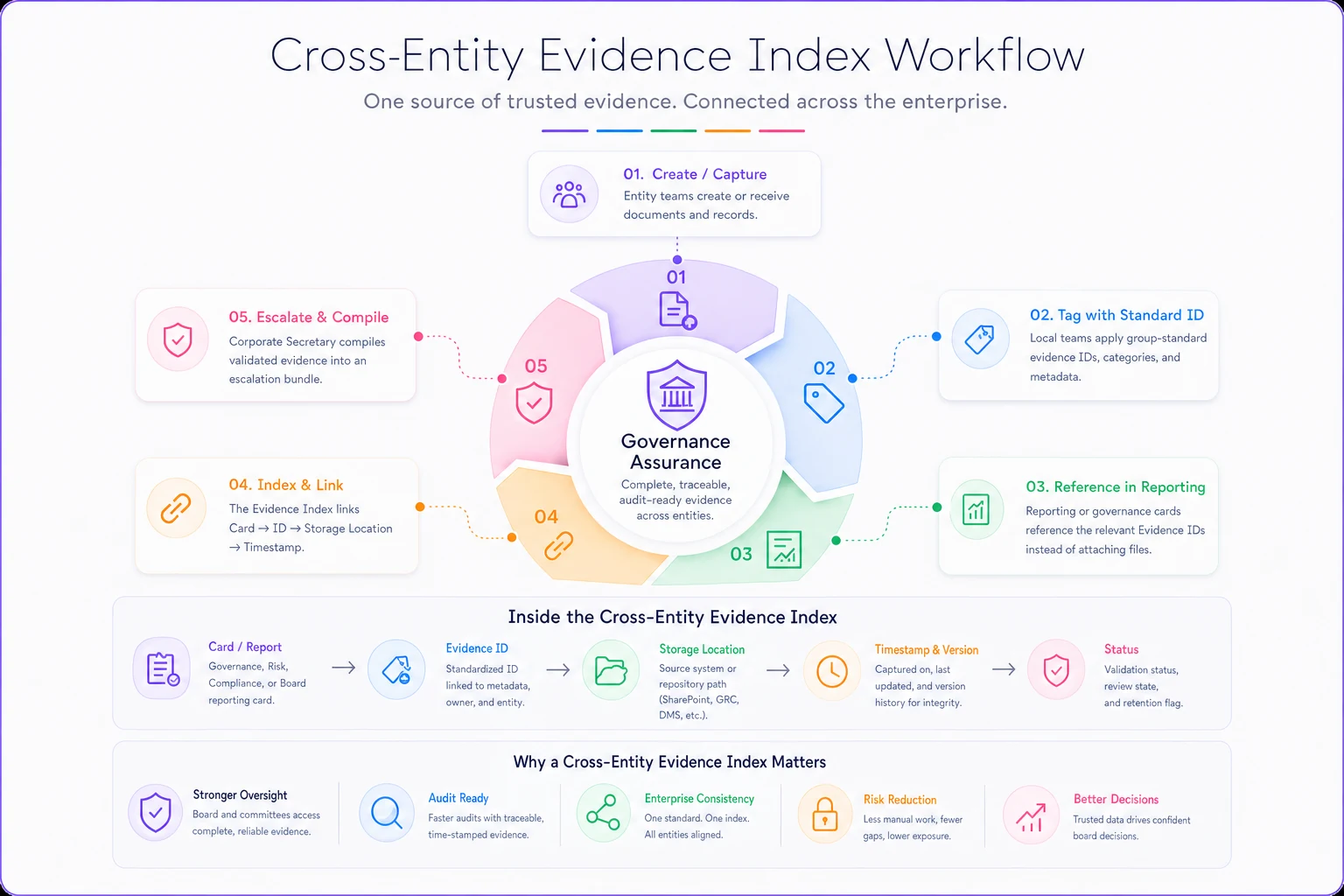
The workflow above shows how indexing at the time of reporting removes guesswork during regulatory reviews.
Escalation triggers: the difference between a flag and an action
A reporting card without escalation triggers is just prettier paperwork. The triggers are what convert a standardized flag into a board action, automatically, without depending on someone feeling alarmed enough to escalate.
-
Any single regulator moves from green to red → immediate notice to the group corporate secretary and relevant committee chair, not next quarter.
-
A regulatory fine or penalty above a defined group threshold (set as an absolute figure and a percentage of entity revenue, since a small number can be existential for a small entity).
-
Two or more entities flag the same oversight category as amber in the same period → pattern escalation, because correlated signals matter more than isolated ones.
-
A regulatory deadline inside the next 45 days with no evidence of readiness in the index.
-
Any leadership change in the local reporting officer role, because reporting continuity is itself a risk.
That third trigger — the pattern escalation across entities — is the one most groups don't build, and it's the one that catches the problems that hindsight reviews always flag as "we should have connected these."
Who actually owns which piece
Standardization dies when ownership is fuzzy. The cleanest split:
-
Local reporting officer owns the accuracy and completeness of their entity's card and the filing of supporting evidence.
-
Group corporate secretary owns the canonical card format, the evidence index integrity, and the escalation routing.
-
The relevant board committee owns the trigger thresholds and reviews pattern escalations.
-
A named matrix owner keeps the regulator-impact matrix current.
This naturally sits on top of whatever delegated-authority structure you already run. If your group has mapped who can decide what at each entity level — the kind of thing covered in a multi-entity delegated-authority matrix — the reporting card's escalation flags should route to exactly the authority level that matrix already defines. Reporting and authority should mirror each other, or you get flags that go to people who can't act on them.
A real scenario: four entities, one missed pattern
A mid-sized industrial group had four subsidiaries — in Germany, Poland, Mexico, and Malaysia — plus the parent. Each reported quarterly in its own format. The board packs ran long, and every entity's report said roughly the same reassuring thing each quarter.
Over about three quarters, the German and Polish entities both mentioned, in passing, increased attention from environmental regulators on a specific emissions reporting requirement. In the German report it appeared on page 11 under "operational notes." In the Polish report it was a single line framed as a routine filing update. Neither flagged it as material because, locally, neither was.
The board never connected them. When the Mexican entity hit the same category of issue two quarters later — now with a penalty attached — the group realized it had been watching a shared regulatory trend unfold across three entities for the better part of a year without ever seeing it as one pattern. The remediation that followed cost the group somewhere in the low six figures, most of which was advisory and retrofit work that would have been far cheaper if addressed as a group-wide issue when the first two signals appeared.
After implementing a canonical card with a regulator-impact matrix, the same situation would have surfaced differently. Both the German and Polish cards would have tagged the issue to the same oversight category, the "two or more entities flag the same category" trigger would have fired, and the board would have seen it as a correlated signal in a single quarter instead of a coincidence spread across a year.
The change wasn't more reporting. The reports actually got shorter. The change was that the reports finally became comparable, and the comparison did the work people had been expecting their eyes to do across inconsistent formats.
When this is worth building — and when it isn't
This makes sense when:
-
You have three or more subsidiaries across different jurisdictions.
-
Entities operate under genuinely different regulators.
-
Your board already struggles to compare entity reports in a single sitting.
-
You've had at least one "we should have seen that coming" moment across entities.
This is probably overkill when:
-
You run one or two entities in the same jurisdiction with identical regulators.
-
Your subsidiaries are dormant or purely financial holding vehicles with no operations.
-
The entities are so different in business model that forcing one card creates false equivalence rather than real comparability.
Who should not do this: groups mid-acquisition where the entity list is about to change dramatically. Build it after the structure settles, or you'll design a card around entities you're about to sell or merge away.
Making it stick
The single biggest failure mode isn't design — it's drift. You roll out the canonical card, it works for two quarters, and then a busy local director reverts to their old format "just this once," HQ accepts it to avoid conflict, and within a year you're back to six formats.
Keeping it consistent is where a shared governance platform earns its place — not as a magic fix, but as the thing that enforces the format, stores the evidence index in one place, and fires the escalation triggers without relying on someone at HQ remembering to cross-reference eight reports. When the card is a structured form rather than a document everyone edits freely, drift becomes much harder. The evidence index stays linked to each flag automatically instead of depending on manual discipline that erodes under deadline pressure.
Lock required card fields in the governance platform so local teams can't submit freeform reports that restart format drift.
The goal isn't elegance. It's that when a regulator asks what the board knew, when it knew it, and how it compared across entities, the answer already exists — assembled the moment each entity reported, in a format the board could actually read side by side.
That's the whole point of a cross-border subsidiary governance playbook: not more reporting, but reporting that finally lets the board see one picture instead of six.
Ready to enhance your board's productivity?
Join 500+ organizations using Panlly to save time, improve governance, and streamline board operations.