

The worst contract approvals aren't the ones where directors argue. They're the ones that sail through in four minutes because the deck said "standard terms" and nobody wanted to be the person holding up the meeting. Six months later the indemnity gets triggered, the uncapped liability clause surfaces, and the minutes say the board "reviewed and approved" a document that half the room never opened.
That gap — between what the board approved and what the board actually understood — is the single biggest contract risk most boards carry. Not the contract itself. The approval process around it.
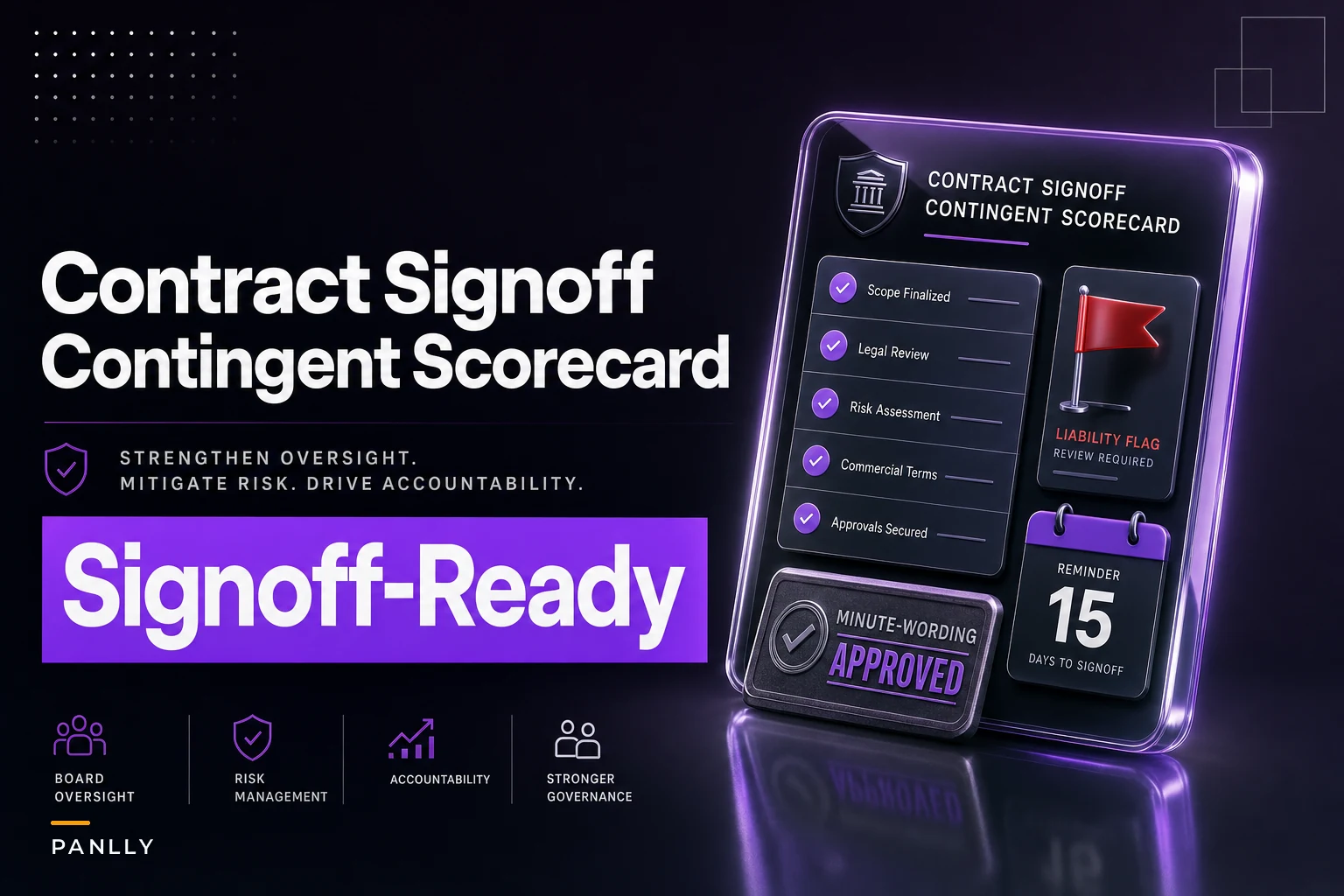
This piece is about closing that gap with a pre‑brief scorecard. Not a legal review (that's counsel's job), but a structured one‑page screen that forces the real risks — contingent liabilities, indemnities, renewal traps — into the board's line of sight before the vote, and produces minute wording that actually protects the directors who signed off.
Why "standard terms" is the phrase that gets boards in trouble
When a management team describes a contract as "standard," what they usually mean is "we've seen worse." That's not the same as low‑risk, and it's definitely not the same as understood.
-
Contingent liabilities that don't appear on any financial statement because they haven't crystallized yet — the earn‑out that only triggers at a revenue threshold, the volume commitment with a shortfall penalty, the guarantee the parent entity quietly signed on behalf of a subsidiary.
-
Indemnities written asymmetrically, where the company agrees to defend and hold harmless the counterparty for a broad category of claims, sometimes without a cap, sometimes surviving termination indefinitely.
-
Renewal mechanics — the auto‑renew that rolls for another three years unless you give 180 days' notice, the price‑escalation clause tied to an index nobody tracks, the exclusivity that renews with it.
None of these show up if the board summary leads with deal value and strategic rationale. And management isn't hiding them maliciously. They're summarizing for approval, and approval summaries optimize for "yes," not for "here's what could bite us."
A typical example: a mid‑size company approves a five‑year managed‑services agreement. The board sees the annual cost — roughly $1.4M — and a tidy strategic justification. What the one‑page summary leaves out is a clause making the company liable for the vendor's compliance failures on data it merely passed through. An indemnity with no monetary cap and a seven‑year survival period. The exposure, if it ever triggers, dwarfs the contract value. Nobody asked, because nothing in the pre‑read prompted the question.
The pre‑brief scorecard: what actually belongs on it
The job of the scorecard is narrow. It is not a substitute for legal review. It's a forcing function that surfaces the handful of terms a board must see, scored consistently so directors can compare one contract against another and against their own risk tolerance.
Eliminate boardroom chaos with seamless coordination.
Panlly simplifies scheduling, collaboration, and follow-ups for every board meeting.
- Centralized meeting scheduling
- Secure document sharing
- Task assignment & tracking
No credit card required
Keep it to a single page. The moment it becomes three pages, people stop reading it and you're back where you started.
| Scorecard dimension | What to capture | Risk flag trigger |
|---|---|---|
| Contract value & term | Annual value, total contract value, term length | TCV above delegated authority threshold |
| Contingent liability | Max quantified exposure beyond contract value | Any uncapped or >2x TCV exposure |
| Indemnity profile | Direction (who indemnifies whom), cap, survival period | Uncapped, or survival >3 years post‑termination |
| Renewal mechanics | Auto‑renew yes/no, notice window, price escalation | Notice window >90 days, or escalation uncapped |
| Termination rights | For‑convenience clause, exit cost, transition obligations | No for‑convenience exit, or exit penalty >20% TCV |
| Counterparty concentration | Share of category spend with this counterparty | Pushes a category above board‑set concentration limit |
| Assignment/change‑of‑control | Can counterparty assign? Consent required on our side? | Change‑of‑control triggers without consent |
The scoring doesn't need to be clever. A simple green/amber/red per row, with any red requiring explicit board discussion and a stated reason it was accepted, does more work than a weighted 100‑point model nobody trusts. The value is in consistency — every contract above the threshold gets screened the same way, so a red indemnity flag means the same thing in March as it does in November.
Have the scorecard validated by legal or the company secretary before circulation.
One pattern worth flagging: boards that adopt a scorecard but let management self‑score tend to see very few reds. The fix is to have it prepared or at least validated by someone whose incentive isn't the deal closing — legal, the corporate secretary, or a risk function. The person who wants the signature shouldn't be the person grading the risk.
Quantifying contingent liabilities so the number is actually on the page
Most board packs go soft here. They mention that an indemnity exists. They don't tell you what it could cost. "The company provides customary indemnities" is not a number, and a board can't weigh a risk it can't see sized.
You don't need actuarial precision. You need a defensible estimate of maximum exposure and a rough probability band, so the board is making a decision rather than a shrug.
-
Identify each contingent trigger. List every clause that could create a payment or liability not already in the base contract value — indemnities, penalties, guarantees, earn‑outs, shortfall commitments.
-
Size the maximum exposure per trigger. For an uncapped indemnity, that's genuinely "unbounded," and you should say so plainly rather than inventing a comfortable ceiling. For a capped one, it's the cap. For a volume shortfall, it's units short × penalty rate.
-
Assign a rough likelihood band. Low / medium / high is fine. The point is to separate the uncapped‑but‑remote from the moderate‑and‑plausible.
-
Calculate an expected‑value and a worst‑case figure. Worst case matters more than expected value here — boards exist to protect against the tail, not the average.
-
Compare worst‑case against the contract's benefit. If the worst‑case contingent exposure exceeds the total value the deal creates, that's a board‑level conversation no matter how remote it looks.
A realistic worked example: a distribution agreement carries a minimum‑volume commitment of around 50,000 units a year, with a shortfall penalty of roughly $12 per unit under‑ordered. If demand softens and the company only moves 30,000 units, that's a 20,000‑unit shortfall — about $240k in penalties, on a contract whose annual margin contribution is maybe $300k–$350k. Suddenly a "routine" distribution deal has a contingent liability that could erase most of a year's benefit. That belongs in front of the board as a number, not buried as "minimum volume terms apply."
Putting a figure on the page changes the conversation. A board will happily approve a known, sized, remote risk. What gets boards sued is approving an unsized one they later claim they didn't understand.
Minute‑ready approval wording that actually protects the directors
Most minutes record the wrong thing. They record that the board approved the contract. What they should record is what the board considered before approving — because that's what a regulator, a litigator, or a D&O carrier looks for when the indemnity triggers two years later.
If the minutes say "the board reviewed and approved the agreement," and the agreement had an uncapped indemnity nobody discussed, the record works against the directors. If the minutes show the board was briefed on the specific exposure, weighed it, and accepted it for stated reasons, the record protects them — even if the risk later materializes.
Sample resolution language that captures consideration, not just conclusion: > "The Board reviewed the pre‑brief contract scorecard for the [Managed Services Agreement with Vendor X], prepared by [Legal/Company Secretary]. The Board noted the amber flag on indemnity profile, specifically an uncapped indemnity with a seven‑year survival period, and the estimated maximum contingent exposure as set out in the scorecard. Following discussion, during which management confirmed [mitigation: insurance coverage / counterparty financial standing / narrowed indemnity scope negotiated], the Board resolved to approve the Agreement on the terms presented, authorizing [named officer] to execute, subject to [any conditions]. The Board directed that the renewal notice window of 180 days be calendared with a reminder to [owner] no later than [date]."
Three things that wording does which generic minutes don't:
-
- It names the specific risk the board saw. "Noted the amber flag on indemnity profile" ties the approval to the scorecard and shows the exposure was actually in front of the directors.
-
- It records the mitigation reasoning. The board didn't just accept risk; it accepted risk because of something. That's the difference between a defensible business‑judgment decision and a rubber stamp.
-
- It assigns the renewal action. The single most common contract failure isn't signing a bad deal — it's missing the notice window and auto‑renewing one you wanted out of. Putting the calendar reminder in the resolution creates an accountable owner.
For deals above delegated authority or with change‑of‑control sensitivity, this logic overlaps heavily with how boards handle larger transactions — the same evidence‑of‑consideration discipline that underpins solid M&A board approvals and templated decision records applies to any contract where contingent exposure runs ahead of headline value.
Where this goes wrong operationally — and the quiet fixes
The scorecard is only as good as the process feeding it, and a few failure patterns show up repeatedly.
The scorecard arrives with the vote, not before. If directors see it for the first time at the meeting, there's no time to probe the reds. The pre‑brief has to actually precede the brief — scorecard circulated with the board pack, not revealed at the table.
Scorecards get recreated from scratch every time. When each contract's screen is built fresh in a new document, you lose comparability and you lose the ability to search "which of our live contracts have uncapped indemnities?" A consistent template and a central place to store completed scorecards matters more than people expect. This is the same discipline behind keeping a searchable board document taxonomy with consistent metadata — a scorecard you can't find or compare later is one that only worked once.
Renewal dates live in someone's head. The 180‑day notice window gets noted in the minutes and then forgotten, because nobody owns the calendar. The fix is dull but effective: every amber or red renewal flag generates a dated reminder assigned to a named owner, tracked until it's actioned.
This is where workflow and board management platforms earn their keep quietly — not by making the judgment call, but by making sure the same scorecard template gets applied every time, that completed scorecards are stored where they can be compared and retrieved, and that renewal deadlines surface as automated reminders rather than relying on whoever happens to remember. The decision stays human. The bookkeeping around it stops being a liability.
A simple workflow view:
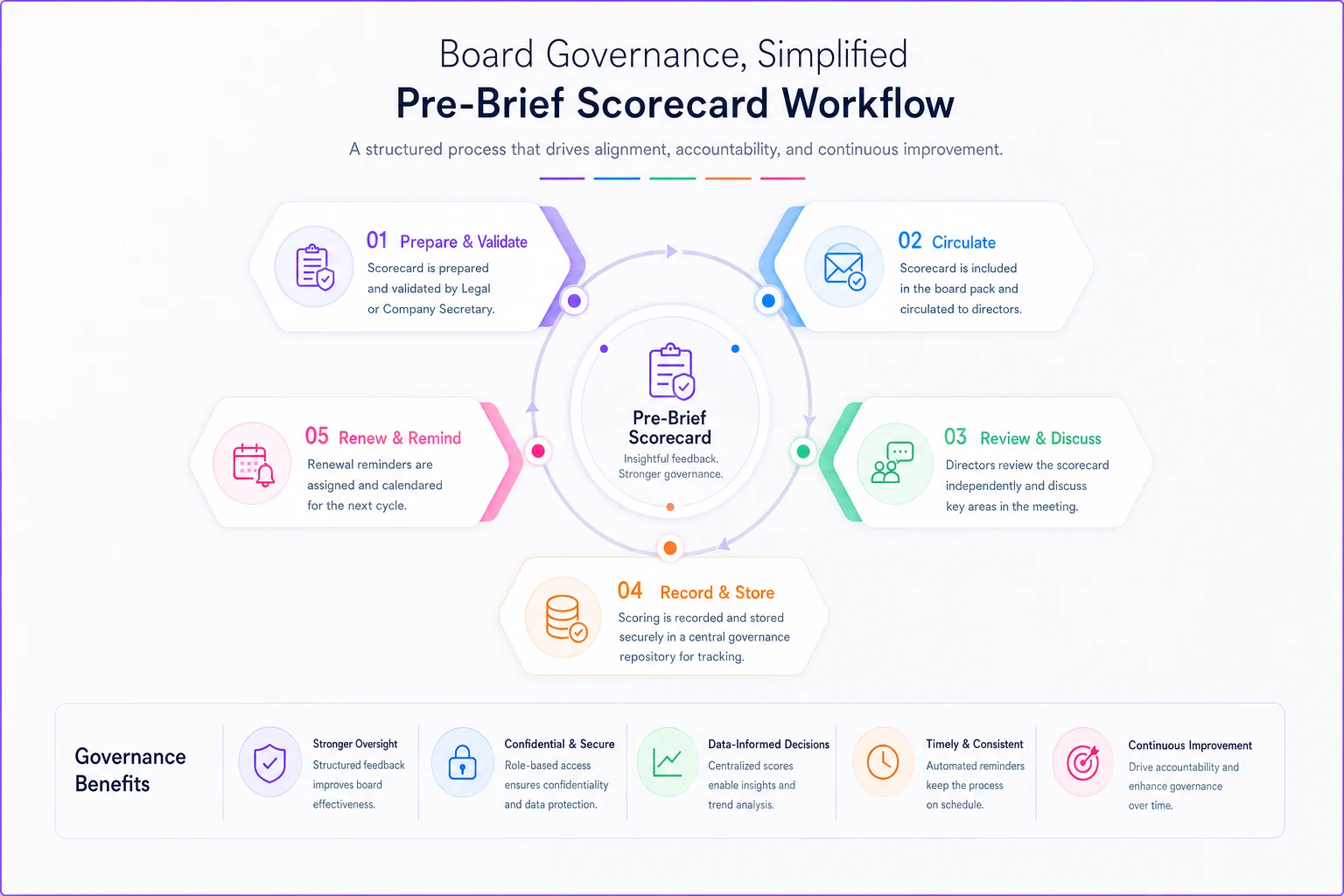
This maps the fixes above.
When this level of rigor makes sense — and when it's overkill
Not every contract needs a scorecard. Run the full process on every office‑supplies renewal and people will route around it. The discipline collapses fast.
This makes sense when: the contract exceeds your delegated authority threshold, carries any indemnity or guarantee, commits the company for more than a year, involves a counterparty the company can't easily replace, or includes a change‑of‑control or exclusivity provision. Those are the deals where unsized contingent exposure actually lives.
This is overkill when: you're dealing with low‑value, short‑term, easily terminable agreements with capped or standard liability. Set a threshold — any contract above a defined TCV, or any contract with a contingent trigger — and screen only what crosses it.
Who should not try to run this alone: management teams scoring their own deals. The screen has to be prepared or validated by someone without a stake in the signature. That's the whole point. A scorecard graded by the person who wants it approved is theater.
The short version
Boards don't get burned by contracts they debated. They get burned by contracts they approved in four minutes because the summary said "standard terms" and the real exposure — the uncapped indemnity, the shortfall penalty, the 180‑day renewal trap — never made it onto the page.
A one‑page pre‑brief scorecard, a sized contingent‑liability figure, and minute wording that records what the board actually considered won't make a bad contract good. But it will make sure that when a board says yes, it's saying yes to something it understood — and that the record proves it. That's the difference between a business‑judgment decision that holds up and an approval that comes back to haunt the people who signed it.
Ready to enhance your board's productivity?
Join 500+ organizations using Panlly to save time, improve governance, and streamline board operations.