

Board packs have a strange habit of growing. A single approval item shows up as a 40-slide deck plus three appendices, and somewhere on slide 27 there's a sentence that actually asks the board to decide something. Directors read it on a plane the night before, the corporate secretary reformats it four times, and the meeting itself turns into a group reading exercise instead of a decision.
Why most board packs bury the decision and how a strict two-page format fixes it
The fix isn't better slides. It's a hard cap. One page that frames the decision, one page that backs it up. Nothing else goes in front of the board for a discrete decision. This piece lays out exactly what goes on each of those two pages, which metadata fields are non-negotiable, and how the resolution language should be written so the corporate secretary can drop it straight into the minutes.
If you've already tightened your consent-agenda rules, this is the natural companion for the items that don't qualify for consent — the ones that genuinely need debate and a recorded vote.
The core problem: packs optimize for coverage, not for the decision
Management writes board material to protect itself. That's the honest driver behind bloat. If something goes wrong later, nobody wants to be the person who left out the risk analysis or the sensitivity table. So everything gets included, and the actual ask gets diluted.
Eliminate boardroom chaos with seamless coordination.
Panlly simplifies scheduling, collaboration, and follow-ups for every board meeting.
- Centralized meeting scheduling
- Secure document sharing
- Task assignment & tracking
No credit card required
A pattern that shows up repeatedly across board cycles: the more comprehensive the pack, the less precise the eventual motion. Directors who read 40 pages tend to approve vague language like "the board supports management's recommendation regarding the ERP migration." That sentence means nothing six months later when a regulator or plaintiff's counsel asks what exactly was authorized, at what spend ceiling, with what conditions.
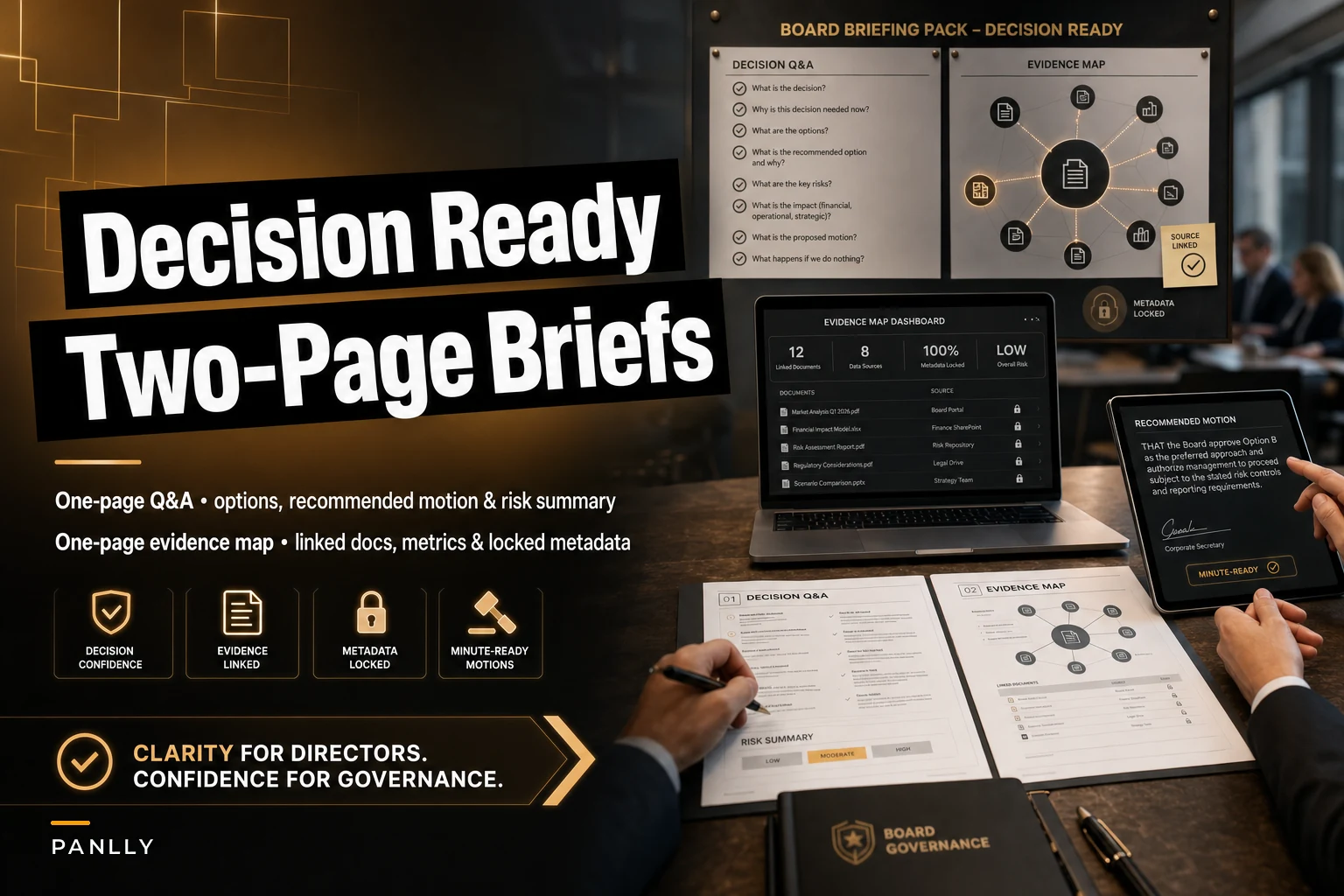
The two-page format flips the incentive. Instead of "include everything so we're covered," it becomes "state the decision so precisely that the record protects everyone." Coverage still exists — it just moves into the evidence map and its linked source documents, not into the decision framing.
Page one: the decision Q&A
Page one is not a summary. It's a structured question with structured answers. Treat it almost like an interrogation of the proposal, because that's what a good board does anyway.
The four required blocks:
1. The question. A single sentence, phrased as a yes/no or a choice. Not "discuss the refinancing" — instead, "Shall the board authorize refinancing of the $18M term loan on the terms in Option B, up to a spend ceiling of $220k in fees?" If you can't write the question in one clean sentence, the proposal isn't ready to come to the board.
2. The options. Usually two to four. Each option gets one or two lines, no more. Include the "do nothing" option explicitly, because boards forget it exists and it's often the real alternative. A typical set looks like:
-
Option A — Refinance now at fixed rate, ~5.9%, fees ~$210k
-
Option B — Refinance now at floating rate with cap, fees ~$180k
-
Option C — Wait one quarter, accept rollover risk on the existing facility
3. The recommended motion. Management's pick, in plain language, plus the reason in one sentence. Not a paragraph. If the reasoning needs a paragraph, it belongs in the evidence map.
4. The risks. Three to five bullet points, each tied to the recommended motion specifically — not generic market risk. What breaks if the board says yes? "Floating rate exposure above cap if base rates exceed 7%" is useful. "Interest rate environment remains uncertain" is filler.
Here's a compact way to lay out page one so directors can scan it in under two minutes:
| Block | Content | Length rule |
|---|---|---|
| Question | The decision as one yes/no or choice | 1 sentence |
| Options | Including "do nothing" | 1–2 lines each |
| Recommended motion | The pick + one-line rationale | 2 sentences max |
| Risks | Tied to the recommendation | 3–5 bullets |
| Metadata header | See below | Fixed fields |
The discipline here matters more than the layout. Once management knows the risks section has to name what breaks if the board approves, the quality of pre-work jumps. They stop hiding the downside in an appendix.
If you can't state the question in one sentence, the proposal isn't ready for the board.
The discipline here matters more than the layout. Once management knows the risks section has to name what breaks if the board approves, the quality of pre-work jumps. They stop hiding the downside in an appendix.
Page two: the evidence map
Page two is where the 40 slides went. But instead of dumping them, you map them. The evidence page is a directory, not a document. Its job is to let any director — or later, any regulator — trace every claim on page one back to a source they can open.
Three columns do most of the work:
-
The claim or number (e.g. "fees ~$180k on Option B")
-
The source (e.g. "Term sheet, Lender B, section 4")
-
The link and metadata (document ID, version, date, owner)
The reason to separate the map from the underlying docs is retrieval. When a board decision gets questioned two years later, nobody wants to reconstruct which version of a spreadsheet the numbers came from. The evidence map freezes that lineage at the moment of the vote.
This connects directly to the value of a durable board decision log — the evidence map is essentially the exhibit list that a good decision log points back to. One captures what was decided; the other captures what it was decided on.
The metadata fields that can't be optional
This is the part most templates skip, and it's the part that saves you during an audit or litigation. Every two-page briefing carries a fixed metadata header, and every document referenced in the evidence map carries the same field set. No exceptions, no "we'll fill it in later."
-
Decision ID — a unique reference the minutes and the log both cite
-
Meeting date and body — full board, or which committee
-
Owner / sponsor — the executive accountable for the item
-
Version and version date — of the briefing itself
-
Source document IDs — every doc in the evidence map, with its own version
-
Confidentiality tier — who can see it, relevant for privilege
-
Related decisions — prior IDs this one depends on or amends
The field that gets fought over most is "version date." People think it's bureaucratic. It isn't. In real disputes, the entire question is often which version of the numbers the board actually saw. A briefing that says "v3, dated 14 March, sourced from term sheet v2 dated 11 March" is nearly bulletproof. A briefing with no version stamp is a gift to opposing counsel.
Minute-ready resolution language
This is the piece that saves the corporate secretary hours and saves the company from ambiguous records. The recommended motion on page one must be written in resolution form — the exact words that will appear in the minutes if the board approves.
> "The board discussed the refinancing and was supportive."
> "RESOLVED, that the board authorizes management to refinance the $18M term loan on the floating-rate terms described in Option B, subject to an all-in fee ceiling of $200,000 and a rate cap not exceeding 7.0%, and delegates execution to the CFO subject to review by counsel."
Notice what the good version does: it names the amount, the option, the ceiling, the cap, the delegate, and the condition. The corporate secretary copies it, records the vote count and any abstentions, and the minute is done. No reconstruction from memory, no "roughly what we agreed."
Writing the resolution before the meeting also surfaces problems. When management has to commit to a spend ceiling in advance, they discover whether they actually know the number. More often than people expect, drafting the resolution reveals that the proposal wasn't as baked as the deck implied.
When this format actually makes sense
The two-page format works best for specific, high-stakes decision types. Not every board item needs this level of structure, but certain categories clearly benefit from it.
It's the right fit for discrete authorizations — financings, acquisitions, major contracts, spend above a defined threshold. It also earns its place on anything likely to be scrutinized later: regulated decisions, related-party matters, anything where the record needs to hold up under pressure. Recurring approvals where consistency of documentation matters, like quarterly capital allocations, are another natural home for it.
When it's a bad fit
The two-page format is wrong for genuinely exploratory discussions. If the board is working through a strategy session or something with no clear decision yet, forcing it into a decision Q&A creates false precision. Strategy discussions need room to wander. Don't jam them into a template built for a vote.
It's also overkill for consent-agenda items. If something is routine enough to consent through, it doesn't need an evidence map. Reserve the two-page discipline for items that carry real risk or real money.
A realistic before-and-after
Consider a mid-market manufacturer with a nine-person board that met roughly every six weeks. Their capital-approval items ran 25 to 45 pages each, and directors routinely spent the first 15 minutes of every such item just orienting themselves. Two of their last four major approvals had minutes so loosely worded that the finance team had to email directors afterward to confirm the approved spend ceiling — which is exactly the kind of after-the-fact clarification that undermines a clean record.
They moved capital items to the strict two-page format. The underlying analysis didn't disappear; it moved into linked documents referenced on the evidence map. Orientation time on those items dropped noticeably because the question was stated up front. And because the resolution language was pre-drafted, the post-meeting confirmation emails stopped almost entirely. The board wasn't approving less carefully — the sponsors were just doing the precision work before the room instead of after.
The interesting side effect: management pushback on the format faded within two cycles once they realized the shorter briefing was harder to write, not easier. Compression forces clarity. Sponsors who couldn't state their ask in one sentence learned they weren't ready to ask.
How to roll it out without a fight
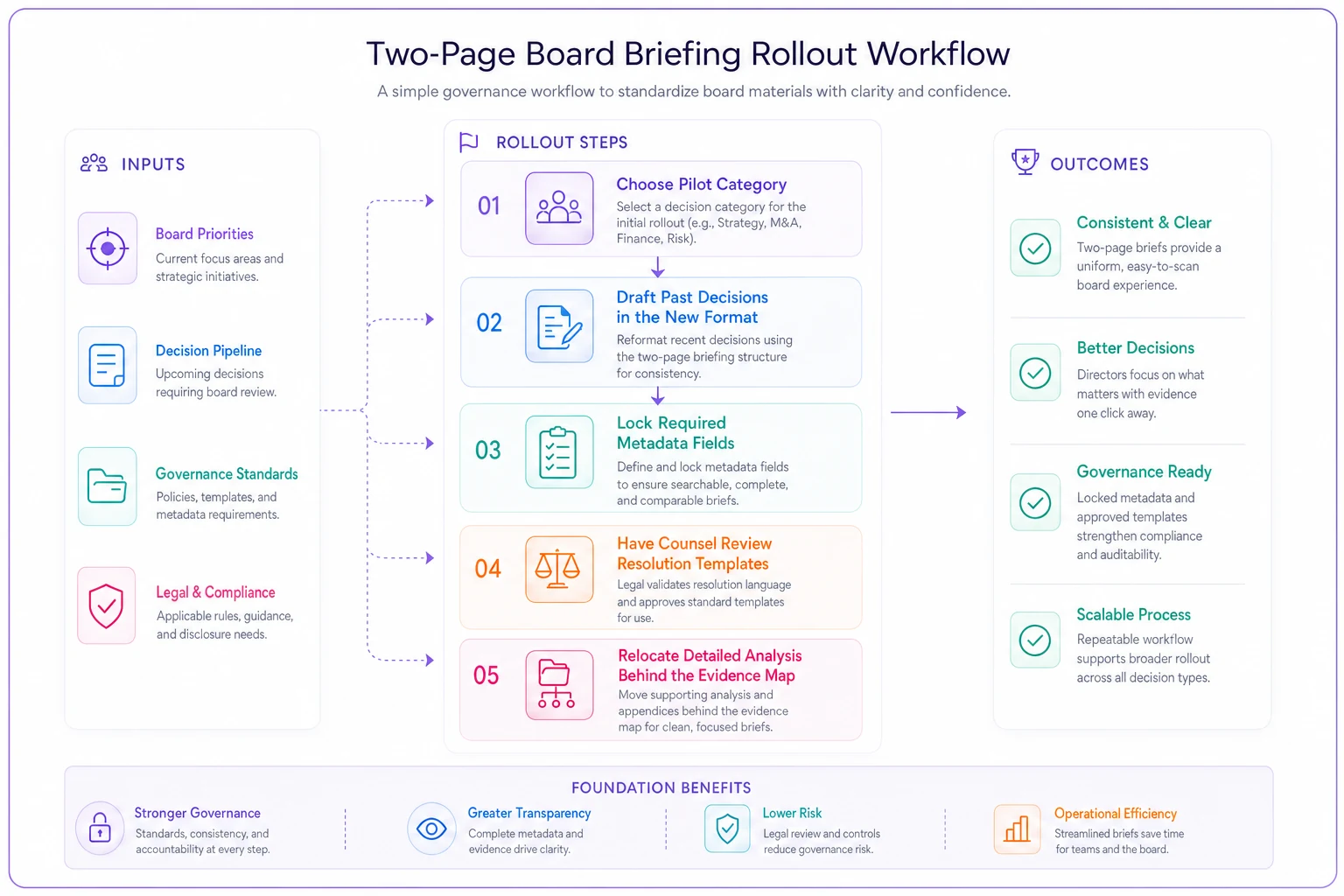
Start narrow. Pick one category first — capital approvals or contract authorizations — and don't try to convert everything at once. Draft two or three real past decisions in the new format so directors see it with familiar content before they encounter it live.
-
Pick one category first — capital approvals or contract authorizations — don't convert everything at once.
-
Draft two or three real past decisions in the new format so directors see it with familiar content.
-
Lock the metadata fields as a required header; make "no version date, no submission" a hard rule.
-
Have counsel review the resolution-language pattern once, so sponsors have an approved template to copy.
-
Keep the old detailed analysis — just relocate it behind the evidence map rather than in front of the board.
Visual workflow for rolling out the two-page template:
A quick pre-submission checklist for whoever owns the item:
-
- [ ] The question fits in one sentence
-
- [ ] "Do nothing" is listed as an option
-
- [ ] Every risk is tied to the recommendation, not generic
-
- [ ] Every number on page one appears in the evidence map with a source
-
- [ ] All seven metadata fields are filled, including version date
-
- [ ] The recommended motion is written as final resolution language
-
- [ ] Every source document is linked and version-stamped
Keep the old detailed analysis — just relocate it behind the evidence map rather than in front of the board.
The point isn't shorter packs
Two pages sounds like a length rule, but it's really a rigor rule. The constraint forces sponsors to know their number, name their risk, and commit their resolution language before they ever walk into the room. Everything the old 40-page pack contained still exists — it's just organized so the board can decide and the record can defend that decision years later.
Directors don't need more material. They need the decision framed cleanly and the evidence one click away. Get those two pages right and the meeting gets faster, the minutes get tighter, and the archive stops being a liability.
Directors don't need more material. They need the decision framed cleanly and the evidence one click away. Get those two pages right and the meeting gets faster, the minutes get tighter, and the archive stops being a liability.
Ready to enhance your board's productivity?
Join 500+ organizations using Panlly to save time, improve governance, and streamline board operations.