

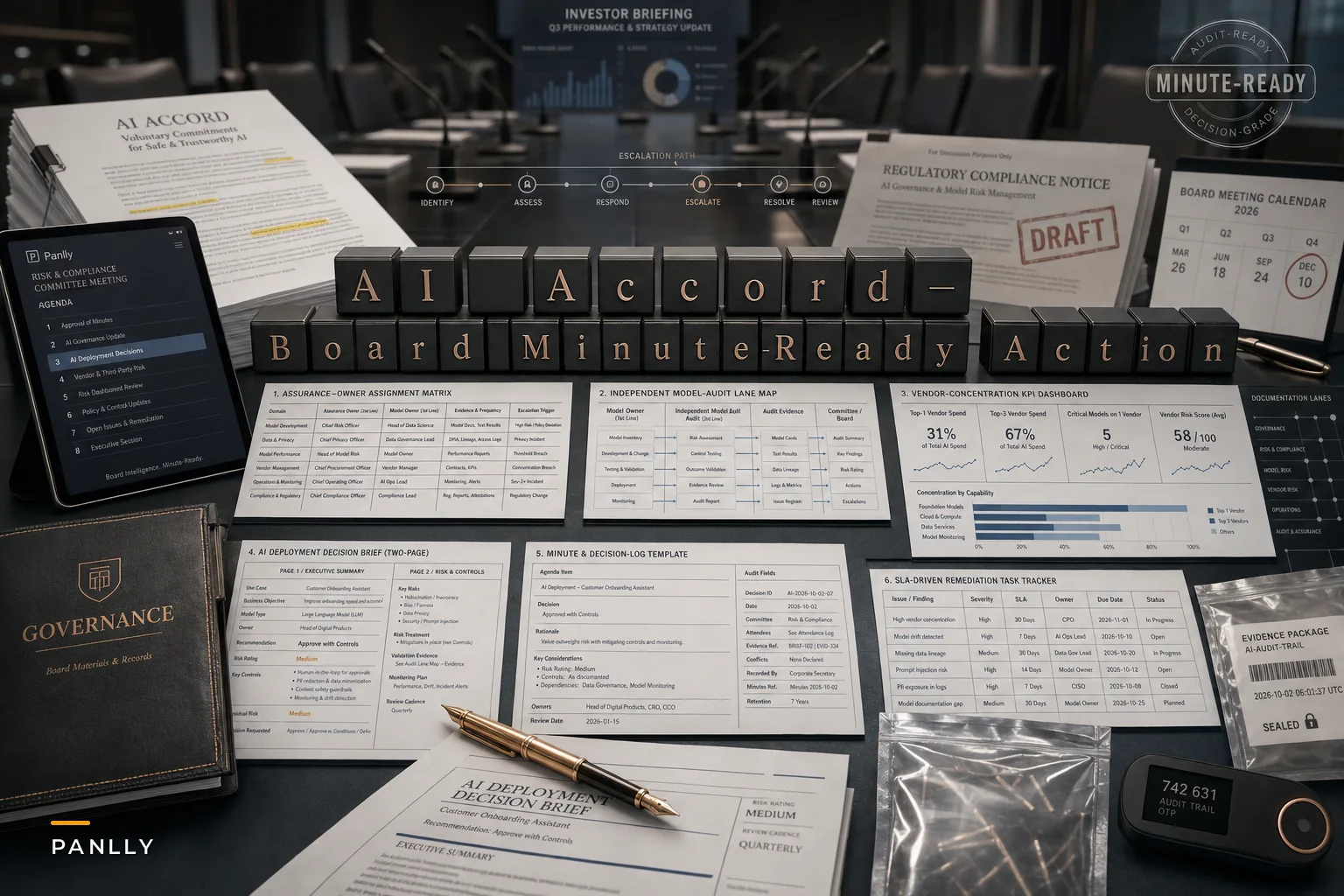

When the White House released its industry AI accord on September 29, 2026 alongside a set of Presidential actions on advanced AI, the headline language settled on "voluntary safety controls," "independent audits," and "board-level oversight." Reuters reported that signatories committed to layered controls and board review — and that last phrase is the one that should make corporate secretaries sit up. "Board review" sounds simple until someone asks you to produce the evidence.
Most boards already believe they have AI oversight. What they actually have is a slide in the quarterly CTO update that mentions AI three times, a committee that nods, and minutes that say "the Board discussed." That's not oversight — that's attendance. When an investor, auditor, or regulator asks what the board specifically did to govern AI risk, "we discussed it" is the answer that invites a second, considerably less friendly question.
This piece isn't really about the accord itself — the news is the entry point. It's about the gap the accord exposes: boards have no standard method for converting AI principles into auditable board AI oversight. So let's build what closes that gap. Audit lanes, named assurance owners, and minutes that hold up under scrutiny.
The real problem isn't AI. It's that AI risk has no home on the board.
Governance failures around novel risk categories follow a familiar pattern, and AI is running the same playbook. The risk is new enough that nobody wants to own it, technical enough that non-specialist directors defer, and fast-moving enough that by the time a charter gets updated, the risk has already changed shape twice.
The result is floating responsibility. Audit thinks it's a tech issue. The tech committee thinks it's a risk issue. Risk thinks the full board owns strategic AI bets. Everyone assumes someone else is holding the rope. The rope is on the floor.
A scenario that comes up more than it should: a mid-market company deploys a vendor model into its customer-service workflow and a credit-decisioning tool in the same fiscal year. Neither deployment hits a board committee as a named decision. Both surface months later as a line in an operational update. When the audit committee eventually asks "who approved the credit model and against what controls," the honest answer is that no single body did. It went through procurement and IT, and the board's involvement was retroactive awareness.
That's the exposure. Not that the company did something reckless — it may have been operationally competent throughout — but that there's no documented chain showing a board-level body set expectations, received assurance, and made a recorded decision. In a dispute, absence of evidence reads as absence of oversight.
Audit lanes: deciding who owns what before you need the answer
The first step is unglamorous and it's the one everyone skips: assign AI risk to specific lanes with named owners, then write it into charters so it survives personnel changes.
Eliminate boardroom chaos with seamless coordination.
Panlly simplifies scheduling, collaboration, and follow-ups for every board meeting.
- Centralized meeting scheduling
- Secure document sharing
- Task assignment & tracking
No credit card required
AI risk isn't one thing. Treating it as one thing is exactly why it falls between committees. Break it into categories that actually behave differently, then route each to the body best positioned to oversee it.
| AI risk category | What it actually covers | Natural oversight owner | Primary assurance source |
|---|---|---|---|
| Model safety & performance | Accuracy, drift, failure modes, independent model audits | Risk or dedicated Tech/AI committee | Independent audit + internal model validation |
| Third-party / supplier model risk | Vendor model providers, concentration, contract terms | Audit or Risk committee | Vendor assurance reports, contract review |
| Data governance & privacy | Training data provenance, consent, data leakage | Audit / Privacy committee | Internal audit + DPO reporting |
| Regulatory & disclosure | Emerging rules, accord commitments, investor statements | Full board + Audit | Counsel + compliance attestation |
| Financial & use-case materiality | AI in credit, pricing, financial reporting inputs | Audit committee | Internal controls + external auditor |
The point of that table isn't to be prescriptive about committee names — structures vary. The point is that each row needs one accountable owner, not a shared one. Assigning something to "the board collectively" is the polite version of assigning it to nobody.
Assign a single accountable owner per lane in the charter to avoid floating responsibility.
Companies that handle this well don't necessarily create a new AI committee. Many just extend an existing committee's charter and resource it properly. A new committee feels decisive but often creates another silo that meets quarterly and knows less than the operators. What matters is that the lane is named, the owner is named, and the assurance source is specified.
Assurance owners and the three lines
This is where the accord's "independent audits" language gets operationally real. An independent audit only means something to a board if the board knows who commissioned it, who reviews it, and what happens when it comes back with problems.
It's fundamentally a three-lines problem, and it maps onto structure boards should already have. The people building and running AI systems are the first line. Risk and compliance functions setting and monitoring controls are the second. Internal audit — and the independent external auditors the accord contemplates — are the third. For a longer treatment of how these layers fit together without overlapping or leaving gaps, the board assurance architecture framework covers aligning them, and AI slots into that structure rather than requiring a parallel one.
The mistake boards make repeatedly is accepting first-line assurance dressed up as independent review. The engineering team presents their own model-validation results, the committee nods, and it gets logged as oversight. It isn't. First-line telling you it's fine is not assurance — it's the thing assurance is supposed to check.
A workable assurance flow for AI oversight:
-
First line (model owners/IT) produces model inventory, performance monitoring, and incident logs on a defined cadence.
-
Second line (risk/compliance) sets control standards, reviews first-line outputs, and flags exceptions against defined tolerances.
-
Third line (internal audit + independent auditors) tests whether the controls are real and operating, not just documented.
-
Committee owner receives a consolidated assurance view — not raw first-line slides — and interrogates exceptions.
-
Full board gets a periodic summary with anything breaching tolerance escalated by exception.
This diagram summarizes the flow from first-line activity to board escalation.
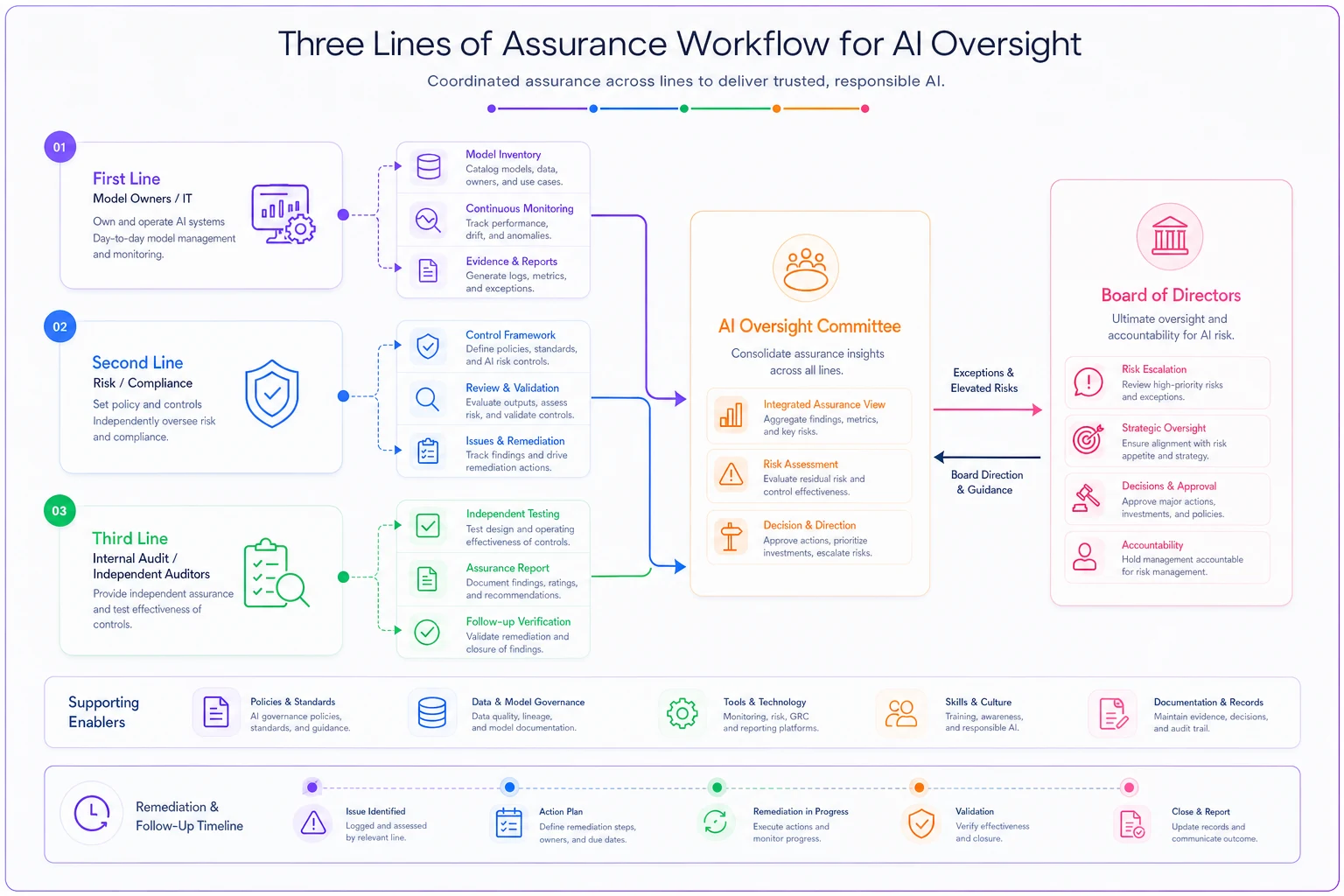
The discipline here matters: the committee should mostly be looking at second and third line outputs. When the board reviews first-line self-reporting directly, it's not overseeing — it's spectating.
Minute-ready oversight: making the record carry the weight
All of this is worthless if the minutes don't capture it. And minutes are where good intentions go to die, because the person writing them wasn't in the technical conversation and defaults to "the Committee reviewed and discussed the AI risk update."
That sentence protects no one. It doesn't show what was reviewed, what the directors actually asked, what assurance they relied on, or what they decided. Compare:
-
Weak "The Committee received an update on AI risk and discussed the Company's use of third-party models."
-
Defensible "The Committee reviewed the Q3 model inventory (12 production models, 2 new credit-related deployments), received the independent validation report on the credit-decisioning model dated [date], and questioned management on drift monitoring for the two new deployments. The Committee requested a remediation timeline for the two monitoring gaps identified in the internal audit report and set a review date of [date]. Motion to approve continued deployment subject to that remediation carried unanimously."
The second version takes maybe ninety extra seconds to write and does ten times the work in a dispute. It shows a specific body, specific evidence, specific challenge, and a recorded decision with a follow-up gate.
A minute-ready AI oversight checklist
-
[ ] The specific AI matter is named, not referenced generically
-
[ ] The evidence relied on is identified by document and date (audit report, validation, vendor attestation)
-
[ ] The assurance source is clear (independent vs. first-line)
-
[ ] At least one substantive director question or challenge is recorded
-
[ ] Any exception against tolerance is noted with an owner and date
-
[ ] The decision is recorded as a motion with outcome
-
[ ] A follow-up or review date is set where remediation is pending
-
[ ] The responsible committee and its charter authority are clear
If your minutes can't clear these bars for AI, they probably can't for your other emerging risks either. AI just has the spotlight on it right now.
A short real scenario
A regional financial-services firm — roughly 400 employees, two consumer lending products, growing reliance on vendor models for fraud screening and underwriting support. Before any of this work, the board touched AI once a quarter through the CTO's general technology update. No named owner, no independent validation, minutes that said "discussed."
After reworking the structure, AI supplier and model risk was assigned to the audit committee's charter, with a defined assurance view combining internal audit testing and vendor independent model reports. The quarterly pack shifted from a narrative slide to a one-page assurance summary flagging exceptions. The first pass surfaced two things nobody had centrally tracked — a single vendor supplying both the fraud and underwriting models (a concentration problem), and no documented validation on the underwriting tool.
Neither issue was catastrophic. But both were now documented, owned, and on a remediation clock before any regulator raised them. The shift wasn't about catching a disaster in progress. It was the difference between "we'd be scrambling" and "here's the file." That's the whole value of auditable oversight.
When a dedicated AI committee makes sense, and when it doesn't
When it makes sense: AI is genuinely core to your product or revenue, deployments are frequent and material, and you have directors with real technical depth. If AI is the business, a standing committee with proper resourcing is probably necessary.
When it's a bad idea: You're adopting third-party AI into otherwise conventional operations. A new committee here usually becomes a box-ticking body that meets quarterly, lacks operational detail, and fragments oversight that belonged in audit or risk all along. Extend an existing charter instead.
Who should not rush this: Boards without a working three-lines structure. Bolting AI oversight onto broken assurance just gives you a new category of undocumented risk. Fix the architecture first, then route AI through it.
Where tooling quietly helps — and where it doesn't
A fair amount of this is a records and workflow problem, not a judgment problem. The judgment has to come from directors. But the parts that fail in practice — charters that don't get updated, assurance reports that arrive as scattered PDFs, follow-up items with review dates nobody tracks, minutes that drift back to vague language — those are exactly where a governance platform with workflow and decision-logging earns its place.
Keeping the model inventory, assurance sources, exception items, and recorded decisions in one searchable, timestamped record is what turns "we have oversight" into "here's the evidence." That's the supporting role though. The tool keeps the file honest. It doesn't do the overseeing.
The bottom line
The accord didn't create a new obligation so much as it raised the expectation that boards can show their AI oversight, not just assert it. The companies that struggle won't be the ones with the most AI — they'll be the ones whose governance records can't survive a direct question about who owned what and what they decided.
Build the lanes before you need them. Name the owners in the charter, not in a meeting. Insist on assurance that isn't the first line grading its own work. Write minutes a stranger could read in two years and understand exactly what the board knew and chose. None of that requires predicting where AI goes next. It just requires that your oversight leaves a trail worth following.
Ready to enhance your board's productivity?
Join 500+ organizations using Panlly to save time, improve governance, and streamline board operations.