

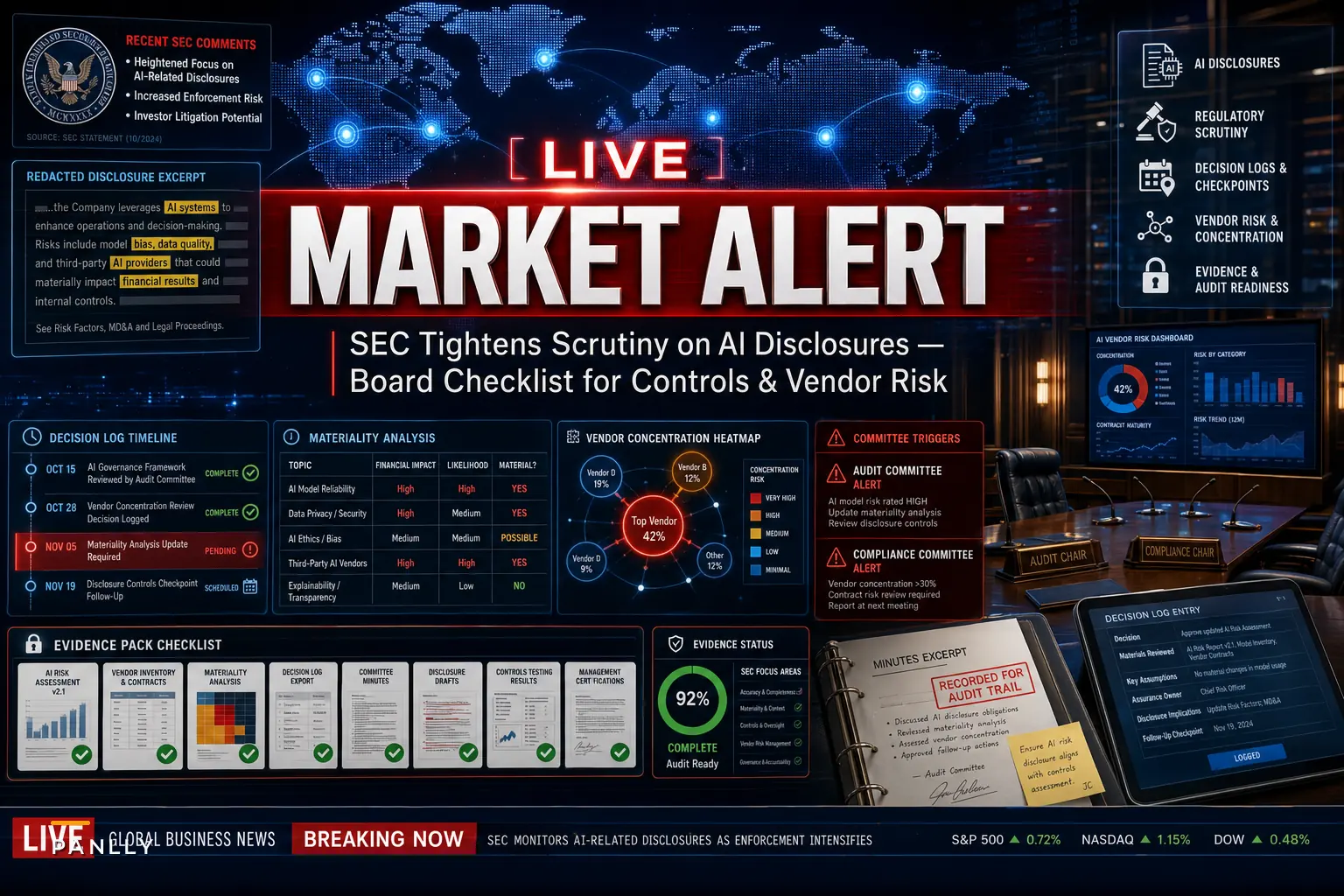

The SEC's enforcement division has put companies on notice that it's reading their AI disclosures closely. In reporting dated October 30, 2026, the agency's top enforcement official said regulators are actively monitoring corporate disclosures about artificial intelligence, warning that inaccurate or incomplete statements could draw enforcement — especially as investors get nervous about how much companies are spending on AI and how much of the messaging is hype.
That warning landed at a specific moment. Public companies had just disclosed enormous AI investments, tech stocks had wobbled, and investors started asking harder questions about returns. When the gap between what a company says about AI and what it can prove gets too wide, that's exactly the kind of territory enforcement staff likes to walk into.
For boards and corporate secretaries, this isn't really a disclosure-drafting problem. It's an evidence problem. The language in your 10-K is the easy part. The hard part is whether your minutes, decision logs, and committee records can support that language if someone asks you to back it up two years from now. That's where most boards are quietly exposed.
Why AI disclosure risk is different from the disclosure risk you already manage
Boards are used to managing disclosure risk around financials, cyber incidents, and material contracts. AI feels similar but behaves differently in three ways that matter operationally.
First, AI spending tends to spread across departments with no single owner. Marketing buys one tool, the data team builds a model, operations licenses something through a vendor, and finance sees it only as a line of cloud spend. By the time it rolls up to a disclosure, nobody in the room can say precisely what was built, what it cost, or what it depends on.
Second, the risk side of AI is easy to overstate and easy to understate at the same time. A company brags about an "AI-driven" capability on an earnings call, then its filing describes the same thing in hedged, generic language. Those two descriptions sitting side by side are what create enforcement exposure — not because either is a lie, but because the record doesn't reconcile them.
Third, AI depends heavily on third parties. The model might be a vendor's. The training data might be licensed. The inference might run on infrastructure you don't control. A disclosure implying proprietary capability, sitting on top of a vendor stack the board never examined, is a mismatch waiting to be found.
What ties all three together is documentation. The SEC enforcement signal isn't asking boards to invent new oversight — it's asking whether the oversight you claim actually leaves a trail.
The underlying problem: your minutes weren't built to carry AI decisions
A pattern that shows up across a lot of boardrooms: a company makes a genuinely significant AI decision — committing eight figures to a platform, or reorienting a product around a model — and the minutes capture it in one line: "The Board discussed the Company's AI strategy and the CEO's update was noted."
Eliminate boardroom chaos with seamless coordination.
Panlly simplifies scheduling, collaboration, and follow-ups for every board meeting.
- Centralized meeting scheduling
- Secure document sharing
- Task assignment & tracking
No credit card required
That single line is fine until the disclosure says something specific, like "the Company expects AI investments to materially improve operating margins." Now an examiner reading backward wants to know: what did the board actually review? What risk assessment informed that statement? Who owned the assumption that margins would improve? The minutes have nothing. The gap between a confident public statement and a thin internal record is the exact seam enforcement looks for.
This usually happens because AI items get slotted into the agenda as "updates" rather than "decisions." Updates don't trigger the same documentation discipline. Nobody assigns an owner, nobody logs the assumptions, and the risk discussion — if it happened at all — lives in people's memory instead of the record.
The fix isn't longer minutes. It's a decision structure that forces the right things onto the page when AI is on the agenda.
A board checklist for AI disclosure controls
Use this before your next disclosure cycle. It's meant to be worked through in a committee meeting, not admired from a distance.
-
Inventory every material AI initiative across departments, with an owner named for each. If you can't produce this list in an afternoon, your disclosures are describing something you can't fully see.
-
Reconcile public language to internal evidence. For each AI claim in filings, earnings calls, and investor decks, point to the board or committee record that supports it. Flag anything that can't be traced.
-
Separate what's built from what's aspirational. Disclosures get into trouble when future intent is described in present tense. Mark each claim as current capability vs. roadmap.
-
Assign an assurance owner to each material AI project — someone accountable for the accuracy of what's reported about it, not just its delivery.
-
Capture the risk assessment in the minutes, not just the strategy. If the board discussed model reliability, data provenance, or vendor dependence, that discussion should appear in the record.
-
Surface vendor concentration to the audit or risk committee. Know which AI capabilities ride on a single provider and what happens if that provider changes terms, fails, or gets acquired.
-
Run a retroactive disclosure audit on the last 12–18 months of AI statements. Find the mismatches before anyone else does.
-
Set a review cadence so AI disclosure language gets a deliberate check each quarter rather than a scramble at filing time.
Use a shared inventory with owners and links to evidence to make reconciliation quicker.
The point of the checklist isn't to generate paperwork. It's to make sure that if enforcement staff ever asks "show me," you have something to show.
A minute-ready process for AI decisions
When a material AI item hits the agenda, the instinct is usually to treat it like any other strategy update — a brief discussion, a nod, and move on. That's where the record breaks down. Running AI decisions through a fixed sequence makes the documentation almost automatic, and it's the kind of structure that tends to hold up under later review.
-
State the decision, not the topic. "The Board approved committing up to $X to Platform Y over 24 months" — not "discussed AI investment."
-
Record what was reviewed. Name the materials
the business case, the risk memo, the vendor assessment, the cost model. If it informed the decision, it belongs in the record.
-
Log the key assumptions. Expected benefit, expected cost, dependencies, and the biggest risks the board identified. These are the assumptions your future disclosures will rest on.
-
Name the assurance owner. One person accountable for the accuracy of what gets reported about this initiative going forward.
-
Note the disclosure implication. Does this decision change what the company should be saying publicly? Flag it so the disclosure committee isn't surprised later.
-
Set the follow-up checkpoint. When does the board revisit this to confirm the assumptions still hold? AI projects drift fast, and stale assumptions in a filing are their own problem.
Six steps, a bit of discipline in the room, and the result is a record that actually matches whatever ends up in the disclosure.
A simple visual of this sequence helps make it repeatable.
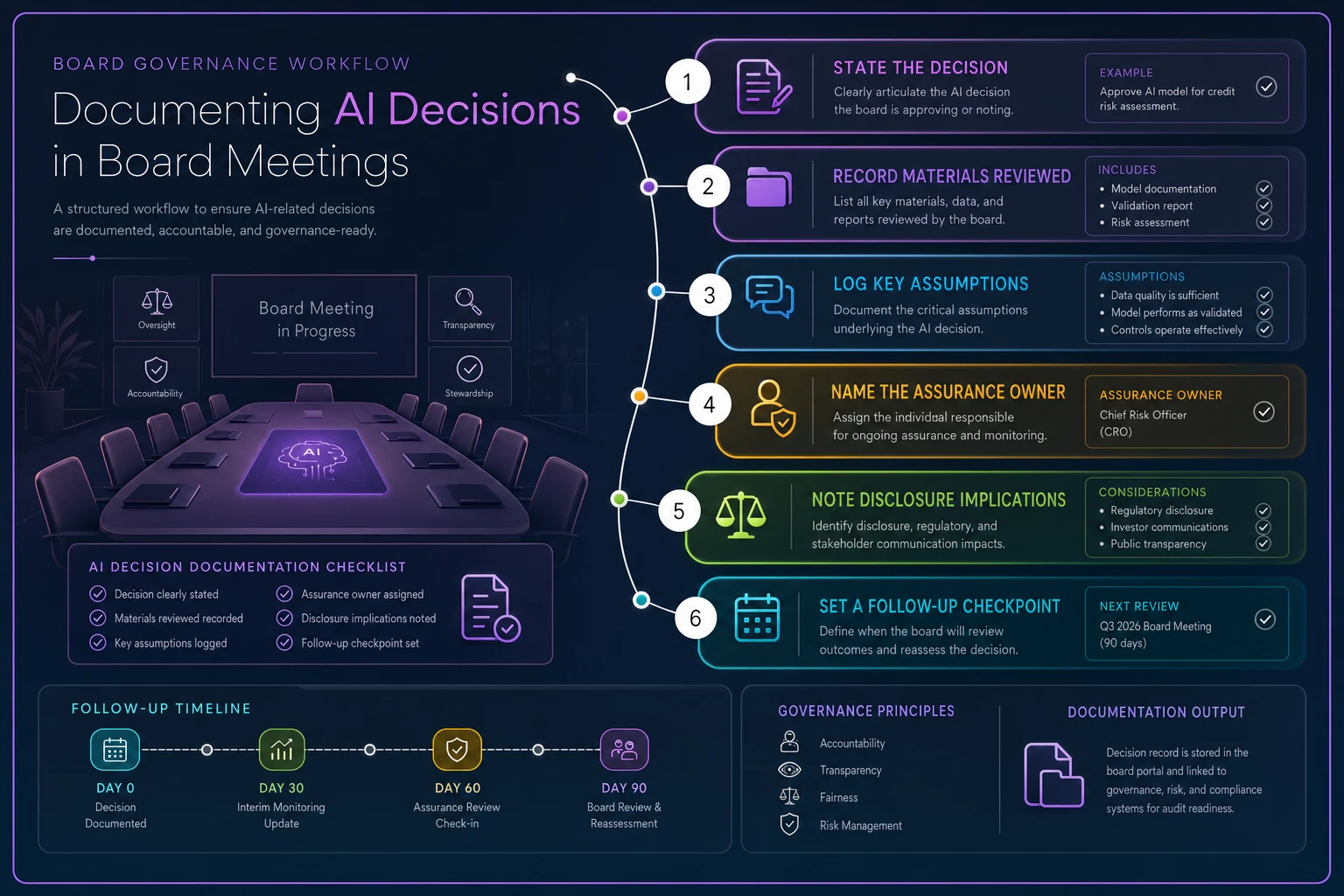
Use this to train meeting chairs and corporate secretaries on the process.
What good evidence looks like vs. what gets boards in trouble
Most boards aren't maintaining a weak record because they're careless — it's just that the standards for "update noted" have always been fine for everything else. AI disclosures changed the stakes. When an examiner reads a confident filing claim and then pulls the corresponding board records, the comparison is often jarring.
| Dimension | Weak record (enforcement risk) | Strong record (defensible) |
|---|---|---|
| Decision capture | "AI strategy discussed; update noted" | Specific decision, amount, timeframe, and vote recorded |
| Materials reviewed | Not referenced | Business case, risk memo, vendor review listed and retained |
| Risk assessment | Lives in memory | Documented in minutes with named concerns |
| Ownership | Diffuse / unclear | Named assurance owner per material initiative |
| Vendor exposure | Never surfaced to committee | Concentration and contract risk reviewed by audit/risk |
| Public vs. internal alignment | No reconciliation | Each disclosure claim traced to a board record |
The left column isn't negligence — it's just how most boards have handled fast-moving topics for years. The problem is that AI disclosures now get read against that record, and the thin version doesn't survive the comparison.
A realistic scenario
Consider a mid-cap software company that disclosed an AI initiative it expected to improve gross margins. The initiative was real. The language was optimistic but not unreasonable. The problem surfaced when the audit committee ran a retroactive review ahead of the next filing cycle.
What they found: the margin assumption traced back to a single slide in a vendor's sales deck, repeated across three quarters of investor communications, with no independent board review behind it. Roughly $40 million in committed spend, and the supporting board record amounted to two "update noted" entries. The core capability also depended on one vendor whose contract was up for renewal — a concentration risk no committee had ever examined.
Nothing illegal had happened. But if an inquiry had landed, the company couldn't have shown its work. Over the following two quarters they rebuilt the record: logged the actual decisions and assumptions, assigned an assurance owner, brought the vendor dependency to the risk committee, and tightened their disclosure language to separate current results from projected ones. The disclosures got more modest and far more defensible. The difference wasn't the AI. It was whether the evidence existed.
When tighter AI disclosure controls make sense — and when they don't
When this is clearly worth it: your company has made or is about to make material AI commitments, talks about AI in investor-facing communications, or depends on AI vendors for capabilities you describe as differentiating. If any of those are true, the enforcement signal is pointed at you.
When it's lighter-touch: if your AI use is genuinely immaterial — a few productivity tools, nothing in the filings, no investor narrative — you don't need a heavyweight program. You need a clear, documented conclusion that it's immaterial, so that conclusion itself is defensible.
Who should be careful not to overreact: boards that respond by burying every AI mention in boilerplate caveats. Over-hedged disclosures that contradict confident earnings-call language create the same mismatch risk from the other direction. The goal is alignment between what you say and what you can prove — not maximum caution in the filing and maximum enthusiasm on the call.
Where this connects to your broader AI oversight
Disclosure controls are the reporting end of something larger. If the board already has a structured way to oversee AI — clear ownership, risk lanes, and a defined level of assurance for each system — the disclosure evidence tends to exist as a byproduct. If that oversight structure is missing, every disclosure cycle becomes a reconstruction project.
This is why disclosure readiness and oversight maturity move together. A board that has built a proper AI oversight framework with explainability and assurance lanes already knows who owns each system, what risks were assessed, and where the vendor dependencies sit — which covers most of what a disclosure examiner would ask for anyway. The reporting discipline this moment demands is really just that oversight becoming visible on the page.
For boards running digital governance tools, this is also where the practical work shows up: making sure AI decisions get captured as decisions, that assurance owners are assigned and tracked, that vendor concentration surfaces to the right committee, and that the trail between a public claim and its internal support is searchable rather than scattered across inboxes and old deck versions.
The bottom line for boards and corporate secretaries
The SEC's enforcement focus on AI disclosures, as reported by Reuters and picked up widely, isn't asking boards to say less about AI. It's asking them to prove what they say. The exposure isn't in the ambition — it's in the gap between the confident sentence in the filing and the thin line in the minutes. Close that gap now, while it's a housekeeping exercise, rather than later, when it's a response to an inquiry. Inventory your material AI initiatives. Reconcile your public language to your actual records. Assign assurance owners. Surface your vendor dependencies to the right committee. And change how AI decisions get captured in the minutes so the evidence exists before anyone asks for it. The boards that do this quietly over the next two quarters will never have to scramble. The ones that wait will find out how expensive a one-line "update noted" can become.
Ready to enhance your board's productivity?
Join 500+ organizations using Panlly to save time, improve governance, and streamline board operations.