

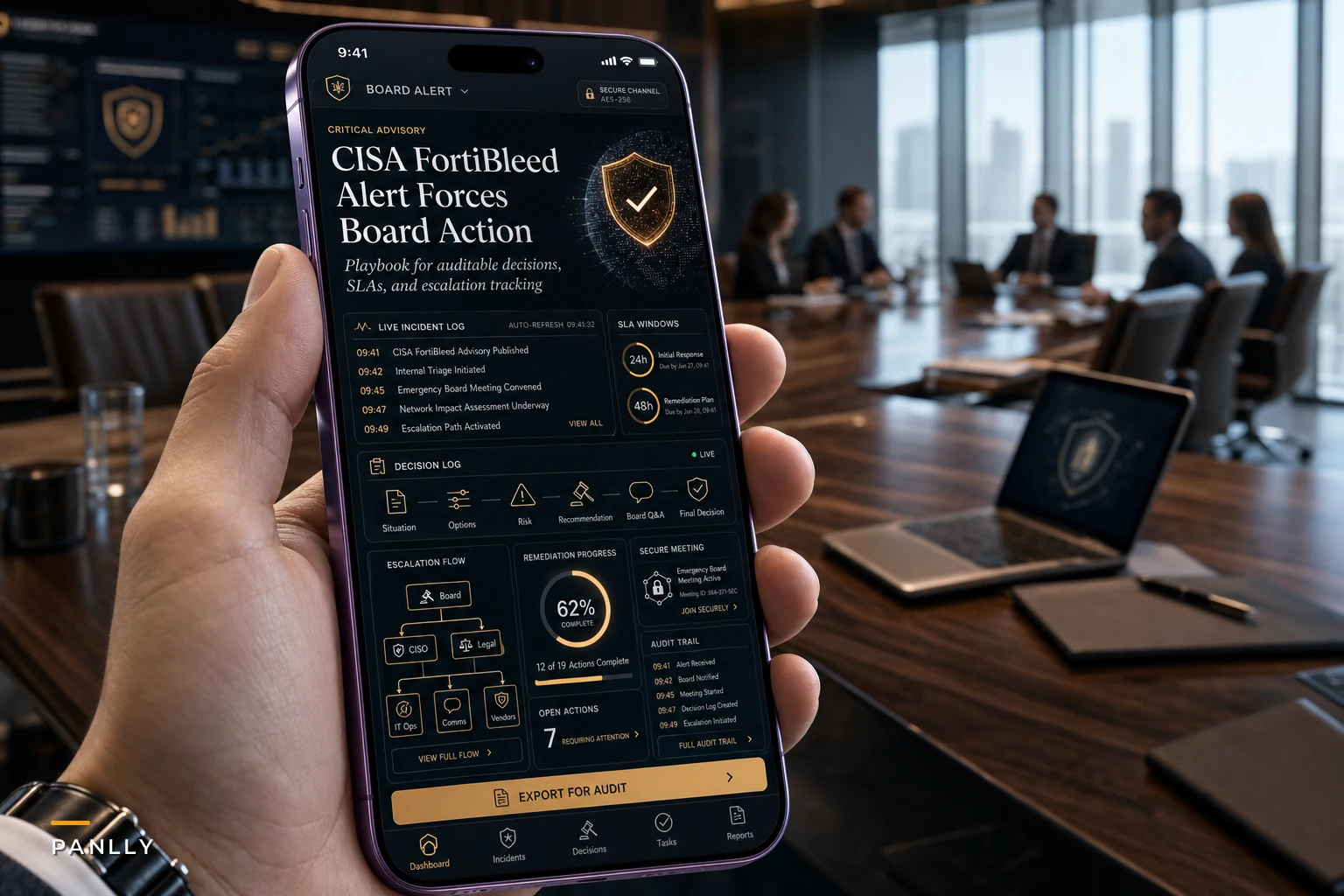

The emergency board call came at 7 PM on a Tuesday. Fortinet devices across thousands of organizations had been systematically harvested for administrative credentials. CISA's advisory landed in executive inboxes while IT teams were already scrambling to rotate passwords and check logs.
For boards overseeing organizations with Fortinet infrastructure, this wasn't just another security bulletin. The scale meant regulatory scrutiny was coming. Insurance carriers would ask pointed questions. And if any actual breach followed, litigation discovery would demand every board communication, decision rationale, and remediation timeline from these critical hours.
A corporate secretary at a mid-sized healthcare system told me their board met three times in 48 hours following the advisory. Not because the technical response required it — their CISO had that handled — but because they needed defensible documentation showing timely board oversight. Every decision needed context. Every assigned action needed tracking. Every update needed proper recording.
Most boards stumble here. Not in making decisions, but in creating a record that proves they exercised reasonable oversight when it mattered.
The Documentation Gap That Shows Up During Crisis
Most boards maintain decent minutes during regular quarterly meetings. They capture motions, votes, high-level discussions. But throw them into an emerging cyber incident requiring daily decisions and the documentation process falls apart fast.
A financial services firm I watched go through a different widespread vulnerability disclosure last year made solid decisions throughout. The board held emergency sessions, approved significant security spending, made critical resource allocation calls. Six months later, when regulators came asking about their response timeline, they couldn't produce coherent records showing who decided what, when, or based on which risk assessments.
The general counsel spent weeks reconstructing the response from emails, chat threads, and people's memories. The actual decisions had been fine. The execution had been swift. The documentation gaps just made everything look like chaos.
During a FortiBleed-scale event, boards typically need to document:
Immediate response decisions:
-
When the board was notified and by whom
-
Risk assessment presented and key assumptions
-
Decision to activate incident response plans
-
Resource allocations and spending authorities
-
Communication strategies for stakeholders
-
Legal privilege assertions for sensitive discussions
Ongoing oversight actions:
-
Daily or weekly status update cadence
-
Specific remediation milestones and owners
-
Escalation triggers if timelines slip
-
Risk acceptance decisions for systems that can't be immediately patched
-
Third-party engagement approvals (forensics, legal, PR)
-
Regulatory notification determinations
Post-incident governance:
-
Lessons learned discussions
-
Policy and procedure updates
-
Investment decisions for security improvements
-
Changes to risk appetite or tolerance
-
Updates to committee charters or oversight responsibilities
Each of these creates a documentation requirement that goes beyond traditional meeting minutes. You need to capture not just what was decided, but the information available at the time, the alternatives considered, and the rationale for the path chosen.
Why Standard Meeting Minutes Fall Apart Under Pressure
Traditional board minutes follow a predictable template. Motion made, seconded, discussion noted, vote recorded. That works fine for approving budgets or reviewing quarterly financials. It fails when you're tracking fast-moving incident response where decisions happen across multiple touchpoints in the same week.
Eliminate boardroom chaos with seamless coordination.
Panlly simplifies scheduling, collaboration, and follow-ups for every board meeting.
- Centralized meeting scheduling
- Secure document sharing
- Task assignment & tracking
No credit card required
During the FortiBleed response window, a typical board might have:
-
An initial emergency call Tuesday evening
-
Email updates Wednesday morning
-
A follow-up video conference Wednesday afternoon
-
Written consents Thursday for emergency spending
-
Another full session Friday to review progress
-
Daily email updates through the weekend
-
A formal Monday session to document the response
Traditional minute-taking can't keep pace with this. The corporate secretary ends up with fragments scattered across formats. Email threads contain critical decisions but lack proper authorization. Video calls capture important context but nobody transcribed them. Written consents get executed but aren't linked to the underlying risk assessments.
When auditors show up three months later, you're piecing together a narrative from fragments. Gaps in the record create inference opportunities you don't want anyone taking.
Building Your Incident Response Documentation Framework
The organizations that handle these situations best have already built their documentation framework before crisis hits. They've defined what needs capturing, who's responsible, and how it feeds into the permanent record.
Pre-incident preparation:
-
Set up dedicated secure channels for board communications during incidents. Not regular email. Not text messages. A proper platform where privilege can be maintained and records properly preserved.
-
Define your documentation standards for emergency sessions. Who takes notes? What level of detail? How are decisions marked versus discussions? When do you invoke privilege?
-
Create templates for common incident decisions — risk acceptance forms, spending authorities, communication approvals. Having these ready means less scrambling during actual events.
-
Establish clear roles between the corporate secretary, legal counsel, and CISO for who documents what. Technical decisions might be captured by IT, legal determinations by counsel, board oversight by the secretary. But everyone needs to know their lane before an incident happens.
During-incident execution:
-
Start a rolling incident log immediately. Not after the first board meeting — the moment senior leadership becomes aware. Document who knew what when.
-
For each decision point, capture
- Current situation summary - Options presented - Risk assessment for each option - Recommendation from management - Board questions or concerns raised - Final decision and rationale - Assigned actions with owners and deadlines
-
Link decisions back to existing policies and risk frameworks. Show you're following established procedures, not improvising. If you deviate from standard policy, document why.
-
Have legal counsel review for privilege issues before finalizing. Some discussions around potential liability or litigation strategy may need redaction or separate maintenance.
This might feel excessive in the moment. But Reuters reported that the Fortinet credential harvesting campaign potentially affected tens of thousands of organizations. When you're one of many dealing with the same issue, regulators compare responses. Better documentation means a better comparative position.
Post-incident completion:
-
Consolidate all documentation into a single authoritative record within 30 days. Pull together the emails, meeting notes, decision logs, and status updates into one coherent timeline. Don't let it sit in fragments.
-
Have legal counsel review for privilege issues before finalizing. Some discussions around potential liability or litigation strategy may need redaction or separate maintenance.
-
Get board attestation that the record is complete and accurate while memories are still fresh. Six months later, nobody remembers the subtle details that might matter.
A simple workflow to follow during an incident can help keep documentation consistent and defensible.
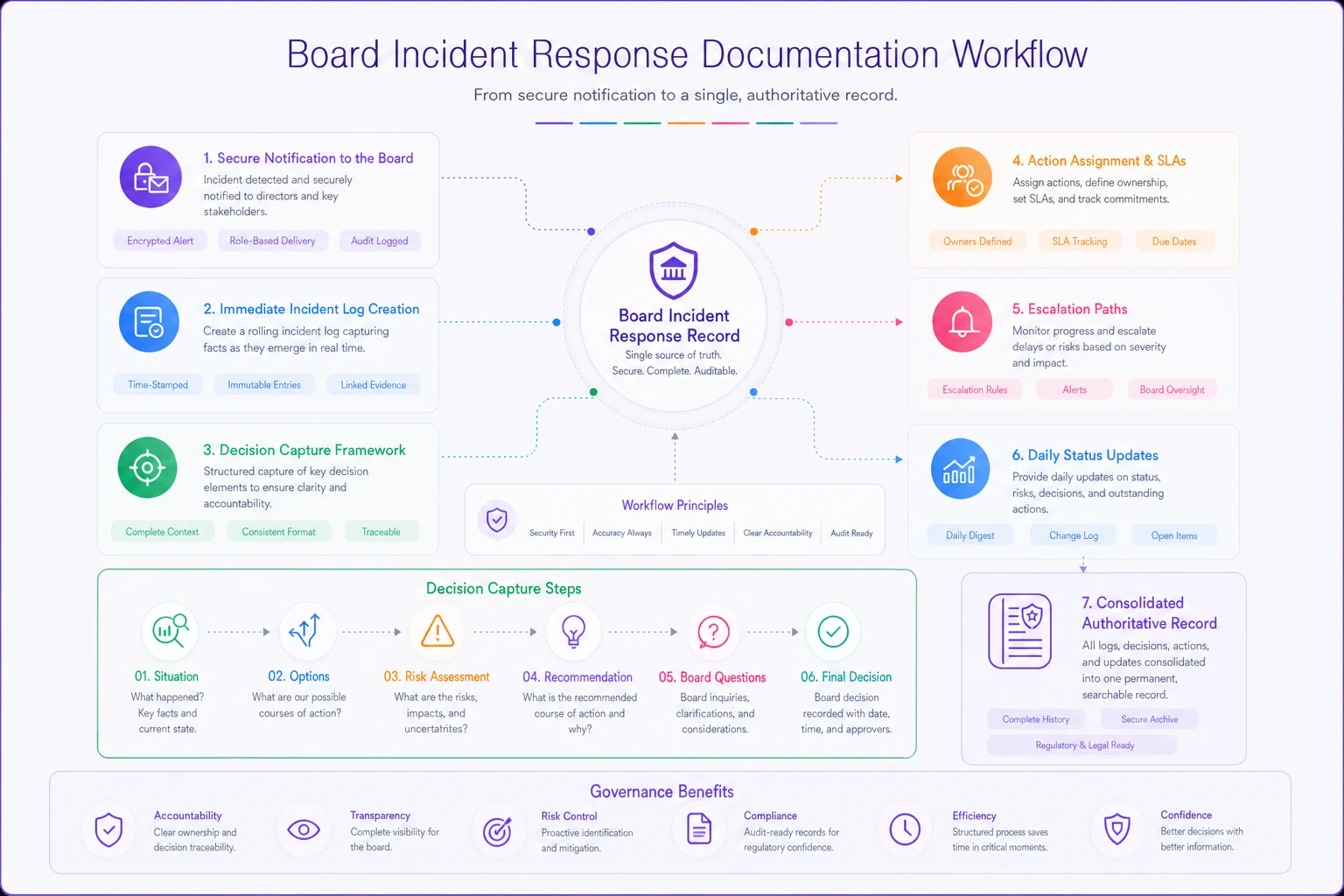
This maps the core documentation and decision steps into a repeatable process the board can follow.
Start the rolling incident log the moment senior leadership becomes aware.
Link decisions back to existing policies and risk frameworks. Show you're following established procedures, not improvising. If you deviate from standard policy, document why.
The Critical Connection Between Documentation and Execution
Recording decisions means nothing if they don't turn into completed actions. During a FortiBleed response, boards might assign dozens of specific tasks — rotate these credentials by Thursday, implement MFA on these systems by Monday, report status to the audit committee daily.
Without systematic follow-up, half of those will fall through the cracks. The board made sound decisions, management had good intentions, but operational chaos got in the way.
This is where automated action-item tracking with SLAs and escalation rules becomes critical. Every board decision requiring action should flow into a tracking system that monitors completion, escalates delays, and gives real-time status visibility.
For a FortiBleed-type incident, this might look like:
-
CISO assigned
Review all Fortinet devices for exposure — Due in 24 hours
-
IT Director assigned
Rotate admin credentials on identified systems — Due in 48 hours
-
Security team assigned
Implement MFA on all management interfaces — Due in 72 hours
-
CISO assigned
Report completion status to board — Daily at 5 PM
Each action gets logged with owner, deadline, and escalation path. If the IT Director hasn't confirmed credential rotation by hour 48, it automatically escalates to the CISO. If the daily update hasn't arrived by 5 PM, the board chair gets notified.
That systematic approach is what turns board decisions into outcomes instead of good intentions buried in crisis management chaos.
What Your Regulator Actually Reviews
When regulators investigate an organization's response to something like FortiBleed, they're not really evaluating whether you made perfect technical calls. They're assessing whether you exercised reasonable oversight given what you knew at the time.
The key word is "reasonable," and reasonableness gets demonstrated through documentation showing:
Timely awareness and response: How quickly did the board learn about the issue after management became aware? Hours is acceptable. Days is problematic. Weeks is a governance failure.
Appropriate expertise involved: Did you bring in the right internal and external resources? Your documentation should show IT, legal, risk, and other relevant functions providing input.
Risk-based decision making: Can you show the board considered various risk scenarios and made informed trade-offs? Not every system can be patched immediately. Document why you prioritized certain systems and accepted temporary exposure on others.
Consistent follow-through: Did assigned actions actually get completed? Can you show escalation when deadlines slipped? Regulators understand that perfect execution is impossible, but they expect systematic tracking and adjustment.
Continuous monitoring: Did the board maintain appropriate oversight until the issue was resolved? One emergency meeting followed by radio silence for three weeks doesn't demonstrate ongoing governance.
Common Documentation Failures That Create Liability
Certain patterns of documentation failure show up repeatedly across incident response records:
The "privileged everything" trap: Some boards try to conduct entire incident responses under legal privilege, producing minimal official records. This backfires when you can't demonstrate reasonable oversight to regulators or insurers. Reserve privilege for genuinely sensitive legal discussions.
The "too much detail" problem: Recording every technical detail from IT presentations buries critical board decisions in noise. Focus documentation on what the board decided and why, not every technical particular that was presented.
The "retroactive documentation" issue: Trying to create records weeks after the fact when someone asks for them. These always feel manufactured because they are. Contemporary documentation, even if imperfect, carries more weight than a polished retroactive narrative.
The "informal decision" gap: Critical decisions made in hallway conversations or side emails that never make it into official records. In crisis, decisions happen everywhere. You need processes to capture them regardless of where they originate.
The "incomplete action tracking" failure: Recording that the board directed management to take certain actions, then never documenting whether those actions actually occurred. The loop has to close.
Creating Your FortiBleed Response Playbook
Phase 1: Initial Assessment (Hours 0-6)
-
Document when and how the board was notified
-
Capture initial risk assessment from management
-
Record decision to activate incident response plans
-
Assign specific assessment tasks with tight deadlines
-
Establish meeting cadence for updates
Phase 2: Response Planning (Hours 6-24)
-
Document technical findings and business impact assessment
-
Record risk mitigation options presented
-
Capture board's risk appetite decisions
-
Approve resource allocations and spending authorities
-
Assign specific remediation tasks with SLAs
Phase 3: Execution Tracking (Days 1-7)
-
Daily status updates on remediation progress
-
Document any deadline extensions and rationales
-
Record escalations for delayed actions
-
Capture decisions on risk acceptance for systems that can't be immediately addressed
-
Track stakeholder communications
Phase summary table:
| Phase | Timeframe | Key Actions |
|---|---|---|
| Phase 1 | Hours 0-6 | Document notification, initial risk assessment, activate IR plans, assign assessment tasks |
| Phase 2 | Hours 6-24 | Document technical findings, record mitigation options, set SLAs and approve resources |
| Phase 3 | Days 1-7 | Daily status updates, track escalations, document deadline changes, record risk acceptances |
| Phase 4 | Days 7-30 | Testing/verification, residual risk assessment, lessons learned, approve policy updates |
| Phase 5 | Days 30-90 | Consolidate record, board attestation, regulatory/insurance documentation, archive |
Phase 4: Verification and Closure (Days 7-30)
-
Document testing and verification procedures
-
Record residual risk assessments
-
Capture lessons learned discussions
-
Approve policy or procedure updates
-
Assign longer-term improvement initiatives
Phase 5: Post-Incident Review (Days 30-90)
-
Consolidate all documentation into permanent record
-
Obtain board attestation on record completeness
-
Document any regulatory interactions
-
Record insurance claim decisions
-
Archive according to retention policies
Consolidate all documentation into a single authoritative record within 30 days to avoid fragmented narratives.
The Operational Reality of Board Cyber Oversight
Modern boards can't treat cybersecurity as a quarterly CISO update anymore. Events like FortiBleed demand real-time governance with documentation standards that match the scrutiny that follows.
The challenge isn't making good decisions — most boards have sufficient expertise or access to it. The challenge is systematically capturing those decisions, tracking their execution, and maintaining records that hold up when examined months or years later.
Organizations running board management platforms with integrated action tracking and automated escalation handle these scenarios noticeably better than those relying on email and traditional minutes. When every board decision flows into trackable tasks with clear owners and deadlines, the gap between intent and execution narrows considerably.
FortiBleed won't be the last widespread vulnerability requiring urgent board attention. The question is whether your documentation and tracking processes can keep pace with modern cyber threats while maintaining the governance standards regulators and courts expect.
Build these capabilities before you need them. Because when the next advisory drops, you won't have time to figure it out while also managing the actual response.
Ready to enhance your board's productivity?
Join 500+ organizations using Panlly to save time, improve governance, and streamline board operations.