

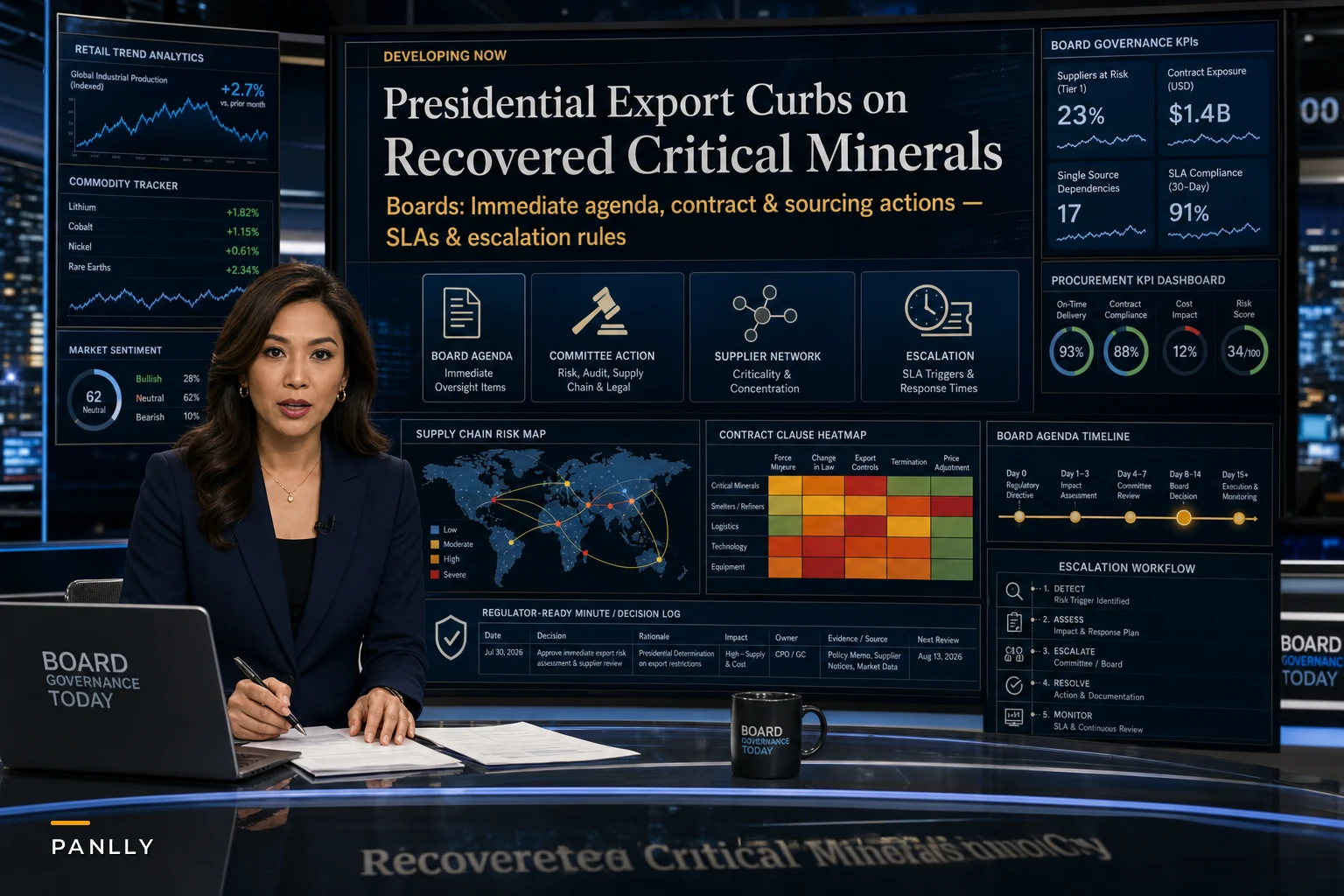

The July 30th Presidential Determination delegating Defense Production Act authority over recoverable critical minerals hit procurement teams during their morning coffee. By lunch, legal was reviewing force majeure clauses. By the afternoon board call, directors were asking questions nobody had clean answers for.
The White House fact sheet laid out broad authority to restrict exports of recovered materials — battery black mass, permanent magnets, electronic scrap containing critical minerals. What it didn't spell out was how quickly Commerce could move, which materials would face restrictions first, or how exemptions might work.
For boards overseeing companies that depend on recycled lithium, cobalt, rare earths, or similar inputs, this isn't a theoretical risk to monitor. It's an operational reality requiring documented decisions within weeks, not quarters.
The 72-hour scramble that exposes real governance gaps
When a supply chain shock hits, boards tend to discover fast that their oversight frameworks weren't built for situations like this.
A manufacturer relying on recycled cobalt from international processors suddenly faces a pile of urgent questions with no clean answers sitting in a dashboard somewhere. Are domestic alternatives actually available at scale? What contractual obligations exist with current suppliers? How much inventory buffer is on hand? What's the cost delta for virgin materials? Which customer contracts have material adverse change clauses that could trigger?
These aren't governance exercises. They're operational decisions requiring board awareness, documented reasoning, and clear accountability — and most boards don't have a structured way to handle that kind of pressure inside a compressed timeline.
What usually happens: emergency committee meetings, hastily assembled briefing packets, and decisions made without anyone really documenting the alternatives considered or the risk tolerances applied. Three months later, when auditors or outside counsel start asking why certain sourcing decisions were made, the institutional memory has already scattered across email threads and hallway conversations.
That's the gap this moment is exposing.
What boards actually need to decide right now
The critical minerals restrictions force three categories of immediate board decisions, each with distinct documentation requirements.
Eliminate boardroom chaos with seamless coordination.
Panlly simplifies scheduling, collaboration, and follow-ups for every board meeting.
- Centralized meeting scheduling
- Secure document sharing
- Task assignment & tracking
No credit card required
Supply chain repositioning means approving material changes to sourcing strategy — not just finding new suppliers, but evaluating the financial stability of domestic recyclers who may see demand surge suddenly, assessing whether alternative processors can handle the technical requirements, and in some cases approving capital commitments into domestic qualifying facilities.
Contract management cuts both ways. On the supplier side, boards need to document which contracts to exit, which to renegotiate, and which force majeure provisions are worth invoking now versus waiting. On the customer side, it means figuring out which delivery commitments are at real risk, how to communicate that, and whether to invoke MAC clauses proactively or hold and see what customers do first.
Risk tolerance recalibration is the one boards tend to skip or handle vaguely. Is a 40% cost increase for domestic recycled material acceptable to preserve supply certainty? Does the company pivot to virgin materials even if that undermines published sustainability commitments? What inventory buffer level actually justifies the working capital expansion it requires? These trade-offs need to be explicitly documented, not just nodded at in a meeting.
From directive to board agenda
Converting broad regulatory language into specific board actions takes more structure than most governance processes naturally provide.
| Impact Category | Specific Questions | Required Data | Decision Timeline |
|---|---|---|---|
| Direct supply exposure | Which materials face restriction risk? | Current supplier locations, material flows | 72 hours |
| Contract obligations | What commitments become problematic? | Delivery schedules, penalty clauses | 5 days |
| Financial implications | Cost impact of sourcing changes? | Alternative supplier pricing, inventory costs | 7 days |
| Competitive positioning | How are peers responding? | Industry intelligence, customer feedback | 10 days |
One electronics manufacturer went through this exercise and discovered their recycled rare earth supplier operated production facilities across three countries — which made restriction impacts genuinely unpredictable depending on which jurisdictions Commerce targeted first. The board had to approve a dual-sourcing strategy within a week to avoid production delays. Nobody had mapped that exposure before the directive dropped.
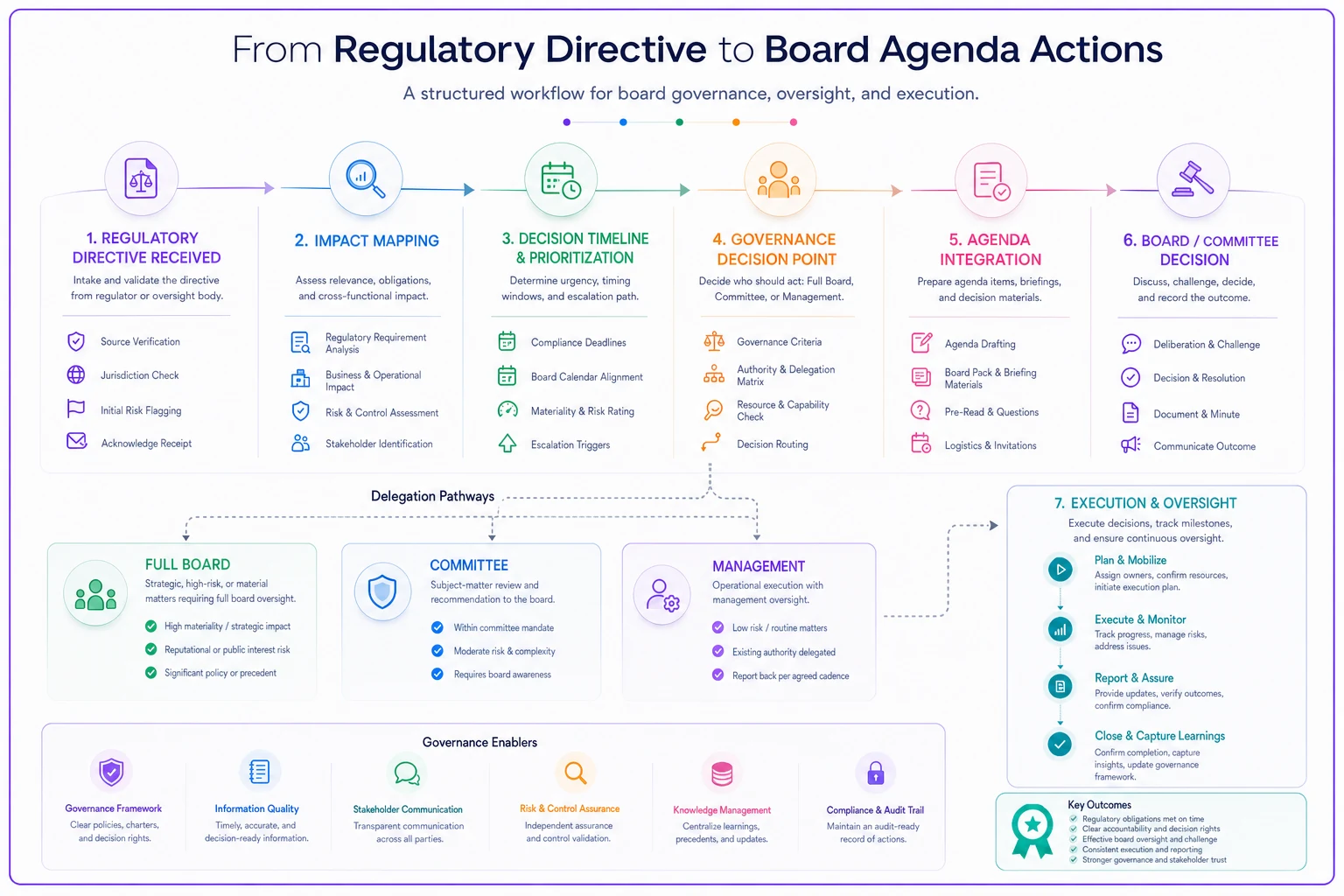
Decision sequencing matters too. Not everything needs to go back to the full board, but the board has to explicitly delegate and document what flows where:
A simple visual of the flow from directive to board action can help align expectations quickly.
-
Immediate board decisions (24–72 hours)
Approve emergency procurement authority increases, authorize management to invoke contract provisions, set temporary risk tolerance adjustments
-
Committee-level decisions (3–7 days)
Review specific supplier changes within board-approved parameters, approve incremental inventory investments below defined thresholds, oversee customer communication strategy
-
Management decisions with board reporting (ongoing)
Execute approved sourcing changes, negotiate contract modifications within defined boundaries, implement operational adjustments
The sequencing prevents bottlenecks while keeping appropriate oversight in place. More importantly, it creates a documented chain of authorization when external scrutiny arrives later.
Documentation that actually holds up
The speed these situations demand often kills documentation quality. Boards make defensible decisions but don't create defensible records. That gap becomes a real problem months later when regulators investigate market disruptions or shareholders challenge strategic choices.
A battery materials company that went through a similar process during earlier supply disruptions built a useful documentation habit: instead of meeting minutes that just noted "sourcing strategy discussed," they captured the specific scenarios evaluated, the quantified cost and risk implications of each, and explicit reasoning for why certain options were rejected.
Their records included things like: why recycled lithium from one supplier was chosen over virgin material from another, which risk factors were acceptable (roughly a 23% cost premium), which weren't (supply uncertainty beyond 30 days), and what would trigger a revisit of the decision. That's the kind of record that survives regulatory scrutiny and shareholder questions.
It doesn't require a lot of overhead — it requires templates that force structured thinking even under time pressure.
Translating decisions into execution
Board decisions about critical minerals mean nothing without the operational machinery to execute them. And the translation from boardroom approval to actual warehouse reality breaks down more often than people want to admit, especially when execution requires coordinated action across procurement, legal, finance, and operations simultaneously.
Explicit timelines help. A specialty chemicals company implementing sourcing changes during a rare earth supply crunch found that without hard deadlines by function, procurement moved quickly but legal lagged — creating contractual exposure gaps that procurement didn't even know existed until it was almost too late.
Procurement: Identify qualified domestic recyclers within 10 days. Complete technical validation of alternative materials within 15. Execute approved changes within 20 days of board decision.
Legal: Review all supplier contracts for restriction implications within 5 days. Draft force majeure notices within 48 hours of board approval. Complete customer contract risk assessment within 7 days.
Finance: Model cost implications of alternatives within 3 days. Arrange incremental working capital facilities within 10 days. Update forecasts within 5 days of sourcing changes.
Operations: Validate alternative material specs within 7 days. Adjust production schedules based on supply constraints within 3 days. Implement inventory buffer changes within 5 days of approval.
These aren't aspirational targets. They're pressure-test numbers that force realistic conversations about capacity before commitments are made to the board.
The audit trail that matters six months later
Most boards think of audit trails as meeting minutes and formal resolutions. For rapid regulatory response, that's not enough.
As covered in our framework for mapping risk registers to board agendas, the connection between identified risks and actual decisions becomes critical evidence when scrutiny arrives. A complete audit trail for critical minerals response needs to capture:
-
Initial impact assessment with data sources and assumptions documented
-
Alternative scenarios evaluated, with specific rejection rationales — not just what was approved
-
Risk tolerance thresholds applied and trade-offs explicitly accepted
-
External advice received from legal, technical, and market advisors
-
Dissenting views captured with responses
-
Specific triggers for revisiting decisions as regulations clarify
-
Implementation milestones with accountability assignments
The goal isn't paperwork for its own sake. It's strategic selectivity — capturing why alternatives were rejected, quantified trade-offs accepted, and specific triggers for decision review. That's what survives scrutiny. Vague commitments to "continue monitoring" don't.
Warning signs your response framework has gaps
Boards usually discover framework gaps only after implementation starts struggling. A few patterns worth watching for:
Decision recursion — when the same issues keep returning to the board without resolution. If sourcing strategy shows up in three consecutive meetings without clear progression toward a decision, something structural is broken.
Accountability diffusion — when everyone is somehow responsible but no one is clearly accountable. If the answer to "who owns domestic supplier qualification?" involves multiple committees and no single executive, execution will stall.
Documentation degradation — when record quality declines as urgency increases. Emergency meeting minutes shouldn't be thinner than routine ones. If they are, the process lacks templates for pressure situations.
Implementation drift — growing gaps between board decisions and operational reality. If approved sourcing changes take months when the plan said weeks, or if risk tolerances get quietly reinterpreted during execution, the timeline framework needs work.
These patterns showed up across industries during COVID-era supply disruptions and again during the semiconductor shortage. Critical minerals restrictions are another version of the same test.
Practical next steps
Within 24 hours: Schedule a dedicated executive session on critical minerals exposure — not a general update tucked into a broader meeting. Ask management for a single-page summary covering material exposure, contract implications, and early competitor intelligence.
Within 72 hours: Approve temporary authority adjustments. Increase management procurement authority for domestic critical mineral sourcing. Authorize legal to invoke protective contract provisions without additional board approval. Set explicit cost increase tolerance bands and supply buffer targets.
Within one week: Establish a supply chain committee with a weekly reporting cadence. Even if it's temporary, it needs a formal charter. Include the audit committee chair to maintain documentation standards despite decision speed.
Within two weeks: Review and approve a comprehensive response plan covering sourcing pivots, contract strategies, and operational adjustments. Require the plan to include specific triggers for strategy adjustment as regulations clarify.
Monthly thereafter: Review execution against timelines, document any strategy changes, and maintain the audit trail. As Forbes reported, restrictions could expand beyond initial materials — and as Resource Recycling noted, the executive order gives federal agencies meaningful authority to block exports with limited warning. Continued vigilance isn't optional.
Building institutional readiness beyond this crisis
Critical minerals won't be the last regulatory shock requiring rapid board response. Environmental regulations, trade policies, technology standards — external changes will keep demanding governance frameworks that can move fast without compromising accountability.
Boards that handle these situations well tend to treat the current challenge as an opportunity to build institutional muscle for the next one. A medical device manufacturer facing rare earth supply constraints built their response templates with explicit reusability in mind — standardized rapid impact assessments, decision documentation formats, and implementation tracking that now activates whenever a new regulatory disruption emerges. When FDA guidance shifted a few months later, they ran the same playbook with minor modifications and moved faster than most of their competitors.
AI-powered operational software is increasingly useful in this context. These platforms can generate preliminary impact assessments from regulatory changes, map affected contracts and suppliers, and draft board package frameworks before management has to start from scratch. That compression in preparation time matters — directors spend more time on actual strategic choices and less time chasing down information that should have been assembled already.
The companies that navigate critical minerals restrictions successfully won't be those with perfect regulatory foresight. They'll be the ones with governance frameworks robust enough to handle uncertainty, documentation practices that capture real decision context, and execution structures that convert board approvals into measurable operational outcomes. For boards meeting this week, the question isn't whether to act — it's whether the framework you're acting through was actually built for moments like this one.
Ready to enhance your board's productivity?
Join 500+ organizations using Panlly to save time, improve governance, and streamline board operations.