

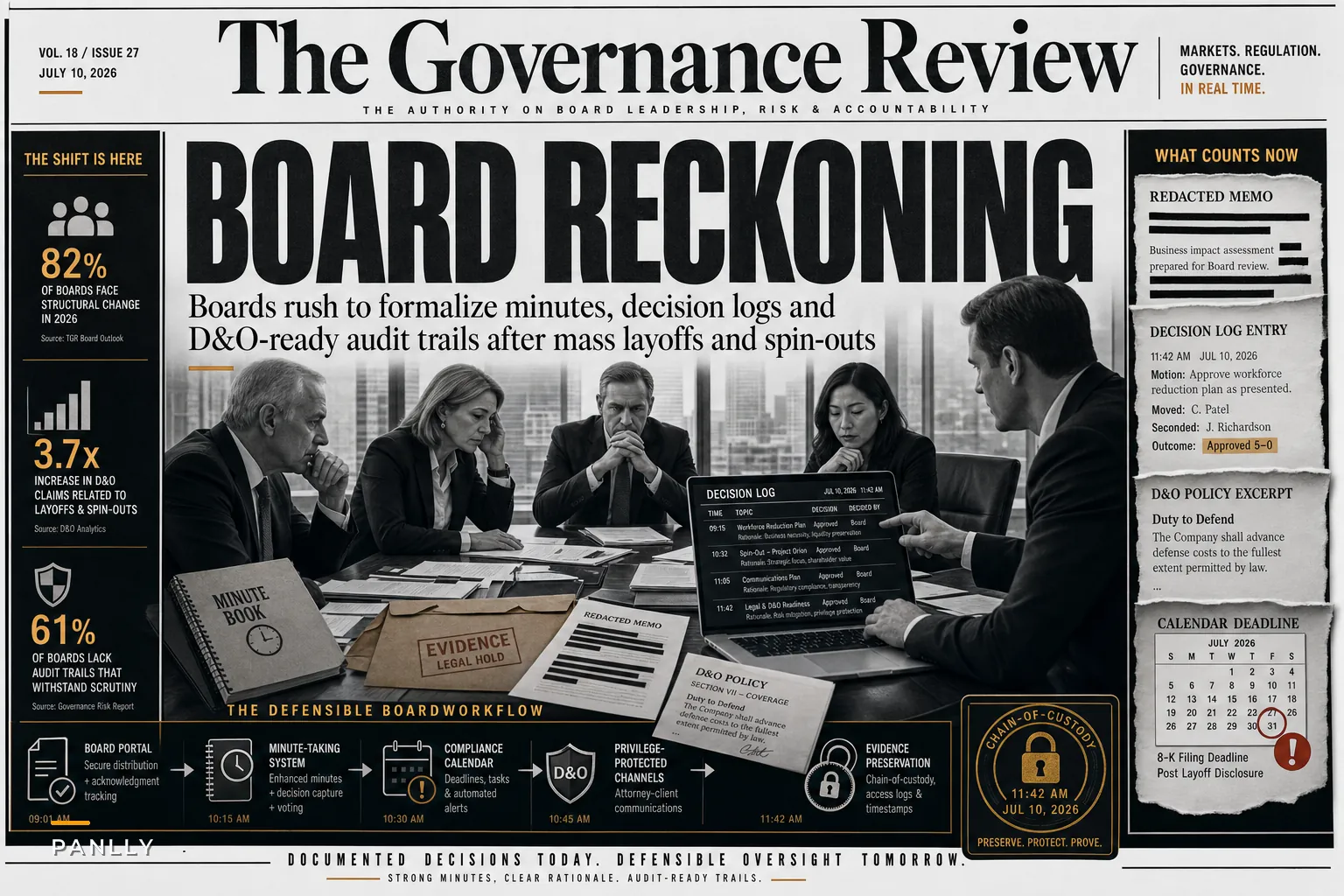

Microsoft just announced they're cutting 4,800 jobs while spinning off multiple Xbox gaming studios. According to CNBC's report, the restructuring represents about 2.1% of their workforce and includes major operational changes to their gaming division. The board likely convened multiple emergency sessions over the past few weeks, each generating dozens of pages of decision records that will either protect or expose directors when the lawsuits hit.
Most boards treat mass layoffs like accelerated regular decisions. Run the numbers, vote, document in standard minutes. Then six months later, a shareholder derivative suit drops citing "inadequate board oversight" and those thin meeting notes become Exhibit A in discovery.
Workforce reductions create fundamentally different governance demands than normal operations. You're not just approving headcount changes—you're building an evidentiary record that proves directors actually fulfilled their fiduciary duties while employees lost jobs and shareholders potentially lost value.
The Documentation Gap Between Normal Operations and Crisis Mode
Regular board meetings follow predictable rhythms. Quarterly financials, committee reports, strategic discussions. Corporate secretaries maintain standard minutes that capture decisions without excessive detail. That works fine when nothing is on fire.
Mass layoffs change that completely. Suddenly you need pre-decision analysis showing alternatives considered, real-time voting records on each reduction component, separate tracks for employee notifications versus public disclosure, conflict-of-interest declarations when executives' own teams face cuts, legal privilege preservation across all communications, and evidence chains linking board decisions to business necessity.
Most boards discover these requirements only after receiving their first information request from plaintiff's counsel. By then, the sparse minutes from those emergency sessions have become serious liability exposures.
The operational burden multiplies when you layer in spin-offs or divestitures. Now you're tracking not just workforce decisions but asset transfers, IP assignments, transition service agreements, and potentially conflicted transactions if management is participating in the acquiring entity.
Building Your Crisis Governance Framework
Phase 1: Emergency Convening Protocols (Hours 0-24)
Eliminate boardroom chaos with seamless coordination.
Panlly simplifies scheduling, collaboration, and follow-ups for every board meeting.
- Centralized meeting scheduling
- Secure document sharing
- Task assignment & tracking
No credit card required
When leadership determines significant workforce action is necessary, board governance machinery needs to activate fast. Not next week's scheduled meeting—within 24 to 48 hours.
-
Notification cascade with acknowledgment tracking — Primary notice via board portal (timestamped), secondary via encrypted email, tertiary via SMS or phone for critical directors, with all response times documented.
-
Privileged communication channels — Establish attorney-client privilege from minute one, route all pre-meeting materials through legal counsel, and create separate discussion threads for legal analysis.
-
Conflict identification sweep — Which directors have relationships with affected divisions? Who holds unvested equity that could be impacted? Any consulting arrangements with reduction targets?
-
Materials distribution with access logging — Financial models showing necessity, alternative scenarios considered, legal risk assessments, and competitive benchmarking data.
The mistake boards make constantly: treating emergency meetings like accelerated regular meetings. They're not. Every communication, every document, every sidebar conversation becomes potential evidence.
Phase 2: Decision Documentation Standards (Meeting Day)
Minute-taking during reduction decisions needs surgical precision. Standard Roberts Rules won't protect you when a judge reviews your governance records two years later.
Here's the documentation framework that actually holds up:
| Decision Component | Standard Minutes | Crisis Documentation Required |
|---|---|---|
| Attendance | "Present: Smith, Jones, Lee" | Full attendance log with arrival/departure times, recusal periods |
| Financial Review | "CFO presented Q3 results" | Detailed capture of metrics discussed, assumptions challenged, alternatives analyzed |
| Voting | "Motion approved 7-0" | Individual director positions, questions raised, concerns documented |
| Legal Advice | "Counsel advised on risks" | Privilege-protected separate record of legal guidance |
| Timeline | "To be implemented Q4" | Specific milestone dates with responsible parties |
The critical addition is decision rationale documentation. Not just what the board decided, but why this specific approach versus alternatives. When plaintiff's attorneys claim the board rubber-stamped management's recommendation, you need evidence of genuine deliberation.
A software company board facing a cut of roughly 400 positions had original minutes that read "Reduction plan approved unanimously." The enhanced documentation created afterward included three alternative scenarios reviewed (300, 400, or 500 positions), specific questions raised by each director, customer impact analysis by scenario, timeline tradeoffs for each option, and separate votes on each alternative before the final decision. That documentation framework held up when a shareholder suit alleged hasty decision-making six months later.
Phase 3: Execution Tracking and Compliance Monitoring
Board oversight doesn't end with the vote. Directors remain responsible for ensuring lawful, compliant execution—which means systematic tracking across several areas.
Regulatory Compliance Checkpoints cover WARN Act notifications (60-day requirement), SEC 8-K filing (4 business days), state-specific requirements, and international labor law compliance for global cuts.
Internal Execution Milestones include employee notification cascades, severance agreement distributions, benefits continuation confirmations, and outplacement service activations.
Stakeholder Communications span press release timing and approvals, investor call scheduling, customer and vendor notifications, and internal all-hands messaging.
Most boards rely on management attestations that these items are complete. That's insufficient when litigation hits. You need timestamped evidence of completion for each requirement.
The Spin-Off Complexity Multiplier
Divestitures and spin-offs during workforce reductions create overlapping governance demands that boards frequently handle poorly. You're not just eliminating positions—you're transferring assets, people, and potential liabilities to new entities.
Asset Transfer Records need to document which intellectual property, customer contracts, and physical assets move with the spin-off. Include board review of valuations, especially if management participates in the acquiring entity.
Employee Transfer Protocols should track which employees receive offers from the new entity versus termination, and document how those decisions were made to defend against discrimination claims.
Transition Service Agreements define what support the parent company provides post-spin. These agreements often become litigation flashpoints when the new entity struggles.
Ongoing Governance Rights documentation covers any board seats, observation rights, or approval requirements the parent company retains, since these create continuing oversight obligations.
A telecommunications company learned this lesson expensively when they spun off their enterprise services division while cutting roughly 30% of corporate staff. They treated it as two separate board actions. When the spin-off failed eighteen months later, investigators found the board had never analyzed the combined impact of losing both the division revenue and the corporate support structure simultaneously. The resulting shareholder settlement exceeded $45 million.
Evidence Preservation from Day One
The period between announcing reductions and completing them generates enormous amounts of potential evidence. Emails between directors, text messages about the decision, even calendar entries become discoverable.
Your evidence preservation protocol needs to activate immediately:
-
Litigation hold notices to all directors and senior management — Specific guidance on preserving all communications related to the reduction decision, not just formal board materials.
-
Communication channel inventory — Document all systems where relevant discussions might occur: email, Slack, Teams, WhatsApp, Signal. Directors use all of them.
-
Privilege protection protocols — Route sensitive discussions through counsel to maintain privilege, mark documents appropriately, and segregate legal advice from business discussions.
-
Third-party data preservation — Ensure consultants, compensation advisors, and other external parties preserve their work products and communications.
Our evidence-preservation minute practices guide covers templates for tracking these requirements, but during workforce actions, the standard approach needs significant enhancement.
The preservation burden extends beyond documents. Modern discovery includes board portal access logs showing who viewed what materials and when, email metadata revealing forwarding patterns, calendar entries showing informal pre-meeting discussions, and building access logs for in-person sidebar conversations.
One board found this out the hard way when defending a reduction decision. A director's assistant had forwarded confidential workforce analysis to the director's personal email for weekend review. That single forward became the basis for claims about inadequate information security and triggered a potential insider trading investigation—the director had traded company stock two days later.
Committee Coordination During Crisis Operations
Workforce reductions touch every board committee's domain. Poor coordination between committees creates governance gaps that plaintiff's attorneys will exploit.
Audit Committee reviews financial projections justifying reductions, ensures accurate disclosure, and monitors internal controls during execution. Compensation Committee analyzes executive severance packages, reviews retention bonuses for remaining key employees, and documents why executives weren't impacted proportionally. Risk Committee evaluates operational risks from reduced headcount, reviews business continuity plans, and assesses litigation probability. Nominating/Governance Committee may need to consider board composition changes if entire business units are eliminated or spun off.
The coordination problem is that each committee generates its own documentation, often with wildly inconsistent detail levels. The audit committee might thoroughly document financial analysis while compensation committee minutes simply state "packages approved."
That inconsistency becomes problematic in litigation. Plaintiff's counsel will hold up the thorough audit documentation as evidence that cursory compensation documentation reflects rubber-stamping of excessive executive packages.
Better approach: establish unified documentation standards across all committees for crisis decisions. Same level of detail, same capture of alternatives considered, same evidence of genuine deliberation.
Managing Conflicted Transactions in Spin-Offs
When senior executives participate in acquiring spun-off divisions, governance complexity spikes. Management-led buyouts during broader reductions create near-perfect conditions for shareholder lawsuits.
Enhanced governance requirements include independent committee formation, excluding any potentially conflicted directors, with the independence determination for each member documented. This committee needs separate counsel, separate financial advisors, and separate documentation protocols. Valuation documentation should draw on multiple independent valuations, not just one, with the committee's review of each methodology captured and assumptions challenged explicitly in minutes.
For negotiation records, unlike normal commercial negotiations, the board needs evidence of arms-length bargaining. Document each offer, counter-offer, and the rationale for positions taken. Alternatives analysis should show the committee genuinely considered other buyers, different deal structures, or retaining the asset—"management's offer was the only one received" is an invitation to litigate.
A software company faced this exact scenario when their CTO led a buyout of their research division while the company cut roughly 20% of staff. Initial board minutes showed quick approval. Shareholder litigation alleged the board had given away valuable IP to management at a discount while firing rank-and-file employees. The defense required reconstructing the decision process from emails and depositions because formal documentation was thin. Final settlement: $8.5 million plus governance reforms requiring enhanced documentation of any future conflicted transactions.
Timeline Pressure Versus Governance Demands
The core tension during workforce actions is that business needs speed while governance needs thoroughness. Markets punish delays, but courts punish haste.
Managing this tension requires parallel tracking. The Fast Track handles essential decisions enabling execution: approving aggregate reduction numbers, authorizing management to proceed with planning, and setting the disclosure timeline. The Governance Track handles detailed documentation and compliance: full analysis documentation, individual component approvals, and compliance checkpoint verification.
The tracks converge at critical milestones, but governance documentation can continue after initial decisions—as long as it happens contemporaneously, not reconstructed months later.
A timeline from one reduction that held up under scrutiny looked like this:
-
Day 1
Emergency board meeting approves concept, authorizes planning
-
Day 3
Detailed analysis provided to directors
-
Day 5
Full board meeting with component-by-component approval
-
Day 7
Public announcement
-
Days 8–30
Execution with weekly board updates
-
Days 31–60
Final documentation and compliance certification
When a discrimination claim emerged four months later, the documentation enabled a relatively quick dismissal.
Post-Execution Governance Requirements
Many boards consider their job done once employees are notified and severance is paid. The obligations continue for months. Ongoing monitoring covers severance payment accuracy, COBRA notification compliance, unemployment insurance claims, discrimination charge responses, and business impact tracking. Documentation updates include final execution reports, variance analysis against plan, litigation status summaries, and regulator inquiry responses.
The most overlooked post-execution requirement is reviewing whether the reductions actually achieved what they were supposed to achieve. When boards approve cuts to improve profitability and profits don't improve, shareholders start questioning whether the initial analysis was adequate.
Document not just the execution but the outcomes. Did the action achieve its stated purpose? If not, why not? What adjustments are needed? That continuing oversight demonstrates ongoing fulfillment of fiduciary duties—not just one-time decision-making.
The Technology Stack for Crisis Governance
Manual processes break down during crisis governance. The volume of documents, the speed of decisions, and the precision required for evidence preservation overwhelm traditional corporate secretary operations.
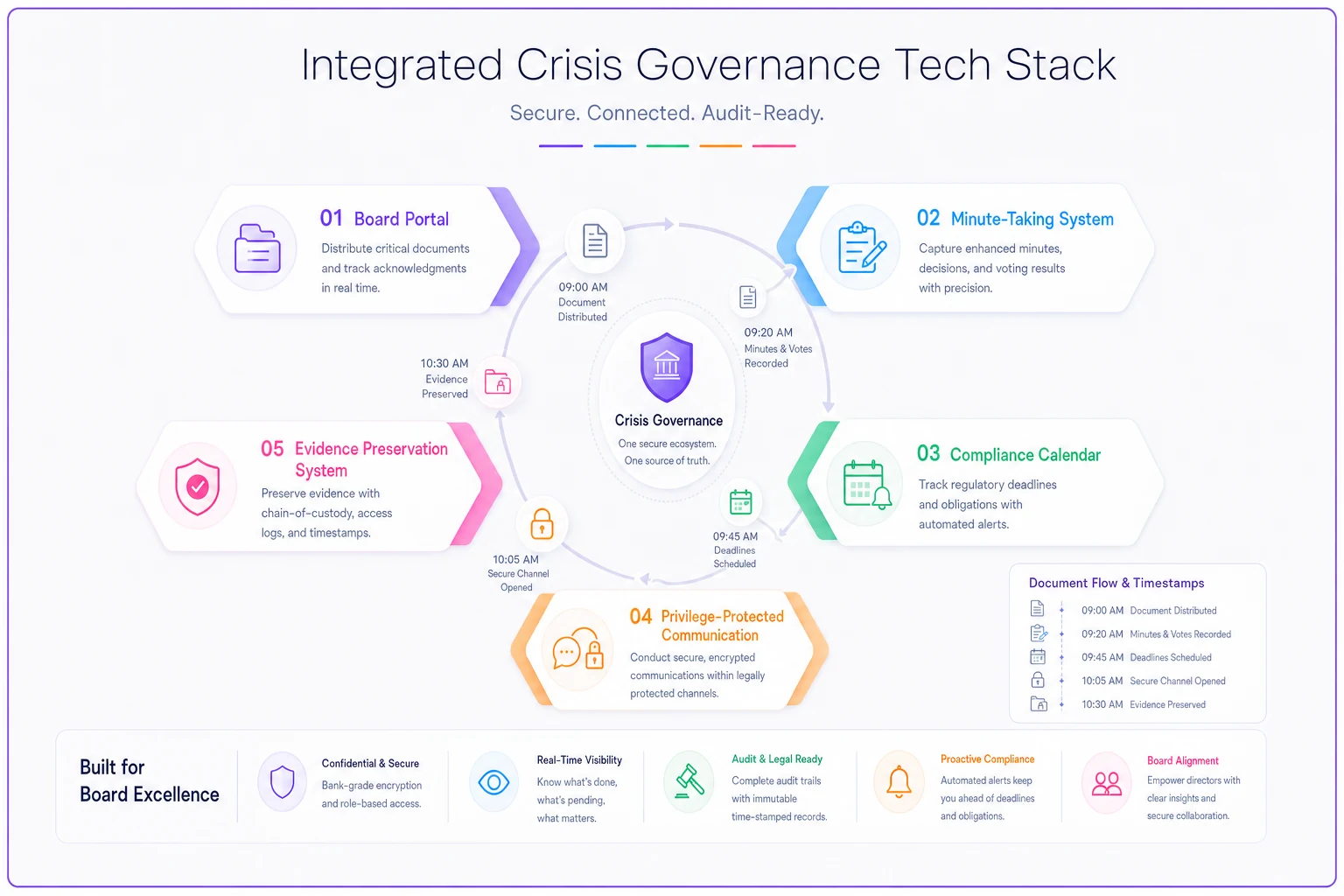
Modern boards need operational software that can handle rapid document distribution with acknowledgment tracking, voting capture with individual director positions, automated compliance deadline monitoring, privilege-protected communication channels, and evidence preservation with chain-of-custody tracking.
The challenge isn't just having these capabilities—it's having them integrated. When your board portal doesn't connect to your minute-taking system, which doesn't connect to your compliance calendar, critical items fall through the gaps.
Below is a simple workflow diagram showing how an integrated crisis governance tech stack should flow.
AI-powered platforms now help corporate secretaries manage these complex workflows. Instead of manually tracking whether each director reviewed the reduction analysis, systems automatically log access and can prompt follow-ups. Rather than separately managing board materials and evidence preservation, integrated platforms maintain unified chain-of-custody records.
The real value shows up during litigation. Instead of spending weeks pulling documentation from multiple systems, corporate secretaries can generate comprehensive governance records in hours. When plaintiff's counsel requests "all board communications regarding the reduction," you have actual confidence nothing was missed.
Preparation: Your Pre-Crisis Advantage
The worst time to build crisis governance protocols is during a crisis. Boards that navigate workforce actions successfully have frameworks ready before they're needed.
Your preparation checklist:
-
Template Documentation Library — Emergency meeting notices, enhanced minute formats, decision matrices, and compliance checklists.
-
Role Clarity Agreements — Who calls emergency meetings? Who maintains privilege protection? Who tracks execution milestones? Who preserves evidence?
-
System Integration Testing — Can you distribute materials securely within two hours? Will voting systems capture individual positions? Do communication channels maintain audit trails? Can you produce comprehensive records quickly?
-
Scenario Planning Exercises — Walk through a hypothetical reduction, test decision documentation, review committee coordination, and identify system gaps.
Maintain a living template library and run scenario exercises annually.
Organizations that handle workforce crises best aren't necessarily those with the best lawyers or most experienced boards. They're the ones with operational infrastructure that can scale from quarterly meetings to daily crisis management without breaking down.
When Microsoft's board approved those 4,800 job cuts—as Reuters reported—they likely generated hundreds of pages of documentation, held numerous committee sessions, and tracked thousands of compliance requirements. The quality of their governance during this period won't be measured by how fast they moved, but by how well their documentation stands up when challenged.
Your board will face similar moments. Not necessarily at Microsoft's scale, but with the same fundamental governance demands: proving you fulfilled fiduciary duties while making decisions that affect people's livelihoods and shareholders' capital. The difference between boards that emerge clean and those that spend years in litigation usually comes down to operational preparedness—having the frameworks, systems, and protocols in place before crisis strikes, because when that emergency call comes, you won't have time to build the infrastructure.
Ready to enhance your board's productivity?
Join 500+ organizations using Panlly to save time, improve governance, and streamline board operations.