

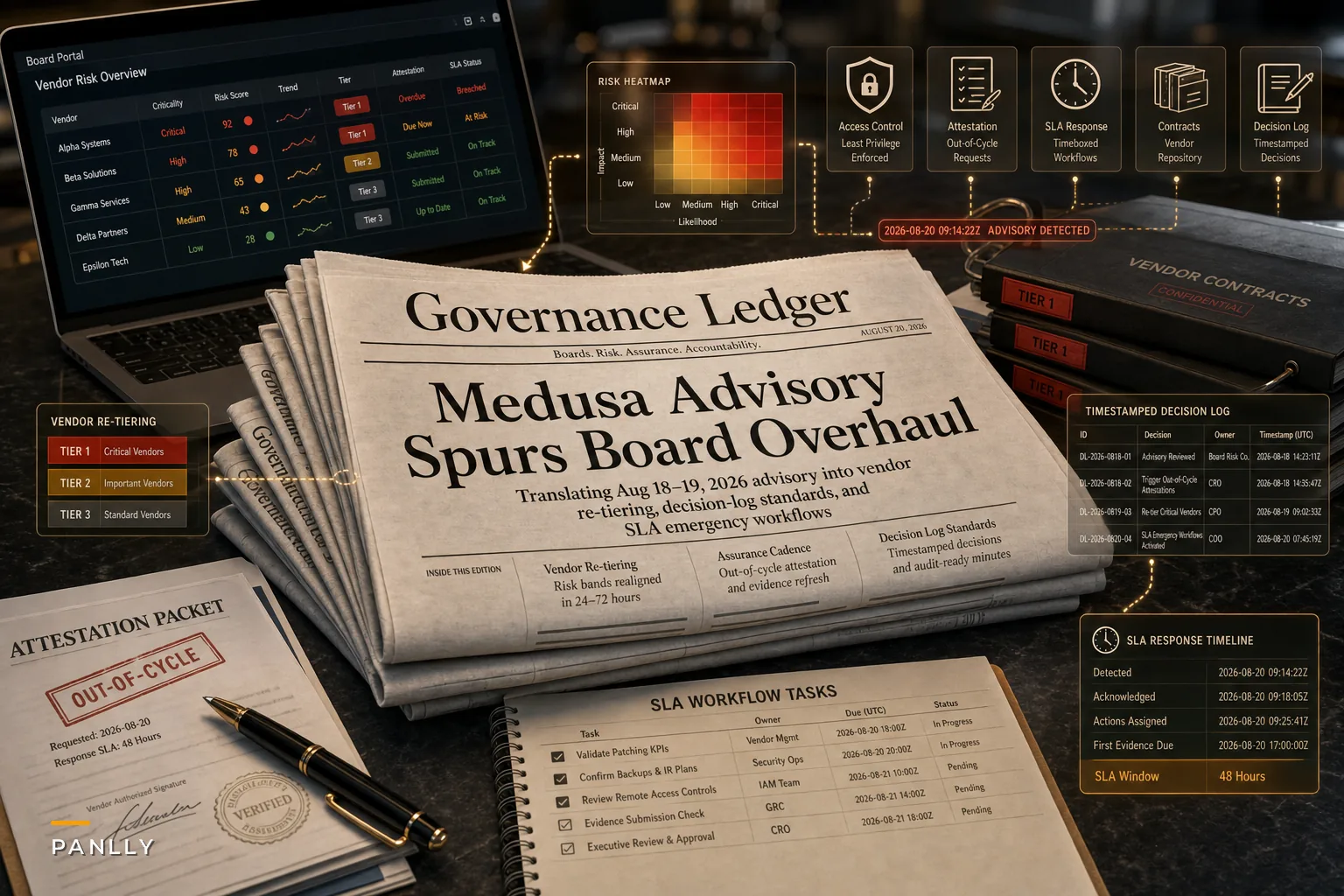

The most uncomfortable line in the updated Medusa advisory isn't the 500+ victim count. It's the operational tempo: attackers weaponizing newly disclosed vulnerabilities within roughly 24 hours of public disclosure. That single detail quietly breaks how most boards have structured their oversight of cyber risk.
When the FBI, CISA, and HHS refreshed the #StopRansomware advisory on August 18–19, 2026, they weren't describing some novel technique. They were confirming a cadence mismatch. Your quarterly risk review, your annual vendor attestation cycle, your "we'll cover it at the next audit committee meeting" reflex — all of it runs on a calendar. Medusa runs on a clock. The gap between those two speeds is exactly where liability accumulates.
This isn't about patching. Your IT and security teams own that. This is about the governance layer sitting above the patching — the assurance cadences, the evidence trails, the vendor oversight structures a board is actually responsible for. Because when a regulator or a plaintiff's attorney comes asking what the board knew and when it acted, the technical remediation logs won't be the problem. The governance record will be.
The real exposure isn't your network — it's your vendor's, and your record of oversight
Boards tend to think of ransomware as an internal event. Something happens to our systems. But the advisory's emphasis on rapid exploitation reframes the risk toward the third-party ecosystem, which is where most organizations have almost no real-time visibility.
Think about what a mid-sized organization's attack surface actually contains: a payroll processor, a managed IT provider, a couple of SaaS platforms holding customer data, a billing vendor, maybe a specialized clinical or logistics partner depending on the sector. Any one of them running an unpatched edge device gives Medusa an entry point that never touches your firewall. The American Hospital Association's briefing on the updated advisory underscored how sharply this lands in sectors where a single compromised vendor can halt operations across an entire care network.
The governance problem underneath all of this: when boards review vendor risk, they almost always review it as a snapshot — an annual questionnaire, a SOC 2 report filed away, a contractual clause about "reasonable security measures." None of that tells you whether your billing vendor patched a critical vulnerability yesterday. And in a 24-hour exploitation window, a year-old attestation is basically decorative.
Most boards can't distinguish between two very different questions:
-
Do we have vendor risk documentation? (Almost always yes.)
-
Can we demonstrate the board acted on a specific, time-bound threat to a specific vendor? (Almost always no.)
The first protects nobody. The second is what actually matters when things go sideways.
Where assurance cadences quietly break
The core defect in most board cyber oversight is that assurance flows on a fixed schedule while threats arrive on an unpredictable one. When those two don't reconcile, you get a predictable failure pattern.
Eliminate boardroom chaos with seamless coordination.
Panlly simplifies scheduling, collaboration, and follow-ups for every board meeting.
- Centralized meeting scheduling
- Secure document sharing
- Task assignment & tracking
No credit card required
A typical breakdown: a critical vulnerability gets disclosed on a Tuesday. Security patches internal systems by Thursday. The vendor management team sends emails to third parties. Some respond, some don't. Nothing about this reaches the board until the next scheduled risk committee meeting — six or seven weeks later — by which point it's a retrospective summary, not a decision point. If a vendor was compromised in that window, the board's record shows a gap: awareness at the operating level, silence at the oversight level.
That gap is the liability. Not the breach itself — breaches happen to well-run organizations. The failure is the absence of a documented oversight response proportionate to a known, active, named threat.
What separates organizations that weather this from those that get caught flat-footed usually comes down to whether they've built a triggered assurance layer on top of their scheduled one. Scheduled reviews still happen. But certain events — a federal advisory naming an active threat, a critical vulnerability affecting a tier-one vendor — automatically fire an out-of-cycle oversight action. The board doesn't wait for the calendar.
| Oversight Element | Calendar-Driven (Common) | Event-Triggered (What Medusa Requires) |
|---|---|---|
| Vendor attestation | Annual questionnaire | On-demand re-attestation on named-threat disclosure |
| Board awareness | Quarterly risk summary | Same-week briefing when advisory names active exploitation |
| Remediation tracking | Reviewed at next meeting | SLA-bound tasks with mid-cycle status confirmation |
| Evidence capture | Minutes filed after the fact | Timestamped decision log created at point of action |
| Vendor tiering | Static list, rarely updated | Reweighted by exposure to the specific active threat |
Define explicit SLA windows for out-of-cycle attestations so boards can expect confirmations within a predictable timeframe.
Almost every organization lives entirely in the left column and assumes the right column is handled somewhere below them. Under a 24-hour exploitation window, that assumption is the whole risk.
The evidence trail problem nobody wants to talk about
An incident occurs. The board did act — someone raised it, there was a hallway conversation, the CISO gave an update, a decision got made to prioritize a vendor audit. All reasonable. But six months later, when counsel asks for the record, what exists is fragmentary: an email here, a slide buried in a deck there, a vague line in minutes that says "the committee discussed cyber matters."
That record is functionally worthless for defending the board's diligence. Directors did the right thing and still carry the exposure, because oversight that can't be reconstructed is, legally, oversight that didn't happen.
An evidence trail that actually holds up needs to answer four questions:
-
What did the board know, and when? (The advisory, the vendor exposure, the specific risk.)
-
What did the board decide? (Not "discussed" — decided. A motion, a directive, a prioritization.)
-
Who was assigned to act, and by when? (Named owner, real deadline.)
-
Was the action confirmed complete? (Closed loop, with evidence, not an assumption.)
Most boards can produce the first two intermittently. The third and fourth are where it collapses. Action items get assigned in a meeting and then vanish into individual inboxes until someone remembers to ask about them next quarter — which is too slow for this threat class.
This is precisely where the three lines of assurance architecture either holds or falls apart. The first line (operating management) sees the vendor risk daily. The second line (risk and compliance) is supposed to aggregate and escalate. The third line (internal audit) validates that the whole thing functions. When Medusa-class threats hit, the failure is almost always a broken handoff between those lines — the first line acted, the second line never formally escalated, and the third line has no evidence the board's directive was carried out. Aligning those lines isn't a theoretical governance exercise. It's the difference between a defensible record and a discovery liability.
A prioritized sequence for the next 30 days
If you're a director, corporate secretary, or committee chair reading this after the advisory dropped, the instinct is to call an emergency meeting and demand a status report. That's fine, but it's not enough, and it's not the right order. A sequence that actually tightens oversight rather than just generating activity looks something like this.
-
Confirm the board has been formally briefed on the specific advisory — in writing. Not "cyber was covered." A dated record noting the Medusa advisory, its exploitation tempo, and its relevance to your vendor base. The primary CISA #StopRansomware advisory is the source document; reference it directly in the briefing so the record is anchored.
-
Direct a rapid re-tiering of vendors by exposure to this threat. Not a full vendor review — a targeted one. Which third parties run the affected technologies? Which ones, if compromised, halt operations or expose regulated data? That short list is your board's actual concern.
-
Issue a time-bound directive for out-of-cycle attestation from tier-one vendors. Give it an SLA — confirmation within 10 business days that critical patches are applied and access controls reviewed. Record the directive as a formal decision, with an owner and a deadline.
-
Assign a single accountable owner to close the loop and report back mid-cycle. Not at the next quarterly meeting. A scheduled interim confirmation that the attestations came in and gaps are being remediated.
-
Capture every step as a timestamped decision record. The advisory acknowledgment, the tiering directive, the attestation demand, the follow-up confirmation. This is the evidence trail that protects the board later.
-
Schedule a debrief to convert this scramble into standing process. The whole point is that the next advisory shouldn't require this improvisation. It should fire an existing triggered-assurance workflow.
That last step matters most. Handling one advisory well is luck. Building the machinery so the next one is routine is governance.
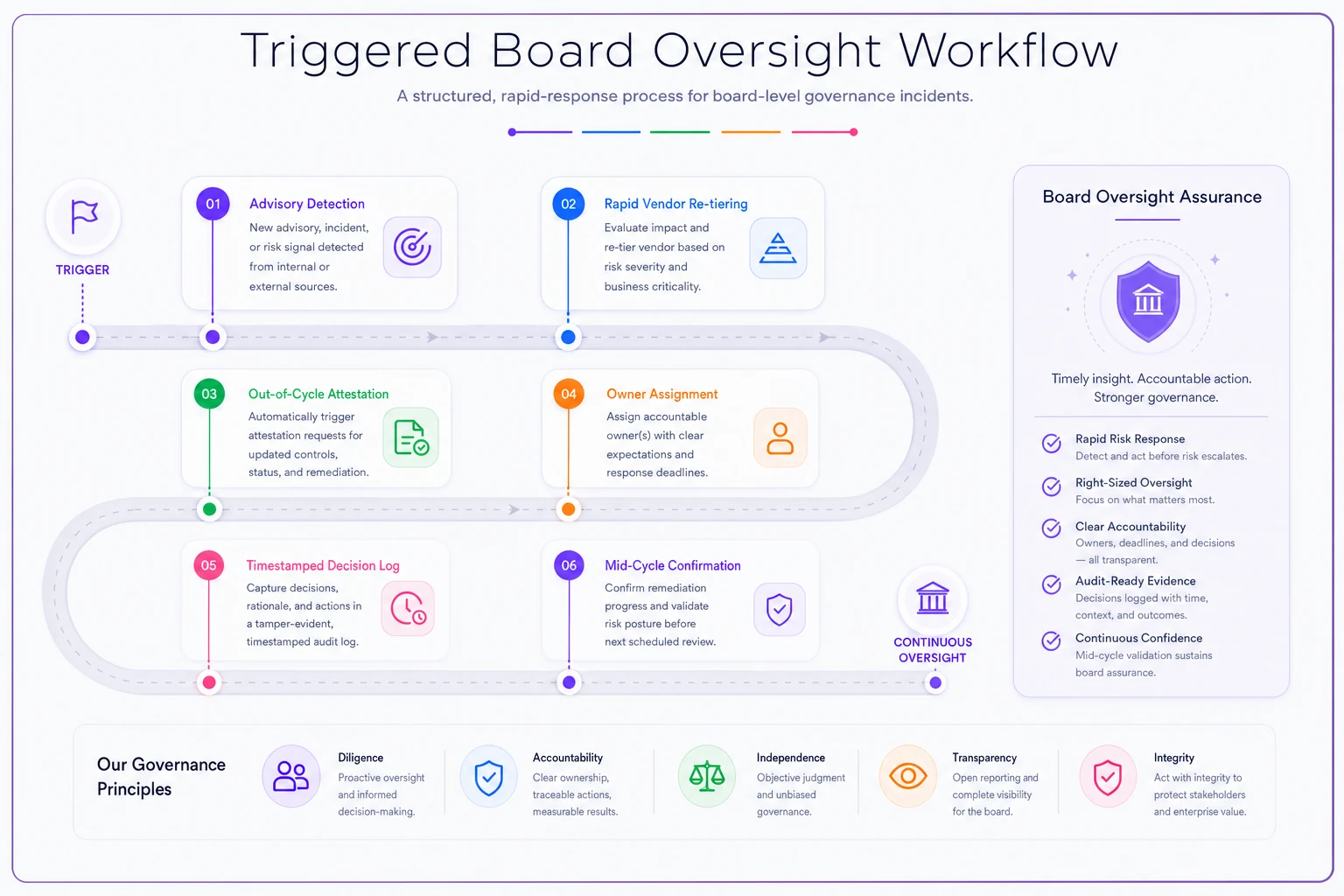
This diagram summarizes the triggered-assurance workflow above.
When a triggered oversight model makes sense — and when it's overkill
Not every organization needs the full event-triggered apparatus, and pretending otherwise wastes board attention on process theater.
This makes sense when your operations genuinely depend on a web of third-party technology providers, when you're in a regulated sector where a breach carries reporting obligations and penalties, or when a single vendor compromise could meaningfully disrupt service or expose sensitive data. If a compromised partner could take you offline or trigger a mandatory disclosure, the triggered model earns its keep.
This is overkill when your third-party footprint is small and non-critical, or when you'd be building elaborate escalation machinery for vendors whose failure would be a minor inconvenience. A five-person board overseeing a business with two low-risk SaaS tools doesn't need a formal re-tiering protocol. It needs a competent IT partner and a paragraph in the minutes.
Who should be cautious are organizations that mistake documentation volume for oversight quality. Generating a thick binder of vendor questionnaires can create a false sense of protection while actual real-time exposure goes unmanaged. More paper is not more diligence. A single, well-maintained, timestamped decision log tied to a short list of genuinely critical vendors protects the board far better than a filing cabinet full of stale attestations.
A short real scenario
A regional healthcare services organization — roughly a dozen facilities, heavily dependent on outside billing and IT management vendors — had a textbook calendar-based oversight model. Annual vendor attestations, quarterly risk committee reviews, minutes that noted cyber was "reviewed."
After a prior advisory season exposed how slow they were to react, the board made one structural change: they defined a small set of escalation triggers, and a federal advisory naming an actively exploited threat was one of them. When the trigger fired, the corporate secretary was responsible for producing a dated board briefing within the week, and the risk committee chair had to issue an out-of-cycle attestation demand to their five most critical vendors.
The measurable difference wasn't dramatic in the way people expect. It was operational. Vendor response time on their critical tier dropped from an unmanaged, weeks-long trickle to confirmed responses within about 8–11 business days. More importantly, when their internal audit function reviewed the cycle, they could reconstruct the entire oversight chain — awareness, decision, assignment, confirmation — from a single decision log rather than reassembling it from scattered emails. One vendor had lagged badly on patching; because the demand was formal and tracked, the gap surfaced in days instead of being discovered after an incident.
Nothing about that is exotic. It's just oversight that moves at the speed of the threat instead of the speed of the meeting calendar.
The uncomfortable takeaway for directors
The Medusa update is a preview, not an anomaly. The 24-hour exploitation window reflects where the entire threat landscape is heading, and it structurally punishes boards that treat cyber oversight as a scheduled agenda item. You cannot govern a real-time risk with an annual instrument.
The work in front of most boards isn't buying more security technology — that's management's job. It's redesigning the oversight layer so that awareness, decision, assignment, and evidence happen fast enough to matter and cleanly enough to defend. That means triggered assurance cadences, an honest view of which vendors actually endanger the enterprise, and a decision trail that a skeptical outsider could reconstruct without your help.
Do that, and the next advisory becomes a Tuesday afternoon workflow instead of a Monday morning crisis.
Ready to enhance your board's productivity?
Join 500+ organizations using Panlly to save time, improve governance, and streamline board operations.