



Board scheduling across time zones breaks down when you treat it like a regular meeting problem. The usual "find a time that works" approach collapses when your directors span twelve hours of time difference and you need statutory quorum for binding decisions.
Most boards default to fixed windows that punish certain regions—Singapore directors perpetually joining at midnight, London participants starting at 5am, or West Coast members cutting dinner short. This creates resentment, reduces engagement, and sometimes triggers resignation discussions that boards can't afford.
The fix involves rotation matrices that distribute the burden fairly while guaranteeing quorum through consent windows and notification rules. Having set up scheduling systems for boards spanning Tokyo to New York, the difference between boards that struggle quarterly and those that run smoothly almost always comes down to having explicit heuristics rather than hoping coordination works itself out.
Fixed windows versus rotating schedules
Fixed meeting windows seem simpler at first. Pick 9am Pacific, force everyone else to adjust. Boards often start here because it requires minimal coordination overhead—everyone knows the standing time, calendar blocks stay consistent, preparation routines become predictable.
The breakdown usually happens around month six. Your Singapore-based director starts missing committee meetings. The London member's participation drops to perfunctory check-ins. Engagement metrics that actually matter—questions asked, materials reviewed, discussion depth—decline for anyone outside the favored timezone.
Rotating schedules distribute this burden but introduce complexity. The board meets at 8am Pacific in Q1, 4pm Pacific in Q2, midnight Pacific in Q3, then cycles back. London gets convenient timing once per year, Singapore gets reasonable hours quarterly, San Francisco takes the overnight shift periodically.
The operational challenge becomes tracking which quarter follows which pattern, ensuring all directors know the rotation schedule months ahead, and handling the inevitable confusion when someone forgets the pattern changed. Documentation becomes critical—not just "next meeting Tuesday" but "next meeting Tuesday 4pm PT (Q2 rotation, favorable for APAC)."
One pattern that reduces confusion: tie rotations to fiscal quarters rather than calendar quarters. Directors already track fiscal periods for reporting purposes, so Q2 earnings calls and Q2 board meetings following the same timezone rotation creates natural memory anchors. It avoids the "wait, which rotation are we on?" confusion that kills participation.
Priority rules for guaranteeing quorum
Quorum requirements turn scheduling from preference optimization into a constraint satisfaction problem. You need specific directors present for binding votes, which means certain timezone combinations become mandatory rather than nice-to-have.
Eliminate boardroom chaos with seamless coordination.
Panlly simplifies scheduling, collaboration, and follow-ups for every board meeting.
- Centralized meeting scheduling
- Secure document sharing
- Task assignment & tracking
No credit card required
Start with your quorum math. Most boards need simple majority, but check your bylaws—some require two-thirds, others have special rules for certain decisions. Map your directors to timezones, then identify which combinations guarantee quorum. If you have seven directors with four in North America, two in Europe, and one in Asia, you can achieve quorum without the Asia director but not without at least one European.
This creates scheduling priorities:
-
Critical zones
Timezones where multiple directors cluster
-
Flexible zones
Single-director zones that don't break quorum if absent
-
Paired zones
Regions that must both participate for quorum
Your rotation matrix should optimize for critical zones first. If four directors sit in Eastern time, that zone should never get the 3am slot. The single director in Singapore might take inconvenient timing more often because their absence doesn't break quorum—though this requires careful relationship management to prevent resentment.
Some boards implement "quorum insurance" rules where each meeting time must work for quorum-plus-one directors. This buffer handles last-minute emergencies without forcing cancellation. The operational overhead increases—you're optimizing for six directors instead of four—but the reliability improvement usually justifies it.
Consent windows and notification requirements
Consent windows solve the "I didn't agree to 2am" problem before it surfaces. Instead of scheduling then notifying, you propose windows and gather explicit consent before locking dates. It seems like extra process, but it prevents the cascading rescheduling that happens when directors revolt against inconvenient timing.
The workflow runs like this:
60 days before quarter-end: Send three proposed windows based on the rotation matrix. Each window includes primary time, backup time, and timezone impact analysis ("Window A: Favorable for NA/EU, challenging for APAC").
45 days before quarter-end: Collect responses through a simple form—not email chains that fragment into confusion. Track who consented to which windows.
40 days before quarter-end: Lock the date based on maximum consent overlap. Send calendar invitations immediately with timezone converters embedded.
30 days before quarter-end: Send materials distribution schedule adjusted for timezone review time. Singapore directors get materials 18 hours before San Francisco to account for overnight review periods.
The notification chain needs explicit rules about which timezone "owns" the notice period. If bylaws require 48-hour notice, whose 48 hours matters? The conservative approach uses the earliest timezone, ensuring everyone gets minimum notice. But this might mean sending notices at awkward hours for the corporate secretary.
Better approach: define notice periods in UTC, then translate to local times in all communications. "Notice provided December 3, 14:00 UTC (6:00 PST / 9:00 EST / 22:00 SGT)" removes ambiguity while keeping timestamps legally clear.
A visual of the consent workflow helps clarify timing and responsibilities.
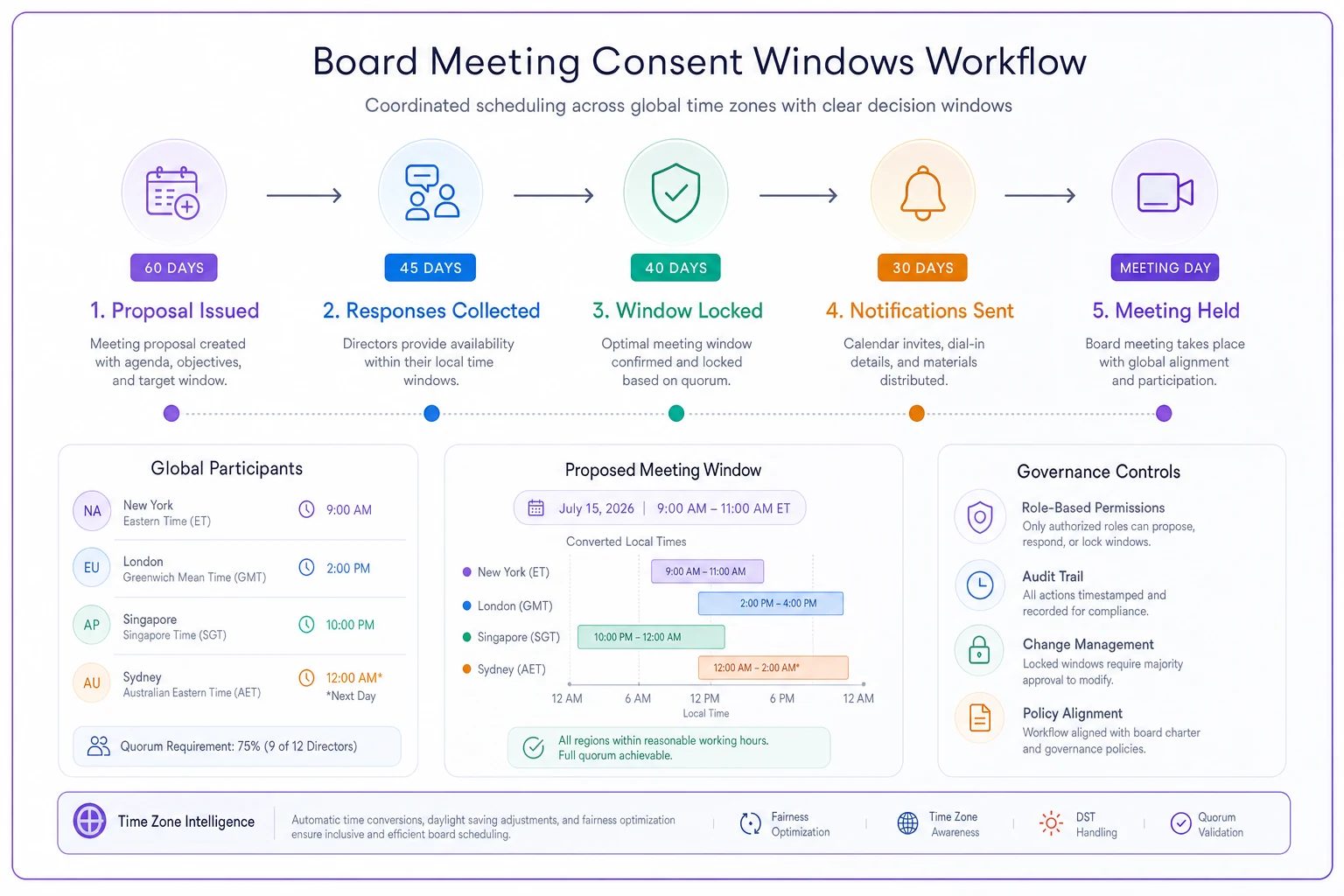
This image maps decision points to calendar actions so coordinators and directors can see the lead times visually.
Sample rotation matrices that preserve fairness
Here's a working matrix for a board with directors across three major regions:
| Quarter | Primary Time (UTC) | Pacific | Eastern | London | Singapore |
|---|---|---|---|---|---|
| Q1 | 14:00 UTC | 6:00 AM | 9:00 AM | 2:00 PM | 10:00 PM |
| Q2 | 01:00 UTC | 5:00 PM (prev) | 8:00 PM (prev) | 1:00 AM | 9:00 AM |
| Q3 | 22:00 UTC | 2:00 PM | 5:00 PM | 10:00 PM | 6:00 AM (+1) |
| Q4 | 06:00 UTC | 10:00 PM (prev) | 1:00 AM | 6:00 AM | 2:00 PM |
Each region takes one painful slot per year. The burden rotates predictably. Directors can plan travel and personal commitments around their difficult quarter.
For boards needing committee meetings between quarterly sessions, create a secondary matrix that counter-rotates. If Singapore took the hard slot in Q1 for the full board, give them priority timing for Q1 committee meetings. This temporal fairness helps maintain engagement even when someone draws the overnight shift.
Some boards modify the matrix based on director role criticality. The audit committee chair might never get the 3am slot during busy season. The lead independent director might get preference during CEO evaluation periods. Document these exceptions explicitly—unwritten preferences breed resentment.
Automation settings that reduce manual coordination
Manual scheduling coordination burns somewhere between 20 and 30 hours per quarter across the board and corporate secretary's office. Calendar polling, email chains, timezone confusion, and rescheduling friction compound into significant overhead.
The automation stack needs three components:
Timezone-aware scheduling logic: The system must understand that 2pm PST and 10pm GMT are the same moment, then optimize across all participant zones. Basic calendar tools fail here—they show availability without understanding the human cost of a 3am meeting.
Consent tracking workflows: Rather than email chains, use forms that feed a central tracking system. When Director A consents to Windows 1 and 3 but not Window 2, that preference data flows directly into the scheduling algorithm. No manual spreadsheet consolidation required.
Notification sequences with confirmation loops: Automated notices go out at prescribed intervals, but require explicit confirmation of receipt. If the Singapore director doesn't confirm within 24 hours, the system escalates to their assistant or sends an SMS backup. This catches the "I never saw that email" problem before it becomes a quorum crisis.
Escalate unconfirmed notices to assistants after 24 hours to avoid quorum issues.
One important boundary here: some decisions can't be algorithmic. The system can propose optimal times based on the rotation matrix, but a human should review for context the algorithm misses—maybe the proposed date conflicts with earnings announcements, or falls during a major holiday the system doesn't recognize. Automation handles the mechanical parts while humans handle judgment calls.
Preventing the silent revolt against bad timing
Directors rarely complain directly about scheduling unfairness. Instead, they disengage gradually. Camera "malfunctions" during their bad timezone slots. They attend but don't contribute. Materials get "brief reviews" instead of deep analysis. The board loses the very expertise it recruited these directors to provide.
Watch for early signals:
-
Participation metrics dropping for specific directors
-
Increase in "send regrets" from one timezone group
-
Committee work shifting away from certain regions
-
Directors mentioning the "sustainability" of the meeting schedule
One manufacturing company's board ignored these signals until their Asia-Pacific director resigned, citing "incompatibility with board obligations." The replacement search took six months and cost roughly $200k in search fees—far more than the effort needed to implement fair rotation matrices upfront.
The intervention requires explicit discussion at the board level. Put scheduling fairness on the governance committee agenda. Show the data on who has taken overnight calls most frequently. Propose the rotation matrix as a formal board policy rather than an informal understanding. Getting buy-in upfront prevents the gradual erosion of engagement.
Some boards include "timezone equity reports" as part of their annual governance review—tracking who attended at inconvenient hours, who got favorable timing, whether the rotation matrix was actually followed. The transparency demonstrates the board takes fairness seriously and catches drift before it becomes systematic.
Building your board's scheduling heuristics
Start with an audit of your current reality. Pull twelve months of meeting history and categorize each by timezone burden. You'll probably find unintentional patterns—European directors always accommodating, West Coast getting priority, certain committees never rotating their timing.
Next, calculate your quorum combinations. With seven directors across four timezones, you might have a dozen valid quorum combinations. Some are easier to schedule than others. Document which combinations you can't afford to lose—if your only financial expert is in Singapore, their participation becomes critical for audit committee meetings.
Design your rotation matrix around these constraints. Start simple—quarterly rotation across four time blocks. Test it against your quorum requirements. Adjust for critical periods like year-end audit reviews or CEO succession planning where certain directors must participate regardless of timezone burden.
Write explicit consent and notification rules. Specify everything: who proposes dates, how far in advance, what constitutes consent, how to handle non-responses, when to trigger backup options. The specificity prevents confusion when someone claims they "didn't really agree" to a 3am call.
Then implement gradually. Don't shift from fixed windows to full rotation immediately. Start with committee meetings as a pilot. Iron out the process bugs before applying to full board sessions. This staged approach builds confidence while limiting disruption risk.
When automated scheduling pays for itself
The math on scheduling automation becomes compelling around 8 to 10 directors across three or more timezones. Below that threshold, manual coordination stays manageable. Above it, complexity grows fast.
The real costs of manual scheduling add up:
-
Corporate secretary time
20-30 hours per quarter on coordination
-
Director frustration
unquantifiable but real impact on retention
-
Rescheduling cascades
one conflict triggers 5-10 hours of re-coordination
-
Missed quorum
one failed meeting costs $15k-50k in director time
Automated scheduling platforms with board-specific features typically run $200-500 per month—less than the cost of a single rescheduling cascade. The ROI usually materializes within the first quarter.
The less obvious benefits compound over time. Directors trust a system that treats their time fairly. Participation improves when people know they won't always draw the bad slot. Materials get proper review when directors aren't fighting sleep deprivation.
The compound effect of fair scheduling
Boards underestimate how much scheduling friction degrades governance quality. When directors join exhausted, discussions become surface-level. When certain regions consistently get poor timing, you lose diverse perspectives. When scheduling itself takes dozens of hours quarterly, that's time not spent on actual governance work.
The rotation matrices and automation aren't really about efficiency—they're about creating conditions where governance can actually function. A director in Singapore who knows they'll only face one overnight meeting per year contributes more actively during the other three quarters. A board that trusts its scheduling process stops wasting time relitigating meeting times.
The upfront investment in scheduling heuristics—documenting rotation matrices, implementing consent workflows, automating notification chains—pays off through improved attendance, deeper engagement, and better governance outcomes. For boards stretched across the globe, fair scheduling isn't a nice-to-have. It's the foundation that makes distributed governance actually work.
Ready to enhance your board's productivity?
Join 500+ organizations using Panlly to save time, improve governance, and streamline board operations.